Democratic Primary Thread (Updated Poll #2)

Democratic Primary Thread (Updated Poll #2)

  • Joe Biden

    Votes: 7 29.2%
  • Bernie Sanders

    Votes: 2 8.3%
  • Elizabeth Warren

    Votes: 2 8.3%
  • Pete Buttigieg

    Votes: 0 0.0%
  • Andrew Yang

    Votes: 0 0.0%
  • Amy Klobuchar

    Votes: 13 54.2%
  • Mike Bloomberg

    Votes: 0 0.0%
  • Other Democrat

    Votes: 0 0.0%

  • Total voters
    24
Status
Not open for further replies.

Polish Leppy 22

Well-known member
Messages
6,594
Reaction score
2,009
Dems have gone so far radically left and it's going to cost them another election in 2020. I don't think JFK or even Bill Clinton would make it on that stage now.

Between single payer health, open borders, Trump is racist, and how to provide free healthcare for noncitizens...good luck. Dems think the entire country thinks like NYC and LA, and it's just completely removed from middle America.
 

IrishLax

Something Witty
Staff member
Messages
37,545
Reaction score
28,995
I just watched the clip and you're right. Each of Harris's responses didn't contain any facts to counter the attack. Harris just generalized that she was proud of her work as the SAG.

Harris is done. You do not recover from that hit Tulsi put on her. It would've been one thing if she owned what she did and either apologized or made an equivocation... instead she did the worst kind of waffling I've ever seen, while Gabbard continued to bludgeon her with clear, concise facts and confidence.

When Mayor Pete was asked about the officer involved shooting in South Bend and other issues in the first debate, his answer was a masterclass in how to take accountability.

Biden could learn a thing or two... for example he needs to be willing to talk honestly about unintended consequences from the 1994 crime bill, but I understand the reason he isn't is that he doesn't want to give ammo for political ads... but Harris was next level awful at dealing with the first shot anyone took at her.
 

RDU Irish

Catholics vs. Cousins
Messages
8,625
Reaction score
2,731
Biden looks frail. I can't imagine how he comes out on top of this whole thing.

Gold star to Gabbard for knocking out Harris - go back to Willie Brown you hack.
 

BleedBlueGold

Well-known member
Messages
6,270
Reaction score
2,493
Lax, you wrote a paper on Obamacare a while back didn't you? What's your take on Biden basically doubling down on it (and other Obama policies)?
 

IrishLax

Something Witty
Staff member
Messages
37,545
Reaction score
28,995
Lax, you wrote a paper on Obamacare a while back didn't you? What's your take on Biden basically doubling down on it (and other Obama policies)?

The ACA, IMO, is an awful policy for a lot of reasons. I won't get too into the weeds, but the bottom line is that it is the epitome of a "half-measure" that didn't really work while also disrupting private insurance plans that people liked.

People talk about pre-existing condition coverage and how the ACA "saved lives" but I also know of more than anecdotal examples of people who had coverage reduced, lost their coverage entirely after their employer didn't want to comply with the ACA, etc. and found themselves in a much worse situation than they were pre-ACA. The individual mandate did not accomplish its goal, many of the plans people could afford in the "affordable" care act did nothing for them, it was an awful deal for "healthy" people, etc. It's just an extremely flawed bill on many levels. Pretty much the only good thing it did was ensure that people with pre-existing conditions can't get left out in the cold... which you could've accomplished with a one or two sentence bill and no disruption to the existing system.

The more I've studied healthcare policy (and successes/failures in other countries) I'm convinced that the solution is a combination of the following:
1. A public option that all Americans are automatically enrolled in unless they "opt out" to a qualifying private healthcare plan.
2. Remove a lot of the burdens and restrictions and taxes on private/employer provided healthcare plans that were put in on the ACA. Let groups of people choose plans that work for them.
3. The public option is partially subsidized by an increased Medicare style payroll tax to all people, but otherwise people who "opt in" are billed a reasonable flat rate (probably somewhere in the neighborhood of the level of the individual mandate) + a % of their income to cover the cost.
4. All physicians are required to accept the public option or they cannot practice in the United States.
5. Drug price regulation for all new drugs entering the market. Possibly cap or discount some existing drugs.

This will drive down costs for everyone. And if the private sector can compete with the public one, it still allows people to have "better" plans. One of the main issues with single payer systems in some countries is that the level of care and timeliness of care suffer as a way of defraying costs.
 

ACamp1900

Counting my ‘bet against ND’ winnings
Messages
48,948
Reaction score
11,228
The ACA, IMO, is an awful policy for a lot of reasons. I won't get too into the weeds, but the bottom line is that it is the epitome of a "half-measure" that didn't really work while also disrupting private insurance plans that people liked.

People talk about pre-existing condition coverage and how the ACA "saved lives" but I also know of more than anecdotal examples of people who had coverage reduced, lost their coverage entirely after their employer didn't want to comply with the ACA, etc. and found themselves in a much worse situation than they were pre-ACA.

The saved lives narrative is amazingly frustrating... having 'coverage' doesn't matter when your 'coverage' doesn't actually cover anything but the bare basics, especially when you have health care needs that demand far more than that.

To the bold, I've shared my father's and uncle's stories before, they are both no longer with us for a variety of reasons, chief among them is the ACA doing exactly the bolded to both of them and the new 'coverage' being exactly what my first point touched on.
 
Last edited:

IrishLax

Something Witty
Staff member
Messages
37,545
Reaction score
28,995
Biden looks frail. I can't imagine how he comes out on top of this whole thing.

Gold star to Gabbard for knocking out Harris - go back to Willie Brown you hack.

He's basically up by by 10 to 20 points on the rest of the field though, depending on which poll you look at. He's way ahead in Iowa and even considerably leading in New Hampshire. As long as he is the standard bearer for the "moderate" position while everyone else falls over themselves to out-progressive each other and attack Obama I think he gets the nom regardless of how many gaffes he makes. A lot of people crave a return to normalcy and that's what he is selling.

Honestly, the more I think about it, I think we're heading to a Biden/Warren ticket. We'll see how the September debates go, but I think it's likely that everyone ganging up on Biden is not going to work how they want it to. It turns off a lot of people, especially when he is able to deflect and disarm as well as he did for the majority of last night.

All he has to do is make it to February without one of the other candidates consolidating a large coalition behind them and he's going to win. Which really means that as long as Bernie and Warren both stay in the race through Super Tuesday it's hard to see him losing.
 
Last edited:

IrishLax

Something Witty
Staff member
Messages
37,545
Reaction score
28,995
Democratic Primary Thread (Updated Poll)

Democratic Primary Thread (Updated Poll)

Updated thread with refreshed poll to see where people stand after two debates.
 

IrishLax

Something Witty
Staff member
Messages
37,545
Reaction score
28,995
Democratic Primary Thread (Updated Poll)

Democratic Primary Thread (Updated Poll)

I screwed up the merge, trying this again.
 

BleedBlueGold

Well-known member
Messages
6,270
Reaction score
2,493
The ACA, IMO, is an awful policy for a lot of reasons. I won't get too into the weeds, but the bottom line is that it is the epitome of a "half-measure" that didn't really work while also disrupting private insurance plans that people liked.

People talk about pre-existing condition coverage and how the ACA "saved lives" but I also know of more than anecdotal examples of people who had coverage reduced, lost their coverage entirely after their employer didn't want to comply with the ACA, etc. and found themselves in a much worse situation than they were pre-ACA. The individual mandate did not accomplish its goal, many of the plans people could afford in the "affordable" care act did nothing for them, it was an awful deal for "healthy" people, etc. It's just an extremely flawed bill on many levels. Pretty much the only good thing it did was ensure that people with pre-existing conditions can't get left out in the cold... which you could've accomplished with a one or two sentence bill and no disruption to the existing system.

The more I've studied healthcare policy (and successes/failures in other countries) I'm convinced that the solution is a combination of the following:
1. A public option that all Americans are automatically enrolled in unless they "opt out" to a qualifying private healthcare plan.
2. Remove a lot of the burdens and restrictions and taxes on private/employer provided healthcare plans that were put in on the ACA. Let groups of people choose plans that work for them.
3. The public option is partially subsidized by an increased Medicare style payroll tax to all people, but otherwise people who "opt in" are billed a reasonable flat rate (probably somewhere in the neighborhood of the level of the individual mandate) + a % of their income to cover the cost.
4. All physicians are required to accept the public option or they cannot practice in the United States.
5. Drug price regulation for all new drugs entering the market. Possibly cap or discount some existing drugs.

This will drive down costs for everyone. And if the private sector can compete with the public one, it still allows people to have "better" plans. One of the main issues with single payer systems in some countries is that the level of care and timeliness of care suffer as a way of defraying costs.

Thanks.

Polling that I've seen shows that a little over half of Americans still support the ACA so Biden may do ok with it. But like you've pointed out, it's a terrible policy and needs revamped. It seems far more practical to fix the issues, however, than abolishing private ins. and going full blown MFA, which is what a lot of these Dems are calling for.
 

BleedBlueGold

Well-known member
Messages
6,270
Reaction score
2,493
He's basically up by by 10 to 20 points on the rest of the field though, depending on which poll you look at. He's way ahead in Iowa and even considerably leading in New Hampshire. As long as he is the standard bearer for the "moderate" position while everyone else falls over themselves to out-progressive each other and attack Obama I think he gets the nom regardless of how many gaffes he makes. A lot of people crave a return to normalcy and that's what he is selling.

Honestly, the more I think about it, I think we're heading to a Biden/Warren ticket. We'll see how the September debates go, but I think it's likely that everyone ganging up on Biden is not going to work how they want it to. It turns off a lot of people, especially when he is able to deflect and disarm as well as he did for the majority of last night.

All he has to do is make it to February without one of the other candidates consolidating a large coalition behind them and he's going to win. Which really means that as long as Bernie and Warren both stay in the race through Super Tuesday it's hard to see him losing.

https://www.realclearpolitics.com/epolls/2020/president/us/general_election_trump_vs_biden-6247.html

Biden +8 on Trump at the moment from RCP Average.

*Remember: almost every poll was wrong in 2016 though...
 

Legacy

New member
Messages
7,871
Reaction score
321
The ACA, IMO, is an awful policy for a lot of reasons. I won't get too into the weeds, but the bottom line is that it is the epitome of a "half-measure" that didn't really work while also disrupting private insurance plans that people liked.

People talk about pre-existing condition coverage and how the ACA "saved lives" but I also know of more than anecdotal examples of people who had coverage reduced, lost their coverage entirely after their employer didn't want to comply with the ACA, etc. and found themselves in a much worse situation than they were pre-ACA. The individual mandate did not accomplish its goal, many of the plans people could afford in the "affordable" care act did nothing for them, it was an awful deal for "healthy" people, etc. It's just an extremely flawed bill on many levels. Pretty much the only good thing it did was ensure that people with pre-existing conditions can't get left out in the cold... which you could've accomplished with a one or two sentence bill and no disruption to the existing system.

The more I've studied healthcare policy (and successes/failures in other countries) I'm convinced that the solution is a combination of the following:
1. A public option that all Americans are automatically enrolled in unless they "opt out" to a qualifying private healthcare plan.
2. Remove a lot of the burdens and restrictions and taxes on private/employer provided healthcare plans that were put in on the ACA. Let groups of people choose plans that work for them.
3. The public option is partially subsidized by an increased Medicare style payroll tax to all people, but otherwise people who "opt in" are billed a reasonable flat rate (probably somewhere in the neighborhood of the level of the individual mandate) + a % of their income to cover the cost.
4. All physicians are required to accept the public option or they cannot practice in the United States.
5. Drug price regulation for all new drugs entering the market. Possibly cap or discount some existing drugs.

This will drive down costs for everyone. And if the private sector can compete with the public one, it still allows people to have "better" plans. One of the main issues with single payer systems in some countries is that the level of care and timeliness of care suffer as a way of defraying costs.

Previously posted by one of our esteemed members:
A National Health Program for the United States: A Physicians' Proposal
(New England J. of Medicine)

The law has needed revisions since the results after a couple of years came in, but that has run into political opposition. It was a compromise to get the pharmaceutical and the insurance companies to participate. A few things it did off the top of my head:
1. Require and fund electronic medical records. Not only ridding us of paper but making histories and results immediately available. This helps with treatments, continuity of care, shortened hospital stays, transfers to other facilities and identify fraud which is 10-15% of our health care costs as a nation.
2. CMS has subsequently instituted standards for admission, length of stay and transfers/discharges, cutting costs and wastes.
3. Direct payment to providers instead of through states. Administration costs in our system are huge expenses.
4. Reimbursements are tied to criteria. Facilities can keep patients longer after meeting the criteria for discharge/transfers but they eat the cost. Penalties are tied facilities consistently violating standards. Conversely, if they can discharge the patient sooner, they get the savings from a standard length of stay.
5. As a result, facilities and insurance companies hired case managers to make these more efficient, saving money.
6. Expand the consumer pool to 140% of the federal poverty level so that they could purchase health insurance, nationally or within their state.
7. Set limits on health insurance companies raising rates to 10% a year, but following through had to go through state insurance commissions.
8. Cap HC insurance administrators' raises and bonuses w.r.t. profits.
9. Covering more people without health insurance and providing low cost annual visits and preventative care for participants decreased the expensive ER visits. In turn, early identification and treatments lowered the overall costs to individuals, states who needed to fund their public hospitals and taxpayers.
10. Create waivers by which states could tailor their programs and lower costs.
11. Guarantee coverage to those with pre-existing conditions.
12. Mandate participation of all Americans so that low-risk patients could be combined with those high-risk patients to make HC insurance companies more willing to take on risks in that pool vs. only high-risk patients.
13. Provided for appeals on any decisions.

What it could not do was limit or negotiate drug prices as the VA and Medicaid do. Also, HC insurance companies have merged the result has been less competition for coverage in states pressuring state insurance agencies for approving higher rates. It also could not control the costs for physicians contracting with hospitals from passing their bills to patients (surprise medical bills), nor provide transparency for the consumer on total costs of tests and stays.

Lax, your points 1, 4, and 5 sound a lot like what some have termed "socialized medicine" but are also similar to what the ACA tried to address. Would I be correct in assuming that your points would be regulated by the federal government?
 
Last edited:

BleedBlueGold

Well-known member
Messages
6,270
Reaction score
2,493
I support a public option if it creates lower prices for better coverage, allows are most vulnerable citizens to get the basic healthcare they need and deserve BUT...working in healthcare myself, I can tell you that a huge problem with private insurance companies has become their self determined "standard of care" coverage principles in which THEY, an insurance company (not a doctor), are dictating the type of treatments that doctors give to their patients. I deal with this every. single. day. Technology is getting better, treatments for diseases like cancer are getting better, and insurance companies are refusing to pay for these new protocols until they become "standard." Insurance companies need to do their job: collect a premium, pay for the coverage when a customer comes calling. Period.
 

GATTACA!

It's about to get gross
Messages
15,108
Reaction score
12,945
Have you seen any outside of your living room?


https://www.cnn.com/opinions/live-news/opinion-democratic-debate-night-july-31/index.html

6 hr 44 min ago
A Republican ranks the debaters
By Alice Stewart

Here's my ranking of the candidates' performance in the second debate:

1.) Joe Biden

2.) Kamala Harris

3.) Cory Booker

4.) Tulsi Gabbard

5.) Julian Castro

6.) Michael Bennett

7.) Andrew Yang

8.) Kirsten Gillibrand

9.) Jay Inslee

10.) Bill de Blasio


Top five after two nights:

1.) Joe Biden

2.) Elizabeth Warren

3.) Bernie Sanders

4.) Kamala Harris

5.) Cory Booker


Alice Stewart is a CNN political commentator and former communications director for Ted Cruz's 2016 presidential campaign.


6 hr 33 min ago
A Democrat ranks the debaters
By Joe Lockart

Here's my ranking of the candidates' performance in the second debate:

1.) Cory Booker

2.) Joe Biden

3.) Julián Castro

4.) Michael Bennet

5.) Kamala Harris

6.) Kirsten Gillibrand

7.) Jay Inslee

8.) Tulsi Gabbard

9.) Andrew Yang

10.) Bill de Blasio

Top five after two nights:

1.) Cory Booker: he put himself back in the race.

2.) Joe Biden: because no one emerged as his chief rival and he showed he could fight back.

3.) Pete Buttigieg: despite his youth, he seems the most sensible of the pack.

4.) Elizabeth Warren: still a compelling debater, but not sure she took any Bernie voters.

5.) Michael Bennet: because he won’t make the next debate and that’s too bad.

Joe Lockhart was White House press secretary from 1998-2000 in President Bill Clinton's administration. He co-hosts the podcast "Words Matter." Follow him on Twitter at @JoeLockhart


https://www.vox.com/policy-and-politics/2019/7/31/20749497/2020-democratic-debates-presidential-election-winners-losers-night-two


4 winners and 3 losers from the second night of the July Democratic debates

Winner: Joe Biden

Winner: Elizabeth Warren and Bernie Sanders

Winner: Cory Booker

Winner: single-payer activists


Yang was even mentioned in the Vox writeup. NOT Mentioned.

In the CNN rating, Yang was only mentioned in the Republican List and the Democrat List. No discussion of him.


The NY TIMES said of Yang,


FiveThirtyEight: You can find Yang if you do a search. He spoke the fewest words. And he was listed among those who mentioned Trump the least.


I meant polls with people actually voting on them not some random journalists list of favorites.
 

IrishLax

Something Witty
Staff member
Messages
37,545
Reaction score
28,995
Previously posted by one of our esteemed members:
A National Health Program for the United States: A Physicians' Proposal
(New England J. of Medicine)

The law has needed revisions since the results after a couple of years came in, but that has run into political opposition. It was a compromise to get the pharmaceutical and the insurance companies to participate. A few things it did off the top of my head:
1. Require and fund electronic medical records. Not only ridding us of paper but making histories and results immediately available. This helps with treatments, continuity of care, shortened hospital stays, transfers to other facilities and identify fraud which is 10-15% of our health care costs as a nation.
2. CMS has subsequently instituted standards for admission, length of stay and transfers/discharges, cutting costs and wastes.
3. Direct payment to providers instead of through states. Administration costs in our system are huge expenses.
4. Reimbursements are tied to criteria. Facilities can keep patients longer after meeting the criteria for discharge/transfers but they eat the cost. Penalties are tied facilities consistently violating standards. Conversely, if they can discharge the patient sooner, they get the savings from a standard length of stay.
5. As a result, facilities and insurance companies hired case managers to make these more efficient, saving money.
6. Expand the consumer pool to 140% of the federal poverty level so that they could purchase health insurance, nationally or within their state.
7. Set limits on health insurance companies raising rates to 10% a year, but following through had to go through state insurance commissions.
8. Cap HC insurance administrators' raises and bonuses w.r.t. profits.
9. Covering more people without health insurance and providing low cost annual visits and preventative care for participants decreased the expensive ER visits. In turn, early identification and treatments lowered the overall costs to individuals, states who needed to fund their public hospitals and taxpayers.
10. Create waivers by which states could tailor their programs and lower costs.
11. Guarantee coverage to those with pre-existing conditions.
12. Mandate participation of all Americans so that low-risk patients could be combined with those high-risk patients to make HC insurance companies more willing to take on risks in that pool vs. only high-risk patients.
13. Provided for appeals on any decisions.

What it could not do was limit or negotiate drug prices as the VA and Medicaid do. Also, HC insurance companies have merged the result has been less competition for coverage in states pressuring state insurance agencies for approving higher rates. It also could not control the costs for physicians contracting with hospitals from passing their bills to patients (surprise medical bills), nor provide transparency for the consumer on total costs of tests and stays.

Lax, your points 1, 4, and 5 sound a lot like what some have termed "socialized medicine" but are also similar to what the ACA tried to address. Would I be correct in assuming that your points would be regulated by the federal government?

Yes, there isn't any way not to.

Conceptually, healthcare falls into one of three buckets:
1. Private
2. Public (or "socialized")
3. Private+Public.

When you study healthcare and outcomes (not blanket terms like life expectancy) as implemented worldwide a couple things become obvious. Privatized healthcare leaves people out, which is bad for poor people or the unemployed or however you get your coverage. Public healthcare is only as good as the government administering it, and has a wide range of effectiveness/outcomes/cost. They both have flaws. And we've seen with the VA in the United States how bad "public" healthcare can be, but we've also seen with Medicare how well it can be run when the care provided is still "private" to a degree.

So, IMO, the best way to couple the systems is allow private health insurance companies to compete directly with a full fledged public option that all American citizens get by default. Because when you have competition, there are built in checks and balances. Private insurance screwing people over? They'll lose to their subscriber base to the public option. Public option providing shitty or delayed care? People can leave it for a private plan. It's not perfect but it mitigates the risk associated with going one full way or another.

The reason the ACA is a poor bill isn't because of its aspirations (which were noble), it's mainly been because the details of the law were poorly conceived and the implementation has been a disaster.
 

Legacy

New member
Messages
7,871
Reaction score
321
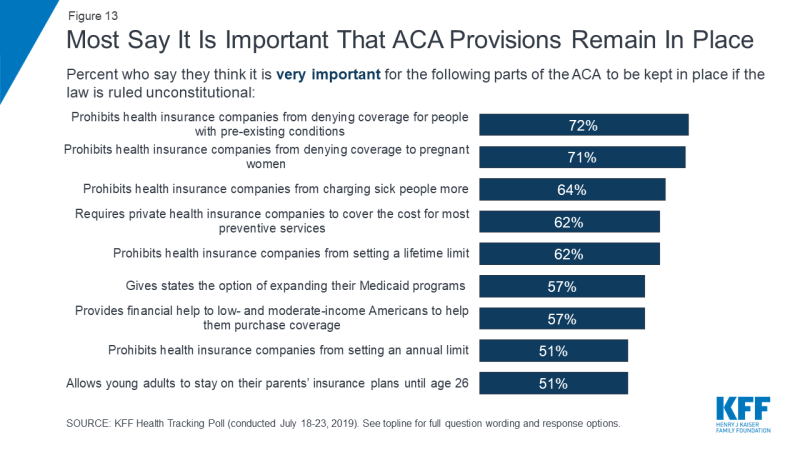
KFF Health Tracking Poll - July 2019: The Future of the ACA and Possible Changes to the Current System, Preview of Priorities Heading Into 2nd Democratic Debate

Recommending the entire article for the public's views, but one graphic.

9333-Figure-13.png
 

BleedBlueGold

Well-known member
Messages
6,270
Reaction score
2,493
Yes, there isn't any way not to.

Conceptually, healthcare falls into one of three buckets:
1. Private
2. Public (or "socialized")
3. Private+Public.

When you study healthcare and outcomes (not blanket terms like life expectancy) as implemented worldwide a couple things become obvious. Privatized healthcare leaves people out, which is bad for poor people or the unemployed or however you get your coverage. Public healthcare is only as good as the government administering it, and has a wide range of effectiveness/outcomes/cost. They both have flaws. And we've seen with the VA in the United States how bad "public" healthcare can be, but we've also seen with Medicare how well it can be run when the care provided is still "private" to a degree.

So, IMO, the best way to couple the systems is allow private health insurance companies to compete directly with a full fledged public option that all American citizens get by default. Because when you have competition, there are built in checks and balances. Private insurance screwing people over? They'll lose to their subscriber base to the public option. Public option providing shitty or delayed care? People can leave it for a private plan. It's not perfect but it mitigates the risk associated with going one full way or another.

The reason the ACA is a poor bill isn't because of its aspirations (which were noble), it's mainly been because the details of the law were poorly conceived and the implementation has been a disaster.

Which candidates are pushing this route? Aka, the ones who are against abolishing private ins. companies? I didn't watch the last debates when the question was asked.
 

RDU Irish

Catholics vs. Cousins
Messages
8,625
Reaction score
2,731
I support a public option if it creates lower prices for better coverage, allows are most vulnerable citizens to get the basic healthcare they need and deserve BUT...working in healthcare myself, I can tell you that a huge problem with private insurance companies has become their self determined "standard of care" coverage principles in which THEY, an insurance company (not a doctor), are dictating the type of treatments that doctors give to their patients. I deal with this every. single. day. Technology is getting better, treatments for diseases like cancer are getting better, and insurance companies are refusing to pay for these new protocols until they become "standard." Insurance companies need to do their job: collect a premium, pay for the coverage when a customer comes calling. Period.

I support unicorns if they crap gold bricks.

State insurance was there for uninsurables prior to ACA and worked well. Socialized the most expensive aspects of the system for those that cared to avoid medical bankruptcy. Medicaid was there for the poor. Expanding on those systems would have made infinitely more sense.
 

RDU Irish

Catholics vs. Cousins
Messages
8,625
Reaction score
2,731
He's basically up by by 10 to 20 points on the rest of the field though, depending on which poll you look at. He's way ahead in Iowa and even considerably leading in New Hampshire. As long as he is the standard bearer for the "moderate" position while everyone else falls over themselves to out-progressive each other and attack Obama I think he gets the nom regardless of how many gaffes he makes. A lot of people crave a return to normalcy and that's what he is selling.

Honestly, the more I think about it, I think we're heading to a Biden/Warren ticket. We'll see how the September debates go, but I think it's likely that everyone ganging up on Biden is not going to work how they want it to. It turns off a lot of people, especially when he is able to deflect and disarm as well as he did for the majority of last night.

All he has to do is make it to February without one of the other candidates consolidating a large coalition behind them and he's going to win. Which really means that as long as Bernie and Warren both stay in the race through Super Tuesday it's hard to see him losing.

The bolded is exactly what will happen. Joe has managed to lose Presidential primary races for a couple of decades - he may be a final four but I would wager he won't be last person standing.
 

GATTACA!

It's about to get gross
Messages
15,108
Reaction score
12,945
Which candidates are pushing this route? Aka, the ones who are against abolishing private ins. companies? I didn't watch the last debates when the question was asked.

Off the top of my head I believe Harris is the only one who's proposal includes abolishing private insurance.

She's donezo anyways.
 

IrishLax

Something Witty
Staff member
Messages
37,545
Reaction score
28,995
I'm going to ask that we move the healthcare discussion to the appropriate thread per the OP about broader political discussion. Want to keep this thread focused. I'll leave what's here, but future posts I'll move.
 

IrishLax

Something Witty
Staff member
Messages
37,545
Reaction score
28,995
Off the top of my head I believe Harris is the only one who's proposal includes abolishing private insurance.

She's donezo anyways.

Warren and Bernie both explicitly stated they will eliminate private insurance. That was a big point of night one with some "moderates" taking Warren to task on that being bad policy.
 

BleedBlueGold

Well-known member
Messages
6,270
Reaction score
2,493
Off the top of my head I believe Harris is the only one who's proposal includes abolishing private insurance.

She's donezo anyways.

I guess easy answer is far left = ban private ins, moderates = public option

I should’ve asked, which moderates have the best sounding healthcare plan in terms of what lax and legacy are talking about?
 

BleedBlueGold

Well-known member
Messages
6,270
Reaction score
2,493
I'm going to ask that we move the healthcare discussion to the appropriate thread per the OP about broader political discussion. Want to keep this thread focused. I'll leave what's here, but future posts I'll move.

Noted.

Although I was trying to keep it on topic in terms of tying it to the candidates directly.
 

ACamp1900

Counting my ‘bet against ND’ winnings
Messages
48,948
Reaction score
11,228
Off the top of my head I believe Harris is the only one who's proposal includes abolishing private insurance.

She's donezo anyways.

Wasn’t that a ‘raise your hands if’ Q at the first debate and every single one raised their hands,... ??? Pretty sure
 

IrishLax

Something Witty
Staff member
Messages
37,545
Reaction score
28,995
The bolded is exactly what will happen. Joe has managed to lose Presidential primary races for a couple of decades - he may be a final four but I would wager he won't be last person standing.

But how does that happen if he continues to hold around 35%? The other four people polling above 5% have a combined share of approximately 47% between them... so all would need to drop *early* and throw their support behind someone like Warren.

The way Trump got the Republican nomination was holding on to a plurality while Cruz, Rubio, and Kasich stayed in the race too long. Biden has virtually the same path, because unless any of the four drop before Super Tuesday there is only ~15% up for grabs from the other candidates.
 

IrishLax

Something Witty
Staff member
Messages
37,545
Reaction score
28,995
Noted.

Although I was trying to keep it on topic in terms of tying it to the candidates directly.

Yeah me too, I just noticed that we were posting a lot about it and getting into a deeper discussion independent of the candidates. Not a problem either way, but I want to try to make sure this thread doesn't have some of the same problems of other politics threads.
 

IrishLax

Something Witty
Staff member
Messages
37,545
Reaction score
28,995
I guess easy answer is far left = ban private ins, moderates = public option

I should’ve asked, which moderates have the best sounding healthcare plan in terms of what lax and legacy are talking about?

In terms of "public option" it's really Buttigieg, Booker, and some of the other "moderates" that don't matter. For example, here's a snippet on Pete's plan (which is for all intents and purposes the Public+Private we're talking about):
Buttigieg describes his health care plan as “Medicare for All Who Want It.” The idea is to allow anyone to enroll in Medicare plans on the public exchange.

But he would not touch the private insurance industry. People who already have health insurance through their jobs can stay on their employers’ plans if they choose. But they’d also have the option of buying into the public exchange as well.

Biden wants to use the ACA as a framework and fix all of the problems... which could be fine, but you actually have to fix all of the problems. I'll believe it when I see it, but at least he acknowledged last night some of the things that are wrong with the ACA.
 

Legacy

New member
Messages
7,871
Reaction score
321
Medicare for All would eliminate Medicaid. Medicaid negotiates drug prices. Allowing Medicare (for All) to negotiate drug prices would require a change in the law.

Federal programs reimburse at about 60% of private insurances. The Medicare for All proposals are opposed by providers at that level of reimbursement saying many hospitals would fold.

The candidates that oppose Medicare for All and would build on the current foundation are:

Joe Biden
Amy Klobucher
Michael Bennet
Jay Inslee
John Hickenlooper
Steve Bullock
Tim Ryan
Seth Moulton
Wayne Messam

Beto opposes Medicare for All, would expand coverage, negotiate drug prices and rethink the whole system.

A lot of governors who have dealt with the issue on a state level. Only one of those candidates, Biden, has qualified for the next debate with Klobuchar passing the polling criteria and needing more donors. She should be in by September. Beto has qualified for the next debate.
 
Last edited:
Status
Not open for further replies.
Top