The Bears' lakefront proposal was asking for a $3b-$4b gift from the city and state. The Bears were going to put up $2b for a project that was ultimately going to cost between $5b and $6b depending on whose numbers you trusted more, and in return, the Bears would capture all revenue from all events at the stadium. What sane person would agree to that? Yet the current mayor was out front saying what a great deal it was.This doesn't even mention that the Lakefront is protected property and the Bears could not even own the stadium if it would have been built. For everyone clamoring for the Bears to build a stadium on the Lakefront and stop asking for money, they're effectively asking that the Bears gift the public a stadium. Nobody would ever do that lol

You are using an out of date browser. It may not display this or other websites correctly.
You should upgrade or use an alternative browser.
You should upgrade or use an alternative browser.
Chicago Bears address
- Thread starter Crazy Balki
- Start date

Katzenboyer
Well-known member
- Messages
- 2,066
- Reaction score
- 3,439
I understand this to a point. But the government should contribute some money to these organizations. The amount of money they bring to the area from restaurants, hotels, and the jobs they bring to the area.
Yes they should pay some but not 40 or 50 percent like I have seen some places ask for.
And the government should up keep the side walks and roadways around this locations.
The "financial impact" arguments have been thoroughly debunked re: public funds to support building stadiums leading to economy prosperity to the surrounding area. I don't have time to pull up all the articles that flatly contradict those claims, but here's a few I found quickly:
Few fields of empirical economic research offer virtual unanimity of findings. Yet, independent work on the economic impact of stadiums and arenas has uniformly found that there is no statistically significant positive correlation between sports facility construction and economic development (Baade and Dye, 1990; Baim, 1992; Rosentraub, 1994; Baade, 1996; Noll and Zimbalist, 1997; Waldon, 1997; Coates and Humphreys, 1999).
These results stand in distinct contrast to the promotional studies that are typically done by consulting firms under the hire of teams or local chambers of commerce supporting facility development. Typically, such promotional studies project future impact and almost inevitably adopt unrealistic assumptions regarding local value added, new spending, and associated multipliers. They often use a regional inputoutput model that depends on outdated technical coefficients which are treated as invariant to shifts in supply and demand (Center for Economic and Management Research, 1991; Deloitte & Touche, 1994, 1996; KPMG, 1996; Economic Research Associates, 1996; KPMG, 1998; C.H. Johnson Consulting, 1999).
See also:
Sports stadiums and taxpayer financing: A primer and research roundup
Research conducted over decades indicates sports stadium public investments almost never lead to massive economic gains for host cities.
 journalistsresource.org
The Myth of Economic Growth Through Stadium Subsidies | Nevada Policy
In the past decade, Nevadans have subsidized private sports stadiums to the tune of over $1 billion dollars. Most notably Nevadans are on the hook for $750 million that was […]
 nevadapolicy.org

Boosters Beware: Stadiums Aren’t Magic | AIER
"Just about every economist knows publicly financed stadiums are boondoggles that, if anything, imperil cities’ financial positions." ~Art Carden
 aier.org

Jiggafini19Deux
Minister of Delayed Gratification
- Messages
- 14,520
- Reaction score
- 15,628
Its an obvious hardball move.

dublinirish
Everestt Gholstonson
- Messages
- 27,915
- Reaction score
- 13,920
Sent from my iPhone using Tapatalk

SouthernLeprachaun
Member
- Messages
- 12
- Reaction score
- 45
The move to Northwest Indiana is actually a conspiracy to make the South Shore Line money

zelezo vlk
Well-known member
- Messages
- 18,485
- Reaction score
- 5,613
Sent from my iPhone using Tapatalk
It's a big reason why the Arlington Heights site makes sense. The way it was explained to me was out of the $5BB estimate, 2 come from the Bears, 1 comes from the state for necessary infrastructure, and the last 2 come from outside investment as there will be an entertainment complex etc. I have no idea if they have those investors lined up just yet, but if that gist is accurate then that's easily the best case scenario for the Bears.
dublinirish
Everestt Gholstonson
- Messages
- 27,915
- Reaction score
- 13,920

Crazy Balki
Site Assigned Optimist
- Messages
- 8,121
- Reaction score
- 4,744
I can't remember a day where the crowd was this infectious. This might be the craziest I've seen Soldier Field in years.
Must win game IMO. Go take care of business.
Must win game IMO. Go take care of business.
Crazy Balki
Site Assigned Optimist
- Messages
- 8,121
- Reaction score
- 4,744
And of course you fucking choke.
I just don't understand it. How do you play so well only to drop this much of a turd in arguably the most important game of the year.
I just don't understand it. How do you play so well only to drop this much of a turd in arguably the most important game of the year.

PolishDomer
Well-known member
- Messages
- 1,876
- Reaction score
- 2,976
Caleb you idiot
Crazy Balki
Site Assigned Optimist
- Messages
- 8,121
- Reaction score
- 4,744
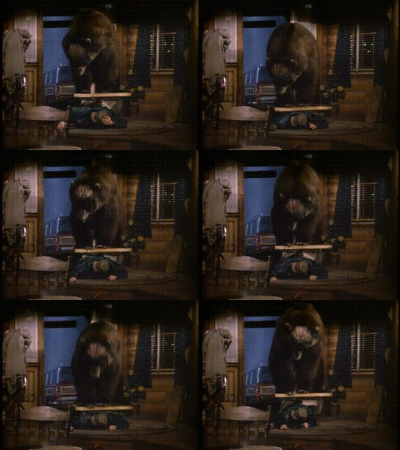
HOLY SHIT! LET'S GOOOOOOOOOOOO!!!!!!

Crazy Balki
Site Assigned Optimist
- Messages
- 8,121
- Reaction score
- 4,744
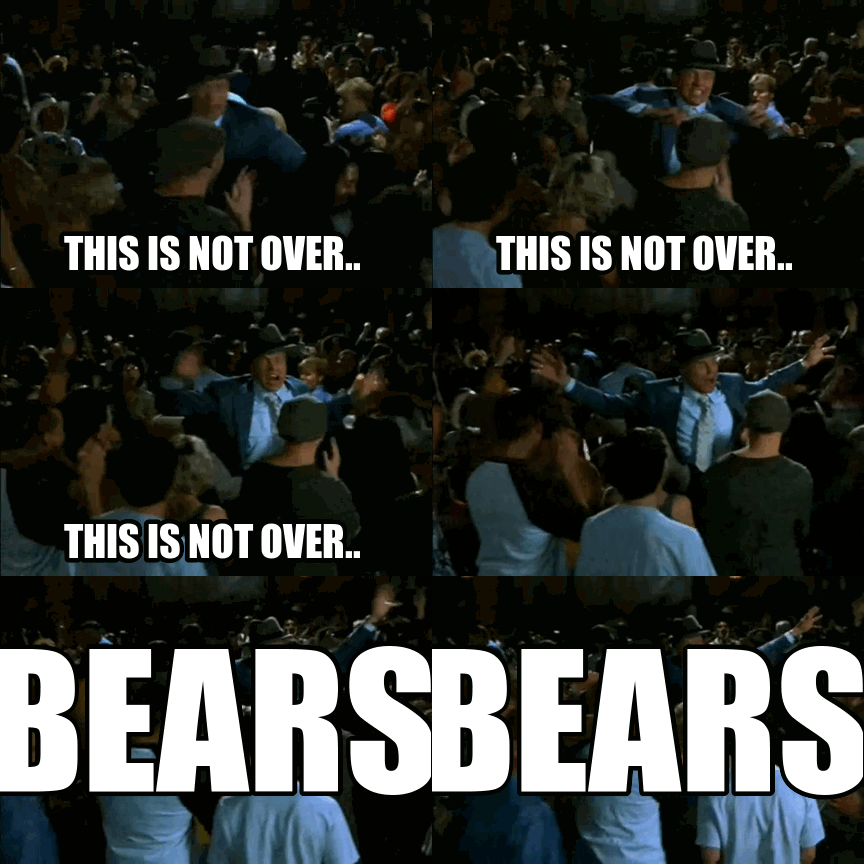
Packers fans leaving the stadium after blowing this game:

BleedBlueGold
Well-known member
- Messages
- 6,457
- Reaction score
- 2,761
The Bears are a roller coaster of emotions every game. And I happily stand in that line eagerly awaiting the ride. What a freaking game!
All might be well in the world if Da Bears can win a Super Bowl 😂
All might be well in the world if Da Bears can win a Super Bowl 😂

FLDomer
Polish Hammer
- Messages
- 3,232
- Reaction score
- 516
My buddy made me a bet, prior to the season that if the Bears made the Super Bowl I had to paint my finger nails in honor of Caleb Williams. As a jaded Bears Fan, I made what was a “safe” bet….he texted me after the game and said he was nailing polish shopping tomorrow 😂

irishff1014
Well-known member
- Messages
- 26,696
- Reaction score
- 9,510
This football season sucks and to watch Caleb have a good season is truly awful.
Jiggafini19Deux
Minister of Delayed Gratification
- Messages
- 14,520
- Reaction score
- 15,628
That mom hugging son of a bitch threw a hell of a ball. Wow.
Caleb's comments after the game about the fans were spot on, and more importantly, a sign to me that he know only gets it but that he's matured in the last three years as a person and player. He just turned 24 years old last month. Still a lot of room for him to get better. A lot. Same goes for the rest of the team.
Ben Johnson can coach ball. He's changed the culture at Halas Hall, but last night was a monumental shift in how this team and it's fans perceive itself. Whatever the outside world perceives....who cares. Beating Green Bay is the first step to getting back to where everyone wants to be.
Last night was round one of the playoffs. Merry Christmas, you filthy animals.
Caleb's comments after the game about the fans were spot on, and more importantly, a sign to me that he know only gets it but that he's matured in the last three years as a person and player. He just turned 24 years old last month. Still a lot of room for him to get better. A lot. Same goes for the rest of the team.
Ben Johnson can coach ball. He's changed the culture at Halas Hall, but last night was a monumental shift in how this team and it's fans perceive itself. Whatever the outside world perceives....who cares. Beating Green Bay is the first step to getting back to where everyone wants to be.
Last night was round one of the playoffs. Merry Christmas, you filthy animals.
Crazy Balki
Site Assigned Optimist
- Messages
- 8,121
- Reaction score
- 4,744
We're in.

MKEagle
Can you take me higher?
- Messages
- 380
- Reaction score
- 373
Call 1-800-IDGAFThis football season sucks and to watch Caleb have a good season is truly awful.
Jiggafini19Deux
Minister of Delayed Gratification
- Messages
- 14,520
- Reaction score
- 15,628
I hate national broadcasts. Here is what I learned from Tom Brady:
1. The Bears and Packers don't like each other.
2. Chicago is the Windy City.
3. Deep Dish Pizza
They didn't mention anything about the stadium nonsense, and for that I give props.
I had a friend at the game who said it was the loudest Soldier Field has been in 15 years. He has season tickets. The place was absolutely rocking old school.
1. The Bears and Packers don't like each other.
2. Chicago is the Windy City.
3. Deep Dish Pizza
They didn't mention anything about the stadium nonsense, and for that I give props.
I had a friend at the game who said it was the loudest Soldier Field has been in 15 years. He has season tickets. The place was absolutely rocking old school.

Jiggafini19Deux
Minister of Delayed Gratification
- Messages
- 14,520
- Reaction score
- 15,628

Caleb Williams spreads Christmas cheer while simulteneously rubbing salt in the Packers’ wounds
The city of Chicago is on cloud nine these last 24 hours.
Helped deliver meals yesterday as part of a Christmas food drive.
Irishdwarte
Well-known member
- Messages
- 306
- Reaction score
- 631
Wearing a cheese grater is next level trolling by him. This rivalry is all the way back. It’s awesome to see Soldier rocking like that.
Jiggafini19Deux
Minister of Delayed Gratification
- Messages
- 14,520
- Reaction score
- 15,628
There is a head coach and quarterback who actually understand what beating Green Bay means not just to the success of the franchise but to the fans.
Rivalries have give and take, ebbs and flows. This has been tremendously lopsided for 35 years.
Rivalries have give and take, ebbs and flows. This has been tremendously lopsided for 35 years.
BleedBlueGold
Well-known member
- Messages
- 6,457
- Reaction score
- 2,761
I hate national broadcasts. Here is what I learned from Tom Brady:
1. The Bears and Packers don't like each other.
2. Chicago is the Windy City.
3. Deep Dish Pizza
They didn't mention anything about the stadium nonsense, and for that I give props.
I had a friend at the game who said it was the loudest Soldier Field has been in 15 years. He has season tickets. The place was absolutely rocking old school.
Same. Best friend's in-laws have 6 tickets. The parents are older now and don't enjoy the late and/or frigid games. They're notorious for giving them to younger die-hards who they trust. The friends said it was inanely loud.

Jiggafini19Deux
Minister of Delayed Gratification
- Messages
- 14,520
- Reaction score
- 15,628
Having watched the game back again, I think Caleb Williams saved Ben Johnson's ass Saturday night. The Bears were thoroughly outcoached for the majority of that game. The Packers left the door cracked, Caleb and special teams did the rest.

rtrn2glory
Well-known member
- Messages
- 16,614
- Reaction score
- 7,041
A wins a win in the league don't get me wrong but I think Green Bay lost that game more than the bears won it