Back to Baghdad

Whiskeyjack

Mittens Margaritas Ante Porcos
Staff member
Messages
20,894
Reaction score
8,126
Slate's Jamelle Bouie just published an article arguing that Iraq war hawks have been utterly discredited, and should be completed ignored:

Let’s say you’re an academic-turned-public official who helped push your government into war. You promised an easy victory and an inexpensive reconstruction, financed by the conquered nation’s oil revenue. You built your case on the presence of weapons of mass destruction in the targeted country, and then switched gears—this was a war for “liberation”—when none were found.

Within a year of the invasion, it was clear your advocacy was a mistake. The easy occupation never materialized, and America was stuck with an expensive quagmire. The war you helped engineer had become a disaster for everyone involved, with countless deaths and trillions in wasted dollars. Now, more than a decade later, the United States has ended its war and left this country to handle its own affairs. And in short order, it has collapsed into chaos and anarchy, thanks to sectarian leadership and deadly extremists.

Given your role in building this catastrophe, you should be barred from public comment, since anything you could say is outweighed by the damage you’ve done. But this assumes a world where elites, like yourself, are accountable for their ideas. Not only are we not in that world, we’re in its opposite, where failed elites are invited to pontificate on their failures, as if they haven’t been already discredited by their performances.

Which is how we get to this past Sunday, where former Deputy Secretary of Defense Paul Wolfowitz was on Meet the Press to opine on the appropriate response to growing violence in Iraq—as if he weren’t the disgraced architect of a disastrous war that led to today’s violence. In his comments to David Gregory, Wolfowitz called for an open-ended commitment to the country, analogizing his preferred approach to the long-term U.S. presence in South Korea. “We stuck with South Korea for 60 years, South Korea is a miracle story, but if we had walked away from South Korea in 1953—that country was a basket case.”

Ignore, for a moment, the fact that the circumstances of Iraq are vastly different than those of Cold War Korea. Or that, as my colleague Fred Kaplan notes, “the collapse of Mosul … has little to do with the withdrawal of American troops and everything to do with the political failure of Prime Minister Nouri al-Maliki.” What’s amazing about this is the extent to which Wolfowitz is treated as a serious interlocutor. It’s as if his history never happened, and he were just another pundit with another perspective.

More egregious than Wolfowitz on Meet the Press was Bill Kristol on ABC’s This Week, where he also held forth on the violence in Iraq. “It’s a disaster unfortunately made possible, certainly made more likely by our ridiculous and total withdrawal from Iraq in 2011,” said the former Iraq war cheerleader, who famously declared, “American and alliance forces will be welcomed in Baghdad as liberators.” He continued, “President Obama said two days before Election Day, in 2012, al-Qaida is on the path of defeat, the war in Iraq is over. That was enough to get him re-elected, but how does it look today? Al-Qaida is on the path of defeat, the war in Iraq is over. Neither is true. It’s a disaster for our country.” For Kristol the prospect of “defeat” is enough to justify a new presence in Iraq, regardless of the costs to American soldiers and Iraqi civilians. If you want intelligent commentary on this situation—or any other—you’d do well to stay away from anything Kristol says.

What’s maddening about all of this is that it’s only the beginning. With Iraq in the news again, a whole host of war boosters have re-entered the public conversation, despite their utter lack of credibility. As the No. 3 man at the Pentagon under George W. Bush, Douglas Feith pushed a report on Iraq and al-Qaida that then-Vice President Dick Cheney called the “best source of information” on the alleged link between Saddam Hussein and Osama Bin Laden. If we lived in a reasonable world, Feith would be barred from talking on the subject of Iraq. As it stands, he’s making the rounds of commentary. Here he is in Politico, which treats him as a disinterested observer, and not someone with a clear stake in shifting the blame:

“This is the education of Barack Obama, but it’s coming at a very high cost to the Syrian people to the Iraqi people [and] to the American national interest,” said Doug Feith, a top Pentagon official during the George W. Bush administration.

“They were pretty blasé,” Feith said of the Obama team. “The president didn’t take seriously the warnings of what would happen if we withdrew and he liked the political benefits of being able to say that we’re completely out.”

Remember, this is the same Feith who led the office responsible for postwar planning in Iraq, which—you’ll recall—was a disaster that helped set the stage for the current situation of civil collapse in the country. And in the Wall Street Journal, another failed administrator has called for new involvement. “It is time for both American political parties to cease their ritualistic incantations of ‘no boots on the ground,’ ” wrote Paul Bremer, former head of the Coalition Provisional Authority, who—in 2006—insisted that most of Iraq was at peace.

Listening to either for advice on appropriate Iraq policy is like asking Michael Brown, the former head of the Federal Emergency Management Agency, for advice on disaster preparation. And yet, here we are.

The simple fact is this: We are a country where poor teenagers are locked up for the slightest transgression, but with vanishingly few exceptions, elites are shielded from the consequences of their actions. If you’re a billionaire who funds calls for aggressive austerity at the expense of ordinary Americans, a banker who helped crash the global economy, or a pundit who pushed the country into a disastrous war, you’ll never be sanctioned. If anything, you’ll be rewarded with audiences to listen to you, firms to hire you, and producers to book you on Sunday morning shows.

Neocons deserve one thing: to be ignored.
 

Redbar

Well-known member
Messages
3,531
Reaction score
806
Slate's Jamelle Bouie just published an article arguing that Iraq war hawks have been utterly discredited, and should be completed ignored:

Excellent piece Whiskey, and I want to be very careful with how I make my next point because it is likely to be jumped on with both feet. But earlier in this thread you mentioned our "client" states in that region, when I think of that term with relation to the Middle East I immediately think of Israel although I am frequently confused by who is who's "client". The neo-cons in general and every person cited in that article is not only Jewish they are very strong supporters of Zionism. I have absolutely nothing against any people or person, I have nothing against the nation of Israel, I am not advocating being suspicious of people based upon any demographic they may fall in, but I do have a problem with the United States constantly being coerced into dealing with Israel's foreign policy desires. Am I wrong to suspect that while this may have been a huge clustersfack for the US it has actually worked out pretty well for Israel. We removed one of their major rivals in the region from the board, took a lot of the rage directed at them and transferred it to us, they haven't had boys and girls sitting over there for over a decade and it hasn't cost them much monetarily. As soon as it ended we started hearing saber rattling against their other major foe in the region, Iran. Netanyahu, McCain, Lieberman wanted a "clear red line" drawn, I guess on to the next problem. I completely understand Israel wanting us to be in a state of perpetual war with their enemies in the region I just don't understand why we are so willing to do it to our own detriment. Some People think Obama is a closet Muslim, but no one suspects some of these neo-cons of having strange loyalty. Maybe I am being paranoid but after some of these guys' track record, clearances would be revoked and the ability to shape U.S. Policy or steer the conversation would be nil. Again, I have no problem with Israel, but they are a separate nation with many different considerations, goals and a separate agenda. Being our ally doesn't change that truth. It is dumb in my opinion to forget that.
 

Whiskeyjack

Mittens Margaritas Ante Porcos
Staff member
Messages
20,894
Reaction score
8,126
But earlier in this thread you mentioned our "client" states in that region, when I think of that term with relation to the Middle East I immediately think of Israel although I am frequently confused by who is who's "client".

That's exactly why I put "client" in quotes. The UK is supposed to be the nation with which we have a "special relationship", but our foreign policy over the last 20 years clearly indicates that Israel is the ally with elevated status. Except that "special relationship" is incredibly one-sided, and has cost us tremendously in blood and treasure. They've stolen nuclear technology from us, they continue to aggressively spy on us and meddle in our politics... just a few months ago, Sheldon Adelson held court in Vegas and invited Republican presidential hopefuls to come kiss his ring. Almost all of them obliged, and have been spouting cartoonishly hawkish pro-Israel bullshit ever since. Suffice it to say, if there's one "ally" we would benefit from cutting loose, it's Israel.

Andrew Sullivan just posted an article titled "Wolfowitz's Noble Lies":

I tend not to hold the somewhat conspiratorial view that followers of Leo Strauss, the guru of the neocon intelligentsia, actively believe in deceiving the American people in the pursuit of statecraft. Strauss argued that many critical texts in Western civilization were written with an esoteric teaching for the intelligent few, while presenting a less radical and palatable public doctrine for the masses. Hence the Straussian penchant for a noble lie – one that is good for the people to believe but which the elite knows is bullshit. Perhaps the classic example of this is the Straussian support for public religion, while the bulk of them are atheists. For them, religious faith is entirely instrumental – a way to lie your way to social order and cohesion.

In the case of the Iraq war, several untruths were told. Among them: there is no sectarianism in Iraq; it will cost next to nothing; it will be over in months; there are WMDs everywhere; Saddam and al Qaeda are joined at the hip. It’s hard to tell which of these untruths were sincerely believed by men like Wolfowitz and Kristol, longtime Straussians both, and which were a function of them not knowing anything about the country that was to be their text-book case of “creating reality”. But when a disgraced architect of that war goes on television to argue that the public needs to be told now that ISIS is al Qaeda, even though he knows that they are separate organizations with separate ambitions, I tend to withdraw whatever benefit of the doubt I give these men with the blood of hundreds of thousands on their hands.

Here’s the money quote from Wolfowitz:

We should say al Qaeda. ISIS sounds like some obscure thing; it’s even more obscure when you say Shia and Sunni … It means nothing to Americans whereas al Qaeda means everything to Americans … My point is that these are the same people, they are affiliated with the same people, who attacked the United States on 9/11 and still have an intention of attacking the United States and attacking Europe …

We should say al Qaeda. ISIS sounds like some obscure thing; it’s even more obscure when you say Shia and Sunni … It means nothing to Americans whereas al Qaeda means everything to Americans … My point is that these are the same people, they are affiliated with the same people, who attacked the United States on 9/11 and still have an intention of attacking the United States and attacking Europe …

This is a rare moment in which a Straussian actually comes out and says: yes, we’re deliberately lying by conflating all sorts of different things in the Middle East – the Sunni-Shia divide; the hostility between ISIS and al Qaeda – in order to concoct a simple and terrifying message to the American people that will enable us to get into another war in order to advance our goals in the Middle East.

Yes, we know this is a lie – just as our insinuation that Saddam and al Qaeda were in cahoots before 2003 was also a lie. But it’s a noble one, and that’s all that counts. That Wolfowitz was revealed as grotesquely incompetent in getting his war to achieve anything for the United States or Iraq but catastrophe is not something this smug propagandist has to worry about. We should not go into recriminations about the past, see. All of that is wiped from the ledger, and anything that went awry was always someone else’s responsibility.

It’s not just that these people refuse to be held accountable for their incompetence, war crimes and catastrophic foreign policy. It is that they are still prepared to go on television and brazenly lie to the American people and to use fear to whip up another war in the Middle East. They are trying to do this again. It’s not just that they are shameless; they are actively dangerous in their ability to manipulate and lie this country into another disastrous war.

These guys are legitimately evil.
 
Last edited:

Whiskeyjack

Mittens Margaritas Ante Porcos
Staff member
Messages
20,894
Reaction score
8,126
Or maybe they are Israeli agents pretending to be patriotic Americans.

You joke, but most of these high-profile neo-cons have amassed small fortunes already by warmongering on Israel's behalf. Calling them "Israeli agents" isn't that far off.
 

T Town Tommy

Alabama Bag Man
Messages
6,278
Reaction score
2,768
"Freedom is never voluntarily given by the oppressor; it must be demanded by the oppressed."

Martin Luther King, Jr

Until the Iraqi people demand peace and stability, nothing we do will ever matter. I am upset that they don't seem to want to "police" themselves, fight for their own being, and belittle America until they find themselves in another mess and come calling for us to bail them out so they can get back to "oppressing" the minority again.

#fixityourself

With that said, when the time comes that the region poses a real, quantifiable threat to Americans, we should attack with the ferosity of the likes never seen since the Blitzkriegs of WWII. And that American threat should be understood for all that want to cause us harm. And we have to be willing to accept that stance as threats will never be defeated by disfunctional politicians on both sides of the political aisle in Washington, DC.
 
Last edited:

GoldenToTheGrave

Well-known member
Messages
1,907
Reaction score
772
Until the Iraqi people demand peace and stability, nothing we do will ever matter. I am upset that they don't seem to want to "police" themselves, fight for their own being, and belittle America until they find themselves in another mess and come calling for us to bail them out so they can get back to "oppressing" the minority again.

#fixityourself

With that said, when the time comes that the region poses a real, quantifiable threat to Americans, we should attack with the ferosity of the likes never seen since the Blitzkriegs of WWII. And that American threat should be understood for all that want to cause us harm. And we have to be willing to accept that stance as threats will never be defeated by disfunctional politicians on both sides of the political aisle in Washington, DC.

It's Maliki who doesn't want to fix it, he has his own personal political fiefdom, while the Sunnis of the country have legitimate grievances and have had them for years. We had our own revolutionary war due to "no taxation without representation", on some level it's hard to blame them for wanting to fight back. It's not as if they just don't like "freedom" or whatever we pretend that's supposed to mean in this context.

And also as far as "real, quantifiable threats", ISIS is one of the most powerful Jihadist group with foreign fighters and transnational ambitions controlling large swaths of land in the country with the world's 2nd highest oil reserves. Not saying we should necessarily do "shock and awe" pt 2 but I don't see how this wouldn't qualify under your own definition.
 
Last edited:

T Town Tommy

Alabama Bag Man
Messages
6,278
Reaction score
2,768
It's Maliki who doesn't want to fix it, he has his own personal political fiefdom, while the Sunnis of the country have legitimate grievances and have had them for years. We had our own civil war due to "no taxation without representation", on some level it's hard to blame them for wanting to fight back. It's not as if they just don't like "freedom" or whatever we pretend that's supposed to mean in this context.

And also as far as "real, quantifiable threats", ISIS is one of the most powerful Jihadist group with foreign fighters and transnational ambitions controlling large swaths of land in the country with the world's 2nd highest oil reserves. Not saying we should necessarily do "shock and awe" pt 2 but I don't see how this wouldn't qualify under your own definition.

Maliki should have been pressured to resign much, much sooner. Maybe that would have helped the current situation somewhat but that would have required us to have a coherent foreign policy and I haven't seen that yet from this administration.

Right now, the real threat is to the neighbors of Iraq. Maybe they should step up and do something. I think there is a difference in national interest as opposed to quantifiable threats and the ISIS should understand clearly that any actions taken toward the security of American's will be dealt with unforgiving power. Destroy them with everything you have and then let the rest of the radical terrorists take notice. When they crawl out of whatever rock they are under with the intent to harm Americans they ought to be looking over their heads.
 
Last edited:

Whiskeyjack

Mittens Margaritas Ante Porcos
Staff member
Messages
20,894
Reaction score
8,126
Until the Iraqi people demand peace and stability, nothing we do will ever matter. I am upset that they don't seem to want to "police" themselves, fight for their own being, and belittle America until they find themselves in another mess and come calling for us to bail them out so they can get back to "oppressing" the minority again.

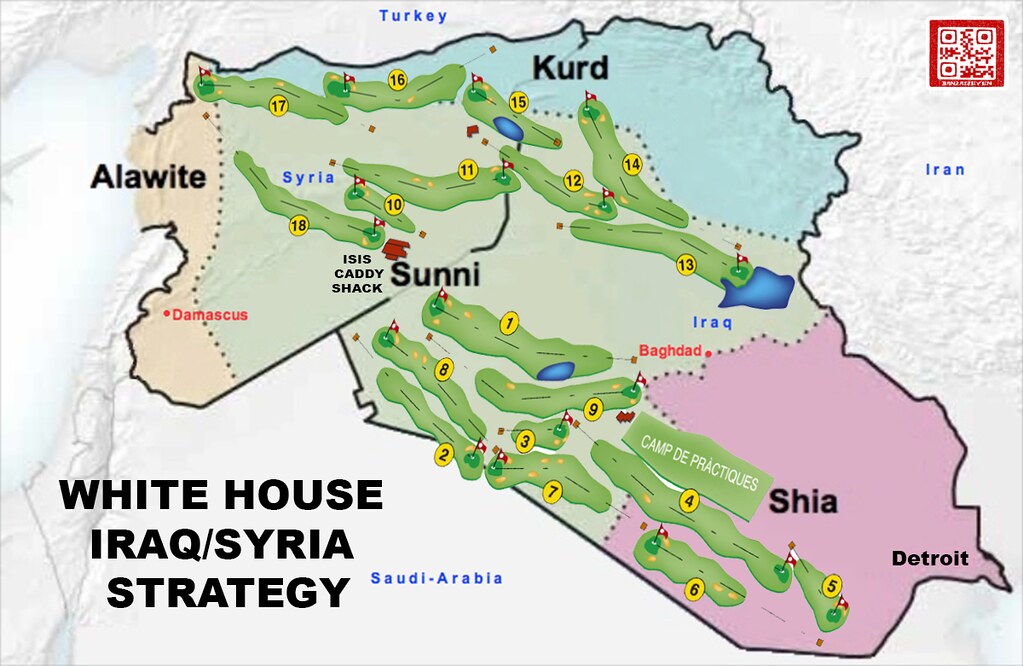
The borders of modern Iraq were, in typical colonial fashion, drawn rather arbitrarily by the Allies at the end of WWI. The "Iraqi people" isn't a meaningful label, since they don't identify themselves as a coherent nation. The Sunni majority and Shia minority have taken turns oppressing one another over the last ~1400 years since Muhammad's death caused schism within Islam, and the Kurds in the north are ethnically distinct and should probably have their own state. So to imply that they lack the will to be free is a little disingenuous. Western-style democracy never had a chance in Iraq due to its poor demographic mix.

With that said, when the time comes that the region poses a real, quantifiable threat to Americans, we should attack with the ferosity of the likes never seen since the Blitzkriegs of WWII. And that American threat should be understood for all that want to cause us harm. And we have to be willing to accept that stance as threats will never be defeated by disfunctional politicians on both sides of the political aisle in Washington, DC.

What would you count as "a real, quantifiable threat to Americans"? Because hawkish politicians and commentators have no problem labeling even the most parochial conflicts in the farthest flung corners of the globe as threats to our vital interests.

It's Maliki who doesn't want to fix it, he has his own personal political fiefdom, while the Sunnis of the country have legitimate grievances and have had them for years. We had our own revolutionary war due to "no taxation without representation", on some level it's hard to blame them for wanting to fight back. It's not as if they just don't like "freedom" or whatever we pretend that's supposed to mean in this context.

Saddam's Sunni-dominated and Saudi-backed Ba'athist party brutally oppressed Iraq's Shia minority for decades. Now Maliki's Shia-dominated and Iran-backed government is repaying the favor. There are legitimate grievances on both sides, and no "good guys" for us to back.

And also as far as "real, quantifiable threats", ISIS is one of the most powerful Jihadist group with foreign fighters and transnational ambitions controlling large swaths of land in the country with the world's 2nd highest oil reserves. Not saying we should necessarily do "shock and awe" pt 2 but I don't see how this wouldn't qualify under your own definition.

The National Interest's Ted Galen Carpenter just published an article titled "Al Qaeda and the Taliban: Not the Same Thing". Here's a relevant snippet:

[A]s U.S. leaders formulate a response to the military offensive currently being conducted by the Islamic State of Iraq and Syria (ISIS), it is crucial to soberly assess the political dynamics. Specifically, we need to determine whether ISIS is merely a subregional actor with the goal of creating a new Sunni state out of rapidly fracturing portions of Syria and Iraq, or whether the organization is truly “an Al Qaeda affiliate,” as has widely been charged, and shares Al Qaeda’s global agenda with a fanatical focus on the United States as the great enemy. The latter scenario may warrant a U.S. response; the former does not.

Blandly assuming that political movements are automatically components of a large-scale threat directed against America, leads to unnecessary U.S. entanglements and missed opportunities for constructive dialogue. We’ve made that mistake before, and we need to adopt more flexible thinking to prevent similar blunders in the future.

Al-Qaeda and the Taliban are both brutal, Islamist regimes. But one is (or was) a legitimate (though frequently exaggerated) threat to America, and the other one isn't. We shouldn't make the same mistake with ISIS.

Right now, the real threat is to the neighbors of Iraq. Maybe they should step up and do something.

Absolutely. The only long-term solution probably lies in carving out a separate nation state for the Kurds, and then having Iran and Saudi Arabia agree on how to split up the rest. But the recent rhetoric coming out of Tehran and Riyadh is not encouraging.

I think there is a difference in national interest as opposed to quantifiable threats and the ISIS should understand clearly that any actions taken toward the security of American's will be dealt with unforgiving power. Destroy them with everything you have and then let the rest of the radical terrorists take notice. When they crawl out of whatever rock they are under with the intent to harm Americans they ought to be looking over their heads.

We brought the full brunt of our military power down against on the Taliban, and they're virtually guaranteed to outlast the government we setup in Kabul. Our military isn't designed to fight Islamist insurgencies.
 
B

Buster Bluth

Guest
Absolutely. The only long-term solution probably lies in carving out a separate nation state for the Kurds, and then having Iran and Saudi Arabia agree on how to split up the rest. But the recent rhetoric coming out of Tehran and Riyadh is not encouraging.

I can't imagine Turkey accepting a Kurdish state. The uproar from Kurds within Turkey would be huge.
 

Whiskeyjack

Mittens Margaritas Ante Porcos
Staff member
Messages
20,894
Reaction score
8,126
TAC's Scott McConnell just published an excellent article titled ""Moral Clarity' on Iraq":

A critical moment of the TAC-sponsored New Internationalism conference occurred when Daniel Drezner said that a key debate in the months ahead will be over whether Washington fears more an ISIS state in parts of Iraq and Syria (or even an ISIS seizure of Baghdad) or the rise of Iranian influence in the Persian Gulf. If I had been quicker to the microphone, I would have asked how could this even be a debate? One hears echoes of the phrase “moral clarity,” a neoconservative catchword of the Cold War era, which always made less sense when they sought to apply it to the Israeli-Palestinian conflict. But though a polemical term, it’s not meaningless, and what would it mean here?

It should be obvious: Iran is complex country, with both secular and religious leaders, a semi-democracy whose rulers are influenced by public opinion, where there are meaningful competitive elections. It is certainly not free, there are far too many political prisoners and arbitrary arrests, but its level of democracy compares favorably to, say, China. It is quite modern, has a middle class, a scientific infrastructure, is a producer of world-class films and cuisine.

ISIS is by contrast barbaric, the ideological offspring of those who brought down the twin towers. The group wants to introduce sharia to the regions it rules, and commits mass murder and brags about it. Iran has been long been accused of sponsoring terrorism, but Shi’ite terrorism has always been a different animal than Sunni terrorism, less suicidal, less messianic, more like the terrorism of say, the IRA—brutal means against specific targets for concrete political aims.

People who know the Mideast better than I argue that American air strikes and drone strikes won’t bring the end of ISIS—and there is rightly no desire to re-send an American army to seize and try to hold hold the major Sunni population centers of Iraq. Joint Iranian-American military action would potentially play into the hands of ISIS and al-Qaeda—alienating the many Sunni Muslims who are right now politically on the fence. When Hillary Mann Leverett, the former NSC aide and State Department official, and as outspoken an advocate of American outreach and detente with Iran as exists in Washington, pours cold water on the idea of American-Iranian military cooperation, I tend to listen. Retired ambassador and Mideast expert Chas Freeman makes a similar point: America has no good military options. Rushing arms to Maliki’s government would ensure that they eventually get used against us, captured and/or sold by corrupt Iraqi forces.

It’s a bitter pill to swallow—there is a visceral impulse to want to do something, in an area where the United States has spent trillions of dollars and shed a fair amount of blood; this impulse arises in some—myself for instance—who opposed the invasion of Iraq from the beginning. But there is little militarily we can do that wouldn’t make things worse. The answers, if they exist, are almost certainly political: Sunni Iraqis are for the most part going to resist any effort to impose Sharia law, by ISIS or anyone else, and Iran has enough influence in Baghdad to get Maliki either broaden the Sunni representation in his government, or to encourage formation of an alternative government. We should welcome Iran’s role in the crisis, do nothing to thwart it. Perceiving it as a de facto stabilizing and anti-jihadist force in the Gulf, which it actually is, would probably make it easier to end the sanctions and come to reasonable nuclear agreement.

When I asked Dan Drezner who in Washington would support the Sunni jihadists rather than an increased role for Iran, he replied that our traditional Mideast allies (Israel and Saudi Arabia) would make any change of course difficult. Freeman also acknowledges this: the Israelis fear Iran’s nuclear program (though they themselves have nuclear weapons), and the Saudis get hysterical about the rise of Iranian influence in the region. But a great deal of responsibility for America’s disasters in the Mideast can be laid at the feet of excessive deference to Israel and Saudi Arabia. Sound and cooperative relations with Iran would do more to ward off a deepening catastrophe in Iraq than any policies suggested by Tel Aviv or Riyadh.

Cannot emphasize those last two sentences enough.
 

Emcee77

latress on the men-jay
Messages
7,295
Reaction score
555
SO

MUCH

TROOF

Whiskey, did I quote you correctly?

The situation in the Middle East is impossible as long as the region's "nations" consist of a toxic mix of ethnic groups with centuries-old hate for one another. We need a partition or two or 7. I know that looks like balkanization, and it would hardly solve the problems over there by itself, but I think it would be a start.
 

ozzman

Well-known member
Messages
1,526
Reaction score
1,597
14273272538_1c083f175c_b.jpg
 

Whiskeyjack

Mittens Margaritas Ante Porcos
Staff member
Messages
20,894
Reaction score
8,126
Here's another good article from The National Interest titled "America's Middle East Mistakes Keep Multiplying":

There’s an old saying that when you go to war it is imperative that you take pains to know your enemy, meaning to understand his motives, capabilities and likely actions. But, when the United States went to war after the startling 9/11 attacks on the homeland, it did so without even knowing who the enemy actually was. It went after the wrong targets—and thus generated the mess we now see in the Middle East.

Was the enemy Iran? No. Iran actually helped the United States when we attacked the Afghan Taliban, a common enemy, in the immediate aftermath of the 9/11 attacks. The opportunity for ongoing cooperation was thwarted by Bush himself, with his remarkable (and remarkably incendiary) “axis of evil” characterization.

Was the enemy Saddam Hussein’s Iraq? Certainly not. Saddam was a largely secular leader who ruled as a thug, based on the thuggish leverage of fear and greed. Thus, he considered cultural passion to be his enemy, a destabilizing element unlikely to respond to his fear-and-greed brand of leadership. Not only was he not the enemy, but he offered a rich opportunity for cooperative action of mutual benefit. He wanted the sanctions against his country lifted and markets for his oil; the United States wanted guaranteed flows of oil and sub rosa help in combating Al Qaeda. Therein lay a potential exchange.

Was the enemy Libya’s Muammar Qaddafi? Again, no. Qaddafi was a brutal dictator who was well practiced in the tools of terrorism. But he had been domesticated by American diplomacy backed up by the threat of American force (particularly credible in the wake of Ronald Reagan’s bombing attack in 1986). He offered stability in his country and a guarantee that it wouldn’t be overrun by Islamist radicalism.

Was the enemy Syria’s Assad or Egypt’s Mubarak? Again, no.

The enemy was—and is—Islamist fundamentalism. Many people after 9/11, including George W. Bush at the time, sought to emphasize that Islamist fundamentalism isn’t really a natural element of Islam but rather an aberrational phenomenon—the product of people who don’t really understand their own culture. They had to press this point in order to protect their broader philosophical objective, which was to inject Western ways and thinking into the world of Mideast Islam. That was the underlying philosophical objective of Bush’s 2003 Iraq invasion.

But this characterization of Islamist fundamentalism as a cultural aberration is false. It isn’t that most Muslims embrace cultural radicalism; obviously, they don’t. But Islamist sentiment, even radical sentiment, has a heritage and a history within the larger world of Islam. The desire for a restored Islamic Caliphate, the call to protect fundamentalist beliefs and practices from the forces of modernity, the assault on the notion that church and state should be separated, the defensive hostility towards the West—all of these emanate naturally from the broader Muslim religion and its history.

Particularly significant is the ongoing tension between Islam and the West, going back centuries and impervious to the fuzzy idealism of those who want to wish it away. “Some Westerners,” wrote the late Harvard scholar Samuel P. Huntington, “…have argued that the West does not have problems with Islam but only with violent Islamist extremists. Fourteen hundred years of history demonstrate otherwise.” Huntington later elaborated on this theme when he wrote:

The underlying problem for the West is not Islamic fundamentalism. It is Islam, a different civilization whose people are convinced of the superiority of their culture and are obsessed with the inferiority of their power. The problem for Islam is not the CIA or the U.S. Department of Defense. It is the West, a different civilization whose people are convinced of the universality of their culture and believe that their superior, if declining, power imposes on them the obligation to extend that culture throughout the world.

Where Bush and the American elite went wrong after 9/11 was in refusing to believe those attacks reflected a clash of civilizations between Islam and the West. In believing the problem was a dearth of democracy, they crafted a policy that destroyed those elements within Mideast Islam best-positioned to keep at bay the forces of Islamist fundamentalism. And, in interjecting American power into the Islamic heartland—planting the American flag in Islamic soil in a highly provocative manner—they fanned the flames of Islamist fundamentalism throughout the Middle East and North Africa.

We now see the result—radical Islam taking vast swaths of territory in Syria and Iraq, threatening to overrun Libya, positioning itself for far greater power and protection than it had ever known before. And suddenly, America is seeing possible allies where it once saw only enemies.

It appears now that Washington sees its interests in Iraq and Syria as coinciding with those of Iran, that once-reviled element of the axis of evil but now bent, like the United States, on thwarting the ongoing push into Iraq by vicious Sunni radicals. There’s much talk in the American capital about this, and Secretary of State John Kerry has suggested the United States should “see what Iran might or might not be willing to do” to help save Iraq from the Islamic State of Iraq and Syria (ISIS), which has been capturing territory in Iraq at an alarming rate.

No doubt many in Washington will see this turn of events as reflecting a new state of things in the Mideast, raising new prospects for cooperation between two nations that had previously, in a different state of things, been enemies. But this will be entirely wrong-headed. For the United States, the strategic imperatives have not changed; they have been and remain the need to check the spread and the reach of Islamist fundamentalism.

The elements of the policy suggested by these strategic imperatives could have been:

- Work with Saddam Hussein on matters of mutual interest, as noted above. Leave him in place in exchange for help in tamping down Islamist fervor and activity.

- Use Saddam’s Iraq as a strategic counterweight to Iran, but also foster better relations with the Islamic Republic whenever they could help in the effort against fundamentalist sentiment.

- Abandon the missionary effort to spread democracy in the lands of Islam and announce that Middle Eastern politics are recognized by the United States as the domain of the Middle Eastern people. Refrain from projecting U.S. military power into Islamic territories for fear of rendering anti-Western fervor in those lands, both more intense and more widespread. This would mean no war in Iraq, no military action against Gaddafi, no verbal shoving against Mubarak, no wringing of hands against Syria’s Assad. (The initial Afghan operation, designed to push out the Taliban and destroy Al Qaeda’s base of operation, would still have been undertaken, but with no subsequent effort to control the countryside or overhaul local governments. Any Taliban restoration would have unleashed warnings of horrendous retaliation for any attacks on America or its direct interests launched from Afghan territory.)

- Stealthy and deft intelligence and clandestine operations against Islamist elements whenever and wherever they threatened America or its interests. Also, highly targeted and highly destructive retaliatory action against any Islamist groups that attacked American interests or citizens.

Think of how events could have unfolded differently if such an approach had been taken. But it would have required knowing our enemy, beginning with who the true enemy was.
 

T Town Tommy

Alabama Bag Man
Messages
6,278
Reaction score
2,768
Good post again whiskey. I guess my question would be this then. In a world dominated by global economic forces, how then does the West and Islamic fundamentalism co-exist? The vast supply of oil that inhabits their land makes them a global player, whether they want it or not. To me, when the Islamic world can not even agree on their own religion and have fought each other for hundreds of years over the very tenants of it, how can we expect them to live harmoniously within the world in which we inhabit? Further, when that religion has a basis for convert, be converted, or be killed as the underlying philosophy, how then does anyone, including the West, not have a right to want to do what is necessary to protect our people and our way of life? Understanding their religious beliefs, etc., is nice, but asking the rest of the world to step in line is a whole other thing. It's almost as if they - being Islamic fundamentalists - are contradicting themselves and their whole belief system. Don't tell us how to live, while at the same time trying to do the exact same thing to us.
 

Whiskeyjack

Mittens Margaritas Ante Porcos
Staff member
Messages
20,894
Reaction score
8,126
I guess my question would be this then. In a world dominated by global economic forces, how then does the West and Islamic fundamentalism co-exist?

Islamic fundamentalists are simply one faction among many in the Muslim world. We should use diplomacy and other forms of soft power to ensure that the factions which oppose Islamism within the Muslim world succeed in containing it. Those factions are never what Western liberals would call "good guys"--historically, they've been autocrats like Hussein, Qaddafi and Assad-- but we can both do business with and peacefully coexist along side such governments. ISIS? Not so much. Too bad we decided to depose a bunch of those would-be allies in a naive quest to democratize the Middle East.

To me, when the Islamic world can not even agree on their own religion and have fought each other for hundreds of years over the very tenants of it, how can we expect them to live harmoniously within the world in which we inhabit?

There are plenty of stable regimes in the Muslim world that have no issue peacefully co-existing with the West. We just have to make sure our actions in the region are directed toward promoting stability. Putting boots on the ground and overtly taking sides in a 1400-year-old religious conflict has done nothing but pour gasoline on the Islamicist fire; so no matter how badly the Saudis and Israelis want us to throw our weight around, we need to define our interests and pursue them much more judiciously.

Further, when that religion has a basis for convert, be converted, or be killed as the underlying philosophy, how then does anyone, including the West, not have a right to want to do what is necessary to protect our people and our way of life?

We absolutely have a right to defend ourselves. But the large-scale military operations we've conducted to date have arguably made us less safe due to blow-back, and they have definitely destabilized the region as a whole.

Understanding their religious beliefs, etc., is nice, but asking the rest of the world to step in line is a whole other thing. It's almost as if they - being Islamic fundamentalists - are contradicting themselves and their whole belief system. Don't tell us how to live, while at the same time trying to do the exact same thing to us.

It's not about leaving them alone and hoping they don't choose to bomb us. Any faction that defines us as the enemy and seeks to harm us should be undermined with extreme prejudice. The issue is how to go about doing that? Our strategy over the last 20-years--invasions, collateral-damage-heavy drone strikes, and reflexively opposing all Shia-dominated factions and regimes-- has been an unimtigated failure. A much better alternative would be to stop basing our foreign policy on a simplistic sorting of the world's regimes into groups of enemies and allies. Our "enemies" frequently share interests with us (see Iran v. ISIS), and our "allies" frequently don't (see Israel on pretty much any issue recently). I'd rather see us return to the principals of George Washington's foreign policy as outlined in his Farewell Address:

Observe good faith and justice towards all nations; cultivate peace and harmony with all. Religion and morality enjoin this conduct; and can it be, that good policy does not equally enjoin it - It will be worthy of a free, enlightened, and at no distant period, a great nation, to give to mankind the magnanimous and too novel example of a people always guided by an exalted justice and benevolence. Who can doubt that, in the course of time and things, the fruits of such a plan would richly repay any temporary advantages which might be lost by a steady adherence to it ? Can it be that Providence has not connected the permanent felicity of a nation with its virtue ? The experiment, at least, is recommended by every sentiment which ennobles human nature. Alas! is it rendered impossible by its vices?

In the execution of such a plan, nothing is more essential than that permanent, inveterate antipathies against particular nations, and passionate attachments for others, should be excluded; and that, in place of them, just and amicable feelings towards all should be cultivated. The nation which indulges towards another a habitual hatred or a habitual fondness is in some degree a slave. It is a slave to its animosity or to its affection, either of which is sufficient to lead it astray from its duty and its interest. Antipathy in one nation against another disposes each more readily to offer insult and injury, to lay hold of slight causes of umbrage, and to be haughty and intractable, when accidental or trifling occasions of dispute occur. Hence, frequent collisions, obstinate, envenomed, and bloody contests. The nation, prompted by ill-will and resentment, sometimes impels to war the government, contrary to the best calculations of policy. The government sometimes participates in the national propensity, and adopts through passion what reason would reject; at other times it makes the animosity of the nation subservient to projects of hostility instigated by pride, ambition, and other sinister and pernicious motives. The peace often, sometimes perhaps the liberty, of nations, has been the victim.

So likewise, a passionate attachment of one nation for another produces a variety of evils. Sympathy for the favorite nation, facilitating the illusion of an imaginary common interest in cases where no real common interest exists, and infusing into one the enmities of the other, betrays the former into a participation in the quarrels and wars of the latter without adequate inducement or justification. It leads also to concessions to the favorite nation of privileges denied to others which is apt doubly to injure the nation making the concessions; by unnecessarily parting with what ought to have been retained, and by exciting jealousy, ill-will, and a disposition to retaliate, in the parties from whom equal privileges are withheld. And it gives to ambitious, corrupted, or deluded citizens (who devote themselves to the favorite nation), facility to betray or sacrifice the interests of their own country, without odium, sometimes even with popularity; gilding, with the appearances of a virtuous sense of obligation, a commendable deference for public opinion, or a laudable zeal for public good, the base or foolish compliances of ambition, corruption, or infatuation.

As avenues to foreign influence in innumerable ways, such attachments are particularly alarming to the truly enlightened and independent patriot. How many opportunities do they afford to tamper with domestic factions, to practice the arts of seduction, to mislead public opinion, to influence or awe the public councils. Such an attachment of a small or weak towards a great and powerful nation dooms the former to be the satellite of the latter.

Against the insidious wiles of foreign influence (I conjure you to believe me, fellow-citizens) the jealousy of a free people ought to be constantly awake, since history and experience prove that foreign influence is one of the most baneful foes of republican government. But that jealousy to be useful must be impartial; else it becomes the instrument of the very influence to be avoided, instead of a defense against it. Excessive partiality for one foreign nation and excessive dislike of another cause those whom they actuate to see danger only on one side, and serve to veil and even second the arts of influence on the other. Real patriots who may resist the intrigues of the favorite are liable to become suspected and odious, while its tools and dupes usurp the applause and confidence of the people, to surrender their interests.

The great rule of conduct for us in regard to foreign nations is in extending our commercial relations, to have with them as little political connection as possible. So far as we have already formed engagements, let them be fulfilled with perfect good faith. Here let us stop. Europe has a set of primary interests which to us have none; or a very remote relation. Hence she must be engaged in frequent controversies, the causes of which are essentially foreign to our concerns. Hence, therefore, it must be unwise in us to implicate ourselves by artificial ties in the ordinary vicissitudes of her politics, or the ordinary combinations and collisions of her friendships or enmities.

Our detached and distant situation invites and enables us to pursue a different course. If we remain one people under an efficient government, the period is not far off when we may defy material injury from external annoyance; when we may take such an attitude as will cause the neutrality we may at any time resolve upon to be scrupulously respected; when belligerent nations, under the impossibility of making acquisitions upon us, will not lightly hazard the giving us provocation; when we may choose peace or war, as our interest, guided by justice, shall counsel.

Why forego the advantages of so peculiar a situation? Why quit our own to stand upon foreign ground? Why, by interweaving our destiny with that of any part of Europe, entangle our peace and prosperity in the toils of European ambition, rivalship, interest, humor or caprice?

It's well worth reading the whole thing.
 
Last edited:

T Town Tommy

Alabama Bag Man
Messages
6,278
Reaction score
2,768
When I grow up, I hope I am as smart as you. Thanks for the clarifications. Makes pretty good sense. I nominate Whiskey as Sec of State.
 
Top