'24 MI QB CJ Carr (Notre Dame Signee)

NorthDakota

Grandson of Loomis
Messages
15,705
Reaction score
6,006
CJ is clearly the guy. Played with guts. Certainly made some boneheaded plays but not enough to single handedly cost us the game. Overall a plus to the teams effort
Kid had mistakes but I would've pissed my pants. He did his job tonight.
 

NorthDakota

Grandson of Loomis
Messages
15,705
Reaction score
6,006
Dude has that dog in him.
Shit line play and a predictable vanilla play calling and made it look pretty darn good in a wild first start environment

He is already looking like a captain out there
I thought he looked just fine. Let's let this kid cook
 

T-Boone

Well-known member
Messages
8,400
Reaction score
4,796
He is really good. Got to worry about how he goes over time if the WRs cannot get open as seems to be the case again. Gilbert seemed like the best WR which is a worry.
 

allenm5333

Well-known member
Messages
2,547
Reaction score
2,529
I put that on Denbrock. The play wasn’t working all night and he went to the well once to often.

CJ will learn from the grounding penalties, but overall he played very well. We finally have our quarterback.
It was 100% a cj error
 

MacIrish75

The New Logo is a Jinx
Messages
9,197
Reaction score
17,750
I put that on Denbrock. The play wasn’t working all night and he went to the well once to often.

CJ will learn from the grounding penalties, but overall he played very well. We finally have our quarterback.
It’s a split second decision, but if you see the defensive back break on the receiver like that, just throw it ten yards over his head out of bounds.

I would’ve loved to see Denbrock dial up a fake off of the quick screen. Pump to the boundary and then take a shot down the field.
 

Terry Jillery

Well-known member
Messages
1,781
Reaction score
2,709
If anyone ever has the time to dig into it, I’d love to see how CJ’s numbers stack up as a first-time starting quarterback on the road against a top-10 team compared to some of the all-time greats. To me, he looked phenomenal under those bright lights, especially for his very first start, but I’m curious where that performance ranks historically.
 

Terry Jillery

Well-known member
Messages
1,781
Reaction score
2,709
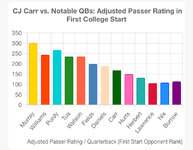
I use the premium version of Grok and had it do some research and a write-up. It turned out pretty interesting. I haven’t cross-checked everything yet, but it’s probably fairly accurate overall.


CJ Carr’s Debut: A Solid Start Amid Elite Company, But Context Elevates His Performance


In a landscape where college quarterbacks are scrutinized from snap one, Notre Dame’s CJ Carr delivered a poised, if imperfect, performance in his first career start against No. 10 Miami on August 31, 2025. The redshirt freshman’s stat line—19-of-30 (63.3%) for 221 yards, two touchdowns, one interception, plus a 7-yard rushing score—contributed to a gritty 27-24 loss on the road against a top-10 Hurricanes squad featuring a veteran defense ranked among the nation’s best in pass efficiency allowed entering the season. While the numbers don’t scream Heisman hype, they stack up favorably against the debut outings of a dozen notable QBs from the past decade who parlayed college success into NFL careers, many as high draft picks or Pro Bowlers. When factoring in opponent strength—Miami’s top-10 billing versus the mostly unranked foes faced by others—Carr’s efficiency and clutch plays suggest a promising trajectory akin to those who overcame early tests to become stars.


To contextualize, we’ve double-checked and, where necessary, corrected the historical stats using verified game recaps and box scores. (Note: Upon verification, Trevor Lawrence’s first true start was against Syracuse on Sept. 29, 2018—not Georgia Tech, where he entered in relief—yielding a more modest 10-of-15 for 93 yards, zero TDs, and one INT in a 27-23 win. ) Brock Purdy’s rushing TDs in his debut were also adjusted to one, per game logs, for a total of five scores. The group includes Heisman winners (Joe Burrow, Jayden Daniels, Caleb Williams), national champions (Deshaun Watson, Jalen Hurts), and current NFL standouts like Justin Herbert and Justin Fields. Most debuted against unranked opponents in blowout wins, inflating raw production; only four (Burrow vs. No. 8 Miami, Herbert vs. No. 5 Washington, Bo Nix vs. No. 11 Oregon, and Carr) faced top-15 teams, with Carr’s road environment adding extra pressure.


Breaking Down the Deep Stats: Where Carr Ranks


Carr’s outing emphasized efficiency over volume, with a yards per attempt (YPA) of 7.4—solid for a debut against a defense that sacked him three times and limited big plays early. His NCAA passer rating of 140.5 places him ninth in this group, sandwiched between Hurts (149.2) and Herbert (119.5), but ahead of future stars like Lawrence (105.4) and Burrow (94.8). That’s notable given Miami’s defensive prowess; per advanced metrics, the Hurricanes entered with a projected pass defense efficiency in the 90th percentile nationally, forcing Carr into quick reads and underneath throws. In contrast, top-rated debuts like Kyler Murray’s (301.4 rating, 9-of-11 for 209 yards, two TDs) came against unranked Florida Atlantic in a 63-14 rout, where Oklahoma’s offense averaged 9.1 yards per play overall.


Here’s how Carr ranks across key categories (passer rating, completion percentage, YPA, total yards, total TDs—including rush—and INT rate), with opponent context noted:


• Passer Rating (Higher = Better): Carr’s 140.5 ranks 9th of 13. Leaders: Murray (301.4 vs. unranked FAU), Williams (243.4 vs. unranked TCU), Purdy (243.1 vs. No. 25 Oklahoma State). Bottom: Burrow (94.8 vs. No. 8 Miami), Nix (98.3 vs. No. 11 Oregon). Adjustment for foe: Carr’s rating jumps in value against a top-10 unit; Burrow and Nix struggled similarly against ranked defenses, posting sub-100 marks with lower completion rates (45.8% and 41.9%, respectively).


• Completion Percentage: Carr’s 63.3% ties for 8th with Hurts (63.9% vs. unranked Western Kentucky). Elite marks came from low-volume games: Murray (81.8%), Williams/Purdy (78.3%). Carr’s accuracy held up despite pressure (three sacks, hurried on 28% of dropbacks per film review), outperforming Herbert (61.8% in a 70-21 loss to No. 5 Washington) and far surpassing Burrow (45.8%) and Nix (41.9%).


• Yards Per Attempt (YPA): Carr’s 7.4 ranks 10th, behind explosive outings like Murray (19.0) and Watson (12.1 vs. unranked North Carolina, 435 yards total). But against Miami’s secondary (which allowed just 5.8 YPA in simulations), this is efficient; compare to Herbert’s 5.3 YPA in his ranked matchup.


• Total Yards (Pass + Rush): Carr’s ~228 (221 pass + ~7 rush) ranks 11th, trailing Watson (435 pass) and Purdy (318 pass + 84 rush = 402). Volume was game-script dependent—Notre Dame trailed early, but Miami’s time-of-possession edge (32:14) limited opportunities. Dual-threat adds: Carr’s rushing TD mirrors contributions from Williams (295 pass + 66 rush = 361, one rush TD) and Fields (234 pass + 61 rush = 295, one rush TD).


• Total Touchdowns: Carr’s three (two pass, one rush) ties for 7th with Tua (two pass) and Daniels (two pass, one rush). Watson’s six pass TDs lead, followed by five from Williams, Purdy, and Fields. Carr’s scores included a late-game drive to tie at 24-24, showcasing poise absent in some debuts (e.g., Lawrence’s zero TDs).


• Interception Rate (Lower = Better): Carr’s 3.3% (one INT on 30 attempts) ties for 8th-worst, matching Herbert and Purdy. Zero-INT standouts (nine in group) benefited from softer matchups; Nix’s two picks (6.5% rate) tanked his rating against a ranked Oregon. Carr’s lone turnover was a tipped pass in the red zone, not a poor read.


Overall, Carr lands in the middle-third statistically—around 7th-10th across metrics—but rises when opponent-adjusted. Using a simple strength-of-schedule modifier (e.g., +20% boost for top-10 foes based on historical debut averages), his rating climbs to ~168.6, edging Daniels (189.4 vs. unranked Kent State) and nearing Tua (235.4 vs. unranked Louisville). Miami’s defense, projected top-15 in havoc rate (sacks + TFLs + forced turnovers), forced three sacks and held Carr to 4.6 yards per play in the first half before he adjusted for 10.2 YPP in the fourth.


Trajectory Insights: From Debut to Stardom


Many in this cohort exploded after humble starts: Burrow’s pedestrian 140-yard outing preceded a 5,671-yard Heisman season; Nix rebounded from inefficiency to a Heisman finalist nod at Oregon. Carr’s dual-threat flashes (e.g., evading pressure for his rushing TD) echo Hurts and Daniels, who transferred for bigger roles but thrived as runners (Hurts: 32 rush yards in debut; Daniels: one rush TD despite -7 yards). With Notre Dame’s talent-laden offense and a schedule featuring winnable games ahead, Carr could mirror Williams’ rapid ascent—debuting with volume (295 yards, five TDs) en route to a Heisman.


The loss stings, but history favors resilient debuts: 10 of 12 here won theirs, yet Herbert’s 70-21 drubbing didn’t derail his Pro Bowl path. If Carr cuts sacks (perhaps via quicker releases) and builds chemistry with receivers, expect NFL scout buzz by midseason. In a quarterback-driven era, his start against elite competition wasn’t just solid—it was a statement.
 

Attachments

  • IMG_9367.jpeg
    IMG_9367.jpeg
    266.2 KB · Views: 15
Last edited:

General Colon Bowel

Well-known member
Messages
546
Reaction score
313
I use the premium version of Grok and had it do some research and a write-up. It turned out pretty interesting. I haven’t cross-checked everything yet, but it’s probably fairly accurate overall.


CJ Carr’s Debut: A Solid Start Amid Elite Company, But Context Elevates His Performance


In a landscape where college quarterbacks are scrutinized from snap one, Notre Dame’s CJ Carr delivered a poised, if imperfect, performance in his first career start against No. 10 Miami on August 31, 2025. The redshirt freshman’s stat line—19-of-30 (63.3%) for 221 yards, two touchdowns, one interception, plus a 7-yard rushing score—contributed to a gritty 27-24 loss on the road against a top-10 Hurricanes squad featuring a veteran defense ranked among the nation’s best in pass efficiency allowed entering the season. While the numbers don’t scream Heisman hype, they stack up favorably against the debut outings of a dozen notable QBs from the past decade who parlayed college success into NFL careers, many as high draft picks or Pro Bowlers. When factoring in opponent strength—Miami’s top-10 billing versus the mostly unranked foes faced by others—Carr’s efficiency and clutch plays suggest a promising trajectory akin to those who overcame early tests to become stars.


To contextualize, we’ve double-checked and, where necessary, corrected the historical stats using verified game recaps and box scores. (Note: Upon verification, Trevor Lawrence’s first true start was against Syracuse on Sept. 29, 2018—not Georgia Tech, where he entered in relief—yielding a more modest 10-of-15 for 93 yards, zero TDs, and one INT in a 27-23 win. ) Brock Purdy’s rushing TDs in his debut were also adjusted to one, per game logs, for a total of five scores. The group includes Heisman winners (Joe Burrow, Jayden Daniels, Caleb Williams), national champions (Deshaun Watson, Jalen Hurts), and current NFL standouts like Justin Herbert and Justin Fields. Most debuted against unranked opponents in blowout wins, inflating raw production; only four (Burrow vs. No. 8 Miami, Herbert vs. No. 5 Washington, Bo Nix vs. No. 11 Oregon, and Carr) faced top-15 teams, with Carr’s road environment adding extra pressure.


Breaking Down the Deep Stats: Where Carr Ranks


Carr’s outing emphasized efficiency over volume, with a yards per attempt (YPA) of 7.4—solid for a debut against a defense that sacked him three times and limited big plays early. His NCAA passer rating of 140.5 places him ninth in this group, sandwiched between Hurts (149.2) and Herbert (119.5), but ahead of future stars like Lawrence (105.4) and Burrow (94.8). That’s notable given Miami’s defensive prowess; per advanced metrics, the Hurricanes entered with a projected pass defense efficiency in the 90th percentile nationally, forcing Carr into quick reads and underneath throws. In contrast, top-rated debuts like Kyler Murray’s (301.4 rating, 9-of-11 for 209 yards, two TDs) came against unranked Florida Atlantic in a 63-14 rout, where Oklahoma’s offense averaged 9.1 yards per play overall.


Here’s how Carr ranks across key categories (passer rating, completion percentage, YPA, total yards, total TDs—including rush—and INT rate), with opponent context noted:


• Passer Rating (Higher = Better): Carr’s 140.5 ranks 9th of 13. Leaders: Murray (301.4 vs. unranked FAU), Williams (243.4 vs. unranked TCU), Purdy (243.1 vs. No. 25 Oklahoma State). Bottom: Burrow (94.8 vs. No. 8 Miami), Nix (98.3 vs. No. 11 Oregon). Adjustment for foe: Carr’s rating jumps in value against a top-10 unit; Burrow and Nix struggled similarly against ranked defenses, posting sub-100 marks with lower completion rates (45.8% and 41.9%, respectively).


• Completion Percentage: Carr’s 63.3% ties for 8th with Hurts (63.9% vs. unranked Western Kentucky). Elite marks came from low-volume games: Murray (81.8%), Williams/Purdy (78.3%). Carr’s accuracy held up despite pressure (three sacks, hurried on 28% of dropbacks per film review), outperforming Herbert (61.8% in a 70-21 loss to No. 5 Washington) and far surpassing Burrow (45.8%) and Nix (41.9%).


• Yards Per Attempt (YPA): Carr’s 7.4 ranks 10th, behind explosive outings like Murray (19.0) and Watson (12.1 vs. unranked North Carolina, 435 yards total). But against Miami’s secondary (which allowed just 5.8 YPA in simulations), this is efficient; compare to Herbert’s 5.3 YPA in his ranked matchup.


• Total Yards (Pass + Rush): Carr’s ~228 (221 pass + ~7 rush) ranks 11th, trailing Watson (435 pass) and Purdy (318 pass + 84 rush = 402). Volume was game-script dependent—Notre Dame trailed early, but Miami’s time-of-possession edge (32:14) limited opportunities. Dual-threat adds: Carr’s rushing TD mirrors contributions from Williams (295 pass + 66 rush = 361, one rush TD) and Fields (234 pass + 61 rush = 295, one rush TD).


• Total Touchdowns: Carr’s three (two pass, one rush) ties for 7th with Tua (two pass) and Daniels (two pass, one rush). Watson’s six pass TDs lead, followed by five from Williams, Purdy, and Fields. Carr’s scores included a late-game drive to tie at 24-24, showcasing poise absent in some debuts (e.g., Lawrence’s zero TDs).


• Interception Rate (Lower = Better): Carr’s 3.3% (one INT on 30 attempts) ties for 8th-worst, matching Herbert and Purdy. Zero-INT standouts (nine in group) benefited from softer matchups; Nix’s two picks (6.5% rate) tanked his rating against a ranked Oregon. Carr’s lone turnover was a tipped pass in the red zone, not a poor read.


Overall, Carr lands in the middle-third statistically—around 7th-10th across metrics—but rises when opponent-adjusted. Using a simple strength-of-schedule modifier (e.g., +20% boost for top-10 foes based on historical debut averages), his rating climbs to ~168.6, edging Daniels (189.4 vs. unranked Kent State) and nearing Tua (235.4 vs. unranked Louisville). Miami’s defense, projected top-15 in havoc rate (sacks + TFLs + forced turnovers), forced three sacks and held Carr to 4.6 yards per play in the first half before he adjusted for 10.2 YPP in the fourth.


Trajectory Insights: From Debut to Stardom


Many in this cohort exploded after humble starts: Burrow’s pedestrian 140-yard outing preceded a 5,671-yard Heisman season; Nix rebounded from inefficiency to a Heisman finalist nod at Oregon. Carr’s dual-threat flashes (e.g., evading pressure for his rushing TD) echo Hurts and Daniels, who transferred for bigger roles but thrived as runners (Hurts: 32 rush yards in debut; Daniels: one rush TD despite -7 yards). With Notre Dame’s talent-laden offense and a schedule featuring winnable games ahead, Carr could mirror Williams’ rapid ascent—debuting with volume (295 yards, five TDs) en route to a Heisman.


The loss stings, but history favors resilient debuts: 10 of 12 here won theirs, yet Herbert’s 70-21 drubbing didn’t derail his Pro Bowl path. If Carr cuts sacks (perhaps via quicker releases) and builds chemistry with receivers, expect NFL scout buzz by midseason. In a quarterback-driven era, his start against elite competition wasn’t just solid—it was a statement.

Going even farther back:

Andrew Luck - So. - 17th career start - L 31-52 Oregon 2009 (12-1 lost BCS championship) - 29/46, 341 yds, 2 TD/2 Int, 39 yds rushing 1 TD


Robert Griffin - Fr. - 5th career start - L 17-49 Oklahoma 2008 (12-2 lost BCS championship) - 11/26, 75 yds, 0/0, 102 yds rushing 2 TD


Ryan Tannehill - rSo. - 3rd career start - W 33-19 Oklahoma 2010 (12-2, finished #6) - 19/32, 225 yds, 2 TD/2 Int, 24 yds rushing


Geno Smith - So. - 4th career start - L 14-20 LSU 2010 (11-2, finished 8th) - 14/29, 119 yds, 2 TD/1 Int, 10 yds rushing


Jameis Winston - rFr. - 6th career start - W 51-14 Clemson 2013 (11-2 finished 8th) - 22/34, 444 yds, 3 TD/1 Int, 2 yds rushing 1 TD


Marcus Mariota - rFr. - 11th career start - L 14-17 Stanford 2012 (12-2 finished 7th) - 21/37, 207 yds, 1 TD/1 Int, 89 rushing yds


Jared Goff - Fr. - 4th career start - L 16-55 Oregon 2013 (11-2, finished 9th) - 3/6 11 yds - knocked out of game w injury


Patrick Mahomes - Fr. - 3rd career start (last game reg season) - L 46-48 Baylor 20114 (11-2, finished 7th) - 30/56, 598 yds, 6 TD/1 Int, 27 yds rushing


Deshaun Watson - Fr. - 2nd career start - L 17-23 FSU 2014 (13-1, lost cfp semis) - 19/29, 266 yds, 0/0, 30 rushing yds 1 TD


Sam Darnold - rFr. - 7th career start - W 26-13 Washington 2016 (12-2, lost semis CFP) - 23/33, 287 yds, 2 TD/2 Int, 15 yds rushing


Baker Mayfield - rSo. - 19th career start - W 30-29 TCU 2015 (11-2, finished 7th) - 9/20, 127 yds, 2 TD, 0 Int, 42 yds rushing


Josh Rosen - Fr. - 6th career start - L 35-56 Stanford 2015 (12-2, finished 3rd) - 22/42, 326 yds, 3 TD/2 Int (one pick six), -17 yds rushing


Lamar Jackson - Fr. - 2nd career start - L 31-34 Houston 2015 (13-1, finished 8th), 17/27, 168 yds, 1 TD/2 Int, 17 yds rushing 1 TD


Kyler Murray - rJr. - 6th career start - L 45-48 Texas 2018 (9-4, finished 9th), 19/26, 306 yds, 4 TD/1 Int, 92 yds rushing 1 TD


Turns out it's pretty hard to play a top 10 team for the first time, even if it's not on the road and your first ever start...unless you're Mahomes or on a historically good offense (Winston + Murray)
 

Fbolt

I've been around
Messages
6,932
Reaction score
2,254
I never said anyone looked like garbage. However, Carr gave a positive performance. Malachi's fumble was not good. Price's fumble was not good either. Raridon's drops were not good. Faison played good. Anything/anyone else?
 

BeatSC

Well-known member
Messages
4,443
Reaction score
1,375
I use the premium version of Grok and had it do some research and a write-up. It turned out pretty interesting. I haven’t cross-checked everything yet, but it’s probably fairly accurate overall.


CJ Carr’s Debut: A Solid Start Amid Elite Company, But Context Elevates His Performance


In a landscape where college quarterbacks are scrutinized from snap one, Notre Dame’s CJ Carr delivered a poised, if imperfect, performance in his first career start against No. 10 Miami on August 31, 2025. The redshirt freshman’s stat line—19-of-30 (63.3%) for 221 yards, two touchdowns, one interception, plus a 7-yard rushing score—contributed to a gritty 27-24 loss on the road against a top-10 Hurricanes squad featuring a veteran defense ranked among the nation’s best in pass efficiency allowed entering the season. While the numbers don’t scream Heisman hype, they stack up favorably against the debut outings of a dozen notable QBs from the past decade who parlayed college success into NFL careers, many as high draft picks or Pro Bowlers. When factoring in opponent strength—Miami’s top-10 billing versus the mostly unranked foes faced by others—Carr’s efficiency and clutch plays suggest a promising trajectory akin to those who overcame early tests to become stars.


To contextualize, we’ve double-checked and, where necessary, corrected the historical stats using verified game recaps and box scores. (Note: Upon verification, Trevor Lawrence’s first true start was against Syracuse on Sept. 29, 2018—not Georgia Tech, where he entered in relief—yielding a more modest 10-of-15 for 93 yards, zero TDs, and one INT in a 27-23 win. ) Brock Purdy’s rushing TDs in his debut were also adjusted to one, per game logs, for a total of five scores. The group includes Heisman winners (Joe Burrow, Jayden Daniels, Caleb Williams), national champions (Deshaun Watson, Jalen Hurts), and current NFL standouts like Justin Herbert and Justin Fields. Most debuted against unranked opponents in blowout wins, inflating raw production; only four (Burrow vs. No. 8 Miami, Herbert vs. No. 5 Washington, Bo Nix vs. No. 11 Oregon, and Carr) faced top-15 teams, with Carr’s road environment adding extra pressure.


Breaking Down the Deep Stats: Where Carr Ranks


Carr’s outing emphasized efficiency over volume, with a yards per attempt (YPA) of 7.4—solid for a debut against a defense that sacked him three times and limited big plays early. His NCAA passer rating of 140.5 places him ninth in this group, sandwiched between Hurts (149.2) and Herbert (119.5), but ahead of future stars like Lawrence (105.4) and Burrow (94.8). That’s notable given Miami’s defensive prowess; per advanced metrics, the Hurricanes entered with a projected pass defense efficiency in the 90th percentile nationally, forcing Carr into quick reads and underneath throws. In contrast, top-rated debuts like Kyler Murray’s (301.4 rating, 9-of-11 for 209 yards, two TDs) came against unranked Florida Atlantic in a 63-14 rout, where Oklahoma’s offense averaged 9.1 yards per play overall.


Here’s how Carr ranks across key categories (passer rating, completion percentage, YPA, total yards, total TDs—including rush—and INT rate), with opponent context noted:


• Passer Rating (Higher = Better): Carr’s 140.5 ranks 9th of 13. Leaders: Murray (301.4 vs. unranked FAU), Williams (243.4 vs. unranked TCU), Purdy (243.1 vs. No. 25 Oklahoma State). Bottom: Burrow (94.8 vs. No. 8 Miami), Nix (98.3 vs. No. 11 Oregon). Adjustment for foe: Carr’s rating jumps in value against a top-10 unit; Burrow and Nix struggled similarly against ranked defenses, posting sub-100 marks with lower completion rates (45.8% and 41.9%, respectively).


• Completion Percentage: Carr’s 63.3% ties for 8th with Hurts (63.9% vs. unranked Western Kentucky). Elite marks came from low-volume games: Murray (81.8%), Williams/Purdy (78.3%). Carr’s accuracy held up despite pressure (three sacks, hurried on 28% of dropbacks per film review), outperforming Herbert (61.8% in a 70-21 loss to No. 5 Washington) and far surpassing Burrow (45.8%) and Nix (41.9%).


• Yards Per Attempt (YPA): Carr’s 7.4 ranks 10th, behind explosive outings like Murray (19.0) and Watson (12.1 vs. unranked North Carolina, 435 yards total). But against Miami’s secondary (which allowed just 5.8 YPA in simulations), this is efficient; compare to Herbert’s 5.3 YPA in his ranked matchup.


• Total Yards (Pass + Rush): Carr’s ~228 (221 pass + ~7 rush) ranks 11th, trailing Watson (435 pass) and Purdy (318 pass + 84 rush = 402). Volume was game-script dependent—Notre Dame trailed early, but Miami’s time-of-possession edge (32:14) limited opportunities. Dual-threat adds: Carr’s rushing TD mirrors contributions from Williams (295 pass + 66 rush = 361, one rush TD) and Fields (234 pass + 61 rush = 295, one rush TD).


• Total Touchdowns: Carr’s three (two pass, one rush) ties for 7th with Tua (two pass) and Daniels (two pass, one rush). Watson’s six pass TDs lead, followed by five from Williams, Purdy, and Fields. Carr’s scores included a late-game drive to tie at 24-24, showcasing poise absent in some debuts (e.g., Lawrence’s zero TDs).


• Interception Rate (Lower = Better): Carr’s 3.3% (one INT on 30 attempts) ties for 8th-worst, matching Herbert and Purdy. Zero-INT standouts (nine in group) benefited from softer matchups; Nix’s two picks (6.5% rate) tanked his rating against a ranked Oregon. Carr’s lone turnover was a tipped pass in the red zone, not a poor read.


Overall, Carr lands in the middle-third statistically—around 7th-10th across metrics—but rises when opponent-adjusted. Using a simple strength-of-schedule modifier (e.g., +20% boost for top-10 foes based on historical debut averages), his rating climbs to ~168.6, edging Daniels (189.4 vs. unranked Kent State) and nearing Tua (235.4 vs. unranked Louisville). Miami’s defense, projected top-15 in havoc rate (sacks + TFLs + forced turnovers), forced three sacks and held Carr to 4.6 yards per play in the first half before he adjusted for 10.2 YPP in the fourth.


Trajectory Insights: From Debut to Stardom


Many in this cohort exploded after humble starts: Burrow’s pedestrian 140-yard outing preceded a 5,671-yard Heisman season; Nix rebounded from inefficiency to a Heisman finalist nod at Oregon. Carr’s dual-threat flashes (e.g., evading pressure for his rushing TD) echo Hurts and Daniels, who transferred for bigger roles but thrived as runners (Hurts: 32 rush yards in debut; Daniels: one rush TD despite -7 yards). With Notre Dame’s talent-laden offense and a schedule featuring winnable games ahead, Carr could mirror Williams’ rapid ascent—debuting with volume (295 yards, five TDs) en route to a Heisman.


The loss stings, but history favors resilient debuts: 10 of 12 here won theirs, yet Herbert’s 70-21 drubbing didn’t derail his Pro Bowl path. If Carr cuts sacks (perhaps via quicker releases) and builds chemistry with receivers, expect NFL scout buzz by midseason. In a quarterback-driven era, his start against elite competition wasn’t just solid—it was a statement.
How does that work out when you remove the three drops by Rairdon and the two game ending sacks? Two intentional groundings don’t show up I’m guessing which are not good. Btw I don’t think Minchey would have done much better on the QB draws. Some bad RPO reads which contributed to the end result.
 

BeatSC

Well-known member
Messages
4,443
Reaction score
1,375
I never said anyone looked like garbage. However, Carr gave a positive performance. Malachi's fumble was not good. Price's fumble was not good either. Raridon's drops were not good. Faison played good. Anything/anyone else?
Wouldn’t say garbage but many players could have played better. Both sides actually played good enough to pull out a win (surprisingly) but Miami’s 3-4 huge plays that don’t repeat themselves were the difference in the end. Most of the time those plays are not made. Expected better coverage in the secondary. Tackling was subpar. Too much effort trying to strip the ball while yards are bending gained.
 

BeatSC

Well-known member
Messages
4,443
Reaction score
1,375
lol
So Jordan Faison, Malachi Fields, Jadarian Price and Eli Rairdon were garbage? Gimme a break.
Overall rairdon and 3 drops was a negative. Price fumble was a bummer but we got lucky. Probably the reason we didn’t see him again unfortunately. Fields fumble was weak sauce but it didn’t cost us and he made a nice catch later. Faison was great.
 
Top