
You are using an out of date browser. It may not display this or other websites correctly.
You should upgrade or use an alternative browser.
You should upgrade or use an alternative browser.
Culture
- Thread starter Whiskeyjack
- Start date

ulukinatme
Carr for QB 2025!
- Messages
- 31,518
- Reaction score
- 17,386

GATTACA!
It's about to get gross
- Messages
- 15,105
- Reaction score
- 12,943
This is all very normal
I’m convinced dems don’t care about winning elections. Why focus on shit like this no one cares about?

irishff1014
Well-known member
- Messages
- 26,513
- Reaction score
- 9,288
This is all very normal
The dumbocrats don't care about the American people at all. And this is why they have armed body guards. That's all i'll say about that.
Maybe it is time for the entire world to just blow up.
ulukinatme
Carr for QB 2025!
- Messages
- 31,518
- Reaction score
- 17,386
The dumbocrats don't care about the American people at all. And this is why they have armed body guards. That's all i'll say about that.
Maybe it is time for the entire world to just blow up.

I do fear for our children, we're going down some dark paths where social media often doles out blind justice before someone is found guilty or innocent. Just the tip of the iceberg.

- Messages
- 44,591
- Reaction score
- 20,046
This is all very normal
How does anyone with common sense rationalize this?
- Messages
- 44,591
- Reaction score
- 20,046
I'm with you there. Especially for those kids with parents that are willing to let their kids start transitioning.
I do fear for our children, we're going down some dark paths where social media often doles out blind justice before someone is found guilty or innocent. Just the tip of the iceberg.

drayer54
Well-known member
- Messages
- 8,389
- Reaction score
- 5,814
reinforce it in the schools-I'm with you there. Especially for those kids with parents that are willing to let their kids start transitioning.
GATTACA!
It's about to get gross
- Messages
- 15,105
- Reaction score
- 12,943
reinforce it in the schools-
Please stop using gendered pronouns!
- Messages
- 44,591
- Reaction score
- 20,046
reinforce it in the schools-
The sad thing is the admin probably won't do anything about it due to fear of a lawsuit.
ulukinatme
Carr for QB 2025!
- Messages
- 31,518
- Reaction score
- 17,386
Why didn't they come for the Quaker Oats dude?! This looks awfully racist.


ACamp1900
Counting my ‘bet against ND’ winnings
- Messages
- 48,947
- Reaction score
- 11,225
I think this is a Canadian classroomThe sad thing is the admin probably won't do anything about it due to fear of a lawsuit.

- Messages
- 44,591
- Reaction score
- 20,046
Well that explains it all.I think this is a Canadian classroom

- Messages
- 20,894
- Reaction score
- 8,126
Here's an article by Isaac Simpson called "There's Gonna Be War in Montana":
In popular culture, protagonists and antagonists battle eternally for Montana’s precious land. Country folk fight off city folk in Yellowstone and the podcast Land Grab: A Podcast About the Place We Call Montana. Long before that Montana (1950) pit sheep farmers against cattle farmers. In Last of the Dogmen (1995) cowboys faced Cheyenne Indians. Of the 14 major film/TV projects scheduled to be shot in Montana, every single one involves some take on the battle for Montana’s soul. And Montana’s soul is in its land
Land conflicts have led to at least one recent murder, but despite Yellowstone’s depiction of ranchers (our heroes) massacring greedy real estate developers with machine guns, so far Montana hot wars have been relegated to fiction.
My wife, toddler, and I attended a family reunion on a ranch in Tom Miner Basin—one of the most beautifully preserved parts of the state—for a week. Six years ago I attended the same event at the same ranch. There is indeed something special about the land and particularly the sky in Tom Miner Basin. Rural Montana is astonishing. I won’t bore you with more cringey descriptions because that’s all there is to say. Jockeying for Montana’s land provides great stakes for drama because the prize is priceless.
More interesting to me were the parts of Montana I saw by accident. A new coldness grips the relationship between visitors and locals. I first noticed it at the ranch. Six years ago the kitchen helpers were a happy mix of blue collar whites, hispanics, and native Americans. The chef was known for his thoughtful local cuisine, elk with au jus, beef burgers from ranch cattle, loaded baked potatoes, hearty mac and cheese. The servers wore big smiles. The progressive boomers attending the reunion were comfortable with this type of staff, the same hodgepodge they interacted with at home. Much backslapping occurred.
This time, the help had clearly experienced a vibe shift. They were all white, and distant. The food was awful—boiled carrots and reheated pork steaks, clearly the result of some Aramark-type lowest-bidder supply chain. The new staff had been mostly hired on Coolworks, a website for low paid service jobs on ranches, resorts, and other “great places.” They came from the surrounding towns, forgotten about, left behind, bright red Trump country. Young women with sloped posture and heavy eyeshadow, barely 18. Their clothes don’t fit, they looked impoverished, hungry, skittering. The young chef who had once proudly presented his take on local food was gone. The guests no longer chatted with servants. There was separation and silence.
Then my wife tested positive for COVID so we fled to Bozeman. Throughout the subsequent week, I explored Bozeman and Big Sky, ultra-hot destinations (and now homes) for the woke bourgeoisie, and Three Forks, the polar opposite, a totally different world a razor thin distance away. I saw two groups of people, an overclass and an underclass, pressed up against each other, spoiling for a fight, just waiting for the littlest spark to set their fury ablaze.
Over what? The soul of Montana of course. One-of-a-kind land. That’s nothing new. What’s new is the character of the warring factions. They aren’t who you see on TV. On one side you have global interests imputing their values, importing cheaper labor, hollowing out Montana’s attractions and selling them to an international bourgeoisie for maximum profits. On the other you have the new underclass. Not the friendly Christian country folk of times past. And not Cowboy Hat Republican Rancher Dad either. No, these are a new kind of country person. Angry, exasperated, poor, Trump-loving service-workers—the Oxy takers, the meth cookers, the eaters of Chick-Fil-A. This group is acutely aware of just who controls Bozeman and Big Sky, and believe that the same people are coming for their territory. And they’re right.
If you listen, you can hear the two groups screaming at each other in silence, waiting for their very own Gavrilo Princip to spark this thing off.
On the one lane road to Big Sky, next to the idyllic River Runs Through It location Gallatin River, there’s a stretch of three straight miles of home decor stores. High end statuary. Moose fountains. Moose-sized twigs. Totem poles. Explosions of roses. Pallets of expensive stones. A stone hauler is a bitch to end up behind because the stones shuffle out of the top of the trailer like pennies in a coin pusher arcade and slam into your windshield like rock mosquitos sent to puncture your child. On the ride up, my wife became James Brown: ”aah!” “eeyow!” “good God!” “Oh no!”
In town, in what’s ostensibly the wild rugged mountains, I see three separate women riding bicycles with helmets on, safe under the fluorescent street lamps that definitely aren’t secretly powered by coal. The air smells like exhaust. SUVs line up at a squawking blind-friendly crosswalk. There’s fresh asphalt and a labor shortage. In the long line at the understaffed co-op, construction workers in neon vests clutch single tallboys. The restaurants won’t answer the phones…or take walk ins. A Chinese family of 8, rejected from the flatbread restaurant, wanders down Candy Cane Lane forlorn and hungry.
Big Sky is a REIT’s terrible fantasy. The soul of private equity made flesh. Thin walls, $23 flatbreads, yoga pants, white people overpaying for ski condos they use twice a year. Third wave coffee seeped in. Then Female Owned™ retail stores with names like Twig and Whistle and Bird in Hand. Then REI. Then, finally, Starbucks. The home buyers think it’s a good thing, nice to have the comforts of home out here in the woods. Jen needs her cold brew, it’s, like, not even a choice. Big Sky is gingerbread land for bourgeois cattle who—distracted by golf or skiing or fly fishing or hiking or anything else they can possibly do with carbon fiber poles—somehow don’t see the mechanical claw shifting, siphoning, sucking above their heads.
Bozeman much the same, unrecognizable from even six years ago, even further down the path to hollowed out soullessness. Where Big Sky is sold as Marshmallow Puff Mountain, Bozeman is packaged as Cosmopolitan Outdoorsperson’s Paradise: “Bozeman is nature’s playground no matter the season, whether you ski, snowboard, hike, fish, or just want to go for a scenic drive.” The local spend on Patagonia and Lululemon alone must crack $10 million year.
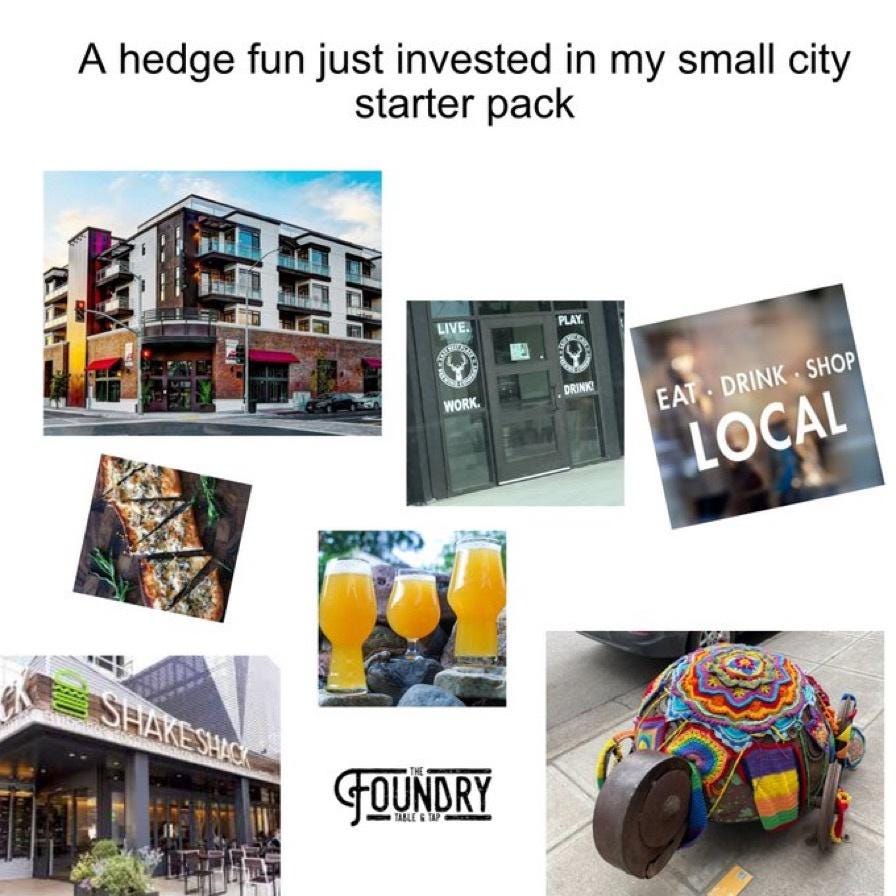
Bland and boxy hedge-fund-chic architecture, sometimes called "Minecraftsmen,” “Developer Modern,” or “LoMo,” has taken over. Work.Play.Live. Lofts with local Hazy IPA on tap. Sidewalk sculpture series featuring abstract takes on local animals. Feminist book store that kindly asks you to wear your mask. Ukraine flags. Translucent rainbow heart decals in the upper right hand corner of almost every storefront.
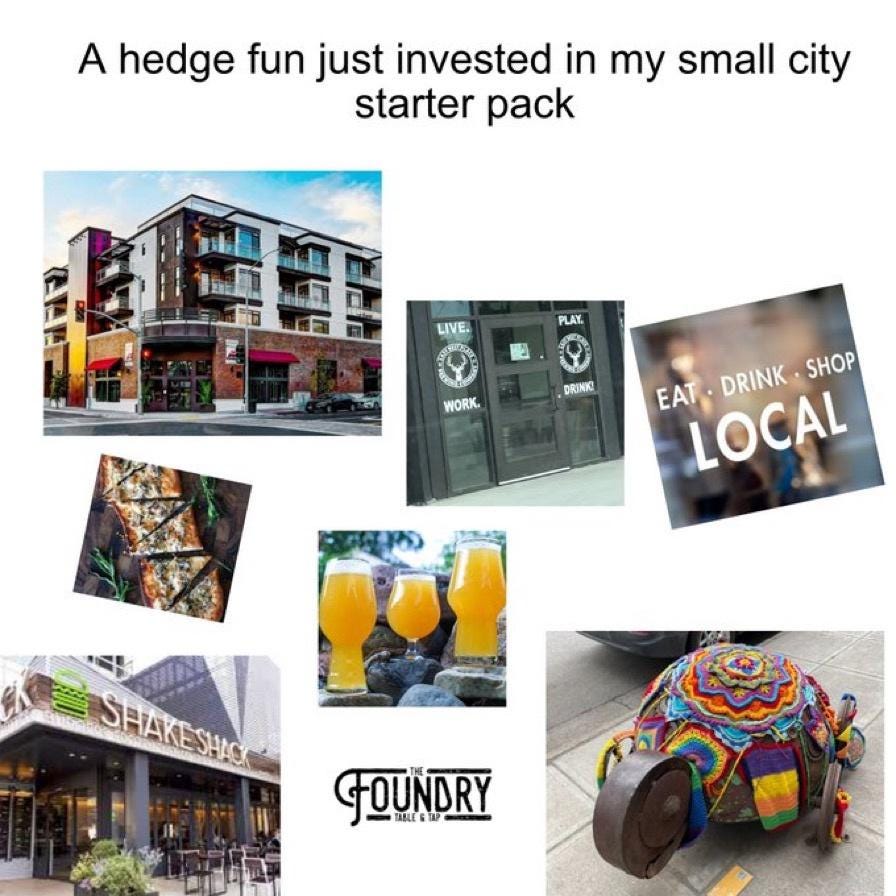
Treeline Coffee Roasters is triple rainbowed. Inside, perfect cappuccinos and a species of constantly-hiking 37 year-old women in $78 running shorts with the butt zipper pocket. Maybe recent transplants. Brand managers. Boulderers. Drinkers of local IPA. At happy hour she meets her running group at chain gastropubs with names like Smoke & Fire and The Foundry. Rubbery brisket. Frozen bison burgers. Spicy rigatoni. French fries covered in Old Bay. Eat local!
Even at the dive bar it’s purple hair and tattoos. Baseball on the TVs. The only cowboy hats ironic. Not even a biker left. Alexander Skaarsgaard in another third wave coffeeshop talking loudly in Swedish. A girl in Yeezies and a Prada purse window shop Twig and Whistle, her tall, impossible-jawline panama-hat boyfriend crinkles his tan crows-feet and attempts a Reaganite howdy.
Before, all this could be excused as the seasonal cycle of a ski town. The point is skiing, not culture, so who cares if the localism is real or the mask at the end of a proboscis tube feeding back to international banks. But that’s the old cycle, the old class, the old morality. Now, ski towns are town towns. People stay in Big Sky year round. The occupational class flees the city. I mean why not, honey? We can ski in the winter and just, like, chill in the Summer. It’s getting bad around here. We love hiking…why not just live in nature all the time?
So now in July the one lane road from Bozeman to Big Sky looks like Los Feliz Boulevard at 3pm on a Friday. Plus pebble torpedoes.

26 minutes away, Three Forks, Montana. Sick with a different disease. If Bozeman has parasites, Three Forks has dysentery. 2,000 impoverished white people play host to stragglers who’ve fallen like expensive pebbles over the edge from Bozeman. A beaten down main street, a few residential blocks and an electron cloud of mobile homes and trailers with kids playing out back and parents drinking out front.
You’ve seen the amount of Trump flags that supporters put on boats and cars; these aren’t the mild mannered conservatives of yore. Their propaganda yells, shrieks something that the other side refuses to hear. In Three Forks, every vehicle is a pickup truck and in every truck bed a hostile dog and on every bumper a hostile statement. “My Carbon Footprint is Bigger than Yours” “Proud to be Everything a Liberal Hates.” “Welcome to Montana, Now Go Home.” “We the People.”
Palpable nativism. An ungoogleable Blood and Soil biker gang thunders through town. On the beautiful plantation porch of the Sacajawea Hotel the country station plays 14 hours a day. “These are my people/This is where I come from/We're givin' this life everything we've got and then some/It ain't always pretty/But it's real/That's the way we were made/Wouldn't have it any other way.” A woman eyes me from a porch swing, sees me clacking on my laptop and says to her family, “Think about our ancestors sittin’ out here with books. Now people have laptops!” No elevator at this hotel. No disabled access. No concierge even. Just a “fine dining” restaurant that serves dressed up versions of the food from the basement bar, a local’s hangout, one of three dives in the span of maybe 1000 feet.
Locals avoid eye contact, sneer, or give overtly friendly helloes that feel like interrogations. I’m sitting at the basement bar not sixty seconds before I hear the N word. The upstairs/downstairs drama of this bar and the hotel a manifestation of the relationship between the locals and us tourists. They hate us, but they need the money. The streets feel pressurized. Bikers. Drunks. A man slides into his car holding a clear plastic cup of whiskey in one hand and a six pack of Bud in the other. In between rows of teal mobile homes sit obese wheelchair families, cackling, drinking, staring. Two drunks catcall my wife from yet another pickup. Another bar is full of methed-out faces at midday, sipping away from the sun. A Black Rifle Coffee sign sits in the window of a closed gym. We’re 20 minutes from Bozeman. No rainbows, many Trump flags.

- Messages
- 20,894
- Reaction score
- 8,126
Continued from above.
Liberal Boomers love handwringing over conflicts like the one brewing in Montana.
The “experts”—their clergy—crunched some numbers around civil wars. They found two reliable precursors. The first is anocracy, which means authoritarianism. The second is nativism, how tied people are to their race, ethnicity, religion, or local identity.Societies with grey anocracy scores, meaning they’re somewhere in the middle of highly democratic and highly authoritarian, are susceptible to civil war. High political identitarianism—AKA nativism—is also an indicator. So this obviously raises the alarm about hot conflict in places like Montana where there is clearly grey anocracy and high nativism.
But this is a new thing. Montana has always been the site of land battles—but these warring factions are brand new. The Washington Post presents the risk as one-sided—that angry Trumpists are going to soon resort to violence because, well, that’s what they do when the modern world comes knocking. The media doesn’t notice that Trump flags are being raised in reaction to the rainbow ones, not in spite of them. The anger bubbling up from Three Forks isn’t happening because Montanans, left alone for decades, somehow developed into anachronistic bigots unready for the modern world. It’s happening because Montanans got their sh*t taken. They were intentionally shoved out, left behind. Their music, their signs, their cars, their language—they’re all born from a fresh wound.
Private equity fears nativism because nativism equals economic protectionism—no free access to markets, no distant ownership of local assets, no importation of cheap labor. Blood is thicker than water, and private equity is terrified of relationships it can’t buy. This is why it posts Live Local! on its LoMo buildings and serves frozen versions of authentic Montana cuisine. It needs to placate people just long enough to take over the land, hollow out the existing culture, and replace it with a replica that siphons the locals’ milkshake back to them.
It took awhile for Montanans, and the rest of White Working Class, to realize this, but now they do, so they’ve become reactionaries. In response, private equity has given up convincing them and focused on the liberal cosmopolitan, the bourgeoisie whom they want to buy condos and flatbreads in their newly conquered lands.
Private equity knows that the bourgeoisie is reliably distracted by rainbows. To them, the rainbow represents tolerance, and tolerance (of everyone besides 100 million Trump supporters) must be exported everywhere. So, hand in hand, the bourgeoisie and private equity raise the rainbow flag over Montana. The new underclass shouts back. Buys another pickup. Tacks on another Trump flag. Digs in. The bourgeoisie gets more triggered, hunkers down, more rainbows, more Washington Post articles. Back and forth until it feels like we’re one mistake away from all those pickup trucks becoming the war machines of an American Taliban.
The media doesn’t warn us about a civil war in San Francisco or Seattle, even though downtown Seattle was occupied for two months by insurrectionists not two years ago. That’s because the bourgeoisie/private equity tag team is secure in its ownership of the cities—this new underclass isn’t a threat. No, they warn of civil war in places where there’s still land to win. And there’s no better land than Montana’s.

Rockin’Irish
Hearing Impaired
- Messages
- 3,244
- Reaction score
- 2,507
Not surprising at all……this “crying” about cultural appropriation is idiotic. All of society is cultural appropriation…..used to be viewed that mimicry was the highest form of flattery but now it is bad? Everyone copies someone else (clothes, food, hairstyles, words, etal.).
I think the result of this stupid stunt would have been dramatically different if he had chosen to wear that outfit and conduct his poll in say Boyle Heights or Glassell Park as opposed to the tourist trap that is Olvera Street.
Thank you for posting something worth reading.Here's an article by Isaac Simpson called "There's Gonna Be War in Montana":
This same reaction to gentrification has been taking place in areas of East Los Angeles for some time now. One could argue that the riots post MLK assassination, Rodney King beating and George Floyd killing stem from the same sense of hopelessness as what is described in this article. Anyhow, interesting stuff.Continued from above.
ulukinatme
Carr for QB 2025!
- Messages
- 31,518
- Reaction score
- 17,386


du Lac
CEO of IE
- Messages
- 1,643
- Reaction score
- 1,064
Dot not really follow this much but I thought I read an article the other day that said they had a swap deal. Now it’s saying 9 years. Anyone know what’s up here?

 www.bbc.com
Brittney Griner: US basketball star jailed for nine years on drug charges
Brittney Griner, 31, is jailed on drug charges, a verdict President Joe Biden calls "unacceptable".
www.bbc.com
Rockin’Irish
Hearing Impaired
- Messages
- 3,244
- Reaction score
- 2,507
This is the sentence that the Russian court gave her, her defense attorneys are appealing. There have been swaps proposed but there has been no agreement between Russia and the USA (made public, that is).Dot not really follow this much but I thought I read an article the other day that said they had a swap deal. Now it’s saying 9 years. Anyone know what’s up here?
Brittney Griner: US basketball star jailed for nine years on drug charges
Brittney Griner, 31, is jailed on drug charges, a verdict President Joe Biden calls "unacceptable".
ulukinatme
Carr for QB 2025!
- Messages
- 31,518
- Reaction score
- 17,386
I'm not a weed guy, but 9 years seems just a liiiiittle bit too much for a weed sentence, especially in a Russian prison. Knowing that Russia is gonna Russia, I still don't get what would possess her to bring banned substances over there. It's like the college student that tried to steal North Korean propaganda while he was visiting, you're just asking for trouble.

calvegas04
Well-known member
- Messages
- 11,875
- Reaction score
- 8,448
Not bad she will only be 40 when she gets out
ACamp1900
Counting my ‘bet against ND’ winnings
- Messages
- 48,947
- Reaction score
- 11,225

Dori: Port Townsend Woman, 80, banned from pool after dispute with biological male in women’s shower - MyNorthwest.com
“I saw a man in a woman’s bathing suit watching maybe four or five little girls pulling down their suits in order to use the toilet,” Jaman recalled.
 mynorthwest.com
Rockin’Irish
Hearing Impaired
- Messages
- 3,244
- Reaction score
- 2,507
I read this story earlier as well……assuming the facts are correct, where is the common sense with the way the YMCA handled the situation?Dori: Port Townsend Woman, 80, banned from pool after dispute with biological male in women’s shower - MyNorthwest.com
“I saw a man in a woman’s bathing suit watching maybe four or five little girls pulling down their suits in order to use the toilet,” Jaman recalled.

goldandblue
Well-known member
- Messages
- 3,721
- Reaction score
- 419
Toronto should be able to give a good explanation as to why this is perfectly fine and acceptable behavior.