Follow the Money - The Big Business of College Football

Legacy

New member
Messages
7,871
Reaction score
321
Texas

Texas

Texas Longhorns remain nation's most profitable athletic department - Burnt Orange Nation


Texas' team value is up 16% this year to $152 million, and that climb to the stratosphere should hardly be a surprise at this point. Last season Texas generated an unprecedented $121 million in revenue; the Longhorns remain the only college football team to ever break the $100 million revenue mark, which they've done for four straight years. Even more staggering: The team booked $92 million in profit. Alabama, arguably the most popular team in the nation, only managed revenue of $97 million.
 

Ndaccountant

Old Hoss
Messages
8,370
Reaction score
5,771
People want to talk about academics being a place where ND is challenged and I don't think anyone disputes that. However, what doesn't seem to get nearly the same attention is where ND compares with budget. This isn't about ND paying a coordinator $1M+ and we know ND pays well, but not the best. What I am talking about is support staffs. Check out the article below. This is the playing field ND has to deal with. At some point, we need to concede ND has a much greater uphill battle than just academics or spend, spend spend.

For instance, Alabama director of player personnel Kerry Stevenson made more in 2015 ($181,309) than 45 percent of the FBS assistant coaches listed in the USA Today coaching salary database. Mike Dooley, Clemson's director of high school relations and player personnel, wasn't far behind Stevenson at $150,000.

Stevenson's salary was higher than on-field assistants at schools such as Oklahoma State, Utah, North Carolina, Colorado, Oregon State, Illinois, Virginia, Maryland, Indiana, Purdue and California. Four assistants at Kansas made less than Stevenson.

Woody McCorvey, Clemson associate athletic director for football administration, made $245,000 in 2015, a 77-percent increase when factoring in inflation since he was hired in 2009. McCorvey's salary today mirrors what Clemson on-field assistant coaches made four years ago.

...

Scott, a former South Carolina head coach and Clemson offensive coordinator, describes himself as the “freshmen player development guy” who insulates Swinney from minor issues that parents or players might think are huge. By that, he means once a player enrolls to Clemson, Scott is their “coach” off the field for their first year and he handles housing, dining, study hall and tutorial programs, just to name a few areas.

“It's to make sure they don't fall through the cracks,” Scott said. “Freshmen get here and there's so much expectations. They've got a little entitlement issue, too. So Coach felt like, especially as your talent pool gets better, those guys start at the back of the line and it's tough to stay on top of them. My job is to make sure someone is watching after freshmen.”

...

In the multibillion-dollar industry of college sports, paying more for support staff is simply the price associated with trying to win football games.

“At the end of the day, a lot of people give a lot of money to our university and it helps us provide a lot of different things, so it's quality control,” Warwick said. “We're trying to put the best product out on the field and that's the nature of the business.”

Alabama, Clemson roll into title game with $3 million football support staffs - CBSSports.com
 

Legacy

New member
Messages
7,871
Reaction score
321
Nike Reaches $252 Million Deal to Extend Sponsorship at Ohio State

National Letter of Indenture: Why College Athletes are Similar to Indentured Servants of Colonial Times

Before proclaiming that college athletics is a modern-day form of indentured servitude, it is important to note several important differences. In key respects, college athletes face a more daunting economic reality. Professor David Galenson has shown that would-be indentured servants actually operated in a vigorously competitive market; the more talented the servant, the better the terms he (or she) could demand, in terms of a reduced length of service or a larger payment (known as “freedom dues”) after the completion of the indenture. Servants also negotiated whether they would receive guaranteed training in a trade and whether education would be provided.

In many ways the contracts which indentured servants signed before leaving England for the colonies could be seen as a de facto “letter of intent,” similar to the ones college athletes sign when they commit to play sports at a particular school. Yet unlike today, the colonial system evolved so that once indentured servants arrived in the new world, they usually had up to 30 days for their contracts to be bought out by a family member, friend, or someone willing to give an advance in order to hire them for their services. The professional baseball world is similar; when a high school player is drafted before college, he can choose to go play professional or enter college with the hopes being redrafted at some later point in time. Of course, this luxury exists because there is a free market alternative in the MLB, which is willing to put a value on players before they enter college. College football and basketball lack a competitive alternative for recruits.

Though differing in degree, the punishment laid on indentured servants for attempting to get out of their contracts shares much in common with NCAA rules that penalize college athletes if they want to transfer to a different institution.

Michigan player refers to athlete payments as 'indentured servant checks'

A Way to Start Paying College Athletes

Here’s how it would work:

Every Division I men’s basketball and football team would have a salary cap, just as the pros do — except the amounts would be vastly lower. In basketball, the cap would be $650,000. In football, it would be $3 million. It is ludicrous to argue that the Power 5 programs cannot afford this; the combined $3.65 million is barely half the $7 million that Michigan Coach Jim Harbaugh made this season. (I would also drop the number of scholarships in college football to 60, which is closer to the size of an N.F.L. team, from 85 in the top tier.)
 
Last edited:

Legacy

New member
Messages
7,871
Reaction score
321
Colleges Raised $1.2 Billion in Donations for Sports in 2015

There was no slowing Texas A&M University, which brought in nearly $67 million, the most of any institution that responded to the survey. In the past three years, Texas A&M donors have contributed more than $350 million in cash and pledges toward the renovation of the university’s football stadium and other athletics projects.

The University of Oregon — which last year announced a $2-billion campuswide campaign, $400 million of which is for athletics — brought in $53.7 million. Clemson University, which did not respond to the survey but provided information to The Chronicle, raised $60.1 million. Nearly half of that came from major gifts toward a $176-million renovation of facilities for football, basketball, and other programs.

As in previous years, the wealthiest programs accounted for most of the contributions. The top 20 athletic departments reported collective donations of about $670 million in 2015 — more than half of the $1.2-billion raised.
 
Last edited:

Legacy

New member
Messages
7,871
Reaction score
321
ESPN has lost more than $2 billion because of cord cutting

In 2011, at their peak in terms of subscribers, ESPN was charging cable providers an estimated $4.69 per subscriber, per month. In other words, everybody who had a cable subscription plan was paying about $68 per year for ESPN alone, whether they watched it or not.

Since then, the number of homes with ESPN has dropped ~8.3%. However, the amount ESPN is able to charge for each of those customers is actually up 40.9%, to an estimated $6.61 per subscriber, per month, according to the Wall Street Journal.

The bottom line is that ESPN is actually making more money than ever off cable subscription fees, despite the drop-off in subscribers.

56% Would Drop ESPN In A Heartbeat If It Meant Saving $8 A Month On Cable
There are limits to increasing cable prices.
 
Last edited:

NorthDakota

Grandson of Loomis
Messages
15,695
Reaction score
5,995
Greedy-ass Dakota med school deans taking food right out of the hockey coaches' mouths.

Hakstol(flyers coach now) was making north of a half a million dollars. I imagine his replacement is doing pretty well for himself. That makes me wonder how much the dean of a pretty poorly rated med school is pulling in?!
 

Legacy

New member
Messages
7,871
Reaction score
321
College teams becoming copycats as gap betweens haves, have-nots widens

Texas has a larger athletic budget -- No. 1 nationally at $179 million -- than the entire Mountain West combined. Nick Saban makes more per year than the lower-resource Mid-America Conference gets in network media rights.

Last year, the (San Diego) Aztecs made $850,000 in TV revenue, Long said. As an SEC member, Saban's program hauled in almost $33 million.
The new/renovated stadium is at the top of the list. Texas A&M is one of those 42 schools to go all in since 2009. The school currently leads that category with a $500 million renovation of Kyle Field.

Jim Delany rather crassly defined the gap speaking to then-WAC commissioner Karl Benson a few years ago.

“The problem is your [teams playing on the] big stage takes away opportunities for my teams, to play on the stage they created in 1902.”
 

Legacy

New member
Messages
7,871
Reaction score
321
Board of Governors approves $200 million distribution to DI members
Funds earmarked for programs that benefit student-athletes


The NCAA Board of Governors approved a one-time supplemental distribution of $200 million to Division I schools, which must be used explicitly for programs that benefit student-athletes. Athletics departments will be permitted to use the funds to create endowments that directly support students, to launch financial literacy and mental health programs, or to expand academic advising and tutoring resources, for example. Additionally, uses can include funding for scholarships up to the full cost of attendance, four-year guaranteed scholarships and unlimited meals and snacks for athletes, all of which have been approved in Division I in the past two years.

The funds, which will be disbursed in spring 2017, will be distributed based on the number of full athletics scholarships, providing the most support to the schools that have the largest populations of student-athletes. These funds are in addition to the normal annual distributions to members.

NCAA Division 1
With nearly 350 colleges and universities in its membership, Division I schools field more than 6,000 athletic teams, providing opportunities for more than 170,000 student-athletes to compete in NCAA sports each year.

Full scholarships limits (for football, for example)
FBS - 85
FCS - 63
 
Last edited:

Legacy

New member
Messages
7,871
Reaction score
321
Playing in the Red: Big Time College Athletic Departments are taking in more money than ever - and spending it just as fast.

Big-time college sports departments are making more money than ever before, thanks to skyrocketing television contracts, endorsement and licensing deals, and big-spending donors. But many departments also are losing more money than ever, as athletic directors choose to outspend rising income to compete in an arms race that is costing many of the nation’s largest publicly funded universities and students millions of dollars.

“College sports is big business, and it’s a very poorly run big business,” said David Ridpath, a business professor at Ohio University and board member for the Drake Group, a nonprofit advocating for an overhaul of commercialized college sports.

“It’s frustrating to see universities, especially public ones, pleading poverty . . . and it is morally wrong for schools bringing in millions extra on athletics to continue to charge students and academics to support programs that, with a little bit of fiscal sense, could turn profits or at least break even.”


The NCAA Just Misses $1 Billion In Annual Revenue

The NCAA pulled in $989 million in its 2014 fiscal year, according to an audited financial statement cited by USA Today on Wednesday.

Since the association had $908.6 million in expenses, it ended up with a nearly $80.5 million surplus for the year. A large percentage of the surplus will go to an ever-growing endowment fund whose main purpose is to safeguard the institution against a financial catastrophe, particularly related to its primary moneymaker: the March Madness basketball tournament.

The annual surplus is the NCAA’s greatest in at least 10 years and $20 million more than its surplus in 2013, according to calculations made by USA Today. But the NCAA has been generating surpluses in the tens of millions of dollars for years now, and its assets have grown tremendously as a result.
 
Last edited:

Legacy

New member
Messages
7,871
Reaction score
321
Alabama spent $7.3M, Clemson $5.4M on College Football Playoff trips

The University of Alabama Made Almost $100 Million From Football In 2015


According to numbers obtained by The Tuscaloosa News, Alabama’s football program made a profit of nearly $46,491,330 during the Tide’s 2015 championship season, which was down nearly $7 million from the year before. While revenues rose significantly, part of the overall decline in profit is due to the team’s trip to both Dallas and Glendale to participate in the College Football Playoff, as well as increases in recruiting expenses and coaching salaries.
 
Last edited:

Legacy

New member
Messages
7,871
Reaction score
321
Power Five conferences see revenue grow by 33 percent in one year:
The Power Five conferences brought home a huge payday in 2014-15


The Power Five combined for nearly $2.1 billion in revenue during 2014-15, up nearly $520 million from the previous year. The total, which amounted to roughly a 33 percent increase, can now be calculated after the ACC released its 2014-15 tax return on Friday.

While the NCAA defends amateurism in court, revenue generated by the SEC, Big Ten, ACC, Pac-12 and Big 12 more than doubled over a four-year period. The Power Five took in a little more than $1 billion in 2010-11 and reached $2.1 billion in 2014-15. Last year was the first season with the College Football Playoff, the SEC Network, some revised TV money due to expansion, and new bowl agreements.

Each conference's approximate 2014-15 payouts per school: SEC $32.7 million, Big Ten $32.4 million, ACC $27 million, Pac-12 $25.1 million, Big 12 $23.3 million.

The ACC reported $403 million in revenue, up nearly $100 million from a year earlier. That's in part due to a $31 million exit fee Maryland paid to leave the ACC.

The tax return shows the ACC distributed an average of $26.2 million per full member. (Notre Dame received about $6.2 million.) The payouts for full members ranged from $27.6 million for to about $24 million for Syracuse. The ACC provided about another $800,000 per school for championship reimbursements not reflected in the distribution.

Conference commissioner pay in 2014-15: Pac-12's Larry Scott $4 million, SEC's Mike Slive $3.6 million, ACC's John Swofford $2.7 million, Big Ten's Jim Delany $2.6 million, Big 12's Bob Bowlsby $2.6 million.

Swofford was credited with about a $600,000 raise from a year earlier. His base salary in 2014-15 was $2,618,543.
The ACC spent about $2.2 million in legal fees last year, with $1.75 million paid to Smith Moore Leatherwood LLP in Greensboro, , and $451,000 on Appel Law LLC in Atlanta. The total legal fees were down about $100,000 from 2013-14.

The conference spent $625,000 on Wasserman Media Group, which is exploring the possibility of an ACC Network with ESPN. Swofford told reporters this month that the ACC remains in "quality discussions" with ESPN. Swofford would not comment on a report that ESPN must pay the ACC $45 million if an ACC Network is not in place by July 1.
 
Last edited:

Legacy

New member
Messages
7,871
Reaction score
321
New Deals With Fox, ESPN And CBS Nearly Triple Big Ten Television Revenue

You didn’t really think ESPN was going to give up its 50-year relationship with the Big Ten did you? Despite cost cutting in recent months, SportsBusiness Daily is reporting that ESPN will pay an average of $190 million per year over the next six years for half of the Big Ten’s media rights package.

Fox already committed $240 million over the same time period for the other half of the Big Ten’s media rights, securing the conference football championship game and the advantage when it comes to choosing games.

CBS will also renew its basketball-only package at $10 million annually through 2023. As part of that agreement, CBS will retain the conference basketball tournament semis and the championship game.

The three deals together, along with Big Ten Network’s rights through 2031-32, tie up the Big Ten’s media rights for the next six years and nearly triples the conference’s revenue from television.

Last month, we learned the Big Ten reported $448.8 million in total revenue for fiscal year 2015, a $110 million increase over the previous year. Each of the conference’s 11 members from before conference realignment received $32.4 million each, with Nebraska, Maryland and Rutgers still being phased in as full conference members.

Report: Big Ten getting $2.64 billion in new TV deal

The Big Ten’s media windfall over the six-year period totals $2.64 billion.

Big Ten schools received $27 million per year from the last rights deal, a figure that will rise to $35.5 million in 2016-17, in the final year of the deal. (And that doesn't include schools' individual deals. Michigan State just announced a 15-year, $150-million contract with Fox, and Michigan is on a 12-year, $86-million deal with IMG that began in 2008.)
 
Last edited:

Legacy

New member
Messages
7,871
Reaction score
321
Pac-12 football: Salaries for head coaches (revised with new Whittingham deal)

Top Salaries
1. Washington's Chris Petersen - $3.6 million
2. UCLA's Jim Mora - $3.45 million
3&4. Oregon's Mark Helfrich and Utah's Kyle Whittingham - $3.3 million
5&6. Arizona's Rich Rodriguez and Arizona State's Todd Graham - $3 million

Updating the SEC’s 2016 head coaching salaries

10. Kirby Smart Georgia $3.75 million
11. Mark Stoops Kentucky $3.5 million
12. Will Muschamp South Carolina $3.0 million
13. Barry Odom Missouri $2.35 million
(Vandy's Derek Mason's salary not reported)
 
Last edited:

Ndaccountant

Old Hoss
Messages
8,370
Reaction score
5,771
The business model of college football, long a financial boon to universities, is breaking down. A weeklong look at the pressures of rising costs, falling revenue and what, if anything, universities can do about it.

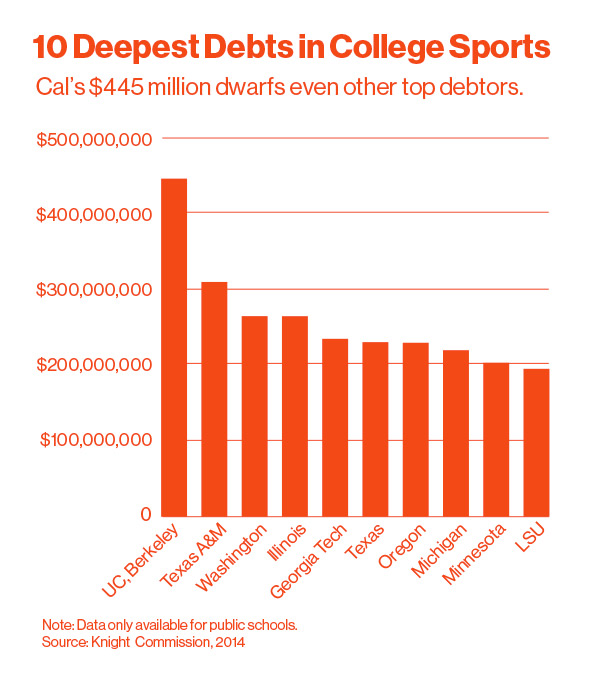
By many standards, University of California, Berkeley has an incredible sports program. Its 30 sports are second only to Stanford in the Pac-12 Conference, and the school has won 22 national titles in the past decade. At the Rio Olympics, current or former Cal athletes collected 21 medals, including eight golds.

By another measure, Cal sports are in big trouble. After completing the most expensive college football stadium overhaul ever, the Golden Bears now owe more money than any other college sports program. Hobbled by debt service payments, the athletic department ran a $22 million deficit last year and expects to end this fiscal year deep in the red.

A university task force is looking for possible solutions, including reducing the total number of Cal’s sports programs. Any cuts could endanger some of the school’s most successful teams, which cost a lot more than they bring in, and Chancellor Nicholas Dirks recently gave the group more time. “Everything is on the table,” said Robert O’Donnell, a lecturer at Berkeley’s Haas School of Business who co-chairs the task force.

Football critics nationwide often point to multimillion-dollar coaches as emblems of excess. They should be more worried about debt, which costs more and lasts longer. A high-priced coach might earn $4 million to $5 million a year. Meanwhile, according to public records, athletic departments at least 13 schools in the country have long-term debt obligations of more than $150 million as of 2014—money usually borrowed to build ever-nicer facilities for the football team.

For some schools, millions in TV money can support a high level of debt service. That includes the University of Alabama, which plays Clemson for the national championship on Monday. The Crimson Tide owes $225 million over the next 28 years. In the Big Ten, also flush from a rich media deal, the University of Illinois owes more than $260 million. If that revenue stream fails to grow or starts to drop, as it already has for some programs in the top tier of college football, the results could be crippling.

“Leaders need to be very careful that long-term expenses and commitments cannot, and should not, be balanced on the assumption that these traditional media rights deals will hold up,” said Karen Weaver, a sports-management professor at Drexel University and specialist in college media rights.

Many in college sports are more optimistic. Pac-12 Commissioner Larry Scott, for example, has said he expects that his schools will make more money from media as rights get carved up among traditional broadcasters and digital streaming platforms. All of the biggest conferences signed rich, multiyear television contracts recently, and most athletic directors believe the money will continue to flow into the next round of negotiations as well.

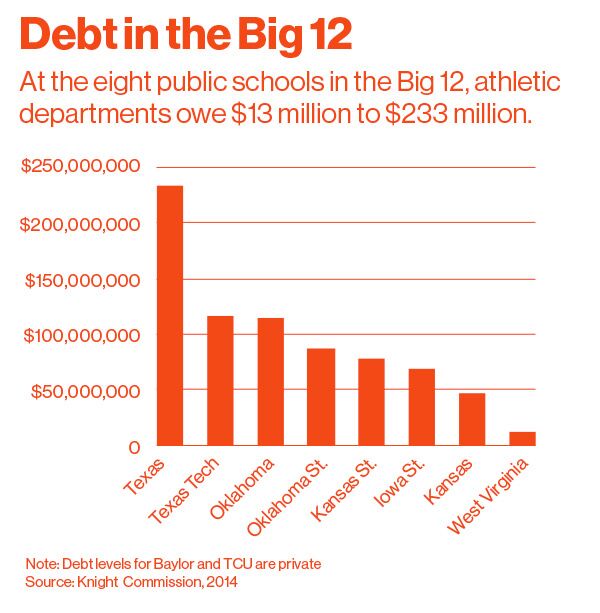
At Kansas State, athletic director John Curry said he won’t borrow for anything but football and basketball, the two sports that make money. The Wildcats, who compete in the Big 12 Conference, have built $210 million in new facilities under Curry while accruing modest annual debt service of about $6 million. “We’ve looked very seriously at the fact that our debt service needs to remain as close to that number as it can as the landscape continues to evolve,” Curry said.

Cal’s debt service last year cost nearly three times as much, the main reason why a department that generally balances its budget had such a massive deficit. Annual payments will be $18 million until 2032, when they jump to $26 million. They’ll peak at $37 million a year in 2039. The school plans to pay off the full sum by 2053, though the loan extends to 2112.

The renovation at Berkeley was always going to be expensive—California Memorial Stadium sits directly on Hayward Fault and needed specific earthquake-related upgrades—but the athletic department planned to pay for it through an “Endowment Seating Program,” decades-long season ticket packages for up to $225,000 each. Sales fell short of expectations; a year after the $474 million renovation finished, the athletic department revised its plans.

At about the same time, the university brought in a new athletic director, Mike Williams, a onetime Cal wrestler who went on to work in corporate finance. In his search for new ways to make money, Williams has negotiated an apparel contract with Under Armour and a media-rights deal that together will increase revenue by $7 million annually for the next decade. Still, Williams said, “We need to do more.”

Enter the Chancellor’s Task Force on Intercollegiate Athletics, charged with reviewing the department’s finances and making recommendations. O’Donnell said the group is still in “input gathering mode.” The Mercury News reported that more than one-third of Cal’s sports could be on the chopping block. An administrative overhaul to lower expenses is also possible, or the broader university could increase the money it devotes to athletics, currently around $5 million.

There may be limits to how much help can come from central campus. Overall, Cal had a $150 million deficit last year and is up against its borrowing limit. “Not only does athletics have a problem on account of the debt service, but it’s also taking up a huge chunk of our available borrowing,” said physics professor Bob Jacobsen, a faculty representative for athletics. Meanwhile, he added, professors are losing research opportunities due to funding concerns.

Debt can be a tool to grow—especially when interest rates are low—but only if it’s used properly, according to the Georgia Tech athletic director Todd Stansbury. In September, he inherited a department with $226 million of debt. Most of the $13 million annual debt service, however, is linked to pledged donor contributions. “When it’s done that way, it’s both healthy and sustainable,” Stansbury said. “When it starts to eat into your operations budget, then it becomes highly problematic.”

-1x-1.jpg


600x-1.jpg


https://www.bloomberg.com/news/feat...tball-s-top-teams-are-built-on-crippling-debt
 

Irish#1

Livin' Your Dream!
Staff member
Messages
44,581
Reaction score
20,031
1) Season ticket packages of $225,000? I'd say good luck in trying to sell that, but they already found out how stupid that was.
2) A loan that goes to 2112? College athletics is out of control.
 

ND NYC

New member
Messages
3,571
Reaction score
209
1) Season ticket packages of $225,000? I'd say good luck in trying to sell that, but they already found out how stupid that was.
2) A loan that goes to 2112? College athletics is out of control.

article said that was to get season tickets for a decade....not one season....still crazy to be sure ($22,500 for season tix to college football-puhlease)
 

Irish#1

Livin' Your Dream!
Staff member
Messages
44,581
Reaction score
20,031
article said that was to get season tickets for a decade....not one season....still crazy to be sure ($22,500 for season tix to college football-puhlease)

Yeah, I saw it was for a decade, but I don't think you'll get many takers who want to shell out that kind of money up front.
 

Legacy

New member
Messages
7,871
Reaction score
321
Notre Dame football season tickets attainable, but costly (ND Insider)

For the 2007 season, Notre Dame added 5,000 seat locations to its season ticket allotment. That move coincided with the renewal of the building fund program, which charges season ticket holders an annual rights fee per ticket in order to pay for stadium maintenance.

Previous season ticket holders were charged a rights fee of $500 for end zone seats, $750 for corner seats and $1,000 for sideline seats. New season ticket holders had to pay $1,200, $1,500 or $2,000 for their seats. Those fees, which came in addition to the ticket cost of $62 per game in 2007, were treated as donations to the university and were 80 percent tax deductible.

The current building fund, which expires at the end of the 2016 season, was created to cover a 10-year span. To avoid annual increases, ticket holders were given the opportunity to pay ahead for the next decade at their quoted price.

Ten seasons later, those rights fees for new season ticket holders have increased to $1,375 for end zone seats, $1,650 for corner seats and $2,200 for sideline seats. The tickets themselves cost $600 for 2016, an average of $100 per home game this fall.

New tradition (Sports Business Journal)


Notre Dame officials have not made pricing public, but the new premium seats cost slightly less than Tennessee’s west club seats at Neyland Stadium, the venue where Notre Dame most closely benchmarked its products. Those seats at UT run $5,000 a seat annually, plus capital gifts of $35,000 to $50,000, according to Tennessee athletics’ website.

At Notre Dame, the annual fees for club seats and loge boxes exclude the cost to buy season tickets and a building fund donation for a total of $2,200 to $2,800 a season, said Rob Kelly, the school’s assistant athletic director for ticketing and technology. In addition, Notre Dame’s new premium seats carry one-time capital gifts of $20,000 to $40,000. Terms are all 20 years for clubs and loges.

By comparison, club seats and loge boxes that are part of Kyle Field’s renovation, another project Notre Dame looked at as part of its research, carry a $4,500 annual fee for the best locations and require capital gifts of up to $15,000.

Club seats cost $1,500 to $2,000 at Baylor’s McLane Stadium, which opened in 2014, in addition to capital gifts of up to $25,000. For TCU’s Amon G. Carter Stadium, where a $160 million renovation was completed in 2012, club seats have annual fees of $1,000 to $3,000 apart from the cost of season tickets. Notre Dame benchmarked those two schools as well, Kelly said
 
Last edited:

D-BOE34

F*** Michigan
Messages
1,730
Reaction score
81
Did I read the last part correct in that Northwestern players are already under this ruling? I guess I wasn't aware. So Northwestern could technically pay for their players?
 
Top