
You are using an out of date browser. It may not display this or other websites correctly.
You should upgrade or use an alternative browser.
You should upgrade or use an alternative browser.
Ukraine
- Thread starter IrishLax
- Start date

kmoose
Banned
- Messages
- 10,298
- Reaction score
- 1,181
Militarly......
NATO, or any other competitor's control of the Crimean Peninsula would be a serious threat to the Russians' Black Sea Fleet. Look at the Black Sea on a map.... it's pretty small, and there is not a lot of room to maneuver. The only access to the Black Sea is through the Bosphorous Strait. Without having to worry about attacks based on the Crimean Peninsula, keeping a Naval force out of the Black Sea would be relatively easy. However, squeeze the Russian Black Sea Fleet between a US(or NATO) carrier task force in the Sea of Marmara, and air forces based on the Crimean Peninsula, and it would be almost like shooting fish in a barrel.
From a strictly military point of view, taking control of the Crimean Peninsula, and leaving the rest to the Ukrainians, makes some sense.
I'm not sure I would be willing to go to war to throw the Russians out of the Crimea, but I sure as hell would let them know that ANY further attempt to gain resources or land that is not already theirs, will be met with withering fire.
NATO, or any other competitor's control of the Crimean Peninsula would be a serious threat to the Russians' Black Sea Fleet. Look at the Black Sea on a map.... it's pretty small, and there is not a lot of room to maneuver. The only access to the Black Sea is through the Bosphorous Strait. Without having to worry about attacks based on the Crimean Peninsula, keeping a Naval force out of the Black Sea would be relatively easy. However, squeeze the Russian Black Sea Fleet between a US(or NATO) carrier task force in the Sea of Marmara, and air forces based on the Crimean Peninsula, and it would be almost like shooting fish in a barrel.
From a strictly military point of view, taking control of the Crimean Peninsula, and leaving the rest to the Ukrainians, makes some sense.
I'm not sure I would be willing to go to war to throw the Russians out of the Crimea, but I sure as hell would let them know that ANY further attempt to gain resources or land that is not already theirs, will be met with withering fire.

- Messages
- 20,896
- Reaction score
- 8,139
And Putin is not acting like "any other leader of a moder superpower" (cause there are so many to compare him to, right?) but he is acting like a declining, former second-rate power, doing everything he can to hold onto diminishing influence that his nation has left for a slight chance to return to the stage as a predominant world power.
Putin's a Russian nationalist, and can be relied upon to act in the best interests of his country. I've not seen him say or do anything that would lead me to believe otherwise. No, he's not a good guy, but Russia's not the sort of country one would expect to find being lead by the Western conception of a "good guy" either. And anytime I read an account of someone trying to paint him as a cartoon villain, they're usually either: (1) incredibly naive regarding international relations; or (2) they're selling an ideological agenda of their own.
The only way he has the slimmest chance of succeeding at that is by consolidating the power of Commonwealth of Independent states into a centralized authoritative system resembling something the former USSR.
Really? That seems a little grandiose. I'd suggest that Putin weighed the Crimea's strategic value to Russia versus the political and economic costs of annexing it, and decided it was worth the risk. Can't say I disagree with him either.
C
Cackalacky
Guest
Yeah... I don't understand how the EU gets steamrolled by Putin, and all of a sudden the talk is what the US is going to do to resolve the situation. How about the EU handles their own issues instead of assuming the US will? They should be able to sidestep this and concede back to Russia an area that was always really theirs (Crimea). I mean, the place is like 80% Russian nationals.
In terms of Putin's motivation, he isn't "crazy." He's no different than any other leader of a modern super-power, and I really can't blame him for capitalizing on political turmoil in a directly neighboring nation. It's a pure power play in the to expand / solidify the political reach of Russia. Hmmm... can I think of any recent US actions with similar motivations?
The Budapest Memorandum (my first post in the thread) explains why people are looking at the US. That and the fact our interventionist policy over the last 30+ years as the world's police force for hire.

tussin
Well-known member
- Messages
- 4,173
- Reaction score
- 2,041
And Putin is not acting like "any other leader of a moder superpower" (cause there are so many to compare him to, right?) but he is acting like a declining, former second-rate power, doing everything he can to hold onto diminishing influence that his nation has left for a slight chance to return to the stage as a predominant world power. The only way he has the slimmest chance of succeeding at that is by consolidating the power of Commonwealth of Independent states into a centralized authoritative system resembling something the former USSR.
I think both of our depictions of Russia are a bit hyperbolic and the answer is somewhere in the middle. If you say the US is the definition of a super power, I suppose literally every other country in the world would be at best second-rate. That being said, my points remain:
1. Still think this is a EU mess. As it currently stands, the US should not get involved beyond potential trade sanctions.
2. Russia's actions are not unlike many taken by the US, except in this case it is in regards to a directly bordering nation.
- Messages
- 20,896
- Reaction score
- 8,139
The Budapest Memorandum (my first post in the thread) explains why people are looking at the US. That and the fact our interventionist policy over the last 30+ years as the world's police force for hire.
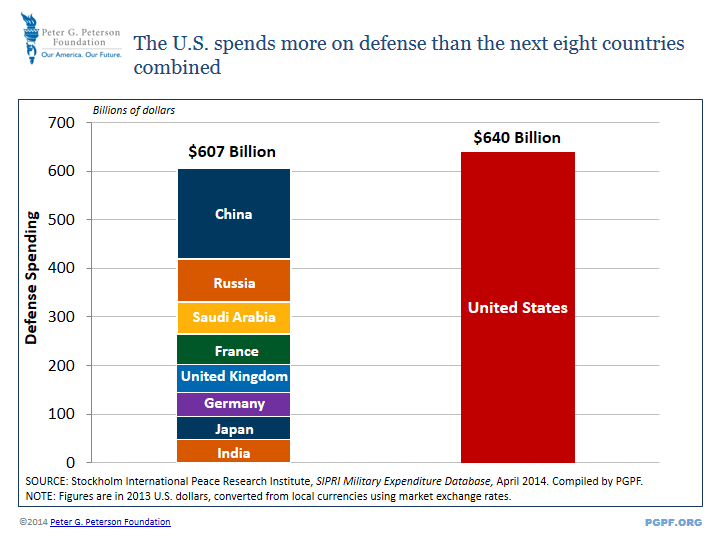
Wait, so people are paying us to do that? Hot damn. Here I thought we were just spending ~$700B/ year out of the goodness of our own cowboy hearts:
tussin
Well-known member
- Messages
- 4,173
- Reaction score
- 2,041
The Budapest Memorandum (my first post in the thread) explains why people are looking at the US. That and the fact our interventionist policy over the last 30+ years as the world's police force for hire.
Of course I know why there is talk of what the U.S. actions will be. I guess I meant to give a more rhetorical: WHY?!?!
C
Cackalacky
Guest
Agreed Whiskey I almost forget how hardline nationalist Soviets behaved. It's no surprise some stances Putin has taken. I'm not saying I would invade a country over it, but I understand.Putin's a Russian nationalist, and can be relied upon to act in the best interests of his country. I've not seen him say or do anything that would lead me to believe otherwise. No, he's not a good guy, but Russia's not the sort of country one would expect to find being lead by the Western conception of a "good guy" either. And anytime I read an account of someone trying to paint him as a cartoon villain, they're usually either: (1) incredibly naive regarding international relations; or (2) they're selling an ideological agenda of their own.
Really? That seems a little grandiose. I'd suggest that Putin weighed the Crimea's strategic value to Russia versus the political and economic costs of annexing it, and decided it was worth the risk. Can't say I disagree with him either.
Also Crimea's strategic location and value have been fought over for years. Britain lost it once before during the Crimean War.
C
Cackalacky
Guest
Of course I know why there is talk of what the U.S. actions will be. I guess I meant to give a more rhetorical: WHY?!?!
Agree. Lol.

chicago51
Well-known member
- Messages
- 3,658
- Reaction score
- 387
I think both of our depictions of Russia are a bit hyperbolic and the answer is somewhere in the middle. If you say the US is the definition of a super power, I suppose literally every other country in the world would be at best second-rate. That being said, my points remain:
1. Still think this is a EU mess. As it currently stands, the US should not get involved beyond potential trade sanctions.
2. Russia's actions are not unlike many taken by the US, except in this case it is in regards to a directly bordering nation.
Great points.
The EU is going up in flames. The EU and China's supply and housing bubbles are probably going to cause a world wide economic crash as one countries economic problems now affect everyone because of globalization.
Germany who does have a great economy is forcing more and more EU countries into indebted slavery forcing extreme measures upon countries like Greece, and Spain them in exchange for saving bailing them out. When European countries lost the ability to print their own currencies it forced extreme interest rates on debt. The EU is going down.
The second point is great also. The US basically told the UN to f-off on Iraq. We have not lead by example by any means.
chicago51
Well-known member
- Messages
- 3,658
- Reaction score
- 387
Wait, so people are paying us to do that? Hot damn. Here I thought we were just spending ~$700B/ year out of the goodness of our own cowboy hearts:
You don't know the arrangement. Our military defends the interests of other nations. In turn they screw us over on with their trade policies toward the US.

IrishinTN
Well-known member
- Messages
- 1,899
- Reaction score
- 358
I think both of our depictions of Russia are a bit hyperbolic and the answer is somewhere in the middle. If you say the US is the definition of a super power, I suppose literally every other country in the world would be at best second-rate. That being said, my points remain:
1. Still think this is a EU mess. As it currently stands, the US should not get involved beyond potential trade sanctions.
2. Russia's actions are not unlike many taken by the US, except in this case it is in regards to a directly bordering nation.
More than we know, but Putin knows. Still has the best intelligence operatives in Europe (except for any Mossad). Perfect time for him to take it.
Edit:first read this to say "EU is a mess" which is also true...
- Messages
- 20,896
- Reaction score
- 8,139
You don't know the arrangement. Our military defends the interests of other nations. In turn they screw us over on with their trade policies toward the US.
So we're into S&M? Kinky, but makes a sad sort of sense.
C
Cackalacky
Guest
Germany who does have a great economy is forcing more and more EU countries into indebted slavery forcing extreme measures upon countries like Greece, and Spain them in exchange for saving bailing them out. When European countries lost the ability to print their own currencies it forced extreme interest rates on debt. The EU is going down..
all this time Germany has been waiting to inflict retribution for WWI and WWII reparations.
IrishinTN
Well-known member
- Messages
- 1,899
- Reaction score
- 358
So we're into S&M? Kinky, but makes a sad sort of sense.
More like just M&M, and I don't mean the candy...

Irish Houstonian
New member
- Messages
- 2,722
- Reaction score
- 301
...Really? That seems a little grandiose...
No, phillyirish is more right than he is wrong on this one.
Eurasian Union - Wikipedia, the free encyclopedia
chicago51
Well-known member
- Messages
- 3,658
- Reaction score
- 387
all this time Germany has been waiting to infliction retribution for WWI and WWII reparations.
Actually in a book I just finish reading the Crash of 2016. The section is titled: Germany Finally Wins WWII.
The book is mostly about how crashes, great wars, and revolutions occur roughly 70-80 years and if a revolution is not successful then another crash is bound to occur and be even worse.
Ironically he had a big crash nearly 80 years after the Great Depression. Is a great war coming? I doubt it as I think nukes scare everyone off even the cycle of crashes, wars, and revolutions says yes.
Last edited:
- Messages
- 20,896
- Reaction score
- 8,139
No, phillyirish is more right than he is wrong on this one.
Eurasian Union - Wikipedia, the free encyclopedia
I'm well aware of it. I just don't think it represents a serious threat to the ideological, economic, and military hegemony of the West.
chicago51
Well-known member
- Messages
- 3,658
- Reaction score
- 387
I really don't consider Russia that much of a world power. With Ukraine slipping away they have little influence outside of central Asia.
Yes they do have great economic potential, and vasts arrays of resources; but positively exploiting those resources is an entirely different thing. Just look at the Democratic Republic of Congo, the most resource rich nation in the world. Sitting on top of 30 trillion dollars worth or mineral, and they aren't exactly an economic powerhouse.
You are correct resources alone don't make an economy.
Interesting fact:
Post WWII through the 1970s the US was actually the leading importer of raw materials and the leading exporter in manufactured goods.
Today it is the exact opposite and the US is the leading exporter in raw materials and the leading importer of manufactured goods.
I think most people regardless of their place on the political spectrum would agree the economy is worse today than say 1970. I think manufacturing is a better indicator of economic strength than natural resources.
This is not to say natural resources practically energy resources are not valuable but that alone doesn't make or break a nation's economy.
I'm not sure what kind of manufacturing base Russia has.
C
Cackalacky
Guest
Wait, so people are paying us to do that? Hot damn. Here I thought we were just spending ~$700B/ year out of the goodness of our own cowboy hearts:
Haha. I did not mean to infer that we were being paid for it, merely expected to for the sake of our global shareholders. You got a ROI for our global military services?


rikkitikki08
Well-known member
- Messages
- 4,329
- Reaction score
- 3,242
The only way the U.S. should be involved is if it some how gets to a Genocide type level of invasion ( which i highly doubt it does). I'm all for America defending itself but at what point do we say enough is enough and allow other countries to fix its own problems?
PerthDomer
Well-known member
- Messages
- 1,326
- Reaction score
- 483
The real issue here is if we let Russia do this, what are we saying to the rest of the world? Would we intervene in the Baltic Republics? Poland? Would we help the Philippines/Taiwan/Japan/SE Asia if China sends in armies? Is America actually credible in keeping the peace?
Short term I think you have to let Crimea go. It probably stabilizes the Ukraine politically as pro western (you remove the core pro western faction). It makes Russia feel safe owning the ports. It removes the dying rust belt from the Ukraine and probably makes reform easier. If Russia pushes further we and the EU have to intervene. If not we lose credibility and Russia/China will see the door as open for further aggression in their local spheres.
Long term Russia is losing population, and the economy is entirely dependent on commodities. Fluctuations in the world market threaten to destabilize the Putin regime.
Short term I think you have to let Crimea go. It probably stabilizes the Ukraine politically as pro western (you remove the core pro western faction). It makes Russia feel safe owning the ports. It removes the dying rust belt from the Ukraine and probably makes reform easier. If Russia pushes further we and the EU have to intervene. If not we lose credibility and Russia/China will see the door as open for further aggression in their local spheres.
Long term Russia is losing population, and the economy is entirely dependent on commodities. Fluctuations in the world market threaten to destabilize the Putin regime.

dshans
They call me The Dribbler
- Messages
- 9,624
- Reaction score
- 1,182
Right, except Putin JUST DID.
As did Dubya ...
chicago51
Well-known member
- Messages
- 3,658
- Reaction score
- 387
The real issue here is if we let Russia do this, what are we saying to the rest of the world? Would we intervene in the Baltic Republics? Poland? Would we help the Philippines/Taiwan/Japan/SE Asia if China sends in armies? Is America actually credible in keeping the peace?
Short term I think you have to let Crimea go. It probably stabilizes the Ukraine politically as pro western (you remove the core pro western faction). It makes Russia feel safe owning the ports. It removes the dying rust belt from the Ukraine and probably makes reform easier. If Russia pushes further we and the EU have to intervene. If not we lose credibility and Russia/China will see the door as open for further aggression in their local spheres.
Long term Russia is losing population, and the economy is entirely dependent on commodities. Fluctuations in the world market threaten to destabilize the Putin regime.
Interesting you brought up China as we do have this dispute going on right now concerning who has rights to the waters of the South China Sea rather it be China or Japan (US by our association to Japan).
kmoose
Banned
- Messages
- 10,298
- Reaction score
- 1,181
As did Dubya ...
Dubya had not one, but two UN Resolutions backing him, though.
Regardless of what we ended up finding, in terms of WMDs, there were UN Resolutions calling for Saddam to get rid of the WMDs, and allow unfettered inspections to prove as much, or be removed from power.
- Messages
- 20,896
- Reaction score
- 8,139
The real issue here is if we let Russia do this, what are we saying to the rest of the world? Would we intervene in the Baltic Republics? Poland? Would we help the Philippines/Taiwan/Japan/SE Asia if China sends in armies? Is America actually credible in keeping the peace?
Concerns about "credibility" are mostly hawkish bullshit. That's simply not how nations go about making decisions.
If Russia pushes further we and the EU have to intervene. If not we lose credibility and Russia/China will see the door as open for further aggression in their local spheres.
Again, we haven't seen that sort of naked aggression for quite a while. If Putin starts acting like an imperialist, then we may need to get serious about containment. But up to this point he's been a very predictable Russian nationalist, and a predictable Russian nationalist is one that we can work with.
Long term Russia is losing population, and the economy is entirely dependent on commodities. Fluctuations in the world market threaten to destabilize the Putin regime.
My impression is the Powers That Be in Russia are largely insulated from that kind of thing (much like the wealthy here in America!) If the Russian economy takes a hit, it'll be Vlad the Plummer who suffers, not Vlad the Plutocrat. And few people can endure prolonged suffering like the Russians.
Last edited:
chicago51
Well-known member
- Messages
- 3,658
- Reaction score
- 387
Concerns about "credibility" are mostly hawkish bullshit. That's simply not how nations go about making decisions.
Again, we haven't seen that sort of naked aggression for quite a while. If Putin starts acting like an imperialist, then we may need to get serious about containment. But up to this point he's been a very predictable Russian nationalist, and a predictable Russian nationalist is one that we can work with.
My impression is the Powers That Be in Russia are largely insulated from that kind of thing (much like the wealthy here in America!) If the Russian economy takes a hit, it'll be Vlad the Plummer who suffers, not Vlad the President. And few people can endure prolonged suffering like the Russians.
Lol at "hawkish bullshit"
This whole post is awesome stuff.
PerthDomer
Well-known member
- Messages
- 1,326
- Reaction score
- 483
Churchill was full of hawkish bullshit to be sure... The issue for Putin/the autocrats if oil/NG crash is that the Russian people have a history of revolting. I'm sure they'll be fine immediately, but the social contract as it stands is predicated on growing international power and the people getting stuff. People stop getting stuff and they get pissed off.
dshans
They call me The Dribbler
- Messages
- 9,624
- Reaction score
- 1,182
Dubya had not one, but two UN Resolutions backing him, though.
Regardless of what we ended up finding, in terms of WMDs, there were UN Resolutions calling for Saddam to get rid of the WMDs, and allow unfettered inspections to prove as much, or be removed from power.
I should have included more to provide context (if I knew how to quote multiple posts, I would):
Quote:
Originally Posted by Secretary Kerry
You just don't in the 21st century behave in 19th century fashion by invading another country on completely trumped up pre-text.
The point being, UN support or not, the rationale was a trumped up smoke screen to maneuver and manipulate. All so that George W. Bush could scratch his itchy trigger finger, strut around an aircraft carrier and secure his place in history as a tough and heroic figure.