zelezo vlk
Well-known member
- Messages
- 18,598
- Reaction score
- 5,745
Many are jokes, but have a hint of truth to them


Many are jokes, but have a hint of truth to them

It really depends on how you define "God." I tend to believe that the God described in the Old Testament and New Testament are different. To be more accurate, while also speaking in generalities, I believe that the Old Testament is more of a historical document with supernatural hyperbole and takes place in the MENA (Middle East and North Africa) region of the world. Having said that, I very much believe that there is something beyond the physical universe that we (or any other intelligent being within our universe) understands. If that constitutes "God," then, yes, there is absolutely a God. Moreover, I think polytheism is inaccurate because I subscribe to the idea that there's a starting point to everything, and that starting point is what I, personally, would consider God. The starting point is a singularity.Question #1- Is there a God? (A question of origin)
If we remove the supernatural and focus merely on historical events, then, yes, I would argue that the Old Testament references historical events (and even myths, which I believe can be considered historic, as they document the zeitgeist of the time) relevant to the MENA region. As for the New Testament, I believe the same could be said, and I also believe that the New Testament is an amalgamation of European pagan myths. Even typing that, I know I sound like a heretic, but I really do not mean that as an insult. Again, the zeitgeist of a period of time is absolutely a piece of history and should be preserved.Question #2- Is the Bible reliable? (That is historically)
This is something that really irritates me. I cannot stand when people contend that the "Jesus" character is purely fiction. Historians, outside of biblical texts, make references to Jesus. I don't think there's a legitimate debate regarding Jesus existing. The treatment of the Jesus character also fits with how the Romans would have punished a figure like him. I'm of the opinion that Jesus not only existed, but many of the stories about him are true. I also believe that Thomas Jefferson was onto something when he created the Jefferson Bible, which was essentially a cut and paste of the teachings of Jesus but deleted any supernatural references and events.Question #3- Who is Jesus? (Real person? Fairy tale?)
I'm aware this post is old, but hey, someone might find this interesting1. I suscribe to the big bang theory while maintaining that the odds were extremely great
Something gave it the best possible chance of succeding then sat back and let nature take
Sefer HaTemunah (Hebrew: ספר התמונה) (lit. "Book of the Figure", i.e. shape of the Hebrew letters) is a 13–14th century kabbalistic text. It is quoted in many Halakhic sources.
Sefer HaTemunah was probably written anonymously in the 13th or 14th century, but it is pseudepigraphly attributed to Nehunya ben HaKanah and Rabbi Ishmael, tannaim of the 1st and 2nd centuries.[1][2] According to Hebrew Manuscripts in the Vatican Library Catalog, the work was composed in the 1270s. The first extant edition was published in the city of Korets in Poland in 1784.[3] Aegidius of Viterbo, a 15th-century cardinal, was influenced by Sefer HaTemunah, as can be seen in his writings Shekhinah and On the Hebrew Letters.
According to Kaplan[8] the Sabbatical cycles in Sefer HaTemunah can be used as a basis for calculating the age of the universe. While Sefer HaTemunah sees the world as existing in the second cycle, others[9] say it is in the seventh cycle.[1] If so, Adam was created when the universe was 42,000 years old, and six worlds were created and destroyed before the creation of Adam.[1] This thesis was laid out by Rabbi Isaac ben Samuel of Acre, a 13th-century Kabbalist, who said that when calculating the age of the universe, one must use divine years rather than physical years.
"I, the insignificant Yitzchak of Akko, have seen fit to write a great mystery that should be kept very well hidden. One of God's days is a thousand years, as it says, "For a thousand years are in Your eyes as a fleeting yesterday." Since one of our years is 365 ¼ days, a year on High is 365,250 our years.[10]"
Rabbi Yitzchak of Akko then goes on to explain a value of 49,000 years, but does not proceed with the multiplication, nor the reduction of 49,000 to 42,000, which is Kaplan's own interpretation. Kaplan calculates the age of the universe to be 15,340,500,000 years old.[1][11] His reasoning was as follows: as the Midrash states, "A thousand years in your sight are but as yesterday" (Psalm 90:4); a physical year contains 365 ¼ days, which, if multiplied by 1000 would give the length of a divine year as 365,250 physical years; if we are living in the last, 7th Sabbatical cycle, that would mean that the creation as it described in the Bible happened 42,000 divine years ago; to convert this figure to physical years it should be multiplied by 365,250; this gives the result 15,340,500,000 years.[1]
In 1993, Rabbi Aryeh Kaplan wrote that the Big Bang occurred "approximately 15 billion years ago", calling this "the same conclusion" as the 13th century kabbalists.[1] According to a 2015 estimate by ESA's Planck project, the age of the universe is 13.799 ± 0.021 billion years.[12] Kaplan also relates to Sefer HaTemunah the idea that Torah teachings are compatible with other areas of modern science. According to Kaplan, Orthodox Jews often challenge the findings of paleontology and geology as conflicting with Torah concepts. But in an "extremely controversial" essay, Israel Lipschitz drew on the writings of Abraham ibn Ezra, Nahmanides, and Bahya ibn Paquda to argue the opposite conclusion: "See how the teachings of our Torah have been vindicated by modern discoveries." Lipschitz wrote that fossils of mammoths and dinosaurs represent previous Sabbatical cycles in which humans and other beings lived in universes before Adam, and that the Himalayas were formed in a great upheaval, one of the upheavals mentioned in Sefer HaTemunah.[1]
Looking at the Crusades and Inquisition from strictly a historical point of view, do you believe that the powers that be were acting more as a vassal for government or the supernatural? Personally, I think it was more for government, and that it's part of a human power struggle. The Islamic Conquests were, obviously, part of this historic human power struggle. I love free will.Right, nicely put. People get sidetracked by historical events like the atrocities of the Crusades or the Inquisition


Ross Douthat and Adrian Vermeule are beefing on Twitter. Whiskey must be beside himself.
A fad or heresy is the exaltation of something which even if true, is secondary or temporary in its nature against those things which are essential and eternal, those things which always prove themselves true in the long run. In short, it is the setting up of the mood against the mind.
— G. K. Chesterton
A little over a decade ago, I did a bit of journalism on what was then called the “new atheism.” I went to a conference for atheists held in a hotel in Virginia. I still think I produced a fine-enough piece of work, but I do feel a bit guilty about it. People go to conferences like these to put their guard down and get their dander up. For an aspiring magazine writer, such conferences are like setting up a minefield underneath a stampede. The carnage is incredible and inevitable. I regret that I was unsporting to a few civilians. But I tried to lightly make a point.
What worried me then was that Richard Dawkins and Christopher Hitchens seemed to be developing an argument that the practice of religion, and the teaching of it, amounted to child abuse. Dawkins would later dare to say that sexually abusing children wasn’t so wicked as teaching them to believe in God. This argument against religious education should, I think, have been discredited by its application under Communism. Alas, the argument seemed to be growing then. European courts were considering bans on circumcision. A I wanted to get underneath this argument and expose it, I wrote:
The question of children preoccupies Richard Dawkins. Using a PowerPoint presentation, the Oxford don displays a photo that appeared around Christmas of three children. The caption designates them “a Christian,” “a Jew,” and “a Muslim.” He changes the labels to “a monetarist,” “a Keynesian,” and “a Marxist” in order to demonstrate that classifying children according to religion is some kind of abuse. Reductively, Dawkins believes religion to be a mere set of mental propositions, not a way of life that can begin sacramentally soon after birth. Until Hayekians perform rituals on children, it’s safe to call this reasoning tendentious.
I was gratified this week to see someone much more capable than I am taking up the same argument. John Gray, the British controversialist, has recently released Seven Types of Atheism. Spoiler alert: Gray is something like an atheist who despises five of the types he describes.
Gray is one of my favorite writers working today, precisely because he does reject the secondhand religious cant that so often trades under the names of secularism or progressivism. Most important, he thinks the idea of the moral progress of mankind to be an absurd myth, though it is a myth that is powerfully important to the political class in most Western nations. He has a more traditional, cyclical view of history and politics. Almost as soon as one social evil is vanquished, it begins to make its return under a new name.
Before taking on the really impressive names in the historical roll call of atheism, Gray first dispenses with new atheists like Sam Harris and Richard Dawkins. These men are merely recapitulating the debate launched by 19th-century Victorians against belief, one that Gray finds insipid, boring. They both, according to Gray, mistakenly reduce the phenomenon of religion to creedal commitments that are more specific to monotheism, and mistake these in turn for primitive scientific hypotheses. “The idea that religion consists of a bunch of discredited theories is itself a discredited theory — a relic of the nineteenth-century philosophy of Positivism,” he writes of Harris’s naïve faith that science can produce a morality consistent with the moral commitments of liberalism. Harris is neatly ridiculed as not only ignorant about philosophy but unfamiliar with atheism itself, which has just as often despised Christianity for giving birth to liberal values.
Gray’s typical line of attack on the types of atheism and the atheists he dislikes is to show how they, unaware, continue to think in the same ways as Christians, smuggling into their own worldview ideas that cannot be justified given their premises. Some will reject the idea that history has an author, but they give history a coherent story and even a moral purpose. They reject a theological mystery, only to replicate the same problem in their account of nature. Christianity cannot solve the problem of evil to their satisfaction, but then atheism has trouble explaining the persistence and resilience of religion. At least Augustus Comte accepted the persistent human impulses and desires that religion points to, and tried to design a religion for atheism, complete with a pontiff in Paris.
Nietzche seems to agree with Christians that loss of Christian faith will be demoralizing, and instead of the Second Coming, he looks for deliverance from the Übermenschen. Followers of Mill await for the emergence of truly free “autonomous individuals.” Political atheists await the coming of new communist man. Like Christians, they are still waiting for the redeeming figure at the end of history.
Very few of Gray’s disliked atheists come out better after his treatment. Though I have to give points to one for prescience: “It was Saint-Simon who first presented the religion of humanity in systematic form. In future, scientists would replace priests as the spiritual leaders of society. Government would be an easy matter of ‘the administration of things’. Religion would become the self-worship of humankind.” Prophetical.
Here’s a long quotation for some flavor:
Atheists attack Christian values because they are changeable and often contradictory. In incessant mawkish debates, they insist that unbelievers can be highly moral people. It does not occur to them to ask which morality an atheist should follow. Like Robinson’s Christians, they are confident that everyone knows what atheist values must be.
In this as in so much else, they are mistaken. Karl Marx and the Russian anarchist Mikhail Bakunin rejected theism because it was an obstacle to human solidarity, the German egoist Max Stirner because it restricted individual self-assertion and Friedrich Nietzsche because it promoted ‘slave virtues’ like humility. Some eighteenth-century French atheists—such as the physician Julien Offray de La Mettrie, whose materialist philosophy is discussed in Chapter 5, where I consider the thought of the Marquis de Sade — recommended the enjoyment of sensual pleasures. Most English atheists at the time and later were horrified by any defence of sensuality. The mid-Victorian philosopher John Stuart Mill looked forward to a time when Christianity would be replaced by something like Comte’s religion of humanity. But Mill shared with the Christians of his time the conviction that life should be devoted to mental and moral self-improvement rather than to enjoyment of physical pleasures. There have been many atheist moralities.
With few exceptions, twenty-first-century atheists are unthinking liberals.
A ghost comes back to me from that atheist conference of over a decade ago. Christopher Hitchens was there, having recently released his book god is Not Great. I admired and disliked him almost equally. I took something like a perverse pleasure in seeing what I believed as his errors of moral and political judgment leading him into the support of the misbegotten Iraq War. But I knew he could be fantastically kind to young writers. And so I got in line to have him sign a copy of his book for me. I tried a move I thought would work on him; I slipped him my card. Officially it was to help him inscribe my book — but it let him know that I was another scribbler at small political magazines just as he had been. The intended impression worked, and he kindly invited me to look up his number in the phone book. I remember being impressed that he was in the phone book, and recalled instantly that a beloved high-school English teacher of mine showed my class that Nat Hentoff was also reachable this way. I think my teacher was trying to prove what you could find by paying close attention to even the most mundane texts. But I was the only student who cared about who Nat Hentoff was. I was too much a coward to take Hitchens up on the invitation. And I still regret it. He surely had entertained many people more slow-witted than I was.
Hitchens isn’t even mentioned in Gray’s book. I can’t decide whether that is a slight on Hitchens or a mercy from Gray. But, Hitchens’s type of atheist, the God-hater, is represented in the figures of the Marquis de Sade and William Empson.
Like Sade, Hitchens in protesting that he hated God come across far more credibly than did his attestations of disbelieving in Him. Like Empson, he claims to find the entire Christian economy of salvation totalitarian. Hitchens’s mostly rhetorical attack on God really has the force of drama only because it is a reenactment of Satan’s rebellion, Non serviam. The frisson is in his implicit promise to carry on the argument even if the Almighty himself turns up at the opposing lectern. This was entertaining as performance, but occasionally ugly in effect. Hitchens would allow his atheism to make him cheer the murderous despoliation of the Russian Orthodox Church. He clearly could reconcile with totalitarianism, when it attacked what he hated.
Hitchens’s main argument that religion poisons everything was his assertion that only religion can make good people do evil things. That is, a person who normally acts with kindness can be cowed by divine authority to do what he would otherwise never do to others: torture, rape, murder, you name it. And indeed, you don’t have to go far back in the news archives to find some previously harmless boys throughout Europe who gave themselves over to jihad after a brief religious awakening they experienced in the course of torturing, raping, and murdering in Syria and Iraq.
Hitchens’s attempt to escape the obvious rejoinder to his argument — that political and social creeds inspire to do just that — is lame. He just reclassifies any political murders he finds too fanatical as religious ones. In fact, in this rhetorical sleight of hand, he does precisely the thing he claims to find so repugnant about Christianity: He creates a scapegoat on which to load all the sins in the world.
I played at atheism as a teenager. Like so many of Gray’s atheists, I had as my stated unbelief nothing else but a tribute to religion expressed in a rebellious mood. I had in mind very specific moral prohibitions that I wanted to eject from my life. With generous help from the culture, I constructed in my head a hateful image of what religious people were, wallowed in the prejudice, and determined not to be like that. But I noticed the way my reasoning ran after my heart. I wouldn’t just desire some pleasure or ambition in life, conclude that there was no divine prohibition against it, and then proceed on the basis of desire alone. I would invent a reason to believe that the thing I wanted was good in itself. Healthy, sociable, politically hygienic. Whatever. Realizing how much mental work was going into the permission-slip part was enough to get me doubting my doubts. Why must I approve of my own desires? Why do I feel shame at fulfilling the ones I do not altogether approve?
Gray’s book is quite good fun. It’s sprightly, erudite. Gray doesn’t quite outline why in turn Christianity’s morality, its eschatological visions, or its views on Providence are so resistant to the atheist’s attempt to reject the religion in which they make sense and are defined. That there is such persistence has always made me slightly less alarmed than some of my peers and friends about an emerging “post-Christian” West. Like Don Quixote, I stubbornly refuse to notice that Christendom has ceased to exist. It hasn’t. The sacraments work ex opere operato. Our civilization has the mark of baptism because so many people in it are baptized. This mark on our civilization becomes all the more obvious in “unbelieving” Europe as Islam comes more and more into contact and collision with the laws and customs of societies that were tutored at the feet of the Church. I take it that our atheists are mostly not unbelievers, they are almost incapable of thorough unbelief. They are merely heretics. Even Gray himself, who tries hard to be a real atheist, has done something Christian and, I would say, charitable, for his fellow atheists, by running them through a compassionate but tough Inquisition.
"I noticed the way my reasoning ran after my heart. I wouldn’t just desire some pleasure or ambition in life, conclude that there was no divine prohibition against it, and then proceed on the basis of desire alone. I would invent a reason to believe that the thing I wanted was good in itself. Healthy, sociable, politically hygienic. Whatever. Realizing how much mental work was going into the permission-slip part was enough to get me doubting my doubts. Why must I approve of my own desires? Why do I feel shame at fulfilling the ones I do not altogether approve?"


Over recent decades, some Church leaders have become ever more reticent in standing up for Catholic teaching, especially when it comes to morality.
Rarely do these prelates defend the unborn from the pulpit, condemn the intrinsic evil of artificial contraception, or speak out against same-sex “marriage” — topics guaranteed to bring them into conflict with the modern world.
This can be seen at the current Youth Synod in Rome where the Church’s moral teaching was hardly mentioned, except in the sense of avoiding moralism.
Instead, attention is generally drawn to safe moral social justice issues such as combating poverty, migration, climate change, and promoting the UN’s Sustainable Development Goals.
According to Professor Thomas Pink, a philosophy lecturer at King’s College London, this is due to a failure of the contemporary Catholic Church to recognize inevitable spiritual conflict when dealing with a largely non-baptized, secular world.
Pink believes that although Church dialogue with the fallen world is obligatory, “you shouldn’t expect to live at peace” with it “unless and until it is converted.”
This truth has been largely forgotten by Church leaders, he argues, which has inevitably led to the Church teaching’s becoming “increasingly embarrassing” to many bishops and senior clergy, consequently leading to changes in “official theology” that are inconsistent with or even contradict magisterial teaching.
In this recent interview with the Register in Rome, Professor Pink explains how and why this situation came about, and what can be done to recover “a realistic expectation of conflict, without being disturbed by it.”
Professor Pink, let’s start with your view of dialogue with the non-baptized: what is your main thesis in this regard, and why is it of concern to you that the Church is trying to dialogue with the non-baptized?
There’s nothing wrong with dialogue and indeed it’s an inevitable part of human life; that you constantly try and find areas of agreement to enable you to cooperate where cooperation is required for normal human life to go on. No one wants conflict, and certainly not for its own sake. But dialogue isn’t always possible without some degree of conflict where fundamental values are at stake. Conflict, of course, needn’t be violent. It can be spiritual. A very, very important aspect of Christian faith is that we are in a state of spiritual conflict, not with other human beings as human beings, with whom we are to be in a relationship of love. We are in a spiritual conflict with the fallen side of human nature, in our own selves as well as other people. Behind that, of course, is an absolutely uncompromising spiritual conflict with the Devil.
How does this relate to the present situation in the Church?
One of the problems about the present state of the Church — and I think it’s deeply involved in the current crisis around [Pope Francis' post-synodal apostolic exhortation on the family] Amoris Laetitia — is that the Church has become afraid of admitting the necessity for spiritual conflict, particularly in the public sphere. This goes back to the last council, the Second Vatican Council. I’m not going to suggest in any way that there’s anything problematic in the strict magisterial teaching of the Second Vatican Council. I’m not claiming that there is, and I’ve spent a lot of time investigating one particular declaration: Dignitatis Humanae, the declaration on religious liberty, which a lot of people on the traditionalist side of the Church have claimed is in conflict with past magisterial Church teaching.
Dignitatis Humanae does not address the authority of the Church, or what the state might do when acting as an agent of the Church, so there’s no clash with previous magisterial teaching.
The problem is not with Vatican II’s magisterial teaching, but with an underlying official theology.
What do you mean by official theology?
The Church may issue magisterial teaching, which invokes the Church’s authority and an obligation on the faithful to believe on the basis of that authority. But the Church at an official level may also make statements that though official are not themselves magisterial teaching. They are statements that are official – made by officeholders in their public role – but they simply explain what the magisterial teaching means, or what the Church’s policies and practices are, without those statements of themselves imposing any obligation on our part to believe them.
Is this a modern distinction?
Official theology is nothing new, it’s always existed in the Church, and indeed it has got to exist. The Church has got to be able to explain herself at an official level without having to turn every such explanation into fixed magisterial teaching.
Official theology often changes over time, and not in a constant direction. The to-ing and fro-ing over unbaptised children [the doctrine on limbo] shows that the official theology of one time can contradict the official theology of another time. And if past official theology of the Church can be mistaken, so too can modern official theology.
You can even get modern official theology that contradicts historic magisterial teaching. If this happens, we definitely do have a problem — and then it is the historic magisterial teaching we have to believe, not the more modern official theology.
So would you say that those supporting a radical interpretation of Amoris Laetitia are right in a sense because doctrine evolves?
If you’re talking about doctrinal development, you’re talking about magisterial teaching — doctrine proper, not mere official theology. And magisterial teaching does not develop by denying earlier magisterial teaching — that would be doctrinal self-contradiction, not development.
Amoris Laetitia seems to have been written to avoid clear and unambiguous contradiction of earlier magisterial teaching. But it has come with a lot of official theology, often from the highest level in the Church, that claims to explain the content of Amoris Laetitia — and that explains it in a way that clearly does contradict previous magisterial teaching. That’s very problematic. It looks as though we do have to reject that explanatory official theology as erroneous.
How can the problem of error in official theology be resolved?
Well I think you’ve got to go back to look at the roots of the official theology. You’re not going to solve this by hopping up and down and saying the Pope’s a heretic, because that’s not going to change any minds. What you’ve got to do is to go back and look at what might have caused the situation, and that involves looking at how the official theology works and what its roots are. And then, since we are not under any direct obligation to believe it, actually criticize that official theology intellectually to see whether it makes sense in its own terms and whether it works.
To understand how the present crisis over Amoris Laetitia has arisen, I think we’ve got to go back to the Second Vatican Council and look at something like Dignitatis Humanae and examine not simply its strict magisterial teaching, but the official theology behind it. That is where the roots of the present crisis lie — not just in the current pontificate, but in that official theology underlying the last Council.
Fundamental is a general vision — that the Church can live at peace with an unconverted world. Jacques Maritain was a very influential philosopher and theologian who helped inspire Dignitatis Humanae, and he applied this vision to the political. The Church, he thought, can live at peace and harmony with a state that is religiously neutral and so unconverted.
I think that’s false. The 19th century popes were very clear on this. They say the state must be Christian, and indeed Catholic. The state must unite with the Church in a single Christian community, enjoying the life of grace at the political level, and not just the level of the private life of citizens — otherwise Church and state will be in deep conflict.
Why is that?
Well, we live in a fallen world. … The Fall has not only denied us heaven, it has also denied us the fullness of nature. The Fall has denied us the ability to lead a fully natural human life, even on this earth, because it has disturbed our reason. … It’s damaged our ability to understand and live according to the natural law, which is the law of reason governing human nature.
Which is why, in a fallen world, while people don’t completely lose morality and the natural law, they very often misunderstand particular applications of it. So they get funny ideas about how gladiatorial shows are fine or about how it’s all right to expose infants at death, to look at the pagan world, or in our world now, about how you can marry someone of the same sex. Or, about how it is all right, or even obligatory, to put people out of their misery through euthanasia.
So what grace does is two things. It elevates us to take us to heaven. It elevates us above what human nature is naturally capable of. But it also heals. It repairs the damage done to human nature and enables us, amongst other things, to understand the content of the natural law, in its fullness, and live according to it, provided we actually receive grace. To receive grace, ordinarily, we need baptism, and we need to live in accordance with the teaching of the Church by receiving the sacraments, going to confession, and repenting of sins that disturb our friendship with God and lose us grace.
So what you would say then, is: dialogue is okay with the fallen world, but only if you’re bringing them to baptism, bringing them to conversion.
You can dialogue with the fallen world — indeed, you’ve got to. But you shouldn’t expect to live at peace with the fallen world — unless and until it is converted.
So yes to dialogue — but with the ultimate goal of baptism.
Well, you cannot expect spiritual peace with people without their baptism and conversion.
You need to baptize out of love for these people, as people who are not baptized may not be saved. I say ‘may not be saved’ because the Church has always left room for God to work outside the visible sacraments. … Read Pius XII in Mystici Corporis. He makes it very clear. While people may be saved outside the visible structures of the Church, until they join those visible structures through conversion they face many obstacles to salvation.
So life within the visible Church is required to repair the damage done by the Fall to take us to heaven. If people aren’t in that position, you dialogue with them, but you also try and baptize them, both for their own good and fully realizing that if they remain unconverted, you will face spiritual conflict. That doesn’t remove the relationship of love you have towards them, but it involves being ready for constant confrontation with what they believe.
Do you think that this unwillingness to confront an unconverted world is what’s weakening the Church?
I think that’s right. And I think the reason why the Church is not currently as willing spiritually to confront the unconverted world is she once was, is that current official theology thinks the Church doesn’t need to. The official theology thinks that harmony between Church and world is available without the world’s conversion. That, as I say, was deeply part of [Jacques] Maritain’s political theology. But as the case of the state shows, it’s clearly not true because, as we’ve seen, as soon as you have political secularization, you immediately get Church-state conflict involving the state abandoning important elements of the natural law. It’s happening continuously, so you get a conflict on laws concerning abortion, marriage, euthanasia, a whole range of issues on an ever-widening front, and there seems no stop to it.
If Maritain had been right, this wouldn’t have happened. Political secularization would have allowed for continued harmony between Church and an unconverted, religiously neutral state within a shared framework of allegiance to natural law. But there has been no such harmony, and natural law has been a point of division not unity. The 19th century popes were entirely accurate in what they predicted. Pius IX says in Quanta Cura that where the authority of Jesus Christ is removed from the political community, then natural justice and right will be lost.
Do we therefore need to perhaps go back to that, to that way of teaching?
Certainly, that way of teaching. You aren’t going to get a Catholic state, but at least what you will get within the Church is a realistic expectation of conflict, without being disturbed by it. Because the problem is when you get conflict, and you think you should have harmony, and you misunderstand why you’re not getting harmony, then things can go wrong.
So, the Church meets conflict with an unconverted world — just because the world is unconverted. But official theology no longer accepts the inevitability of this conflict. Official theology now thinks that harmony should still be possible even when the world isn’t converted.
That same official theology is then liable to think that since the problem cannot simply be with the world’s lack of conversion, the problem must in some way lie with the Church. Official theology will try to remove the conflict — but from the Church’s side. What official theology will especially try to do is to remove the Church’s magisterial teaching as a source of conflict.
The official theology will often deny that there has been any change in magisterial teaching. That’s because many bishops and theologians are still fairly reluctant to contradict past magisterial teaching, at least openly — though reluctance here is alas no longer universal.
The change will be presented initially not as a change in the teaching, but in its pastoral application. The aim of the change: to blunt or remove the conflict-causing differences between how Catholics are called to live and how the unconverted world wants people to live.
I'm not trying to be flippant, because I read the whole interview and found it very insightful. However, once you read "You aren’t going to get a Catholic state...," what's the point of the rest of it?
Absent a Catholic state, the end product of a Church in conflict with the secular world is mass martyrdom.
In the first part of his interview with the Register, Professor Thomas Pink explained why forgetting we live in a fallen, unconverted world of largely unbaptized people has led many Church leaders to falsely believe the Church can find harmony with the world and peacefully dialogue with it.
In this second part of the interview, the philosophy professor at King’s College London explains how this phenomenon partly has its roots in a change in the liturgy, as well as the modern belief that grace can be imparted separate from the visible structures of the Church.
He stresses this compromise with worldly values is happening not because the magisterium has changed, but because of an “official theology” that has departed from magisterial teaching in order to accommodate the world. The crisis, he believes, can only be resolved “by understanding the roots of the official theology, and then confronting it intellectually.”
To sum up what you said in the first part of this interview: what we have is a faulty premise, which is perhaps an overly optimistic view of human nature?
And of the Fall, really. I’ll say a bit more about that because it’s clearly bound up in, I’m afraid, the whole period of the Second Vatican Council.
You can see the change in the new liturgy. If you look at the historical rite of baptism in the Church, it treats the unbaptized child as quite literally living under the dominion of the devil. The traditional rite involves a series of exorcisms in which the devil is repeatedly and very explicitly called upon to leave the child, to depart. Now, I think a lot of modern Catholics find that very disturbing, and these exorcisms have unfortunately been removed from the modern rite of baptism. But Catholics should realize that that these exorcisms present dogmatic teaching. The Council of Florence dogmatically teaches that, thanks to the Fall, children are born under the dominion of the devil – and baptism is the only means of escape.
The unconverted world, the unbaptized world, is under the dominion of the prince of this world. And of course, if you do see the unconverted world in those terms, you won’t expect to live in peaceful dialogue, in harmony, with it for any length of time. Of course, you have to dialogue with parts of it, to coexist, but you’re not going to see that as a long-term strategy for conflict avoidance. Aside from the fact that you owe people to remove them from the dominion of the devil.
But can grace work through an unconverted world?
Here is another related problem: the modern idea that grace will reliably operate in a way that’s anonymous – detached from the visible structures of the Church. But the problem with that is that it appears not to be true.
Now of course, it’s always hard to tell who’s saved and who isn’t. You can’t immediately tell how elevating grace is working. But the same grace that elevates, heals, repairs the damage done to human reason by the Fall. Now this healing, this repair to nature, is very visible. You can tell when it’s not working, and it’s not working where people are falling into serious error as to the content of the natural law.
What precipitates this?
People seem to fall into increasingly serious error about natural law as they move away from a participation in the visible structures of the Church that’s truly devout and proper. A proper participation means, for example, not just taking Communion in a casual way, but actually going to Confession and reforming your life through that. As you move away from that to, shall we say, the less conforming parts of the Church where people don’t bother go to Confession but make what look like casual and potentially unworthy Communions, and then outside the Church, you see ever increasing amounts of error as to the content of the natural law.
So there is an empirical argument here against too much reliance on grace operating anonymously – on grace working independently of visible membership of the Church and properly devoted participation in the sacraments. The effect of grace we really can observe, its repair of the damage done by the Fall, seems very dependent on just that membership and participation.
Of course, once you fall for the view that grace operates quite independently of the visible structures of the Church, the visible life of the Church just becomes a sign of something that’s happening anyway and invisibly, all over the place. The Church becomes not a necessary means of salvation, but a form of salvation theatre. And that view of the Church as salvation theatre then becomes another part of the strategy for achieving harmony with the world without the world’s conversion.
So for example, you’re going to avoid seeking Jewish baptism because that involves disharmony. Why pursue something if that causes offence, if it really is theatre, dispensable to salvation itself? And you’re going to stop denying people in irregular relationships Communion because that again produces disharmony. It produces disharmony with the secular world, and even within the more misinformed parts of the Church, because you would then be applying marriage laws that people now find very disturbing.
Why anyway would you insist on the Church’s sacramental discipline when you have ceased to believe that unworthy Communions are spiritually dangerous? Because you now think salvation occurs and grace operates largely independently of the sacramental structure.
This kind of theology is damaging because it’s essentially saying that Church isn’t needed?
In a sense you are saying that the Church isn’t needed. Or if the Church is needed, she’s only needed as a sort of sign — a sign of something that’s happening anyway and invisibly.
So you arrive at the idea that you should evangelize people, not to save their souls, but simply to tell them about something that’s happening anyway. So mission becomes a sign of salvation, as opposed to a means of salvation. Which is one of the frequent ways in which mission activity is explained. It’s not actually designed to save people, it’s designed to proclaim to people that they are saved, which is quite a different thing.
There’s nothing in the documents from the Vatican II that teaches that the Church’s sacramental system is effectively a form of theatre – but official statements and policy within the modern Church increasingly treat it as if it were. And this makes the Amoris Laetitia crisis extremely predictable.
Why is that?
Magisterial teaching about marriage — Christ’s own teaching — is very uncompromising. People in the secular world find it very difficult to live such a teaching, because of course you couldn’t live it without the help of divine grace. And it tends to produce conflict with people who are not living it, and do not want to live it. And that conflict can extend to the Communion rail. If you think that denying people Communion isn’t about avoiding spiritually damaging Communions, but you see your policy in relation to Communion as more dictated by avoiding disharmony, then of course you’re going to start handing out the sweeties.
You can see this official theology affecting the new liturgy. According to magisterial teaching, if you take Communion in a state of mortal sin, that only adds to your damnation. Unworthy Communions are spiritual death. It’s in Lauda Sion, the Corpus Christi sequence. Now Lauda Sion is still an option in the new rite, but you’ll generally only hear it in its complete form in most places if you go to an old rite Mass I’m afraid. In the new rite people are typically denied the sequence altogether, or at least the verses that teach that unworthy Communions are death to the sinner, only life to someone in a state of grace. Just as in the new rite they are always denied precisely those verses from Corinthians on Holy Thursday and Corpus Christi that teach the same thing.
So it appears you’ve got this pushing aside of that teaching just because it’s difficult?
Official theology and policy increasingly treat the actual delivery of sacraments and sacramental discipline as if they were of no immediate significance to your salvation — as at best merely a sort of sign about something that’s happening anyway.
So, it’s not surprising that you then get Catholic clerics discussing whether to give Communion to Protestants without taking seriously the fact that Protestants do not generally go to a sacramentally valid form of confession. They may be baptized, but they’ve mostly never been to confession. Now Protestants are clearly not especially immune to the danger of mortal sin but, still, this is somehow assumed by these clerics not to matter.
These clerics don’t seem at all concerned to insist on Protestants going to confession as a condition of being offered Communion. But it never occurs that Communion without confession might put Protestants in spiritual danger. Giving Communion has become an issue of being welcoming — of being nice to people — and the priority is now avoiding spiritual conflict and disharmony.
So again, we have old magisterial teaching pushed to one side because of this policy?
Yes, it’s not so much that there is new magisterial teaching that explicitly contradicts the historic magisterial teaching about Communion. What we are dealing with is official policies and official explanations of those policies that effectively disregard that historic teaching – that often simply don’t mention it.
I suppose you could say pastoral practice has changed, so that it’s no longer consistent with the Church’s magisterial teaching , as some critics say of the application of Amoris Laetitia — that there’s now this dichotomy between pastoral practice and doctrine?
But remember that the pastoral practice is still going to be accompanied by policy statements and explanations that are official and theological and that look to the unwary as if they were magisterial teaching – even if they aren’t.
It’s a way, would you say, to circumvent magisterial teaching?
Yes. The Church’s magisterial teaching is increasingly embarrassing to many bishops and senior clergy. And of course, once this process gets going, I can see why people might get worried about apostasy on the part of the Church’s own hierarchy. For sooner or later some bishops and senior clergy stop pretending that it’s all just about changes in pastoral policy, and start openly claiming that the doctrine itself really can be changed.
Some see it as almost undeniable that the Church is drifting into apostasy because they see her going along with a world, putting forward views not backed by grace, by baptism, and so she is following a world which is not going towards salvation. Is she therefore being led astray?
Well, clearly at the level of official theology, yes. I think the reason why I avoid words like apostasy is that the Church cannot fail. The Church cannot leave the Church, which of course what apostasy is about. It’s about leaving the Church.
So as Catholics we’ve got to see the fundamental structures of the Church and magisterial authority continuing. But we can also see that there are considerable and growing departures in official theology and policy from magisterial teaching.
Which is kind of eclipsing magisterial teaching...
Yes. After all, the ordinary Catholic doesn’t read encyclicals, or the decrees of past councils. The ordinary Catholic simply hears what the parish priest says, what that priest has been taught to say at seminary or what he or his fellow-clergy now think he ought to say … . All that is a matter of official theology, not magisterial teaching itself. The problem now is that so much of the official theology omits magisterial teaching, or even contradicts it.
So this is a considerable crisis, but it will only be resolved by understanding the roots of the official theology, and then confronting it intellectually. I think the fundamental point to make is this: we have an official theology that no longer treats the unconverted nature of the world as living under the dominion of the devil, and so inevitably in a state of spiritual war against Christ and his Church. The Church has historically taught that in a fallen world, human nature will degrade, in a way that must inevitably lead to spiritual conflict with the Church. And that historical teaching appears all too true – but modern official theology will not admit the inevitability of the conflict or its roots in the Fall.
And that’s completely opposite of what, progressives if you like, put across, the world is actually getting better, things are getting better. That’s not the case.
No, and there doesn’t appear to be some sort of invisible operation of grace in the world outside of and quite independent of the visible Church that reliably repairs the damage done by the Fall. The only really assured way of escape from the Fall to salvation is visible participation in the life of the Church according to the magisterial teaching of the Church, which is that of Christ.
In the Catholic Church old debates that might seem to have been left behind are constantly returning. Thus, the debate in the nineteenth and early twentieth centuries between “liberal” Catholics and their opponents, sometimes called “integralists,” has recently given signs of revival. One such sign is a seminar offered this semester at Harvard Law School entitled “Law and Catholic Thought: Liberalism and Integralism.” The seminar’s co-teachers can be seen as representing liberalism (Princeton University’s Professor Robert P. George) and integralism (Harvard’s own Professor Adrian Vermeule) respectively. George is certainly not a “liberal” Catholic in the sense in which that term is opposed to “conservative”—he is indeed one of the standard bearers of conservatism in the American Catholic Church. But he is a liberal as opposed to an integralist, because he thinks that political authority exists for the sake of the protection of individual rights, that one of the most important of those rights is the right of religious liberty, and that political authority should therefore not officially favor one religious confession more than others. Vermeule, on the other hand, is an integralist in the sense that he sees political authority as ordered to the common good of human life, that rendering God true worship is essential to that common good, and that political authority therefore has the duty of recognizing and promoting the true religion. Indeed, Vermeule has even contributed to thejosias.com, a website that I edit along with Joel Augustine and E. M. Milco, which is devoted to the elaboration and defense of a revived Catholic integralism.
One way of seeing the debate between Catholic liberalism and integralism is as an argument over the proper response of the Church to the secularization of the modern world. One of the most sophisticated accounts of how the modern world was secularized and what exactly is meant by secularization is that developed by the philosopher Charles Taylor in A Secular Age, and so it will be helpful to summarize the main lines of Taylor’s argument. Taylor distinguishes three main meanings that people give to secularization. The first comes out of the secularization theory of nineteenth and early twentieth century sociologists such as Max Weber and Émile Durkheim. They argued that modernization involves a differentiation of various spheres of social life and—more particularly—their separation from religion. Thus, political life was once ordered toward and by God, but now it supposedly follows its “own inherent rationality” without reference to the divine. And a similar point can be made about the economic and artistic spheres—they too are differentiated into autonomous spheres with their own internal rationality, separate from religion. This very process of differentiation of various public spheres was what Weber, Durkheim, and classical sociology primarily meant by “secularization.” On their view, this differentiation led to a banishing of religion into the private realm. And this in turn led inevitably, they argued, to a decline in religious practice and belief. Such decline is the second meaning of “secularization.” To those two meanings, Taylor adds a third, in which he is primarily interested: secularization can also mean that the conditions of belief have changed in the modern world. Whereas in pre-modern Europe it was nearly impossible not to believe in God, in the modern “West” belief in God is one among several options, and perhaps an embattled option.
Taylor disagrees with classical secularization theory on several points. First, following the work of José Casanova in Public Religions in the Modern World, he denies that differentiation of various social spheres necessarily involves a privatization of religion. Rather, he argues, religion can develop into one of several “public” spheres alongside politics, economics, culture, sports etc. But, more importantly, he disagrees that secularization in the sense of differentiation is strongly correlated with secularization in the sense of decline of belief and practice. He points to a number of examples where the differentiation on the contrary occurred simultaneously with an increase in religious practice—such as in the United States during the Second Great Awakening, or Poland in the twentieth century.
Nevertheless, Taylor does agree with his predecessors in seeing some connection between the different kinds of secularization. He argues that in fact differentiation of social spheres in the West allowed the conditions of belief to change, opening up alternatives to religious belief. And that opening up of options was a condition for the decline of religious belief and practice that did take place in some societies. So, there is an indirect connection between the first meaning of secularization (differentiation of social spheres) and second (decline religious faith and practice) mediated by the third (change in the conditions of belief). Still, Taylor thinks that the first and third kinds of secularization are irreversible, but the second (decline of religious belief) need not be. He even thinks that attempts at reversing developments of the first kind are counter-productive and actually facilitate the second.
Taylor sees attempts at reversing the differentiation of social spheres as taking two different forms, depending on how far social differentiation is to be overcome. There are two basic forms, because there are three basic constellations of social spheres. The first is what Taylor (somewhat confusingly) terms the “paleo-Durkheimian” arrangement of “baroque” Catholic states, in which the Catholic faith is supposed to form all of social life. The second constellation is a “neo-Durkheimian” one in which there is no official religion, but the political action of the citizens is informed by a broad religious consensus across various denominations—this was the case in the United States when a broad Protestant consensus informed their politics. Finally, the third constellation is when politics has become fully unhooked from religion. Taylor sees this as already holding in much of the West, and of being its inevitable future. In this final arrangement the differentiation of different social spheres leads to an “unbundling” of different areas of life within individual persons: public religious worship, private devotion, sexual ethics, works of mercy for others, and political action a no-longer linked together, but become separate. Thus, a contemporary Catholic person in Western Europe might attend church for Christmas services, baptisms, weddings, and funerals; for her private meditation she might follow a Westernized form of Buddhist practice; in her sexual ethics she might be a post-Freudian; in her charitable work she might support some secular society for aiding refugees; and in politics she might support a (traditionally anti-clerical) left-liberal party. Taylor admits that something is lost in such unbundling, but he also thinks that certain valuable freedoms are gained. As a soft-Hegelian neo-modernist, Taylor thinks that it is not our task to cry over spilled milk, but rather to make the best of what the development of human consciousness has given us.
But Catholics who wish to adhere without reservation to the teachings of the Church on faith and morals cannot fully accept such an unbundling. And here Taylor’s two forms of reaction to differentiation come in. There are those who wish to return to a neo-Durkheimian settlement of partial differentiation, and there are those who wish instead to restore something more like the paleo-Durkheimian ancien régime. Robert George and Catholic proponents of classical liberalism in general fall into the first group: they desire a restoration of a “moderate” liberal society in which a broad consensus exists among believers of various denominations and religions on the dignity of the human person, and in which political institutions are understood as being for the sake of defending that dignity and the rights that follow from it. On the other hand, Adrian Vermeule, and Catholic integralists more generally, wish to establish something more like the paleo-Durkheimian arrangement of the baroque confessional state. Or, perhaps even more radically, they wish to work towards something like High Medieval Christendom. In that arrangement, as Andrew Willard Jones has shown in his masterful book Before Church and State, it makes no sense to distinguish Church and state as separate spheres at all; rather there was one single kingdom in which spiritual and temporal authorities cooperated. Thinkers who promote such an integration do not necessarily want to emulate the Middle Ages in other respects. Vermeule, for instance, argues for further development of a robust administrative state, of a sort that St. Louis IX could never have imagined. But the crucial point is that integralists want an ordered relation of temporal and spiritual power in the deliberate pursuit of the good for human beings.
Catholic liberals argue that their view of things was accepted by the Church in the Second Vatican Council’s declaration Dignitatis Humanae, which accepted the ideal of religious liberty, arguing that it was entailed by the nature of truth itself which “cannot impose itself except by virtue of its own truth” (§1). But integralists can counter with the work of the philosopher Thomas Pink, who has argued that the traditional teaching of the Church, requiring temporal powers to recognize and promote the true Faith is irreformable, and that (properly understood) Dignitatis Humanae did not deny that teaching. Moreover, we integralists argue that the nature of human action demands integralism. All political agents, whether they admit it or not, imply some definite conception of the good for man in their action. As Leo Strauss used to tell his students, all political action is concerned with change or preservation. When it is concerned with change it is concerned with change for the better. When it is concerned with preservation it is concerned with preventing change for the worse. But the concepts of better and worse imply a concept of the good. Therefore, all political action is concerned with the good. The Weberian account of separate spheres of social activity, each acting according to its own inherent rationality, conceals more than it reveals of modern social life. There is not and cannot be a neutral “political rationality” that reduces politics to a technique of achieving certain penultimate objectives. For, such penultimate objectives can only become objectives pursued by human beings when they are ordered to an (implicit) ultimate objective. And if the ultimate objective is not the true end of man, the City of God, then it will be a false end, the diabolical city.
Catholic liberals might argue that this stark alternative can be dissolved by recalling the distinction between nature and grace. Human beings are ordered by nature toward the temporal good of a virtuous common life. This natural good can be understood in abstraction from their further order toward supernatural participation in God’s life, which they receive through grace. Through the natural law, written in their hearts, human beings can understand what conduces to the natural good, and what contradicts it. Thus, the Catholic liberal can argue, it is possible to have political institutions which are founded on the natural law, which are respectful of supernatural revelation, as one among many religious confessions, without confessing a religion. But this defense of moderate liberalism neglects a crucial truth. Nature (including human nature) was created good, but it was wounded by the fall and made subject to the devil. Only through Christ can human nature be healed of its wounds, liberated from the devil, and freed to achieve even its natural end. As Tom Pink argues (in a forthcoming essay for The Josias) such liberation takes place through conversion and Baptism. Every part of the world has to be converted and exorcised in order to liberate it from demonic power. This includes political institutions. As long as political institutions attempt to remain “neutral” towards the Church of Christ, they will in fact be under the power of the Prince of this World. As the Second Vatican Council put it in the Pastoral Constitution on the Church in the Modern World:
When the structure of [social] affairs is flawed by the consequences of sin, man, already born with a bent toward evil, finds there new inducements to sin, which cannot be overcome without strenuous efforts and the assistance of grace (§25).
In a way this is the truth confusedly indicated by the classical secularization theory of Weber and Durkheim. Secularization in the sense of the separation of social spheres from religion acts against the practice of the true religion. By doing so it acts not only against supernatural virtue, but against natural virtue as well. If one looks at the world today it is not difficult to see the influence of the Prince of this World: in the unjust distribution of wealth, in the exploitation of the poor, in the dominance of usurers, in the reckless pollution of the natural environment, in the slaughter of millions of innocents in abortion clinics, in unspeakable sexual perversions, in the lying propaganda of progress, and in so much more. To fight the spiritual battle in which we are engaged therefore includes fighting against the separation of social spheres from religion, which hands those spheres over to such influence. Taylor would claim that such a struggle is useless; the historical process is irreversible. But Taylor’s opinion rests on an unreasonable reification of history. Human social life is formed by the ends that we pursue in common. Which ends we pursue are certainly formed by our common habits, traditions, technologies, and experiences, but they are also formed by example, witness, persuasion, and decision. If our social life today is ordered to the wrong ends, it is not too late to correct it. Today, as at any time, the Gospel of Christ has the power to transform every part of human life.

I was wondering if you would post Pater Edmund's piece, but I figured it might be in the Politics thread.

Indulgenced Acts for the Poor Souls A partial indulgence can be obtained by devoutly visiting a cemetery and praying for the departed, even if the prayer is only mental. One can gain a plenary indulgence visiting a cemetery each day between November 1 and November 8. These indulgences are applicable only to the Souls in Purgatory.
A plenary indulgence, again applicable only the Souls in Purgatory, is also granted when the faithful piously visit a church or a public oratory on November 2. In visiting the church or oratory, it is required, that one Our Father and the Creed be recited.
A partial indulgence, applicable only to the Souls in Purgatory, can be obtained when the Eternal Rest (Requiem aeternam) is prayed. This can be prayed all year, but especially during the month of November:
Requiem aeternam dona ei (eis), Domine, et lux perpetua luceat ei (eis). Requiescat (-ant) in pace Amen.
Eternal rest grant to them, O Lord, and let perpetual light shine upon them. May the souls of the faithful departed, through the mercy of God, rest in peace. Amen.
Many families add to the "Prayer Before Meals" the second half of the "Eternal Rest" prayer:
Bless us, O Lord, and these thy gifts, Which we are about to receive, from Thy bounty, through Christ, our Lord, Amen. And may the souls of the faithful departed, through the mercy of God, rest in peace. Amen.
When I think about the future of the Church in America, I like to close my eyes. When I do, I see Marian processions, like the ones held by the Latino Catholics one neighbourhood over from me, but integrated and teeming. I hear the Angelus bell like the Islamic call to prayer. I see the Divine Office being celebrated as a regular part of parish life.
I see lay leadership and even some oversight in the day-to-day administration of parishes. I see more poor people than rich, but I see them all worshipping together. I see people in and around the church at all hours.
I see unlocked church doors upstairs and a pay-what-you-can café downstairs. I see an unassuming but welcoming place to sleep. I see and hear a variety of liturgical aesthetics, but a profound reverence for the Eucharist. I smell incense hours after the most recent Mass. I see public fliers for Eucharistic Adoration, not just for fundraising events. I hear children before I see them – before, during and after Mass. I see the elderly helping with childcare and children helping with eldercare. I see a pastor and his assistant priest, taxed but not overwhelmed by their duties.
This may be too optimistic, but it’s the kind of imagining that Church leaders, lay and ecclesial, must attempt. The Church’s sluggish reflexes are easily mocked, but the Church at Her best isn’t so much flat-footed as sure-footed: Her languidness is (usually) not sloth, but the natural result of Her rootedness.
Time and again, the popes have brought ancient wisdom to bear on contemporary situations: Leo XIII in response to the Industrial Revolution, Pius XI and Paul VI in response to artificial contraception, and Francis in response to the ecological imperialism of capitalism supercharged by technology. Even more strikingly, consider the explosion of Catholic artistic and intellectual life during the Counter-Reformation, with a simultaneous revival in spiritual life – rooted in tradition and tailored to changing circumstances.
The American Church, though, doesn’t need a replica of Trent (or of Vatican II). Rather, we need the Church to reckon with the reality of an American society where a genuinely Catholic culture seemed once to exist, at least at a local level, but then slipped away in a single generation.
My family has lived in Pittsburgh for several generations, and we’ve been Catholic for as far back as we can figure – at least as far back as 1843, when the Diocese of Pittsburgh was raised. While Scotch-Irish Presbyterians owned the mills that made the city famous, Catholic labourers, including my ancestors, kept them humming.
A century later, the rugged cityscape was a patchwork of ethnic enclaves, each organised around a parish. Some neighbourhoods had more than half a dozen parishes within two dozen blocks. The mill workers gave of their modest means and plentiful skills to build cathedral-style churches. Pittsburgh was the epitome of urban Catholic America.
My parents were raised in these neighbourhoods in the 1950s and 1960s. My mother says she didn’t have a non-Catholic acquaintance until after high school. My father tells of the social event of the winter season: Christmas Midnight Mass, where dapper boys escorted their belles to the pew.
The Church, in the proper form of the local parish, was the centre of life. The Church in America, especially in the industrial belt from the Midwest to New England, has been grappling with the unwinding of this system for more than half a century. Migration patterns emptied the old neighbourhoods. New suburban parishes tried to recreate the neighbourhood culture, but the geography of sprawl made it nearly impossible. As the children and grandchildren of the first suburbanites increasingly left the Church, a hard truth was revealed: Catholicism in the United States had for some time been largely social and cultural, rather than spiritual. Once the former anchor was lost, the latter became adrift.
Millennial Catholics in America were raised amid the expectation of apostasy. For most of my peer group, the lesson was clear: each successive generation takes the Faith less seriously. It seemed obvious that we would be the ones to cut ties altogether.
Unsurprisingly, therefore, most of my friends who strive to live the Faith are converts or reverts. My wife and I, for instance, both spent time away from the sacraments during our young adulthood. Others have harrowing stories of drug use and spiritual experimentation; some just gently faded away from Christ and His Church. We all – even those who never left – share something that distinguishes us from recent generations of American Catholics: the knowledge that we freely chose the Church. In an age of apostasy, those who stay or enter or return do so with full freedom and genuine commitment. That means younger Catholics see the Church very differently from the previous generation. We have minimal loyalty to the Church’s ancillary institutions and bureaucracies. The stigma of “pre-Vatican II” traditions means little to us – and so does the allure of innovations since.
What we know for sure, because we have experienced it firsthand, is this: a gauzy cultural Catholicism is no match for the corrosive power of secularism. A family or parish or diocesan culture in which the Faith does not permeate all aspects of life will create, at best, Catholic-themed secularists or, at worst, a new generation of ex-Catholics. This means reverent Masses, yes, but it also means prayer throughout the day for laity as well as clergy; it means making the corporal works of mercy part of regular parish life; it means making practical financial, legal and professional decisions as full-time followers of Jesus, not as part-time secularists. It is good for Christmas Mass to be the social event of the season; it is not good for it to be only that.
The American Church is haunted by memories – cherished by Her present generation of leaders – of teeming Catholic enclaves that can never be recreated and of a promise of renewal that never came to pass. At a young adult “listening session” in my diocese, a friend remarked that the Church’s liturgical tradition is deeply valued by young Catholics and asked about opportunities for nourishing that passion. The facilitator, a deacon who came of age around the time of the Council, was flummoxed at the idea of tradition-loving youth and extolled his parish’s new drum kit, before suggesting that incorrigible traditionalists could attend the diocese’s one Latin Mass church. If only the Church can appeal to contemporary tastes, the thinking goes, we can have vibrant, mainstream communities once again.
But the post-conciliar era has ended. Rapprochement with the surrounding culture has failed. Young Catholics can’t be fooled: we have spent our entire lives among the casualties. As long as the imagination of the American Church is limited by unrealistic nostalgia and vain innovation, though, the best we can hope for is a smoothly managed decline into irrelevance.
In the first days and years of the Church, entire families and towns converted to Christ based on the radical example of the early Christians – their selfless commitment to charity and justice, their confident trust in and love for each other, their total reliance on God. It is a failure not just of imagination but also of hope that so much of the American Church finds itself utterly confounded by this century when our fathers in the faith moved boldly within the Jerusalem of Caiaphas and the Rome of Caesar.
The vision with which I began is comparatively milquetoast: there’s no communal living, no liquidation of property, no courting of martyrdom. It simply imagines a world in which the Church – not just in isolated families and communities but as the united Body of Christ – acts as if She has a tradition of liturgy and charity and spiritual integrity whose attractiveness is timeless. It imagines a Church that acts like She believes what She teaches.
This is the 21st-century American Church that many, many lay people and clergy – especially but certainly not exclusively younger ones – would build if we could. The question is: will those to whom we owe piety and obedience permit us to do so?
Brandon McGinley just published an article in The Catholic Herald titled "America's Catholic enclaves have vanished. But I can imagine a beautiful future."
The thing that I found most interesting is that what the author described as his ideal from a cultural standpoint in this piece is very similar to what it is like living in a Mexican Village/small town.

The Notre Dame Center for Ethics and Culture had its fall conference not too long ago. This year, the conference explored the relationship between Church and state. It closed with a panel discussion between Harvard Law’s Adrian Vermeule, Gladden Pappin of the University of Dallas, Patrick Deneen, and V. Philip Muñoz, both of Notre Dame. Rod Dreher basically liveblogged the proceedings and offered a characteristically behemoth post summarizing his thoughts. In the coverage of the final panel discussion, it occurred to us that much of the resistance to liberalism is premised upon some legends about liberalism. However, upon closer inspection, some of these legends bear little resemblance to the facts as they are.
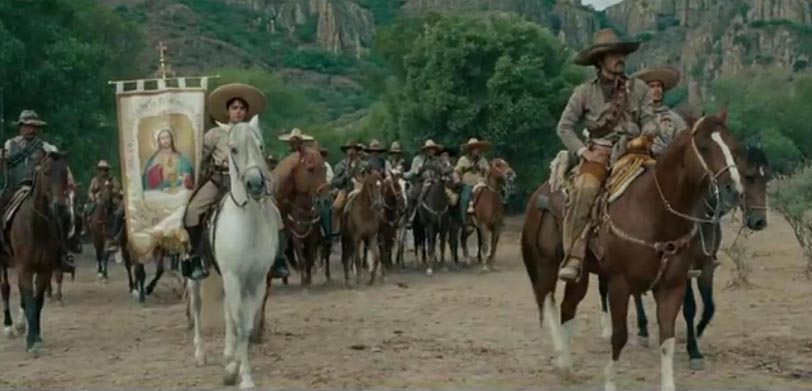
In this, we are reminded of the Black Legend—the set of stories told about the Spanish Empire, usually by English, intended to present Spanish rule as incomparably cruel. The Black Legend relies on exaggerations and misrepresentations of existing facts about Spanish rule, along with a certain economy with the truth about events and persons who might contradict the overarching narrative of bigoted, vicious Spaniards subduing and tormenting across several continents. Such legends, it seems to us, exist about liberalism. However, liberalism’s legends may properly be called White Legends. That is, they are the inverse of the misrepresentations and omissions of the Black Legend. Liberalism does not, as a rule, directly misrepresent illiberal doctrines or omit key facts about them. Instead, liberalism misrepresents itself as the sole defense against the implicit wickedness of illiberal doctrines.
In a certain sense, none of this matters in the broader debate about integralism. John Joy has convincingly argued that Quanta cura and Syllabus are infallible and irreformable. Moreover, as we have noted (following Pappin’s lead), the canonical authority F.X. Wernz held that Leo XIII’s encyclicals have an intimate relationship with the infallible declarations of Quanta cura and Syllabus. Finally, Thomas Pink has shown at great length, whether you find it altogether convincing or not, that Dignitatis humanae does not contradict the Pio-Leonine magisterium. In other words, from a doctrinal standpoint, the onus probandi is clearly on the liberals. And given the careful arguments advanced by Joy and Pink, it is unclear that liberal urgency about tyranny or statism is much of an answer to the definitive status of integralism as Church teaching.
On the other hand, the recent agony on Twitter about whether integralism is “Catholic fascism” or totalitarianism or any of a whole parade of horribles shows that, from a forensic standpoint, the white legends of liberalism are hard to avoid. And there is a temptation to decline to do other people’s homework. However, given some of the horrible advanced by Muñoz and Dreher, it is clear even public figures are invested in liberalism’s white legends. Thus, integralists have some obligation, we think, to rebut these legends. For our part, we will address two of them here. Nothing we say will be particularly groundbreaking—and we suspect that this may be repetitive of earlier posts—there is some value to the exercise of outlining integralist teaching in the context of some of liberalism’s white legends.
The first white legend of liberalism is that liberalism alone is concerned with preventing the state from falling into tyranny. To reject liberalism, the liberals claim, is to start down the road to totalitarianism and tyranny. Adrian Vermeule and Gladden Pappin have both written about liberalism’s bad habit of taking credit for procedural safeguards that it did not introduce. This perhaps the most pernicious aspect of this white legend: liberalism takes credit for the Church’s ideas, and then deploys them against the Church. However, the problem goes well beyond specific procedural safeguards. Catholic thinkers—illiberal Catholic thinkers—have considered the problem of tyranny at great length and well before the rise of liberalism. To suggest that liberalism is preeminently concerned with preserving liberty is, therefore, to misrepresent the fact that Catholic philosophers and theologians, St. Thomas Aquinas preeminent among them, were considering the same problem and coming to sound answers.
Aquinas thought at length about how to keep a ruler from going sour, as it were, and becoming a tyrant. Not quite a year ago, we wrote about a seeming development in Aquinas’s thought regarding the mixed constitution (partly monarchy, partly aristocracy, partly democracy). While Aquinas argues strongly in favor of monarchy in the De regno, by the time he wrote the Prima Secundae of the Summa Theologiae, he implies that a mixed constitution would serve as a strong bulwark against tyranny. Additionally, he argued against the idea that the ruler is totally free from his laws. It is true that the sovereign is not bound by the law, Aquinas admits, in the sense that the coercive power of law comes from the sovereign and no man is bound by himself (ST I-II q.96 a.5 ad 3). More to the point, if the sovereign violates the law, there is no one who can pass sentence on him. However, Aquinas insists on the directive force of the law on the sovereign. That is, before God, the sovereign is morally responsible for keeping his own laws, and he should do so by his own free will. In other words, the sovereign is morally bound to follow his own laws, even if he is free from their coercive power.
Moreover, Aquinas imposes limits on the power of the sovereign’s laws. On one hand, unjust laws do not bind subjects in conscience (ST I-II q.96 a.4 co.). Aquinas identifies several kinds of unjust law. First, a law beyond the competence of the prince is unjust. Second, a law that is not aimed at the common good, instead being ordered toward the ruler’s cupidity or vainglory is unjust. Third, a law that may well be aimed at the common good yet still be unjust if it inflicts disproportionate burdens. Finally, a law contrary to the divine or natural law is no law at all. Aquinas goes so far as to call these unjust laws acts of violence rather than laws. The moral law which imposes upon the ruler the obligation to obey his laws can also free the ruler’s subjects from the obligation to obey his laws.
We might also discuss Aquinas’s notion that human law should not try to repress all vices (ST I-II q.96 a.2). His argument turns basically on the idea that law should forbid only the more grievous vices, which tend to destabilize society altogether (ST I-II q.96 a.2 co.). He lists murder and theft, but it may be possible to come up with a longer list. The upshot of Aquinas’s argument is that law is a rule for human action designed to lead men to virtue, but this process is gradual (ST I-II q.96 a.2 ad 2). Forcing all men, including the less virtuous, into the life of the virtuous, who avoid all vice, would cause greater evils than permitting some vices.
This is, by the way, a really difficult point in discourse about integralism and Aquinas. The purpose of law, especially for Aquinas, is not to create some baseline condition of liberty suitable for maximum flourishing. It is to order people to virtue (ST I-II q.95 a.1 co.). To be sure, some people are naturally sort of virtuous and avoid vice through wise paternal teaching. However, other people, Aquinas argues, are depraved and inclined to vice. Law teaches these people to be virtuous by forbidding by force certain vices. Over time, the vicious, thus forbidden by force, might become virtuous. At the very least, they might leave others in peace. This is a more active and more energetic role for the regime that some like to imagine. It also requires certain choices to be made at the outset that are generally seen as choices regimes ought not to make. Put another way: one cannot be neutral about virtue and expect to frame laws designed to lead the vicious to virtue.
Changing gears a little, as Alasdair MacIntyre has discussed, criticizing the (purportedly) absolutizing and centralizing tendencies of King Louis IX of France and the Holy Roman Emperor Frederick II of Hohenstaufen, Aquinas recognized the value of custom as an interpreter and source of law (ST I-II q.97 a.3). Aquinas’s argument is interesting. He argues that all law proceeds from the reason and will of the lawgiver. However, the reason and will of the lawgiver can be made known through action just as through speech (ST I-II q.97 a.3 co.). And custom is nothing more than repeated actions, so custom makes known the reason and will of those participating in the custom. Thus, custom can make and interpret law. Responding to an objection, Aquinas holds that custom obtains the force of law both for a people free and capable of giving itself laws and for a people under authority of another, insofar as those in authority tolerate the customs (ST I-II q.97 a.3 ad 3).
This sketch, which could profitably be expanded into a lengthy treatment, shows, we think, that Aquinas was acutely concerned with ensuring that the ruler does not become a tyrant and the regime does not become a centralizing, totalizing entity (Whether he goes as far as MacIntyre would have him go is another question.) It is no answer to claim Thomas for liberalism, either. One has only to read Aquinas’s treatment in the Secunda Secundae of coercion of heretics or the limited toleration to be afforded to nonbelievers to see that Aquinas’s vision of good government is far removed from modern liberal ideals such as freedom of religion or separation of Church and state. Instead, it must be recognized that even an illiberal Catholic like Thomas Aquinas can be concerned with tyranny and propose means of avoiding tyranny without endorsing modern concepts of liberty.
To the extent that liberalism advances its white legend that only liberalism is especially interested in preventing tyranny and totalitarianism, that is plainly false. Integralism no less than liberalism is concerned with preventing the well ordered state from decaying into tyranny (or dissension, though this is a matter for another time). Moreover, Aquinas’s thought on the limits of state power—both in terms of when it ceases to bind in conscience and in terms of the implicit decentralization represented by custom—shows that integralism is, in fact, far removed from an all-embracing totalitarianism.
The problem, of course, is that Aquinas’s thought permits a broader range of action for the regime than most American conservatives would like to tolerate. This demonstrates not a limitation or risk of integralism so much as a limitation or risk of trying to wedge Catholic political thought into an American left-right context. Vermeule discusses a little bit of this in his piece we linked above. The risks of applying American politics to Catholic economic thought are well known. The risks of applying American politics to Catholic political thought are no less acute. More on this in a minute.
The second white legend is the idea that liberalism prevents corrupt prelates from exercising too much authority. Dreher gets at this when he says, “integralism looks like Blaise [sic] Cupich and Ted McCarrick putting their loafers on your neck forever.” In other words, integralism means that morally compromised prelates will gain significant temporal authority; liberalism, on the other hand, ensures that these prelates will be kept far from the levers of power. (Perhaps this is a black legend after all!) Such an approach shows an admirable naïveté regarding secular politicians, especially in Dreher’s home state of Louisiana or Cupich’s state of Illinois. The realities of secular politicians alone explode any idea that integralism is a change for the worse. However, Dreher’s anxiety—naïve or not—gets to back to a more obviously white legend: liberalism is all that prevents theocracy.
Is this not really what Dreher is anxious about? Under integralism, prelates of the Church would have, so he implies, significant power that could be implemented by the civil authorities. The prelates become theocrats, which is worrying if they are unworthy. Of course, this ignores the history of actually existing integralist regimes. Frederick II’s Sicily was formally as integralist as Louis IX’s France, and Frederick spent much of his adult life locked in battles of varying intensity with Gregory IX and Innocent IV. This is especially noteworthy when one remembers that Sicily was a papal fief and Gregory IX and Innocent IV both claimed the power to depose the king of Sicily. And Andrew Willard Jones’s magisterial study of Louis IX’s France, Before Church and State, does not depict a theocratic state. The presumption that civil authorities will be entirely passive with respect to the Church does not appear to have strong support in historical fact.
Moreover, Leo XIII’s explanation of integralism in Immortale Dei states that the state and the Church are supreme in their separate spheres. It is when the spheres overlap that the subordination of state to Church comes into play. And Leo makes the salient point that, without such subordination, these instances of joint jurisdiction (so to speak) would result in conflict. Now, given the Church’s teaching on morality, which includes economic relations, perhaps these subjects of joint jurisdiction are particularly important. However, nothing in Immortale Dei suggests that integralism results in the Church obtaining plenary jurisdiction over the state. Moreover, in Cum multa, after condemning the error of separating Church and state, Leo XIII condemned the opposite error: confounding the Church and a given political party.
The bottom line is that liberalism’s claim to be a defense against theocracy has no more merit than its claim that it defends against tyranny and totalitarianism. Historically, integralist regimes have been far from theocracies, and Leo XIII’s teaching on integralism (teaching that is, after all, infallible and irreformable) rejects the notion of priests or prelates becoming dictators. Dreher’s (no doubt carefully chosen) image of “Blaise [sic] Cupich and Ted McCarrick putting their loafers on your neck forever” under integralism is mere hyperbole.
To a certain extent, these debates are unnecessary. No one really thinks integralists support fascism or totalitarianism or theocracy, whatever those terms may mean (and in the case of totalitarianism, it is the Catholic thinker Charles De Koninck who provides the most coherent and intelligent definition). The problem at Notre Dame and on Twitter and elsewhere is that integralism does not square nicely with American right-left politics. And, while integralism would hand culture warriors big wins, it would hand big losses to small-government conservatives who drone on (and on and on and on) about the virtues of personal liberty and personal virtue. Whether they would, in fact, prefer to have liberty over morality is another question for another time.
«Liberalism», a wise pastor once admonished the world, «is a sin». It is both a sin against faith and against the moral order: «In the doctrinal order, it is heresy, and consequently a mortal sin against faith. In the practical order, it is a sin against the commandments of God and of the Church, for it virtually transgresses all commandments». This was the language of the Church in the days when her bloody and heroic wars with the liberal order were still within living memory, with more still waiting to be fought after Don Félix wrote his polemic.
As with many other heresies, Sardá wrote, «the uniform of the [liberal] enemy is so various, changeable, sometimes even of our own colors, that if we rely upon the outward semblance alone we shall be more often deceived than certain of his identity». This deceptive uniform has recrently been the subject of much discussion in English-language debates on Catholic political doctrine, where the transient sympathy between the Church and conservative liberals is visibly collapsing. The conservative’s garb has been shown to be just one more of the liberal’s disguises.
Coming to this realization about conservatism is a liberation of peculiar politcal importance for Catholics: the breaking of the (hopefully) last ideological chain, or at any rate one of the most entrapping, to liberalism. That is, it is becoming clear that no third way is possble between truth and the various flavors of error. Of course, the nature of politics is such that liberalism’s attempts to justify itself to various audiences, including to Catholics, will continue (tedious and non-responsive as most are). An authentic apostolate of politics ― now mercifully free from any perceived need to kowtow to conservative pieties ― must therefore carry on to sort out these confusions.
An admirable exercise in this mandate is today on display in our friend Pat Smith’s post about «The Legends of Liberalism», over at Semiduplex. Smith argues that «much of the resistance to liberalism is premised upon some legends about liberalism». These are «White Legends», whereby «liberalism misrepresents itself as the sole defense against the implicit wickedness of illiberal doctrines». It is, Smith says, «the inverse of the misrepresentations and omissions of the Black Legend» it was created to oppose.
This is the way many heresies are built. In the words of Sardá,
[The] beginnings [of heresy] nearly always present the same character, either wounded self-love or a grievance to be avenged; either it is a woman that makes the heresiarch lose his head and his soul, or it is a bag of gold for which he sells his conscience.
Liberalism is, rhetorically, an avenger of past grievances, a rectifier of legendary wrongs. It must present itself clothed in heroism.
Smith tackles two particular cases of this strategy: liberalism’s absurd claims to be the only true bulwark against tyranny, on the one hand, and theocracy, on the other. With delicious ease, Smith deconstructs these pretentions simply by citing to the most authoritative exponents of Catholic illiberal thought, showing that their conception of political order is crucially concerned with preserving both liberty and the distinction of the temporal and spiritual orders. One simply does not find in them what the White Legend would have us believe is there.
By doing this, Smith clears a path that needs to be opened, and one hopes he will continue debunking other liberal myths and showing the utter falsity of its White Legend. As Smith’s post shows, this is chiefly an effort in historical resurrection. One must rescue the truth about what the pre-liberal order taught and did from the dark cave to which the liberal narrative has relegated it. In other words, crucial to exposing the White Legend is understanding its central preoccupation with the preservation of the Black Legend, its dialectical raison d’être.
The liberal’s White Legend is not historically intelligible as a purely theoretical construction. It was rhetorically and politically effective because it showed its partisans as engaged in a heroic battle with what they could portray as a true and existing evil. Like Hobbes’s Leviathan, whose existence had its sole and sufficient justification in holding back the monstrous chaos of an alleged Behemoth, the liberal order’s entire justification rests on its capacity to heal the world from the wounds and outrages of pre-liberal worlds. Indeed, Hobbes’s political theory is precisely one early attempt to put this rhetorical strategy in philosophical terms.
The hero, if he is to win followers, needs a credible villain, not an enumeration of theoretical errors.
One hundred years of careful historical study has by now shown not only who this villain was, but how the liberals created her. She had a peculiar face, she spoke a particular language, she lived on an identifiable plot of land, her deeds are known to history. In fact, she continues to roam the earth, now vanquished and, what is more, converted to the enlightening truths of liberalism, her past crimes and errors washed away by numerous and bloody acts of contrition. The name of this ancient foe is Hispania.
She was drafted for her role in the liberal drama by centuries of systematic and evangelical propaganda that taught Northern Europe of her allegedly horrific and unconscionable crimes. In retrospect, it is clear now how this strategy was so successful. The propagandists were not merely stoking outrage, but fear. They told of the crimes committed by a people livig scarcely a few hundred miles away. People everyone knew. And, crucially, people they feared. And so, the White Legend was the heresiarchs’ historical justification, and it was built quite deliberately on the occasion of the Black Legend. The Black Legend of Spain.
It was the legend of a monstrous empire, a power like none had existed since the Caesars, which had vanquished the Moor and the Turk and brutally conquered half the globe, which controlled both the lands of Europe and the oceans of the world, almost undefeated and with virtually limitless resources, an armed barrier that no amount of protestant ardor or privateer’s greed could breach. And Catholic. So Catholic. Inquisitorial and inflexible, legalist to a fault, full of superstitious feasts and made up saints, ignorant and brutish, lazy and venal, barbarous and a lover of gold, racist and arrogant, mindless and subservient to authority, chaotic and incapable of rule by law. And, most terrifying, fanatical and unyelding, as if on a permanent crusade ― a crusade of a thousand years.
There is virtually no aspect of this legend that survives the barest historical analysis. Not the Reconquista, not the conquest or civilization of America, not the Inquisition, not the juridical order of the Spanish Empire or its economic structure, not the sociological traits of the Hispanic peoples or their achievements. Perhaps I will go into some of these in later posts, but what is clear is that this Black Legend not only exists and defaces all Hispanics, but that it is the historical raw material out of which liberalism was built.
What use does this knowledge have for an apostolate of politics in the 21st century, in the context of a very different world-empire? Two uses come to mind.
First, as intellectual inoculation. Like all other human doctrines, liberalism is a historically-conditioned creation. We have grown up in it, and though we may come to disagree with its erroneous teachings and perceive its incoherences, we may still be moved by the underlying psychological impulse that (wittingly or not) animates its adherents. An impulse that tells us that even if liberalism is wrong, there must be something we can put in its place. After all, liberalism arose in response to real problems, it fought against real tyrannies, a true darkness, did it not? We cannot look at anything remotely similar to those pre-liberal times without an instinctive shudder, and even when we are no longer persuaded by liberalism, we cannot bring ourselves cleanly to contemplate that past, and in search for alternatives are moved to look elsewhere. Perhaps to a more moderate liberalism, perhaps to a socialistic variation, perhaps to some liberal-Catholic amalgam. But not to that.
This, I would argue, was the chief political success of the prophets of liberalism: the Black and White Legends as a kind of automatic reaction among «civilized peoples». The supposed real tyrannies that we unthinkingly come to associate with what liberalism historically opposed are therefore blind spots for us, and they are located precisely where liberalism’s errors are at their deepest and most poisonous. We still shrink from what they claim to cure. Inquisitions! Religious wars! Imperial expansion! For many, it takes much effort to be freed from these instinctive repugnances.
To study the history of the Black and White Legends is therefore crucial to liberate us from these mindless political reactions. The specific shape of liberalism as a historical phenomenon corresponds with them, and they in turn correspond with what liberalism perceived and told itself about the Spanish Empire specifically. It is precisely on this empire’s salient characteristics that liberalism’s polemics focused, and they determine its theoretical form. The historical form of liberalism is the anti-form not of «tyranny» and «theocracy» generically conceived, it is the anti-form of Spain.
A second use for this knowledge is as political education. The study of the Spanish Empire can show us what an alternative Catholic modernity could actually look like. Because it existed alongside and waged war against the errors of the modern world for over three centuries, as it grew doctrinally and politically into the place we know, it is much closer to us than more ancient Christian political orders. Critics of integralist thought often invoke the facile quip that we cannot go back to the France of St. Louis, thus concluding that integralist thought is at best an amusing philosophical hobby, but not useful for practical politics. Indeed we cannot go back, as integralists themselves have repeatedly pointed out in refuting this straw man. But this does not mean that we have nowhere else to look in history, nothing to illuminate our political thought between the 13th and 21st centuries.
After all, we live in a world of globalized economic interaction, worldwide commercial and political empire, international communications, massive bureacuracies, multicultural states, overlapping legal orders, religious heterodoxy and confusion, and wide-ranging media coverage and fake news. We live, that is, in the world of Philip II.
There is much to be learned from his world. Not so that we way restore the Spanish Empire (unless it be God’s generous will) or live as if in the 16th century (though state-sponsored missionary expeditions converting peoples from Mexico to China and ecclesiastics charting navigable routes in the unkown do sound glorious), but that we may restore a view of political order that not only understands what is useful and good about liberalism’s own world, but can also intelligently embrace it in a fully Catholic mindset. Many of the institutions we assocaite with liberalism had in Spain, in a way that is both more illuminating and closer to us than the examples of earlier Christian polities, an existence and a justification entirely foreign to liberal modes of thought, and which is readily available to us.
The principal political oppostion since the coming of Our Lord is not between left and right, but between empire and tribe: that is, between universalism and fragmentation. Gallicanism is a tribalist heresy. Liberalism, a universalist one. It is a gospel for an anti-empire, and in many ways it has succeeded. In Spain, if we only care to look, there is an actually existing historical alternative: a Christian empire (not a system of commercial colonies), universal in aspiration and almost in fact, founded on law, mighty in sword and pen, builder of roads, cities, and universities like no other people before it, home to saints and champions of the Church, defender and preserver of multiple coexisting cultures, careful and intelligent in its development of global juridical and political structures of semi-federal and bureaucratic administrative rule meticulously archived and organized, subject to the right order of the Gelasian dyarchy, and ― perhaps most offensively for the prophets of liberalism ― unyielding and ferocious up to utter exhaustion in its bitter war against the enemies of Christ and His law.
In short, a federative and missionary empire. Or, what the United States (or its successor) could be.
Destroy the White Legend, that we may overcome it. Or, said another way: ¡viva el Rey!