Theology

greyhammer90

the drunk piano player
Messages
16,820
Reaction score
16,080
"Why" indicates purpose or intent. "How" is just consequential and deterministic. Its what separates us from the animals.

I understand that but when we start getting into questions about life, the universe, and everything, I find that most "why" questions are just slightly twisted "how" questions. (Or vice versa.)
 
C

Cackalacky

Guest
I understand that but when we start getting into questions about life, the universe, and everything, I find that most "why" questions are just slightly twisted "how" questions. (Or vice versa.)

I agree. Applying the concept of "intent" is tricky business, particularly with animals of varying cognitive abilities.
 

Whiskeyjack

Mittens Margaritas Ante Porcos
Staff member
Messages
20,894
Reaction score
8,126
Could you give me an example of a question that is a "why" question that is not also a "how" question? Not being flippant, genuinely trying to understand.

Certainly. Let's take the Fine-Tuned Universe proposition linked above:

The fine-tuned Universe is the proposition that the conditions that allow life in the Universe can only occur when certain universal fundamental physical constants lie within a very narrow range, so that if any of several fundamental constants were only slightly different, the Universe would be unlikely to be conducive to the establishment and development of matter, astronomical structures, elemental diversity, or life as it is understood.

Why are the fundamental physical constants of our Universe within the very narrow range that allows life to develop? Why do all mathematical truths seem not only accurate, but necessary, to the point that we can't even conceive of a universe where 2+2=5? Why is there order, instead of chaos? Why is there anything at all, instead of nothing?

There's no empirical answer to these questions; they all exist within the realm of philosophy.
 
Last edited:

greyhammer90

the drunk piano player
Messages
16,820
Reaction score
16,080
Certainly. Let's take the Fine-Tuned Universe proposition linked above:


Why are the fundamental physical constants of our Universe within the very narrow range that allows life to develop? Why do all mathematical truths seem not only accurate, but necessary, to the point that we can't even conceive of a universe where 2+2=5? Why is there order, instead of chaos? Etc.

There's no empirical answer to these questions; they all exist within the realm of philosophy.

I still don't understand how most of these could not be conceivably answered by scientists, especially as our understanding of the multi-verse and other aspects of theoretical physics grows every year. What if we discover that there are infinitely many universes where the range isn't met? "Ah," some would say, "but this does not answer the question of why our universe is this way." When it really does through simple probability.

It strikes me as the same sort of question as "why do we stay on the ground when in an alternate world we could just float away?" The question is 1) a "how" question dressed as a "why" question, and 2) manipulative in its phrasing to suggest that there must be some grander "purpose". Unfortunately, Newton solved that "why" question and it became a "how" question. Now you may ask "But why does gravity exist at all?" but to me this is just another "how" question that hasn't been answered yet to my knowledge.

Also I would argue that the fine-tuning argument is a weak one for the existence of God as far as I'm concerned. But that wasn't what I asked you about, so I won't make assumptions and (unfairly) argue against something you never said to begin with.
 

NDohio

Well-known member
Messages
5,869
Reaction score
3,060
Wow - I have been completely slammed at work this month and as a result I have missed this thread. Just had a few minutes so I caught up on it. Amazing reading the thoughts from folks on here - well done. I hope to be able to contribute some in the near future when I get some time. For the quick reference:

1. Yes
2. Yes
3. Yes

One of the interesting things I have read in this thread is the beginning of the conversation about religion vs Christianity. It has just been touched on and not delved into yet. Hopefully that can be a subject expanded upon(either here or in a different thread).
 
C

Cackalacky

Guest
The tuned Universe has many assumptions and holes as well. Here is a good write up on the logical problems with a theistic veiw:
The basic argument is that our universe critically depends on a coincidence of properties, and that such coincidence is only possible by supernatural design. Here is Drange’s formulation:

(1) The combination of physical constants that we observe in our universe is the only one capable of sustaining life as we know it.
(2) Other combinations of physical constants are conceivable.
(3) Therefore, some explanation is needed why our actual combination of physical constants exists rather than a different one.
(4) The very best explanation of the given fact is that our universe, with the particular combination of physical constants that it has, was created out of nothing by a single being who is omnipotent, omniscient, all-loving, eternal, and interested in sentient organic systems, and that he “fine-tuned” those constants in a way which would lead to the evolution of such systems.
(5)But such a being as described in (4) is what people mean by “God.”
Hence [from (4) & (5)], there is good evidence that God exists.


I. This befuddlement in the face of facts seems to be the extent of how Christians view science. They view science not as a tool of discovery, but as a source of insolvable puzzles (that is to say, insolvable by science). To the theologian, science does not exist to give answers, but only to provide questions that only he can answer – by invoking his favourite god.


I have addressed this “befuddled” strategy in my article ‘Swinburne’s Justification for Naivete’, where I address a similar kind of argument. Swinburne, in this example, uses natural law instead of physical constants, but the principle is the same, as physical constants are part of the natural laws that we discover. Given that, explaining why the speed of light is the way it is, is no different than explaining E=mc2.

My answer in both cases is the same. To ask why constants are this way or why laws are that way is to presume that there is an ultimate reason to be found, an ultimate cause underlying them, something beyond the material. But if the existence of the universe is necessary, then no reason or cause is to be found.

The question of an ultimate cause or explanation for the way things are, is no more meaningful than to ask a theist why his god is the way it is. Given the necessary nature of existence, it cannot be the case that “some explanation is needed” for fundamental constants which are inherent to existence.

We can also see the question as a scientific one, that is to say, look at the formation of the universe and how the constants arose from it. This is a scientific question, that Big Bang theory answers with symmetry breaks in the early universe. But in neither case is a non-natural explanation necessary, possible, or even relevant.


II. To come back to the general argument, there is one gigantic objection, the kind of thing that does not seem obvious but seems that way after you understand it. That objection is simply that fine-tuning is not an argument for design, but rather an argument against design! The idea of an extreme fine-tuning beyond which the target cannot exist is indicative of a precarious natural system, not of intelligent planning.

To understand this, an analogy may be useful. Suppose that our breathing was dependent on a specific level of oxygen in the atmosphere, and that any other level would cause suffocation. That would certainly count as “fine-tuning” in the sense given by the argument. The atmospheric composition in question would be the only one capable of supporting life, and this would therefore demand “explanation”.

But even if that was true, how would this fine-tuning justify design explanations? A designer would not make it so that humans would constantly face the danger of suffocation! An intelligent designer would try, whether possible, to ensure that a given system could keep functioning under different conditions. Such is the case with humans, who can breathe in atmospheres thin or rich in oxygen. The precarity of a system’s functioning is not evidence of design, but rather of natural law.


III. Another objection to the fine-tuning argument is that we should not be surprised or befuddled that the universe is adapted to our needs, since we evolved within the universe and its parameters. Evolution tends towards adaptation of life to its environment. Therefore, we should no more be surprised of how well the universe fits us, than we should be surprised of how well a baked cookie fits its mold. This argument is also called the WAP.

A possible retort to WAP is that without the fundamental constants as they are, life simply could not evolve at all. But this is based on a misunderstanding: because we know only one possible way for life to evolve, does not mean that no other way is possible. Even the facts of carbon-based life are not a necessity. In many cases, life would have evolved differently, and we would be silicon life forms asking why the universe is so perfectly adapted to our existence. To think this way, without any scientific guidance at all, is nothing more than wish-fulfillment. We must start from the assumption that there is nothing special about the way we evolved, unless contrary evidence is presented.

William Craig, in ‘Barrow and Tipler on the Anthropic Principle vs. Divine Design’, argues against this use of WAP by stating that:

“We should not be surprised that we do not observe features of the universe which are incompatible with our own existence.”
Does not justify:

“We should not be surprised that we do observe features of the universe which are compatible with out existence.”
He gives the example of a man who is shot by a firing squad, but all the shots miss. Such a man should not be surprised at not being dead, since he can still reason and thus must be alive. But, Craig continues, he should be surprised at being alive, given that he should be dead.

I see Craig’s example as illustrating the fallacy of his argument. He misunderstands that which we should be surprised about. In the case of the firing squad, the survivor should not at all be surprised at being alive, but rather at the firing squad missing all their shots. The fact that he is still alive, in itself, should not at all be surprising. It is the underlying causal link that is surprising, not the fact itself. In the case of the universe, these causal links are not surprising at all, and therefore his argument fails.


IV. We have good reason to object to a number of assumptions that are explicitly or implicitly held by theologians who use fine-tuning. The first assumption is contained in the following formulation:


“2. Other combinations of physical constants are conceivable.”

Now granted, some theologians do not explain this step at all, but they usually have no justification for their assumption that physical constants could be otherwise. So Drange’s formulation here is in fact a concession.

At any rate, it is unclear why the fact that “other combinations of physical constants are conceivable” lead to the conclusion in (3) that:

“some explanation is needed why our actual combination of physical constants exists rather than a different one”

In fact, (3) implies that these “other combinations” could exist. But there is no way to deduce this from (2). The fact that something is conceivable does not make it possible! It only means that our imagination can encompass it. I can imagine plenty of things that are plainly impossible, such as alternate pasts. I discussed a similar “fallacy from the imagination” in my article ‘Conifer’s Refutation of Noncognitivism Examined’, refuting Steven Conifer’s assumption that something that is “clear” and “imaginable” makes it meaningful.

The fact that something is conceivable does not make it magically possible. Possibility must be demonstrated with objective evidence.


V. Two other implicit assumptions can be addressed simultaneously. These assumptions are:

Change in physical constants can be isolated.
Change in physical constants necessarily brings about states where life is impossible.
The first assumption is committed by a lot of theologians, but our argument-type does not commit it. I will therefore only justify the second. I already noted that the assumption that our specific carbon-based evolution cannot be special in any way. We must assume that, given a sufficient lifespan for stars, some form of evolution is at least possible.

With this in mind, physicist Victor Stenger developed a program called “MonkeyGod”. This program generates universes using four of the physical constants we have discussed. While this is not as convincing as analyzing the twenty physical constants that we know, MonkeyGod still demonstrates that long-lived stars “occur in a wide range of parameters”. Given this preliminary result, there is no reason to assume a priori that any change would result in the impossibility of life.


VI. We have seen that the proponents of fine-tuning call divine creation a “hypothesis” or an “explanation”. And indeed, if it was not a hypothesis or an explanation, it would not answer the “problem” of fine-tuning at all.

There are three problems associated with calling divine creation a “hypothesis” or “explanation”:

Divine creation…

cannot be a hypothesis because its specificity is not supported by any observation. The facts of fine-tuning, even if true, only justify the existence of a supernatural process or entity, not of a divine Creator.
is not a complete hypothesis or explanation, and is not a proper working hypothesis or explanation.
as a hypothesis or explanation, is contradicted by many facts of the universe.
The first objection is more specific, since it only pertains to god-as-hypothesis, and I will not get into it. For more on this topic, the article ‘Process-Based Noncognitivism’, which discusses the impossibility of positing a god’s existence as a hypothesis, may be helpful.

The second objection is critical. If divine creation, as expressed by theologians, is nothing but hollow words without any substance, then it cannot serve as a hypothesis or explanation. Does it mean anything to say “a god created the universe” and can we explain this process?

The answer is no. According to theologians, the only relevant elements of any divine action on the universe are that a god wills natural change, and that will becomes reality. But both these elements are meaningless.

First, the idea that a god wills natural change contradicts its infinity. It therefore cannot be the case that a god desires to intervene in the natural world. This point is discussed as a strong-atheistic argument in ‘Apathetic God Paradox’.

Secondly, if “a god’s will becomes reality” is to mean anything at all, then one must answer to the modus operandi problem, that is, how a supernatural being could possibly act in the natural world. Without an answer to this general problem, no instance of such a passage can be justified. And if no instance can be justified, then there is no meaning to discuss.

The third objection is perhaps the heaviest. If divine creation is impossible, either due to the nature of divine creation itself or the nature of this universe, then it cannot be used as an explanation for fine-tuning.
The Many Problems of the Fine-Tuning Argument
 

Whiskeyjack

Mittens Margaritas Ante Porcos
Staff member
Messages
20,894
Reaction score
8,126
I still don't understand how most of these could not be conceivably answered by scientists, especially as our understanding of the multi-verse and other aspects of theoretical physics grows every year.

From the wikipedia article on Mulitverse:

For a start, how is the existence of the other universes to be tested? To be sure, all cosmologists accept that there are some regions of the universe that lie beyond the reach of our telescopes, but somewhere on the slippery slope between that and the idea that there are an infinite number of universes, credibility reaches a limit. As one slips down that slope, more and more must be accepted on faith, and less and less is open to scientific verification. Extreme multiverse explanations are therefore reminiscent of theological discussions. Indeed, invoking an infinity of unseen universes to explain the unusual features of the one we do see is just as ad hoc as invoking an unseen Creator. The multiverse theory may be dressed up in scientific language, but in essence it requires the same leap of faith.

— Paul Davies, A Brief History of the Multiverse

My only point is that materialists need to acknowledge when they're entering the realm of philosophy, and argue accordingly.
 

Whiskeyjack

Mittens Margaritas Ante Porcos
Staff member
Messages
20,894
Reaction score
8,126
That's a great post, Cacky, but that's not science! That's materialist philosophy, and all of those retorts are premised on their own unfalsifiable first principles. For instance, the author assets several times that the Universe is necessary. That's an appeal to some form of objective truth. What is that exactly? Why does that exist?

Nothing rivals empirical science in descriptive power. But when we get into normative questions, epistemiology, metaphysics, etc., it enjoys no special privileges. Just because many empricists happen to be materialists doesn't make Materialism especially persuasive. As a philosophy, its assumptions and consequences have to be scrutinized like any other. And on those grounds I find it to be utterly empty.
 

greyhammer90

the drunk piano player
Messages
16,820
Reaction score
16,080
From the wikipedia article on Mulitverse:


My only point is that materialists need to acknowledge when they're entering the realm of philosophy, and argue accordingly.

I didn't mean to give the impression that my entire answer hinged on the multiverse theory being correct, because that was simply an example of a potential way science could turn your "why" question into a "how" question. My point was that saying that science needs to stick to "how" and not "why" is disingenuous, because science has and will continue to answer questions that were previously assumed to be unknowable and thus "purely philosophical".
 

Whiskeyjack

Mittens Margaritas Ante Porcos
Staff member
Messages
20,894
Reaction score
8,126
I didn't mean to give the impression that my entire answer hinged on the multiverse theory being correct, because that was simply an example of a potential way science could turn your "why" question into a "how" question. My point was that saying that science needs to stick to "how" and not "why" is disingenuous, because science has and will continue to answer questions that were previously assumed to be unknowable and thus "purely philosophical".

I agree, but I don't believe it can ever answer all such questions. You eventually have to settle on an objective source of all being (i.e. God), or you're left with an infinite regression, which on empiricism's own terms, is not an acceptable answer.
 

chubler

Active member
Messages
386
Reaction score
34
As I see it, this "fine-tuned universe" is essentially a variation of the Teleological argument, one of the archetypes that encompass pretty much every argument made for the existence of God. Boiled down to its core, this is roughly the Teleological argument:

P1. Natural object x and human artifact y are alike in that they both possess property M.
P2. Human artifact y has property M because it is the product of deliberate, intelligent design.
P3. Like effects have like causes (or like explanations or like requirements).
---------------------------
C1. Thus, natural object x is probably the product of deliberate, intelligent design.
P4. The only being capable of deliberately and intelligently designing natural object x is God.
---------------------------
C2. Thus, God exists.

(p= premise, c= conclusion)

It's called the teleological argument because of a famous example comparing a watch and the universe. In less rigorous terms, the basic thrust of the argument is that various aspects of the universe are organized in a highly complex way that is rarely if ever observed to occur as a result of random chance- i.e., without an intelligent actor designing it. Therefore, it makes more sense to conclude that there was/is an intelligent actor designing that aspect of the universe than to conclude that the complex, orderly structure resulted from random chance. The only plausible option for this intelligent actor is God.

Greyhammer, I hope this helps answer your question on How vs. Why questions: one of the subordinate conclusions of the teleological argument (C1 above) contends that what we can observe about the universe suggests that there is a "purpose", as you put it. The finely-tuned universe argument implies this instead of stating it outright.
 

chubler

Active member
Messages
386
Reaction score
34
I agree, but I don't believe it can ever answer all such questions. You eventually have to settle on a contingent source of all being (i.e. God), or you're left with an infinite regression, which on empiricism's own terms, is not an acceptable answer.

Since I'm already full-on flashing back to my first philo...

This one is the "cosmological argument". St. Thomas Aquinas' 'first mover' example is rightfully the most famous:

P1: In the natural world, some things are in motion.
P2: In the natural world, if a thing is in motion, it must have been caused to move by something else.
P3: In the natural world, there cannot be an infinite regress of causes of motion.
---------------------------
C1: Thus, there must be a first cause of motion (a first/unmoved mover).
That is, there must be a cause that is not itself caused - i.e., an unmoved mover.

P4: God is the only possible (or most probable) first mover
---------------------------
P5: Thus, God exists.

This gets contested all the time but I personally think it's by far the best purely rational argument for God.
 

greyhammer90

the drunk piano player
Messages
16,820
Reaction score
16,080
I agree, but I don't believe it can ever answer all such questions. You eventually have to settle on a contingent source of all being (i.e. God), or you're left with an infinite regression, which on empiricism's own terms, is not an acceptable answer.

If an infinite regression is unacceptable, I can't imagine why an "uncaused cause" (i.e. God) would be acceptable. Logically it's just as absurd.
 

chubler

Active member
Messages
386
Reaction score
34
If an infinite regression is unacceptable, I can't imagine why an "uncaused cause" (i.e. God) would be acceptable. Logically it's just as absurd.

My (obnoxiously academic) summary of the "cosmological argument" above might help. You've hit on the main point of the argument he's making: infinite regression is unacceptable, but unavoidable. The best way to explain this is God.

That's how I was taught the argument, anyway.
 
C

Cackalacky

Guest
I agree, but I don't believe it can ever answer all such questions. You eventually have to settle on a contingent source of all being (i.e. God), or you're left with an infinite regression, which on empiricism's own terms, is not an acceptable answer.

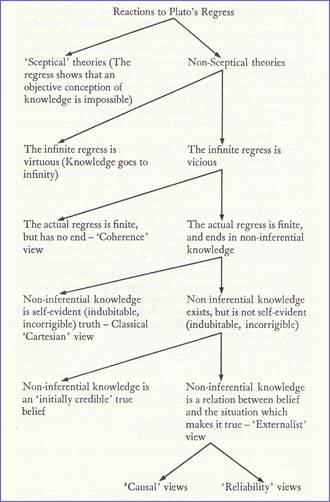
This is a major sticking point for me. The scientific method is not out to answer all such questions, merely the question at hand. There maybe an infinite number of questions at hand, but the question at hand will never be the "end" question.

Here is a philosophical solution for escaping empiricism's classical idea of infinte regress by David Armstrong
ArmstrongRegress.jpg
 

greyhammer90

the drunk piano player
Messages
16,820
Reaction score
16,080
My (obnoxiously academic) summary of the "cosmological argument" above might help. You've hit on the main point of the argument he's making: infinite regression is unacceptable, but unavoidable. The best way to explain this is God.

That's how I was taught the argument, anyway.

But again why is infinite regression unacceptable but an uncaused cause acceptable?

I understand that God (which lets be honest we're not even really talking about God in the religious sense anymore because this could literally be anything that always has existed and always will) is a very convenient way to get yourself out of the infinite regression pickle, but his (her? its?) existence raises another host of logical problems.
 
B

Bogtrotter07

Guest
The two camps here are each "arguing" their points, as the systems of understanding they intend to build, dictate.

This has always been my perspective and the point I make. From a young age I have felt a cosmic loneliness, and it is just for reasons and situations as this.

From my perspective you are two camps, each built with the task of building half a bridge, each being confident that you have adequate materials and resources to hold up your end.

Never mind the start is delayed by foggy weather. At any rate after a herculean heroic effort by both teams, as the fog begins to clear they begin to discover a series of mistakes, including that their piers are offset by hundreds of yards and neither half appears to really bisect the river with their attempt.

The following true points are made : neither has the language and skills to make a conclusive argument (without the other;) and each system falls far short of the enormity of the challenge, just from the fact that we cannot design a system of expression, communication, or thought, that defines what is totally beyond our perspective, experience, understanding and nature.

What we can do is attempt to work in concert to fit the "edge pieces" together.
 

Whiskeyjack

Mittens Margaritas Ante Porcos
Staff member
Messages
20,894
Reaction score
8,126
If an infinite regression is unacceptable, I can't imagine why an "uncaused cause" (i.e. God) would be acceptable. Logically it's just as absurd.

I said an infinite regression is unacceptable on empiricism's own terms. Therefore, the scientific method can't answer all questions. Your post implies you believe that scientific progress will eventually answer all such questions; I think the nature of that method of inquiry is necessarily limited in such a way that it can't. You need philosophy eventually.

My (obnoxiously academic) summary of the "cosmological argument" above might help. You've hit on the main point of the argument he's making: infinite regression is unacceptable, but unavoidable. The best way to explain this is God.

That's how I was taught the argument, anyway.

I agree. The Argument from Contingency is, in my opinion, the the closest thing to an air-tight proof of God's existence. None of its criticisms are very strong.

Granted, as greyhammer noted above, this only gets you from agnosticism to some vague form of theism. No logical proof can take you from theism to the personal God of Christianity. But it's a start.

This is a major sticking point for me. The scientific method is not out to answer all such questions, merely the question at hand. There maybe an infinite number of questions at hand, but the question at hand will never be the "end" question.

But again why is infinite regression unacceptable but an uncaused cause acceptable?

I understand that God (which lets be honest we're not even really talking about God in the religious sense anymore because this could literally be anything that always has existed and always will) is a very convenient way to get yourself out of the infinite regression pickle, but his (her? its?) existence raises another host of logical problems.

See my first response in this post. It's about the unacceptability of infinite regression on empiricism's own terms; thus, the inadequacy of empiricism in the philosophical arena.

Regardless of how you define the "set" (universe, multiverse, etc.), it is ultimately closed, and empiricism can only ever hope to explain that which exists within the set. But humanity is no closer today to solving the infinite regression than the Greeks were thousands of years ago, which seems to imply that reference to something supernatural (as in outside the set) is necessary at some point.

Most mathematicians are platonists. There's a lot of buzz currently over how abstract mathematical objects exist outside of human understanding and language; and how that fact implies that our reality may actually be a super-advanced computer simulation, with mathematics as the programming code. Whatever you want to call it, as soon as you're making reference to some objective truth beyond or behind this reality, you're basically a theist.
 
Last edited:
B

Buster Bluth

Guest
Regardless of how you define the "set" (universe, multiverse, etc.), it is ultimately closed, and empiricism can only ever hope to explain that which exists within the set. But humanity is no closer today to solving the infinite regression than the Greeks were thousands of years ago, which seems to imply that reference to something supernatural (as in outside the set) is necessary at some point.

Most mathematicians are platonists. There's a lot of buzz currently over how abstract mathematical objects exist outside of human understanding and language; and how that fact implies that our reality may actually be a super-advanced computer simulation, with mathematics as the programming code. Whatever you want to call it, as soon as you're making reference to some objective truth beyond or behind this reality, you're basically a theist.

I agree with this. I think I started my posts on here with that fact that you ultimately choose to believe that a god created the universe and its matter, or it spontaneously generated. The mere concept of eternity and "the beginning" was as mind-blowing then as it is now.

I don't like using the "God of the Gap" argument in a scientific sense, but rather a historical one. You and I clearly disagree on Jesus, but I still maintain that it's inexcusable for Jesus to cure a guy of leprosy but not drop the knowledge bomb of "hey guys, there are these things called germs and they will fuck you up. I created them. Deal with it; boil your water and wash your hands and shit. or they'll kill you. well, technically I'll kill you, as I did make them. Did I mention that?" Germs weren't discovered until the 19th century. Jesus could have helped us out there and bettered the lives of billions by letting us know this shit ahead of time. But of course, something something free will. It's too bad that Christianity had a 2,000-year head start for coming up with excuses as to why literally nothing from the history of Christianity is supernatural or even abnormal.
 
Last edited:
C

Cackalacky

Guest
I said an infinite regression is unacceptable on empiricism's own terms. Therefore, the scientific method can't answer all questions. Your post implies you believe that scientific progress will eventually answer all such questions; I think the nature of that method of inquiry is necessarily limited in such a way that it can't. You need philosophy eventually.


I agree. The Argument from Contingency is, in my opinion, the the closest thing to an air-tight proof of God's existence. None of its criticisms are very strong.

Granted, as greyhammer noted above, this only gets you from agnosticism to some vague form of theism. No logical proof can take you from theism to the personal God of Christianity. But it's a start.


See my first response in this post. It's about the unacceptability of infinite regression on empiricism's own terms; thus, the inadequacy of empiricism in the philosophical arena.

Regardless of how you define the "set" (universe, multiverse, etc.), it is ultimately closed, and empiricism can only ever hope to explain that which exists within the set. But humanity is no closer today to solving the infinite regression than the Greeks were thousands of years ago, which seems to imply that reference to something supernatural (as in outside the set) is necessary at some point.

Most mathematicians are platonists. There's a lot of buzz currently over how abstract mathematical objects exist outside of human understanding and language; and how that fact implies that our reality may actually be a super-advanced computer simulation, with mathematics as the programming code. Whatever you want to call it, as soon as you're making reference to some objective truth beyond or behind this reality, you're basically a theist.

I understand this and agree. However we still are at the un-caused cause and what attributes this cause presently has or had in the past. Logically, something that is necessary must also have been necessarily derived, so the infinite regress applies to theological arguments as well. I think the heartburn most people have is taking the step to attribute some special power to the un-caused cause. I, like others, may be willing to accept that the fact that we may never be able to understand that initial condition and be content with understanding what we can derive through logical means. However, I also find it illogical and VERY un-necessary to attribute special privileges or powers to something that may be unknowable. Just to logically deduce that something is necessary as an initial condition, and imply therefore GOD (in whatever form) exists is as illogical as an empiricist delving into objective truth beyond the observable universe.

Maybe we (posters in the thread) should proceed from here at looking (together) at how to look beyond the infinite regress? Maybe another view would be helpful moving forward?

This is fascinating stuff and I have learned much from everyone.
 
Last edited:
C

Cackalacky

Guest
The Argument of Contingency:

From the link you provided Whiskeyjack-

The existence of things that are necessary does not require explanation; their non-existence is impossible. The existence of anything contingent, however, does require explanation. They might not have existed, and so there must be some reason that they do so.

The only adequate explanation of the existence of the contingent universe, the argument from contingency suggests, is that there exists a necessary being on which its existence it rests. For the existence of the contingent universe must rest on something, and if it rested on some contingent being then that contingent being too would require some explanation of its existence. The ultimate explanation of the existence of all things, therefore, must be the existence of some necessary being. This necessary being is readily identified by proponents of the cosmological argument as God.

So if I understand this, contingency arises from some necessary being (defined as God) that requires no explanation, even though that contingency does require an explaination. This is a logical fail for me.

The argument from contingency, then, can be summarised as follows (MY BOLD):
The Argument from Contingency
(1) Everything that exists contingently has a reason for its existence.
(2) The universe exists contingently.
Therefore:
(3) The universe has a reason for its existence.
(4) If the universe has a reason for its existence then that reason is (a necessary entity which but no explanation is required).
Therefore:
(5) A necessary entity with no explanation exists

I guess this would be a real good place to start from as at its base is the assumption of a necessary being and a "reason" for contigencies.
 
Last edited:

no.1IrishFan

Well-known member
Messages
6,279
Reaction score
421
Great video if you guys have time to watch it. Very compelling arguments from some great minds.

<iframe width="560" height="315" src="//www.youtube.com/embed/RKNd_S3iXfs" frameborder="0" allowfullscreen></iframe>
 

Whiskeyjack

Mittens Margaritas Ante Porcos
Staff member
Messages
20,894
Reaction score
8,126
I don't like using the "God of the Gap" argument in a scientific sense, but rather a historical one. You and I clearly disagree on Jesus, but I still maintain that it's inexcusable for Jesus to cure a guy of leprosy but not drop the knowledge bomb of "hey guys, there are these things called germs and they will fuck you up. I created them. Deal with it; boil your water and wash your hands and shit. or they'll kill you. well, technically me, I did make them. Did I mention that?" Germs weren't discovered until the 19th century. Jesus could have helped us out there and bettered the lives of billions by letting us know this shit ahead of time. But of course, something something free will.

The disconnect here likely comes from your misapprehension of the Christian view of creation's purpose. God created the universe in order to provide an environment in which gods could meaningfully (i.e. free will) choose between Him and themselves. Thus, the fallen nature of this universe is necessary because of humankind's spirituality. Had Jesus simply snapped his fingers and recreated Eden here on Earth, the entire purpose of creation would have been undone.

You seem to believe that scientific progress is steadily making the world a better place. In the Christian view, mostly due to the nature of the Fall, the state of humanity never really improves. For every step forward we take in medicine and technology, we lose something equally valuable elsewhere-- social cohesion, community, etc.

It's too bad that Christianity had a 2,000-year head start for coming up with excuses as to why literally nothing from the history of Christianity is supernatural or even abnormal.

The history of the Church is full of miracles. But if your worldview necessarily precludes any belief in such things, then it would obviously appear as you've described. A lack of empirical proof of the supernatural isn't dispositive of anything. It all comes back to faith and your first principles.

I understand this and agree. However we still are at the un-caused cause and what attributes this cause presently has or had in the past. Logically, something that is necessary must also have been necessarily derived, so the infinite regress applies to theological arguments as well. I think the heartburn most people have is taking the step to attribute some special power to the un-caused cause. I, like others, may be willing to accept that the fact that we may never be able to understand that initial condition and be content with understanding what we can derive through logical means. However, I also find it illogical and VERY un-necessary to attribute special privileges or powers to something that may be unknowable. Just to logically deduce that something is necessary as an initial condition, and imply therefore GOD (in whatever form) exists is as illogical as an empiricist delving into objective truth beyond the observable universe.

Maybe we (posters in the thread) should proceed from here at looking (together) at how to look beyond the infinite regress? Maybe another view would be helpful moving forward?

This is fascinating stuff and I have learned much from everyone.

I'm not arguing that theism is more logical than empiricism. My point is that empiricism cannot accept an infinite regression on its own terms, but it also can't explain the initial condition in any other way. I like the Argument from Contingency because it brings us to the point of empiricism's inadequacy via the most direct route possible. What you choose to believe at that point is a matter of faith. You can decide that the infinite regression is a threat to your world view and simply assert the necessity of the Universe (despite the fact that every material thing we've ever encountered is very clearly contingent); or you can decide that there must be something "outside the set" that put everything in motion. If you opt for the latter, regardless of how you choose to define that outside force, you're more or less a theist. And if you choose the former, your world view is no more logical than a theist's, despite the fanatical attachment to empiricism such people usually profess.

So if I understand this, contingency arises from some necessary being (defined as God) that requires no explanation, even though that contingency does require an explaination. This is a logical fail for me.

Let me put it another way. From a theist's perspective, the infinite regression isn't problematic, because his worldview allows for the possibility of supernatural forces. For a secular materialist, who stakes everything on empiricism, the infinite regression is fatal, because it forces him to make the same sort of assertion of faith he criticizes the theist for.
 
Last edited:

AdmiralBackhand

Wir sind wir
Messages
2,962
Reaction score
388
As a vocational pastor I have been digging into three questions as of late and wanted to present them to interested IE members for mutual growth. I must admit I come to this discussion with preconceived notions of the correct answers to these questions, but I do feel as though I have much more room to grow in my understanding. The questions were stirred in me as I engaged a DVD series called "True U" by Focus on the Family (a conservative evangelical para church organization). I would love to hear your ideas, feedback and dialogue about the three. Humor is welcome, but please no abusing one another through hateful, degrading or belittling speech. Thanks!

Question #1- Is there a God? (A question of origin)

Question #2- Is the Bible reliable? (That is historically)

Question #3- Who is Jesus? (Real person? Fairy tale?)

(Since these are each huge questions that do not have simple answers feel free to tackle one at a time).


Yes, yes, and God the Son.
 
C

Cackalacky

Guest
I'm not arguing that theism is more logical than empiricism. My point is that empiricism cannot accept an infinite regression on its own terms, but it also can't explain the initial condition in any other way. I like the Argument from Contingency because it brings us to the point of empiricism's inadequacy via the most direct route possible. What you choose to believe at that point is a matter of faith.
I guess my whole point is that I claim I personally do not know what happened prior to the initial condition. From all the scientific understanding I know and can cite from an infant-like understanding says from an observer's stand point time and space as well as the physical properties of the universe began at a point no larger than a Plank's length and that (most likely) the universe is moving towards ripping itself apart and therefore there will be no more observers. At these points I can no longer claim knowledge and I yield that fact. I am fine with that and I sleep well as at this point everyone has to make a leap of faith logically. The leap being what is outside this event (as you have pointed out several time Whiskeyjack).


(Anyone who wishes to respond please do)
I am in an exploration mood today and as I also see the contingency argument very useful and compelling, I want to move into this realm. Are contingencies defined by a "reason" or can they just be causal (one therefore the next)? What is "necessary?" Also the Argument of Contingency implies that something is necessary and this is not initially posited as part of the argument. Is this an axiom that is assumed to be true with regards to contingency? It seems so from the link above but I want to make sure I am correct before proceeding.
 
B

Bogtrotter07

Guest
Supernatural is the demarcation of the interchange between you. On the rational side of supernatural, you all do fine. Beyond that, not so much.

Watching the video posted in # 203, or in listening to the arguments here, sooner or later you come down to "cause beyond our understanding or observation." Either definition of cause is okay. (My earlier fog analogy.)

You all have do agree, first, on whether or not an unseen, or supernatural cause is relevant. Or if it is more problematic than provable.

I maintain that with anything spiritual, found with, there is first a paradox. And there is here too. The paradox here is that non-deists cannot prove or disprove it because its lack of existence is necessary to their argument. Soup to nuts, a non-deist does not need, cannot have an entity with any kind of attachment to our real tangible word. It crashes every argument that any non-deist has ever made. So non-deists cannot even go there!

Deists cannot prove it either, because based upon all human limitations, proving or supposing the motivation of a being, that is beyond calculation by our own best methods, is irrational and impossible by its own definition. After all, deists continually insist that science in inadequate to measure God in any sense.

Deists can not define God's will in a string of occurrence of events unless all or none of them are "God's will." And if that is the case, the sum total of all events sooner or later disproves the concept of "God's will" being a possibility of an engaged supernatural being active in our world. So there then lies the deists fatal flaw.
 
C

Cackalacky

Guest
Supernatural is the demarcation of the interchange between you. On the rational side of supernatural, you all do fine. Beyond that, not so much.

Watching the video posted in # 203, or in listening to the arguments here, sooner or later you come down to "cause beyond our understanding or observation." Either definition of cause is okay. (My earlier fog analogy.)

You all have do agree, first, on whether or not an unseen, or supernatural cause is relevant. Or if it is more problematic than provable.

I maintain that with anything spiritual, found with, there is first a paradox. And there is here too. The paradox here is that non-deists cannot prove or disprove it because its lack of existence is necessary to their argument. Soup to nuts, a non-deist does not need, cannot have an entity with any kind of attachment to our real tangible word. It crashes every argument that any non-deist has ever made. So non-deists cannot even go there!

Deists cannot prove it either, because based upon all human limitations, proving or supposing the motivation of a being, that is beyond calculation by our own best methods, is irrational and impossible by its own definition. After all, deists continually insist that science in inadequate to measure God in any sense.

Deists can not define God's will in a string of occurrence of events unless all or none of them are "God's will." And if that is the case, the sum total of all events sooner or later disproves the concept of "God's will" being a possibility of an engaged supernatural being active in our world. So there then lies the deists fatal flaw.

Good summation Bogs. I found this video earlier and it pretty much agrees with what you say. Interesting to say the least:
<iframe width="640" height="360" src="//www.youtube.com/embed/EdicTfFygnU?feature=player_detailpage" frameborder="0" allowfullscreen></iframe>
 
B

Bogtrotter07

Guest
Thank you. And might I add, you are incredibly deep. As are some others that have posted on this thread.

Even Fuisce, even though he doesn't speak a word of Irish.


(Whiskey)
 

GoIrish41

Paterfamilius
Messages
9,929
Reaction score
2,119
When I read through this thread, I think of the scene in Animal House where Donald Southerland is getting stoned with the students.
 
Top