Simple IQ Test 1 & 2

Old Man Mike

Fast as Lightning!
Messages
8,968
Reaction score
6,453
Since i have just received your final exam papers, and have tossed them down the stairs to determine grades by which step they landed on, I am forced to give full marks to those who figured out that the first half of the journey used up all the time and therefore no [normal] thinking method of getting the whole mile in a minute [i.e. "averaging 60mph"] existed. The correct answer is, therefore: "there is no speed fast enough to do it". The answer "infinity", while satisfying to St. Thomas Aquinas, is outside the textbook we are using in this course.

Persons thinking that the answer is "90mph" are unfortunately incorrect, but are forgiven. There are two common ways that the term "average" is used and "90mphers" are using the other one [which sadly does not apply here.] Most people when asked to "average" something are being asked to get some statistical imaginary enumeration by treating several different entities NOT actually part of a real world physical whole. Example: how much does our offensive line average in weight?? The answer is amusing but applies to no-thing [dash placed in there on purpose]. If the entities or elements are viewed as truly part of one whole, then that commonplace averaging does not apply --- but it is understandable to try to apply it. The driving problem was a Unity. The word "time" required it to be viewed as a holism, beginning to end.

Creative problem-solvers might try to instantly accelerate to the speed of light but even that would take some small time; plus due to the often-quoted [on this IE board] Lorentzian relativistic equations, the vehicle would become "infinitely" --- i.e. immeasurably large --- massive and everything would collapse into a Black Hole. I would have had to give full marks, though, to anyone employing a finely tuned Tachyon-drive system, which would have gone just fast enough time-positive and time-negative to arrive at the bottom "on time".

Concerning the shape-problem: I'm going to have to give full credit to both the Te'o school of philosophy and the LAX school of philosophy. Debate has indicated that the issue resides on the significant "insider" knowledge as to whether depth and shading must exist in the simple shapes. Insider knowledge is good to have, but it makes for a bad general question.

Lastly, as to Beau's ****ing Brainiacs: -----"We are ND!!"

Don't worry. I've known some Ball State profs in my day. They'll teach you this stuff.
 

Te'o4Heisman

Well-known member
Messages
2,510
Reaction score
2,616
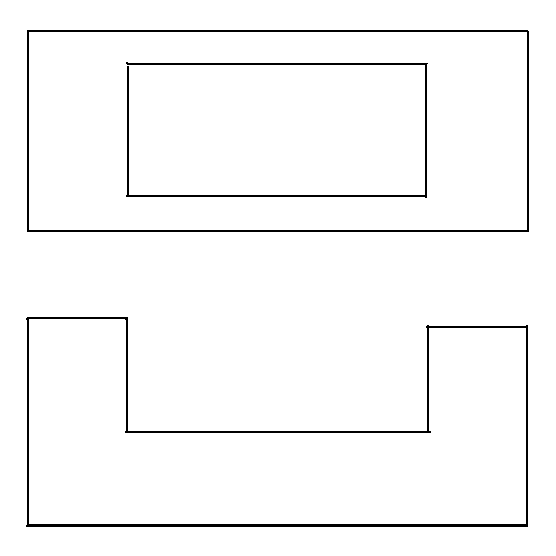
Question 2: I agree with LAX. I don't think it could be a half circle, because of the vertical half wall along the front side. It could definitely be an arc on top of vertical walls though.

It is a half circle. Look at the image I posted. To account for the vertical halfwall in the front image, imagine taking the half circle i posted, and about 2/3 of the way down drawing a dotted line horizontally through it. That dotted line would account for the elevation of the plane all the way through the entire depth of the shape/image. The inner rectangle in the top image is then dug down below the elevation of that plane. From above you would see the dug out section which would appear to be a square. From the front view you would see none of that because your line of site would be blocked by the "half wall", which is essentially the elevation of the "floor" of you object so to speak.

Imagine it like this. You have a bridge, where the road surface is composed of asphalt 12 inches thick. Running parallel to each other along the edges of the bridge you have an arched truss on each side. The bridge is 20 feet long. You take 2 steps into the bridge, then begin to burrow out a hole 6 inches down into the 12 inch asphalt. The hole you burrow runs all the way across the bridge and stops two steps before the end. It extends out wide to the edge of the road right before the truss begins on each side.

Now, imagine you go back to the beginning of the bridge, put your eyes completely at ground level, the point where the 12 inches of asphalt meets the ground, and imagine every object on the bridge is opaque. You would not see the hole you burrowed because it would be below the line of site of the plane of the road. the trusses would appear to be squared off from the front, and would be conjoined with the 12 inches of asphalt which now becomes your "half wall".
From above you would see the 6 inch hole you burrowed out as a rectangle. On the edges, because of the curvature of the trusses, and because everything is opaque you would not see any transition from higher elevation to lower elevation other than your burrowed out hole which creates distinct lines due to the sharp change of elevation.

For visual aid....from the front these trusses would not show curves in a 2D rendering.

23tm3rn.jpg
 

IrishLax

Something Witty
Staff member
Messages
37,545
Reaction score
28,991
Question 2: I agree with LAX. I don't think it could be a half circle, because of the vertical half wall along the front side. It could definitely be an arc on top of vertical walls though.

For what it's worth, I just want to make it clear I'm supporting half-circle. Te'o4Heisman is spot on. Half-circle works great (as do a number of other solutions with curved edges) with no funny business necessary. I'm just also saying there's an awful lot of room for interpretation in the question and a lot of alternative answers because of that.
 

theclassickiller

old and improved
Messages
500
Reaction score
104
See, that's not exactly true, and here's why. If you stick a 2D rectangle or whatever (re: no depth to this object) on the side view you can still have unaltered top and front views while completely altering the side view. That's why the question is flawed. To put it another way, you could have your object with a circle or semi-circle that works; and then stick a 2D rectangle on top of it in AutoCAD and get a completely different side view.

On principle, you are correct. In practicality, I'm saying the question doesn't work unless we add some more premises/conditions to it.

Wait... are you trying to say by "no depth to this object" that you could take the side view and essentially "draw" any shape on the solid surface (since that drawing is a two-dimensional entity with no depth) and that constitutes the side view? Something on the surface of an object that has no depth will not show up in a three-dimensional projection. Surely your students are not saying that.

It has to be a semi-circle. The are no other shapes that can have a cutout section all the way through and yet not show any lines distinguishing changes in depth (except of course the triangle, but there would be a line across the length of the top view if that were the case). Because the semi-circle has an arc to it, the front view can still show the two sides straight up with a section cut out in the middle and the top view can show what looks like a hole in the center. All shadowing, etc. aside, this appears to be the only answer that would be acceptable in the industry (yes, I am in the industry).

Maybe if you can explain your side a little more clearly Lax I could try to look at it again and learn something new. And then trick the old farts at work. No offense to the old farts here.
 

IrishLax

Something Witty
Staff member
Messages
37,545
Reaction score
28,991
Wait... are you trying to say by "no depth to this object" that you could take the side view and essentially "draw" any shape on the solid surface (since that drawing is a two-dimensional entity with no depth) and that constitutes the side view? Something on the surface of an object that has no depth will not show up in a three-dimensional projection. Surely your students are not saying that.

The question is: what does the side view look like based on these two 2D drawings? The answer is: the side view could be any other 2D figure that fits within the height and width constraints as specified in the front and top views.

There is a really strong inherent flaw to the question... and it should be obvious that there is an infinite solution set (even if you reject what I'm saying, there is still an infinite solution set of drawings with curved upper edges that satisfy the constraints given).

It has to be a semi-circle. The are no other shapes that can have a cutout section all the way through and yet not show any lines distinguishing changes in depth (except of course the triangle, but there would be a line across the length of the top view if that were the case). Because the semi-circle has an arc to it, the front view can still show the two sides straight up with a section cut out in the middle and the top view can show what looks like a hole in the center. All shadowing, etc. aside, this appears to be the only answer that would be acceptable in the industry (yes, I am in the industry).

Maybe if you can explain your side a little more clearly Lax I could try to look at it again and learn something new. And then trick the old farts at work. No offense to the old farts here.

If by semi-circle you mean you mean any number of objects with a curved upper edge, then yes. Hell, you can even do a triangle and just round off the point on the top and it works.

You're understanding me correctly, all I'm saying is I had a drafter physically fool around with it on AutoCAD and you can manipulate the side view to be whatever you want within the height and width without having any effect on the two drawings given. It's just a a really, really bad/poorly phrased question with a lot of room for interpretation. And there are an infinite number of solutions (even if you don't give it the funny business I'm suggesting).
 

BeauBenken

Shut up, Richard
Staff member
Messages
16,041
Reaction score
5,491
Wait... are you trying to say by "no depth to this object" that you could take the side view and essentially "draw" any shape on the solid surface (since that drawing is a two-dimensional entity with no depth) and that constitutes the side view? Something on the surface of an object that has no depth will not show up in a three-dimensional projection. Surely your students are not saying that.

It has to be a semi-circle. The are no other shapes that can have a cutout section all the way through and yet not show any lines distinguishing changes in depth (except of course the triangle, but there would be a line across the length of the top view if that were the case). Because the semi-circle has an arc to it, the front view can still show the two sides straight up with a section cut out in the middle and the top view can show what looks like a hole in the center. All shadowing, etc. aside, this appears to be the only answer that would be acceptable in the industry (yes, I am in the industry).

Maybe if you can explain your side a little more clearly Lax I could try to look at it again and learn something new. And then trick the old farts at work. No offense to the old farts here.

OHHHH. Now I think I get what your saying.

You're saying that if it were a rectangle then a line would be drawn showing the sudden drop in depth in the top view. Correct?

Like so?
OHHHH.png
 
H

HereComeTheIrish

Guest
This is way more entertaining than "Gamer"/"Uniform" Threads... Bravo.
 

Te'o4Heisman

Well-known member
Messages
2,510
Reaction score
2,616
OHHHH. Now I think I get what your saying.

You're saying that if it were a rectangle then a line would be drawn showing the sudden drop in depth in the top view. Correct?

Like so?
OHHHH.png

Winner winner chicken dinner! That is precisely what I tried to explain, albeit in a horrible way for anybody but me to understand what I was saying.
What I said in my original post was

"If the middle were cut out like that of a perfect rectancle, the verticle inside lines of of the top rendering would extend all the way to the edges of the outer rectangle thus creating the image as a series of two isolated rectangles on the outside running vertical, two narrow rectangles on the top and bottom inside running horitontal, and then the inner most rectangle."

If you read through that jumbled mess slowly, it would describe exactly the picture you posted. I looked for an image to represent it online, and could find none. I knew exactly what I was trying to say, just had a hell of a time putting the vision in my head into words that would help somebody else envision what I was.
 

BeauBenken

Shut up, Richard
Staff member
Messages
16,041
Reaction score
5,491
Winner winner chicken dinner! That is precisely what I tried to explain, albeit in a horrible way for anybody but me to understand what I was saying.
What I said in my original post was

"If the middle were cut out like that of a perfect rectancle, the verticle inside lines of of the top rendering would extend all the way to the edges of the outer rectangle thus creating the image as a series of two isolated rectangles on the outside running vertical, two narrow rectangles on the top and bottom inside running horitontal, and then the inner most rectangle."

If you read through that jumbled mess slowly, it would describe exactly the picture you posted. I looked for an image to represent it online, and could find none. I knew exactly what I was trying to say, just had a hell of a time putting the vision in my head into words that would help somebody else envision what I was.

Lol Don't blame yourself. I blame myself for being so simple minded. Too many big words in a row and suddenly I'm not really thinking. lol
 

Te'o4Heisman

Well-known member
Messages
2,510
Reaction score
2,616
To better explain, imagine this is your side view below.

The dotted line running from the one side of the arch horizontally to the other side is your elevation plane. Above the line has been completely hollowed out except your two arches that run parallel to each other on the very edges which creates the front image that seems to have a half wall in them middle, then two higher walls on the sides.

The rectangle that is formed by dotted lines branching off below the that is also hollowed out, but not all the way to the edges of your form. From the top you would see that additional hollowed out rectangle in the bottom of the form, but from the front that hollowed out rectangle would be obstructed from view by the the "half wall" portion of the shape. Think of it like an above ground swimming pool. If you were looking at it from the side, but from a height that is half way up the side, you would not be able to see that it opens up inside, but certainly from above you could.

a2rmub.jpg
 

theclassickiller

old and improved
Messages
500
Reaction score
104
The question is: what does the side view look like based on these two 2D drawings? The answer is: the side view could be any other 2D figure that fits within the height and width constraints as specified in the front and top views.

There is a really strong inherent flaw to the question... and it should be obvious that there is an infinite solution set (even if you reject what I'm saying, there is still an infinite solution set of drawings with curved upper edges that satisfy the constraints given).


If by semi-circle you mean you mean any number of objects with a curved upper edge, then yes. Hell, you can even do a triangle and just round off the point on the top and it works.

You're understanding me correctly, all I'm saying is I had a drafter physically fool around with it on AutoCAD and you can manipulate the side view to be whatever you want within the height and width without having any effect on the two drawings given. It's just a a really, really bad/poorly phrased question with a lot of room for interpretation. And there are an infinite number of solutions (even if you don't give it the funny business I'm suggesting).

Ok this makes sense. Yes, it could be any shape with zero vertices on the top edge of the side view as long as the tallest of the "peaks" was closest to the front of the object (otherwise the other "peaks" would show up behind the front "peak" in the front view). So keeping that in mind, and realizing that the top edge is actually one of only two edges (the top and bottom, there can be no vertical edges) and that they both meet on both ends at the ground, there are an infinite amount of answers.

You'll find, however, that many times a projection view will show lines on rounded objects representing the inflection points. On a continually curved object without any change in concavity (such as a semi-circle) you would have no lines because there are no changes in concavity. This is why I believe that only a semi-circle (or other half shape with only one curve) can truly represent this top view. Does the drafter's top view not represent inflection points when he has multiple curves?
 

Endzone2

Banned
Messages
89
Reaction score
11
Here is one solution for the side view. If you didn't have high school drafting, you're at a bit of a disadvantage with this problem. There are a lot of solutions because you could move the curves on the side view in or out in relation to the hidden line in the side view. The width of the hidden line has to be constant to the width shown in the rectange in the top view.

Also I messed up this side view drawing a little bit. It should be just a little bit narrower than it is and a little bit taller than it is. Thanks for playing.

original.jpg


original.jpg


There really aren't an infinate number of solutions though. You can not move the width of the side view (below the dotted line) out more than the width of the base because then the top view would change. You could not move the width of the side view (below the dotted line) in more than the width of the dotted line because then there would be a hidden line in the top view.
 
Last edited:

Te'o4Heisman

Well-known member
Messages
2,510
Reaction score
2,616
Here is one solution for the side view. If you didn't have high school drafting, you're at a bit of a disadvantage with this problem. There are a lot of solutions because you could move the curves on the side view in or out in relation to the hidden line in the side view. The width of the hidden line has to be constant to the width shown in the rectange in the top view.

Also I messed up this side view drawing a little bit. It should be just a little bit narrower than it is and a little bit taller than it is. Thanks for playing.

original.jpg


original.jpg

Interesting enough this would also work, and for a completely different reason than mine would.
 

IrishLax

Something Witty
Staff member
Messages
37,545
Reaction score
28,991
Ok this makes sense. Yes, it could be any shape with zero vertices on the top edge of the side view as long as the tallest of the "peaks" was closest to the front of the object (otherwise the other "peaks" would show up behind the front "peak" in the front view). So keeping that in mind, and realizing that the top edge is actually one of only two edges (the top and bottom, there can be no vertical edges) and that they both meet on both ends at the ground, there are an infinite amount of answers.

You'll find, however, that many times a projection view will show lines on rounded objects representing the inflection points. On a continually curved object without any change in concavity (such as a semi-circle) you would have no lines because there are no changes in concavity. This is why I believe that only a semi-circle (or other half shape with only one curve) can truly represent this top view. Does the drafter's top view not represent inflection points when he has multiple curves?

No it didn't, that would obviously change things.

Also, to expand on what I was saying... I had him do a half-circle in the "middle" section where it matters and then ramp up in a smooth way to the rectangle... if that makes sense. So it's not like it's just some floating 2D plane. I dunno, it's hard to describe and even harder to draw in paint.

But yeah, had him render it in 3D and it's a "real" shape and then in the ortho view in 2D all of the lines matched up.
 

BeauBenken

Shut up, Richard
Staff member
Messages
16,041
Reaction score
5,491
Uh oh. You've lost me again...

Uh oh. You've lost me again...

Interesting enough this would also work, and for a completely different reason than mine would.

How is it for a completely different reason?
 

theclassickiller

old and improved
Messages
500
Reaction score
104
No it didn't, that would obviously change things.

Also, to expand on what I was saying... I had him do a half-circle in the "middle" section where it matters and then ramp up in a smooth way to the rectangle... if that makes sense. So it's not like it's just some floating 2D plane. I dunno, it's hard to describe and even harder to draw in paint.

But yeah, had him render it in 3D and it's a "real" shape and then in the ortho view in 2D all of the lines matched up.

Ok, I think I see what you're saying. As long as inflection isn't shown what you say makes sense. I'm still having a hard time grasping the "ramp up" to the rectangle, because in my mind there are still flat edges on your 3D object and that would create edge lines. You should draw it on paint anyway!

Here's my attempt at paint showing what I was explaining earlier with the inflection (for the maybe one person still interested):

DEMO.jpg


You can see that if there was a curved edge on top and it met a vertical side then the front projection would look like the one above showing that edge. And if there was a curve "peak" behind the frontmost curve that was taller than the frontmost curve (represented by the dotted gray line) then it would show up as another depth level on the front projection. I marked the inflection points in red and represented them in the top view with thin lines (maybe I'm old school ha).

But if you were looking at the projection as a rendered object, not as a wireframe then there would be no inflection and what your draftsman drew would work.

I'm trying to write a report right now and you guys are distracting me. I... just... can't... minimize.

But this is more fun anyway. I love CAD and I love Notre Dame. Where else am I going to get these two topics in the same place?
 

theclassickiller

old and improved
Messages
500
Reaction score
104
Ok, I see where Te'o is heading now. The problem with your diagram, Te'o, is that the "walls" would have lines representing where the arches sit on them. So with vertical sides like you have, there would need to be more lines in the top projection and in the front project showing where the arches meet the flat surfaces.
 

Endzone2

Banned
Messages
89
Reaction score
11
No it didn't, that would obviously change things.

Also, to expand on what I was saying... I had him do a half-circle in the "middle" section where it matters and then ramp up in a smooth way to the rectangle... if that makes sense. So it's not like it's just some floating 2D plane. I dunno, it's hard to describe and even harder to draw in paint.

But yeah, had him render it in 3D and it's a "real" shape and then in the ortho view in 2D all of the lines matched up.

Yea, you could make the curved part above the dotted line narrow very quickly and kind of spike up like a thin point as long as it was rounded at the top.
 
Top