I appreciate the thoughtful response:
I still think an individual like Chicago would benefit much more from reading Animal Farm than a book written by Ralph Nader;
Chicago and I are pretty far apart on a lot of political issues, but we both agree that crony capitalism is a serious problem. That's the subject of Nader's book, which we both expressed some interest in. But you dismissed the book immediately based on its author, and instead recommended that a "silly liberal" like chicago would do better reading an allegorical criticism of Soviet Communism. Doesn't that seem a bit condescending?
[A]nd even though Animal Farm was written with Stalin in mind, the theme can easily be applied to our current government.
Really? Once one starts making comparisons to extremist ideologies (fascism, communism, etc.), the prospect for meaningful dialogue goes out the window. And I would argue that uniformity of political philosophy--shared across both parties-- is a much bigger problem in America than extremism.
The problem with individuals like Chicago (who seems to be a nice guy) is that they lack the knowledge in certain subjects and take the easy way and simply find literature that confirms their preconceived notions. For example, a couple of months ago Chicago found an article written by an obscure journalist claiming that speculators trading futures contracts were driving up the price of the underlying commodity and profiting from this. I explained to Chicago what this was not possible but it did not matter since the author's conclusion matched is own and therefore the author must be correct even though it was clear that the author had no idea what futures are used for; but what was really humorous was that even in the article the author made reference to a quote from an individual heading up a UN agency no less, who stated that futures speculators had no impact on the price of the underlying commodity. This opinion was summarily dismissed by both the author and Chicago.
We're all guilty of this to varying extents, which is one reason why it's good to have civil discussions about controversial topics here. And to chicago's credit, his posting has indicated a consistent willingness to adapt his political views in response to strong arguments or evidence to the contrary. Now he knows more about futures contracts; but does that single misinformed article invalidate his underlying concerns about corporatism? Absolutely not.
Then more recently, Chicago concludes that ATT buying Direct TV is somehow going to create a monopoly in the US telecommunication industry. Question, what telecommunication services does Direct TV provide? Answer: none. As a matter a fact ATT already has an agreement with Direct TV to provide TV service to ATT customers who do not have U-verse service but want a bundled package of phone, internet and TV. Therefore ATT buying Direct TV will have no impact on telecommunication pricing. My quess is that ATT wants access to Direct TV's NFL "Sunday Ticket" package. If they can renew the contract with the NFL they can probably offer the package to their existing U-verse customers and probably increase their U-verse subscriber base with this option. But why let facts get in the way. Chicago found some article written by some college professor who ranted about the lack of access and high prices in the US related to high speed internet and other telecommunication and TV services. And which country did the professor used in comparison to the US to justify his conclusions? France of course. I quess it doesn't matter that France has population density ratio of a little less then 4x's the ratio of the US making this like comparing apples and oranges. But why do a little research when you can find gibberish to confirm your preconceived notion that corporations are simply in business to screw you.
There is ample evidence to support the contentions that: (1) the Antitrust Division isn't looking out for Joe Consumer; and (2) America's telecom giants are lobbying hard for the right to extract rents from Americans instead of providing the sort of infrastructure improvements that they've been promising for decades. I agree that AT&T's purchase of DirecTV doesn't have monopoly implications, but just because chicago linked to a dubious article doesn't mean that he (or his arguments) should be categorically dismissed as misinformed.
That is why Chicago in my opinion would benefit from reading Animal Farm (assuming he has not read it already) then Ralph Nader. He seems to not really want to research an issue that he does not understand and will stop when he finds any piece that agrees with his own preconceived notions. Anyway, that is all I have to say on this issue.
Animal Farm is a classic, and should be read for its own artistic merits. But how are chicago's politics going to be improved by reading it? I can't recall him ever recommending communistic policies, so I doubt he'd find much to disagree with there. In fact, the vast majority of people on the American left have no problem condemning communism, just as those on the right have no issue denouncing fascism.
However, I have a question for you. You seem interested and knowledgeable with regard to classical economic theories. I am curious if you know anything about Joseph Schumpeter? If not don't worry about it is is not that important. If you are familiar with Mr. Schumpeter I am curious about how you feel about his views that equilibrium is not the normal state of the economy?
I'm not sure how to gauge my relative knowledge of economics. I didn't major in it, but I took a handful of econ courses as electives during undergrad and law school, have had a subscription to
The Economist since high school, etc. So, maybe I'm conversant? Definitely not an expert.
Yes, I'm familiar with Schumpeter (
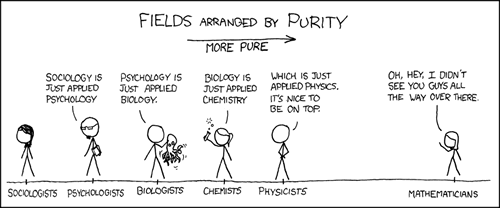
The Economist runs a column named after him), and as a general rule, the Austrian School is intuitively more appealing to me than the Modern, but I'd be in over my head if I tried to take a position on the chief disagreements between them. Regardless, I'm increasingly coming around to the view that it's absurd to treat this most miserable of subjects as a hard science, since it's all contingent on very complex (and still poorly understood) human behaviors:
(Economists would be even further to the left than the Sociologist).
And both schools are very liberal in their philosophy-- they assume that humans are autonomous individuals who interact with each other on a mostly contractual basis, and that "the market" is a pre-existing force of nature that humans discover, rather than a social construct whose contours are defined by the rules and norms that govern it. I disagree strongly with both of those premises, and I think our tendency to analyze everything in economic terms is a symptom of something that is profoundly wrong with modern society.
But I've gotten ahead of myself.