Healthcare

Legacy

New member
Messages
7,871
Reaction score
321
State Actions to Improve the Affordability of Health Insurance in the Individual Market (KFF)
Summary:
Discussion
Actions taken by states in recent years to address rising premiums in the marketplaces sharply differ, reflecting divergent views on the success of the ACA and the role states should play in enforcing the ACA insurance market standards. These state policy choices have implications for the future stability of the marketplaces as well as on the affordability and availability of comprehensive coverage for all residents.

To ensure coverage is available for healthy and sick alike, a number of states have adopted strategies aimed at shoring up the marketplaces and enforcing ACA standards by limiting the availability of coverage outside the marketplaces. These states have sought to lower premiums using levers such as reinsurance programs or enhancing subsidies. One of the challenges states face with these approaches is the need for state financing. States are able to access federal funding through section 1332 waivers; however, an investment of state resources is necessary to have a meaningful effect on lowering premiums. Although reinsurance programs, in particular, have broad bipartisan appeal, the need for state financing has likely precluded more states from implementing these programs. Additionally, while other actions, such as establishing a state individual mandate or public plan option, may not require an investment of money, they require political consensus that may be hard to achieve in other states.

Importantly, state decisions over whether or how to regulate non-ACA-compliant plans will have significant implications for moderate-income consumers with pre-existing conditions. In states that allow non-ACA-compliant policies to proliferate as lower cost alternatives to qualified health plans for people who are currently healthy, adverse selection in the marketplaces will likely continue to drive up premiums. While consumers with lower incomes who are eligible for subsidies will be insulated from any premium increases, consumers with health conditions who do not qualify for subsidies may end up without any affordable coverage options.
 

Legacy

New member
Messages
7,871
Reaction score
321
Drug Pricing

Drug Pricing

A Look at Recent Proposals to Control Drug Spending by Medicare and its Beneficiaries (Kaiser Family Foundation, Aug 01, 2019)

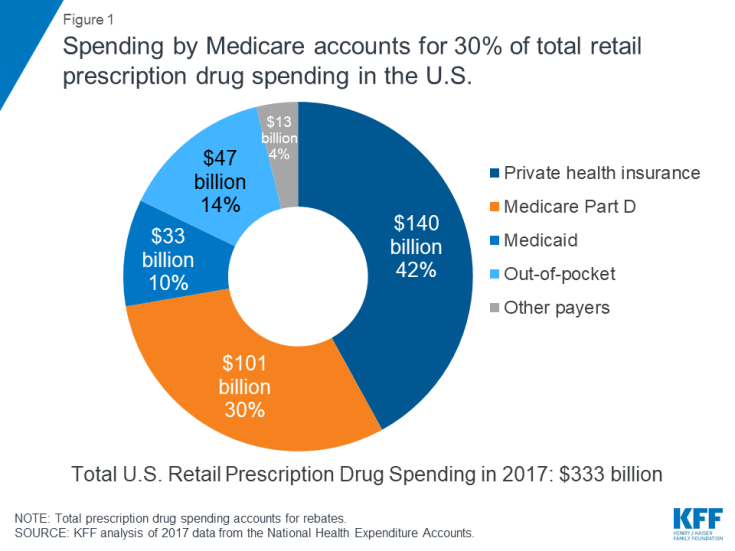
The affordability of prescription drugs is a pressing concern for many Americans, with broad agreement across the political spectrum that lowering prescription drug costs should be a top priority for Congress. The Trump Administration, members of Congress, and several 2020 presidential candidates have offered proposals to lower drug prices. Many of these proposals would affect prescription drug spending under Medicare, which accounts for 30 percent of national retail spending on drugs and nearly $1 out of every $5 in total Medicare spending (Figure 1).
8834-04-Figure-1.png


Prescription drugs are an important component of health care for Medicare beneficiaries, which includes more than 60 million older adults and people with long-term disabilities. The majority of Medicare prescription drug spending is for drugs covered under Part D, the outpatient prescription drug benefit. Medicare Part B also covers drugs that are administered to patients in physician offices and other outpatient settings.

9331-Figure-1.png


Medicare lets private payers negotiate on their behalf. Medicare outsources the negotiation process to private payers. For drugs bought in pharmacies, these drugs are paid under Part D insurance plans. Seniors purchase Part D plans from private payers who contract with Medicare to provide this insurance. For drugs administered by a doctor, Medicare will average the drug prices negotiated across all private payers. This is called the “Average Selling Price.” or ASP which also dictates how doctor’s get paid for drug-related services. Medicare reimburses doctors ASP + 4.3% for doctor-administered drugs.

Medicaid and VA Drug Pricing

Medicaid takes the lowest negotiated price by private payers. After which, states have the right to further negotiate price. Aetna, Express Scripts, and Oscar Insurance all negotiate with pharma companies for the best price. Perhaps Aetna and Oscar only receive 20% discounts while Express Scripts receives a 30% discount. This 30% discounted price is now the Medicaid price. Additional requirements ensure this price level adjusts to inflation. Although the federal government helps fund Medicaid, it’s managed at the state level. At the state level, Medicaid can indeed negotiate further discounts with pharmaceutical companies. However, the federal government is still prohibited.
For Medicaid, companies are mandated to provide drug price rebates.

For The Veterans Administration (VA) drug companies must charge the lowest price they offer to anyone in the private sector. The VA is also entitled to a guaranteed minimum discount of 24 percent off the non-federal Average Manufacturer Price (an amount similar to the minimum discount guaranteed to Medicaid), or a lower price to match the best price provided to non-federal purchasers.

The 1992 Veterans Health Care Act granted the VA minimum discounts on drugs, similar to those received by Medicaid. Notably, the VA discount was enacted after the 1990 Medicaid rebate law, which guaranteed Medicaid a discounted price and also required manufacturers to give Medicaid the "best price" they offered. Once the Medicaid rebate law took effect, some manufacturers canceled discounts to other purchasers (including the VA) to avoid setting a best price that would also have to be offered to Medicaid.

In 2000 the GAO found that one likely impact of extending VA or Medicaid pricing to the Medicare population would be an increase in prices for federal and private purchasers. Citing the experience after enactment of the Medicaid rebate law, the GAO stated that manufacturers would likely cancel other federal pricing agreements wherever possible to avoid having to extend those prices to the much larger Medicare population.

Congress has lowered the percentage doctors may get with the ASP which then lowered drug costs for Medicare. But the processes for drug pricing for the VA, Medicaid, and Medicare are established by law. Since drug pricing for Medicare is determined by ASP vs lowest negotiated price and rebates for Medicaid, Medicare prices are higher.

A Medicaid for All would be cheaper than Medicare for All unless under new law Medicare drug pricing were changed to lowest negotiated price. But drug companies would examine canceling other contracts to keep prices higher. Only in the case where the federal government was the only health care purchaser and negotiator would this type of move by drug companies be negated. Other proposed ways of lowering drug costs to the consumer outside of statutory changes to Medicare and Medicaid laws are reviewed in the article above.

In 2017, total gross spending on prescription drugs was $154.9 billion in Medicare Part D, $30.4 billion in Part B, and $67.6 billion in Medicaid.
 
Last edited:

Whiskeyjack

Mittens Margaritas Ante Porcos
Staff member
Messages
20,894
Reaction score
8,126
Thread:

<blockquote class="twitter-tweet"><p lang="en" dir="ltr">Private insurance is very good at effectively pricing risk. Bad drivers should pay more for car insurance, and homes should be priced out of being built in areas with pre-existing risk factors like being below a mountain prone to mudslides<a href="https://t.co/hiiaRvZnMC">https://t.co/hiiaRvZnMC</a></p>— James Medlock (@jdcmedlock) <a href="https://twitter.com/jdcmedlock/status/1164576572554113024?ref_src=twsrc%5Etfw">August 22, 2019</a></blockquote> <script async src="https://platform.twitter.com/widgets.js" charset="utf-8"></script>
 

Old Man Mike

Fast as Lightning!
Messages
8,972
Reaction score
6,462
.... if only that were true.


cue scenes of gulf beach property and New Orleans.
 

Irish YJ

Southsida
Messages
25,888
Reaction score
1,444
posted this in the dem candidate thread, but probably belongs here too....


I wish someone, anyone, even a dem candidate would come out and say.

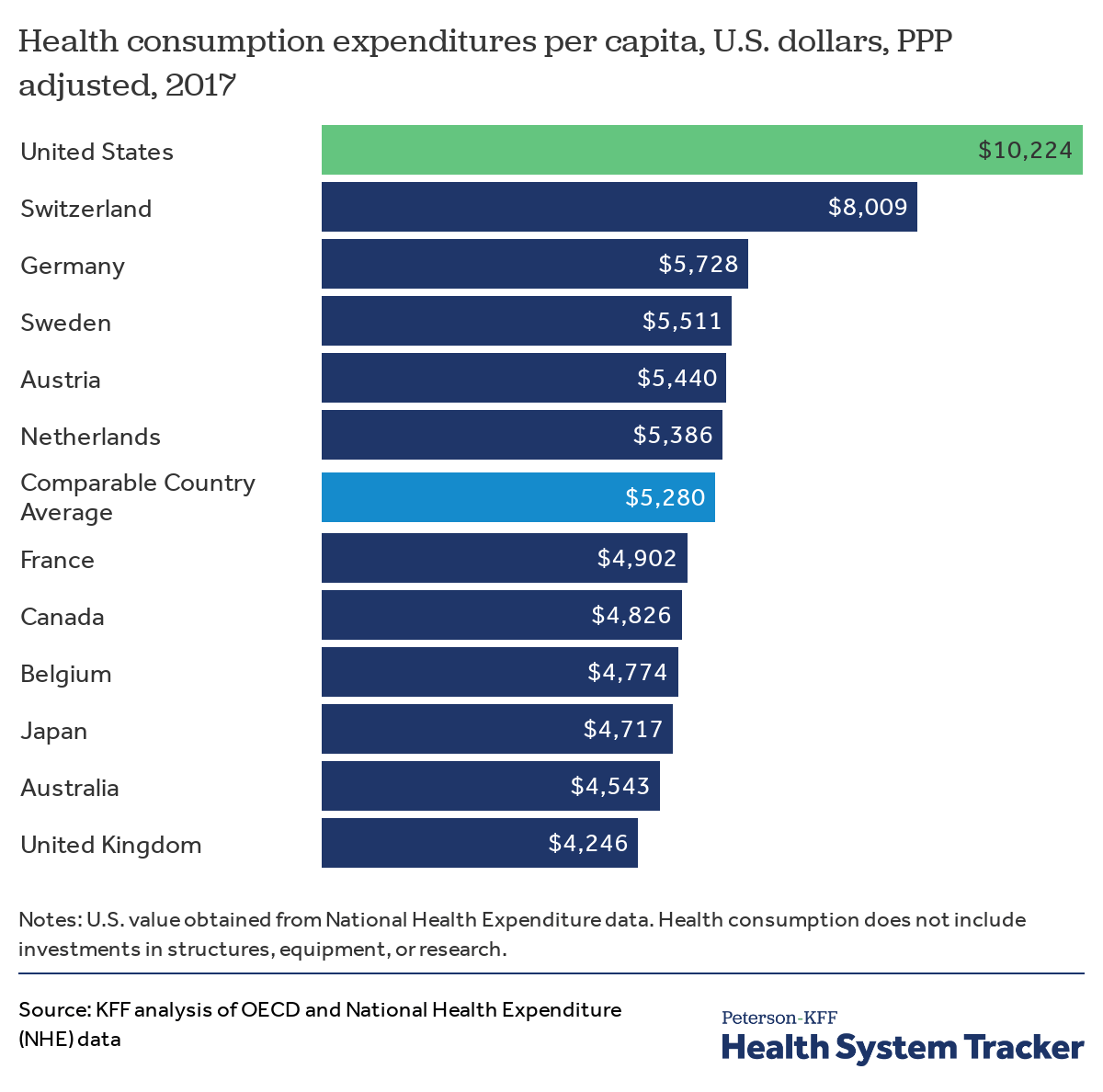
"Hey, we already spend twice as much per capita on medical compared to countries like Canada, France, and the UK who have national health care".

Shouldn't that mean that we already spend enough to cover everyone twice as good as those countries? But hey, we need to keep paying all the middle men for sub par shit care that doesn't cover everyone. And hey, we need to raise taxes at the same time.

SMGDH

full.png


main-qimg-93a891abb40fb9a5d4b6bcc788ad2b3c.webp
 

RDU Irish

Catholics vs. Cousins
Messages
8,622
Reaction score
2,724
.... if only that were true.


cue scenes of gulf beach property and New Orleans.

Isn't that all FEDERAL flood insurance and not private? Stossel has a good piece on the boondoggle that is federally subsidized flood insurance for millionaire beach homes.
 

RDU Irish

Catholics vs. Cousins
Messages
8,622
Reaction score
2,724
I don't understand the free pass given to doctors in the health care debate. Glorified drug dealers in many cases and they act like a cartel protecting their turf from competing medical providers by keeping PAs and NPs subservient to them and controlling the supply of specialists and doctors in general. And who makes up all of the middle management of hospital systems sipping coffee in meetings and never laying a hand on a patient? Can't wait for the AMA to violently oppose tech based health solutions once they start posing a threat to their office hours.
 

Legacy

New member
Messages
7,871
Reaction score
321
Doctors in Debt: These Physicians Gladly Struck a Deal With California

Since physicians are not necessarily obligated to take Medicaid patients and Medicaid pays 60% of private insurance's reimbursements, doctors may well limit their Medicaid patient load. If they see a Medicaid patient in the hospital who requires follow-up, they are obligated to see the patient once after discharge. Areas with larger proportions of Medicaid and Medicare patients like rural areas see a shortage of physicians. Many states have to give incentives to keep physicians in those areas.
 
Last edited:

Legacy

New member
Messages
7,871
Reaction score
321
It's almost axiomatic that a small group of people account for a major part of health care spending in the U.S. Year to year, people may move into or out of this group. Any risk adjustment must take into account these super-users. The mantra of insurance and the health care industry is to keep them out of the hospital and/or diagnosis them early for intervention at a less costly level than the ER.

Fixing the 5 Percent;
“Super-users” with complex medical needs make up a small fraction of U.S. patients, but they account for half of the nation’s overall health-care spending. Now, innovative efforts are providing better care at lower costs. (Atlantic)

Excerpt:
The program that has helped Rizzuto is part of a nationwide movement to improve care for people struggling with very complicated medical needs—so-called super-users—the 5 percent of patients who account for about half of the country’s health-care spending. (Surgeon and New Yorker writer Atul Gawande outlined the problem and one solution in a definitive 2011 piece about the Camden Coalition of Healthcare Providers.) Some of these super-user programs say they provide cost savings of as much as 20 to 40 percent after a few years, as well as provide the kind of advantages offered to Rizzuto: fewer stressful hospital visits, better mental and physical health, and the satisfaction of being treated like a person instead of a package of problems. The program accomplishes this by shifting the focus of medical care. Instead of responding to complications, the care team tries to prevent them. “You can’t even get to the medical issue until you’ve figured out: Do they have a place to sleep, do they have housing they’re not going to lose, do they have food in their refrigerator, do they have a refrigerator?” says Christopher Palmieri, the president and CEO of the nonprofit Commonwealth Care Alliance, which manages 80 percent of One Care patients, including Rizzuto.

The Affordable Care Act (Obamacare) spread the risk with their individual mandate, eliminating reimbursement for readmissions within thirty days, criteria for discharge to lower levels of care, chart reviews for violations with fines of admissions/discharge criteria.

Another analysis showed:
It finds that, among people with three consecutive years of coverage from a large employer, just 1.3 percent of enrollees accounted for almost 20 percent of overall spending in 2017. This group – people in the top five percent of spending in each of the three years from 2015 to 2017 – had average health spending of $87,870 in 2017. That compared to average per person spending of $5,870 among all large group enrollees during that period. Spending on retail prescription drugs accounted for almost 40 percent spending for those with persistently high spending in 2017, more than twice the percentage for enrollees overall.

The analysis also finds a close association between having persistently high spending and being diagnosed with certain chronic health conditions such as HIV, multiple sclerosis, cystic fibrosis, rheumatoid arthritis, diabetes with complications, and a number of cancers. While not everyone with these conditions has persistently high spending, there are large shares of people with persistently high spending who have these diseases.
(Source)

Without lowering the costs involved with super-users and either identify problems and providing early interventions for other factors noted above, insurance companies spread the risk and costs to the rest of us. Lowering drug costs is one of many solutions but a significant one - forty percent.
 
Last edited:

Irish#1

Livin' Your Dream!
Staff member
Messages
44,591
Reaction score
20,040
It's almost axiomatic that a small group of people account for a major part of health care spending in the U.S. Year to year, people may move into or out of this group. Any risk adjustment must take into account these super-users. The mantra of insurance and the health care industry is to keep them out of the hospital and/or diagnosis them early for intervention at a less costly level than the ER.

Fixing the 5 Percent;
“Super-users” with complex medical needs make up a small fraction of U.S. patients, but they account for half of the nation’s overall health-care spending. Now, innovative efforts are providing better care at lower costs. (Atlantic)

Excerpt:


The Affordable Care Act (Obamacare) spread the risk with their individual mandate, eliminating reimbursement for readmissions within thirty days, criteria for discharge to lower levels of care, chart reviews for violations with fines of admissions/discharge criteria.

Another analysis showed:
(Source)

Without lowering the costs involved with super-users and either identify problems and providing early interventions for other factors noted above, insurance companies spread the risk and costs to the rest of us. Lowering drug costs is one of many solutions but a significant one - forty percent.

It's the old 80/20 rule adjusted slightly. Our company has struggled to provide affordable medical coverage. When Obamacare went into effect our rates took a big jump. We have two people that make up over 80% of medical costs. One has a chronic severe issue with his stomach that causes him to miss work more than average. Why? He refuses to watch what he eats, which lands him in the emergency room on a regular basis.
 

Legacy

New member
Messages
7,871
Reaction score
321
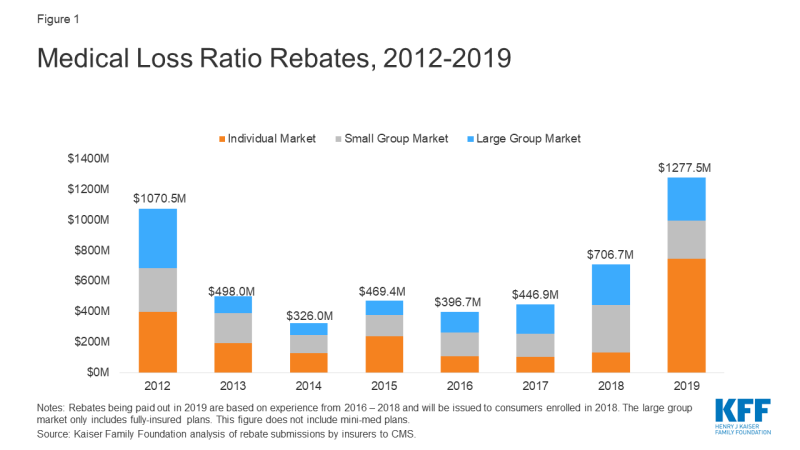
Ever hear of health insurance companies rebating portions of premiums? That was built into the Affordable Care Act and the rebates for 2019 are expected to set a record.

The Centers for Medicare and Medicaid Services (CMS) explanation of Medical Loss Ratio (MLR) calcuation:
Medical Loss Ratio
Many insurance companies spend a substantial portion of consumers’ premium dollars on administrative costs and profits, including executive salaries, overhead, and marketing.

The Affordable Care Act requires health insurance issuers to submit data on the proportion of premium revenues spent on clinical services and quality improvement, also known as the Medical Loss Ratio (MLR). It also requires them to issue rebates to enrollees if this percentage does not meet minimum standards. The Affordable Care Act requires insurance companies to spend at least 80% or 85% of premium dollars on medical care, with the rate review provisions imposing tighter limits on health insurance rate increases. If an issuer fails to meet the applicable MLR standard in any given year, as of 2012, the issuer is required to provide a rebate to its customers.

Those requirements on amounts health insurance companies must spend on health care and quality improvement (80-85%) restricted amounts companies' administration, marketing, and profit to 15-20%.

Using data reported by insurers to CMS, Kaiser Family Foundation estimates insurers will be issuing a total of at least $1.3 billion across all markets – exceeding the previous record high of $1.1 billion in 2012 (based on 2011 experience). The amount varies by market, with insurers reporting at least $743 million in the individual market, $250 million in the small group market, and $284 million in the large group market. Rebates also differ by state.

Without that requirement in federal health care law, those dollars would not be rebated. In 2017, the Senate’s Better Care Reconciliation Act (BCRA) would have eliminated the federal requirement that insurers spend the majority of premiums on health care. (That measure that Mitch McConnell had worked on for months did not pass the Senate.)

Including the rebates being issued in the fall of 2019, total rebates issued from 2012 through 2019 will amount to nearly $5.2 billion.

9346-Figure-1.png


Data Note: 2019 Medical Loss Ratio Rebates (KFF)

Billions in ACA rebates show 80/20 Rule’s impact (HealthInsurance.org)
 
Last edited:

Irish#1

Livin' Your Dream!
Staff member
Messages
44,591
Reaction score
20,040
And think of all of the administrative costs involved that not only do the insurers incur for issuing these rebates, but the government in overseeing this program and that's not counting the companies that offer healthcare to their customers. Maybe we should eliminate the AHCA and let free enterprise drive the market. Competition tends to drive down costs.
 

Legacy

New member
Messages
7,871
Reaction score
321
I'd encourage anyone to read the articles and comments which I have posted - as well as NOLA's outlining one of the biggest barriers to lower health care costs - are decreased competition in the marketplace to understand the components of current federal health care law and the health insurance and hospital trends of historic mergers and acquisitions. These M&As are both horizontal (the six largest HC insurance companies to three, hospitals acquiring smaller ones) and vertical (acquisition by Aetna of CVS, etc).

Otherwise, look at the graph I posted to see where the largest component of MLRs is reflective of profits above limits of established by the ACA and also the KFF article.

Or Google articles like:
Think health insurance is too costly? The parent of Blue Cross Blue Shield of Illinois made $4.1 billion last year. (Chi Trib)

The parent company of Illinois’ largest health insurer, Blue Cross and Blue Shield of Illinois, made a profit of $4.1 billion last year – more than three times as much as it did the year before, according to recent financial statements.

Much of that increase was driven by $1.7 billion the company got back from the federal government last year because of changes made under the new tax law. Blue Cross’ parent company, Health Care Service Corp., operates health insurance plans in five states, including Illinois, and is based in Chicago.

Blue Cross Blue Shield of Texas Parent Company More Than Tripled Profits to $4.1B in 2018
Health Care Services Corporation, the parent company for Blue Cross Blue Shield of Texas, did not pay federal taxes in 2018 and netted $4.1 billion, receiving a $1.7 billion tax refund last year, according to financial statements. In 2017, the company had a net income of $1.3 billion, an increase of over 315 percent for this year.

The tax overhaul passed by Congress and increasing profitability of health insurance played a large role in the increase, according to Axios. Profits don’t include fees from self-insured employers pay to HCSC, and the Affordable Care Act Marketplace was a big winner for HCSC. Only 64 percent of healthcare marketplace premiums were spent on medical care, resulting in $2.7 billion in gross profit. ACA plan holders may be in store for rebates due to premiums that were too high. Axios reports that there were certain tax loopholes that benefitted the Blue Cross companies.

Blue Cross and Blue Shield and subsidiaries are the only HC insurance company granted a tax exempt status by Congress, which they fiercely defend when it comes up for renewal. Only 64% of premiums were spend on medical care.

Think of it. Blue Cross and Blue Shield gets a tax refund of $1.7 Billion under the new tax law, nets $4.1 Billion, has a tax exempt status, pays no taxes and advocates a Republican Congress to eliminate the Medical Loss Ratio provision that penalizes them for not spending 80% on medical care when they only spent 64% last year. Do they want to only spend 50% of premiums on medical care? And use much of the rest to acquire other companies?

As a note: the 2017 AHCA (nicknamed Trumpcare), which would have repealed portions of the Patient Protection and Affordable Care Act (ACA or Obamacare), was hugely unpopular with the American public. Business Insider stated that the AHCA was "the least popular major bill in decades". That year Blue Cross and Blue Shield alone spent $24 million in lobbying. And in 2017 when the Tax Cuts and Jobs Act was passed that resulted in their tax windfall, they spent $17 million in lobbying. That resulted in their profit in 2019 of $1.7 Billion.
 
Last edited:

MJ12666

New member
Messages
794
Reaction score
60
I'd encourage anyone to read the articles and comments which I have posted - as well as NOLA's outlining one of the biggest barriers to lower health care costs - are decreased competition in the marketplace to understand the components of current federal health care law and the health insurance and hospital trends of historic mergers and acquisitions. These M&As are both horizontal (the six largest HC insurance companies to three, hospitals acquiring smaller ones) and vertical (acquisition by Aetna of CVS, etc).

Otherwise, look at the graph I posted to see where the largest component of MLRs is reflective of profits above limits of established by the ACA and also the KFF article.

Or Google articles like:
Think health insurance is too costly? The parent of Blue Cross Blue Shield of Illinois made $4.1 billion last year. (Chi Trib)


Blue Cross Blue Shield of Texas Parent Company More Than Tripled Profits to $4.1B in 2018


Blue Cross and Blue Shield and subsidiaries are the only HC insurance company granted a tax exempt status by Congress, which they fiercely defend when it comes up for renewal. Only 64% of premiums were spend on medical care.

Think of it. Blue Cross and Blue Shield gets a tax refund of $1.7 Billion under the new tax law, nets $4.1 Billion, has a tax exempt status, pays no taxes and advocates a Republican Congress to eliminate the Medical Loss Ratio provision that penalizes them for not spending 80% on medical care when they only spent 64% last year. Do they want to only spend 50% of premiums on medical care? And use much of the rest to acquire other companies?

As a note: the 2017 AHCA (nicknamed Trumpcare), which would have repealed portions of the Patient Protection and Affordable Care Act (ACA or Obamacare), was hugely unpopular with the American public. Business Insider stated that the AHCA was "the least popular major bill in decades". That year Blue Cross and Blue Shield alone spent $24 million in lobbying. And in 2017 when the Tax Cuts and Jobs Act was passed that resulted in their tax windfall, they spent $17 million in lobbying. That resulted in their profit in 2019 of $1.7 Billion.

Read the post and then found and reviewed the underlying HCSC 2018 financial report. Both articles you linked to stated that HCSC was able to get the $1.7 billion “income tax refund” in 2018. I found this curious so I took a look at the underlying HCSC financial report and will attempt to explain it to you what really occurred in the simplest terms possible.

First a little information regarding the corporate alternative minimum tax (AMT) since it turned out to be a major component of the alleged refund. Like individuals, prior to the passage of the 2017 tax act, corporations were required to calculate both a “regular” corporate income tax and the AMT; ultimately having to pay the higher of these two amounts. Just as with the individual AMT, the corporate AMT was intended to make a corporation pay at least some minimum amount of tax by limiting or eliminating certain deductions, credits, and other tax preference items. After making the necessary adjustments, the corporation determines its alternative minimum taxable income (“AMTI”), and calculates its tax based on the AMIT. As stated previously, the corporation owes the larger of the tax on its “adjusted” taxable income versus the tax on its AMIT. Under the provisions of the tax code prior to the 2017 tax act, a corporation generates a minimum tax credit for any AMT paid. This credit can then be used against a future “regular” tax liability where the taxpayer is paying a “regular tax”, but no portion of the credit could not be applied against any AMT liability. So essentially a portion of any AMT payments were a prepayment of future regular income taxes.

With that in mind, per the footnotes included in the HCSC 2018 financial report, the majority of the $1.7 billion in question basically represents the “net” impact of the 2017 tax act on the elimination of the corporate AMT and the impact on deferred taxes related to the reduction in the top corporate tax rate from 35% to 21%. These adjustments resulted in a net $1.7 billion tax credit being reflected on the “Federal and foreign income tax incurred” line of HCSC's 2018 “Summary of Revenue and Expenses”. How much of this credit (if any) was actually received by the company as a refund is not disclosed and therefore both articles claiming that HCSC received a $1.7 billion refund is misleading and possibly false, which makes any conclusions based on these articles suspect.

You can find the link to the HCSC's 2018 financial statement and related notes in the article linked below. This article also incorrectly refers to the $!.7 billion as a refund and not simply as what it is, a "credit" on the company's "income tax expense" line.

https://thehill.com/policy/healthca...er-didnt-pay-any-federal-taxes-in-2018-got-17
 
Last edited:

Legacy

New member
Messages
7,871
Reaction score
321
Read the post and then found and reviewed the underlying HCSC 2018 financial report. Both articles you linked to stated that HCSC was able to get the $1.7 billion “income tax refund” in 2018. I found this curious so I took a look at the underlying HCSC financial report and will attempt to explain it to you what really occurred in the simplest terms possible.

First a little information regarding the corporate alternative minimum tax (AMT) since it turned out to be a major component of the alleged refund. Like individuals, prior to the passage of the 2017 tax act, corporations were required to calculate both a “regular” corporate income tax and the AMT; ultimately having to pay the higher of these two amounts. Just as with the individual AMT, the corporate AMT was intended to make a corporation pay at least some minimum amount of tax by limiting or eliminating certain deductions, credits, and other tax preference items. After making the necessary adjustments, the corporation determines its alternative minimum taxable income (“AMTI”), and calculates its tax based on the AMIT. As stated previously, the corporation owes the larger of the tax on its “adjusted” taxable income versus the tax on its AMIT. Under the provisions of the tax code prior to the 2017 tax act, a corporation generates a minimum tax credit for any AMT paid. This credit can then be used against a future “regular” tax liability where the taxpayer is paying a “regular tax”, but no portion of the credit could not be applied against any AMT liability. So essentially a portion of any AMT payments were a prepayment of future regular income taxes.

With that in mind, per the footnotes included in the HCSC 2018 financial report, the majority of the $1.7 billion in question basically represents the “net” impact of the 2017 tax act on the elimination of the corporate AMT and the impact on deferred taxes related to the reduction in the top corporate tax rate from 35% to 21%. These adjustments resulted in a net $1.7 billion tax credit being reflected on the “Federal and foreign income tax incurred” line of HCSC's 2018 “Summary of Revenue and Expenses”. How much of this credit (if any) was actually received by the company as a refund is not disclosed and therefore both articles claiming that HCSC received a $1.7 billion refund is misleading and possibly false, which makes any conclusions based on these articles suspect.

You can find the link to the HCSC's 2018 financial statement and related notes in the article linked below. This article also incorrectly refers to the $!.7 billion as a refund and not simply as what it is, a "credit" on the company's "income tax expense" line.

https://thehill.com/policy/healthca...er-didnt-pay-any-federal-taxes-in-2018-got-17

Thank you, MJ, for your detailed explanation. I had hoped to return with my thoughts before this.

(HCSC fiscal statement - https://www.documentcloud.org/documents/5764214-Health-Care-Service-Corp-FY-2018.html)

As noted previously, the BCBS network has long had a not-for-profit status from the federal government which they rigorously defend when it comes up for renewal and lobbies heavily. That puts them in an advantageous situation relative to the other health insurance companies, which are all have for-profit tax status.

California changed Blue Cross's tax-exempt status to for-profit in 2015.
With billions in the bank, Blue Shield of California loses its state tax-exempt status

The ACA set standards for amount to spend on medical care while increasing premiums, which HCSC fell way short of triggering the MLR rebates. Without those standards and the penalties of rebates, they bank more money.

Besides the tax rebate, I wondered if HCSC pre-paid taxes and got a tax refund and if the 2017 tax act changed that.

Also, would a tax credit when applied be considered income subject to the 80% required minimum be spent on medical care that the latest fiscal report reflects? Or does their 64% spending on medical care not take that into account as income subject to those requirements?

Lastly, I thought of the high-risk pools the ACA and states have set up, which health insurance companies have contributed to on an annual basis. Should more of HCSC patients in the states they carry be improve their health statuses and fall out of the high-risk category, do they get a return on those monies, which might be termed a "tax refund"?

High-Risk Pools as Fallback for High-Cost Patients Require New Rules
 
Last edited:

Irishize

Well-known member
Messages
4,531
Reaction score
461
How many days would Bernie have to wait for his heart procedure under his proposed plan? Granted, we all know he goes straight to the front of the line as a politician but where would his old ass go as a regular Joe?
 

MJ12666

New member
Messages
794
Reaction score
60
Thank you, MJ, for your detailed explanation. I had hoped to return with my thoughts before this.

(HCSC fiscal statement - https://www.documentcloud.org/documents/5764214-Health-Care-Service-Corp-FY-2018.html)

As noted previously, the BCBS network has long had a not-for-profit status from the federal government which they rigorously defend when it comes up for renewal and lobbies heavily. That puts them in an advantageous situation relative to the other health insurance companies, which are all have for-profit tax status.

California changed Blue Cross's tax-exempt status to for-profit in 2015.
With billions in the bank, Blue Shield of California loses its state tax-exempt status

The ACA set standards for amount to spend on medical care while increasing premiums, which HCSC fell way short of triggering the MLR rebates. Without those standards and the penalties of rebates, they bank more money.

Besides the tax rebate, I wondered if HCSC pre-paid taxes and got a tax refund and if the 2017 tax act changed that.

Also, would a tax credit when applied be considered income subject to the 80% required minimum be spent on medical care that the latest fiscal report reflects? Or does their 64% spending on medical care not take that into account as income subject to those requirements?

Lastly, I thought of the high-risk pools the ACA and states have set up, which health insurance companies have contributed to on an annual basis. Should more of HCSC patients in the states they carry be improve their health statuses and fall out of the high-risk category, do they get a return on those monies, which might be termed a "tax refund"?

High-Risk Pools as Fallback for High-Cost Patients Require New Rules

First, again, we really do not know how much of a rebate they actually received because the balance listed on "Tax Expense" line on their financial statement includes many components, such as tax timing adjustments based on the effects of the 2017 tax act had on deferred tax accounts, any accrual reversals, actual credits applied against current tax liabilities, current period accruals, etc. Non-profit financial reporting requirements differ from SEC reporting requirements so the footnotes accompanying the HCSC's financials do not disclose the composition of the the $1.7 billion credit.

Second, in response to to your question: "would a tax credit when applied be considered income subject to the 80% required minimum be spent on medical care that the latest fiscal report reflects? Or does their 64% spending on medical care not take that into account as income subject to those requirements? " I do not believe so as from the link below, the denominator in doing the questioned calculations is "premium revenue", so even if hypothetically if the entire $1.7 billion credit on the income tax line was a cash refund, it would be excluded from these ratios as it obviously is not "premium revenue.

https://www.cms.gov/CCIIO/Programs-...urance-Market-Reforms/Medical-Loss-Ratio.html

The Affordable Care Act requires health insurance issuers to submit data on the proportion of premium revenues spent on clinical services and quality improvement, also known as the Medical Loss Ratio (MLR). It also requires them to issue rebates to enrollees if this percentage does not meet minimum standards. The Affordable Care Act requires insurance companies to spend at least 80% or 85% of premium dollars on medical care, with the rate review provisions imposing tighter limits on health insurance rate increases. If an issuer fails to meet the applicable MLR standard in any given year, as of 2012, the issuer is required to provide a rebate to its customers.
 

Legacy

New member
Messages
7,871
Reaction score
321
While there is much more understanding of diseases, treatment options, decentralization of facilities and patient rights nowadays, a look back at the history of psychiatric hospitals is an eye-opener. Manyof us are familiar with "One Flew Over the Cuckoo's Nest" filmed at the Oregon Mental Hospital. Even into the seventies, involuntary commitment did not involve the judicial system or have patient rights. It was an exercise of power. Adolescents could be sent to psych facility for acting out and defying their parents, until the parents would accept them back in those '60s and early '70s. In the first half of the twentieth century, women could sent there on the wishes of a husband. Those with mental disabilities, epileptics, alcoholics, diabetics, WWII veterans with "shell shock" or PTSD and those with depression as well as those with true disabling psychiatric conditions. Minors would be housed with adults, including those diagnosed with criminal behaviors. and would be sent there until their parents would accept them back. Some stayed their for the rest of their lives. With over 3,000 patients by the mid-'70s, the staff was overwhelmed. They lived and work there including cooking, raising crops, and other daily activities. They often died there and were buried in cemeteries on the grounds.The bodies were exhumed and cremated with their remains put in cans in the basement. Families often did not discuss relatives there, so subsequent generations had no idea relatives remains were in the hospital's basement. (See below)

The following is a series of essays that won the Oregonian a Pulitzer Prize and changed the Oregon mental health system, which has its historical museum.

Oregon's forgotten hospital

and on the issue of the remains of those who died there:
Missing dead: 1,500 from old Oregon State Hospital cemetery in Salem can't be found

More than 100 cremated remains from state hospital reunited with families (USA Today)
 
Last edited:

IrishLax

Something Witty
Staff member
Messages
37,545
Reaction score
28,995
<blockquote class="twitter-tweet"><p lang="en" dir="ltr">This is the nearly $1 million dollar medical bill ER nurse and new mother Lauren Bard received after her baby was born prematurely. <br><br>Her employer, Dignity Health, tried to use a loophole to stick her with the bill. <br><br> <a href="https://t.co/nVWnos2wUH">https://t.co/nVWnos2wUH</a> <a href="https://t.co/Ng9T37dQqN">pic.twitter.com/Ng9T37dQqN</a></p>— ProPublica (@propublica) <a href="https://twitter.com/propublica/status/1191709349116284928?ref_src=twsrc%5Etfw">November 5, 2019</a></blockquote> <script async src="https://platform.twitter.com/widgets.js" charset="utf-8"></script>

An example of why we need healthcare reform. I'm not sure what the perfect system is, but it sure as hell isn't this one.
 

irishff1014

Well-known member
Messages
26,513
Reaction score
9,287
<blockquote class="twitter-tweet"><p lang="en" dir="ltr">This is the nearly $1 million dollar medical bill ER nurse and new mother Lauren Bard received after her baby was born prematurely. <br><br>Her employer, Dignity Health, tried to use a loophole to stick her with the bill. <br><br> <a href="https://t.co/nVWnos2wUH">https://t.co/nVWnos2wUH</a> <a href="https://t.co/Ng9T37dQqN">pic.twitter.com/Ng9T37dQqN</a></p>— ProPublica (@propublica) <a href="https://twitter.com/propublica/status/1191709349116284928?ref_src=twsrc%5Etfw">November 5, 2019</a></blockquote> <script async src="https://platform.twitter.com/widgets.js" charset="utf-8"></script>

An example of why we need healthcare reform. I'm not sure what the perfect system is, but it sure as hell isn't this one.

This is crazy. Until the political parties quit getting money for heath insurance companies and different providers this will never happen.

Something has to be done. The emergency ambulances are being taking advantage of by nursing home because Medicare won’t pay for private ambulance companies. Then the hospitals get filled up with bs.
And I highly doubt you will get a group of doctors to give an honest opinion and take a pay cut.
 

Irish#1

Livin' Your Dream!
Staff member
Messages
44,591
Reaction score
20,040
<blockquote class="twitter-tweet"><p lang="en" dir="ltr">This is the nearly $1 million dollar medical bill ER nurse and new mother Lauren Bard received after her baby was born prematurely. <br><br>Her employer, Dignity Health, tried to use a loophole to stick her with the bill. <br><br> <a href="https://t.co/nVWnos2wUH">https://t.co/nVWnos2wUH</a> <a href="https://t.co/Ng9T37dQqN">pic.twitter.com/Ng9T37dQqN</a></p>— ProPublica (@propublica) <a href="https://twitter.com/propublica/status/1191709349116284928?ref_src=twsrc%5Etfw">November 5, 2019</a></blockquote> <script async src="https://platform.twitter.com/widgets.js" charset="utf-8"></script>

An example of why we need healthcare reform. I'm not sure what the perfect system is, but it sure as hell isn't this one.

"Save time and pay online". What was the loophole, baby premature?
 

Legacy

New member
Messages
7,871
Reaction score
321
<blockquote class="twitter-tweet"><p lang="en" dir="ltr">This is the nearly $1 million dollar medical bill ER nurse and new mother Lauren Bard received after her baby was born prematurely. <br><br>Her employer, Dignity Health, tried to use a loophole to stick her with the bill. <br><br> <a href="https://t.co/nVWnos2wUH">https://t.co/nVWnos2wUH</a> <a href="https://t.co/Ng9T37dQqN">pic.twitter.com/Ng9T37dQqN</a></p>— ProPublica (@propublica) <a href="https://twitter.com/propublica/status/1191709349116284928?ref_src=twsrc%5Etfw">November 5, 2019</a></blockquote> <script async src="https://platform.twitter.com/widgets.js" charset="utf-8"></script>

An example of why we need healthcare reform. I'm not sure what the perfect system is, but it sure as hell isn't this one.

Thanks for the link to the ProPublica article that has all the details. Amazing that she was employed by the Dignity Hospital, a religious affiliated institution, who also carried her health insurance and whose CEO made over $11 million that year!!

Neonatal intensive care for a twenty-six week old newborn is very, very expensive.
Excerpt from the article:
Bard could see no way out. On Oct. 7, she posted a photograph of the $898,000 bill on Facebook. “When Dignity Health (the company I work for) screws you out of your daughter’s insurance…” she wrote.

A week later, ProPublica, which had been flagged to Bard’s case while reporting about health insurance excesses, contacted a Dignity media representative.

The next day, Bard got a call from the senior vice president of operations for Dignity Southern California, who apologized and said she’d heard about the situation from the organization’s media team and would help. Two days later, Dignity added Sadie to the plan, retroactive to her birth date. It would cover the bills.

Dignity officials told ProPublica that they’d learned about Bard through her Facebook post. Bard said she doubts Dignity would have reversed course without the questions from ProPublica.
Good for ProPublica who wants to know these stories:
Has your employer wrongly denied your health benefits? Please share your story with reporter Marshall Allen at marshall.allen@propublica.org. Have you worked in health insurance or employer-sponsored health benefits? ProPublica is investigating the industry and wants to hear from you. Please complete our brief questionnaire.
I can't imagine if you were a private business owner with an employee in such a situation and advocating for her and the baby's coverage with the insurance company but knowing that your costs next year may impact next year's health insurance costs to you and your employee. Such babies also may birth defects and require further care to correct those in the future.

Dignity as her employer and who contracts with itself for health insurance can garnish her wages having denied all her appeals. Since the article does not mention all the physician's bills, perhaps those doctors not employed by the hospital may have waived their bills. Those employed by the hospital and with whom she may know and work would not have freedom to do that even if they wanted to.

A system that allows a health insurance company to own hospitals and acquire pharmaceutical companies, as is happening, with minimal if any federal regulation demonstrates its total and abject failure.
 
Last edited:

Irish#1

Livin' Your Dream!
Staff member
Messages
44,591
Reaction score
20,040
I was having a conversation with the owner of the company I work for. It's always a struggle to keep health care costs down. He pays 80% of the employee's cost. The employee has to pay for the spouse and kids which comes to over $500 a month. Our costs would go down dramatically if it weren't for five employees who make up more than 80% of the claims. One has an intestinal disorder and ignores it causing him to go to the ER all the time simply because he refuses to watch what he eats.
 

Legacy

New member
Messages
7,871
Reaction score
321
Committee votes to advance Medicaid expansion bill
(Wyoming Tribune Eagle Nov 12, 2019)

CHEYENNE – State lawmakers on the Joint Revenue Interim Committee voted 8-5 Tuesday to move forward with a bill authorizing Gov. Mark Gordon to expand Medicaid coverage in Wyoming.

If approved by the full Legislature next year, the bill would allow for expanding Medicaid to uninsured people whose income is at or below 138% of the federal poverty level.

An estimated 19,000 people in Wyoming would be newly covered within 24 months of the expansion, according to recent estimates from the state Department of Health.

Wyoming would cover 10% of the costs associated with expansion, a total of about $18 million in general funds during the first biennium of implementation. The federal government would pick up the remaining expense under the provisions of the Affordable Care Act.

The Legislature has considered Medicaid expansion for several years, and the state House of Representatives killed a similar bill during the 2019 general session.

Yet, for some legislators, this vote was different.

“I am totally opposed from a business point of view to Medicaid expansion, but the time has come,” said Rep. Pat Sweeney, R-Casper. “The data is supportive, and I believe that for the future of this state, it’s the right thing to do.” (cont)
 

Legacy

New member
Messages
7,871
Reaction score
321
The Uninsured and the ACA: A Primer - Key Facts about Health Insurance and the Uninsured amidst Changes to the Affordable Care Act (KFF, Jan 25, 2019)

How many people are uninsured?
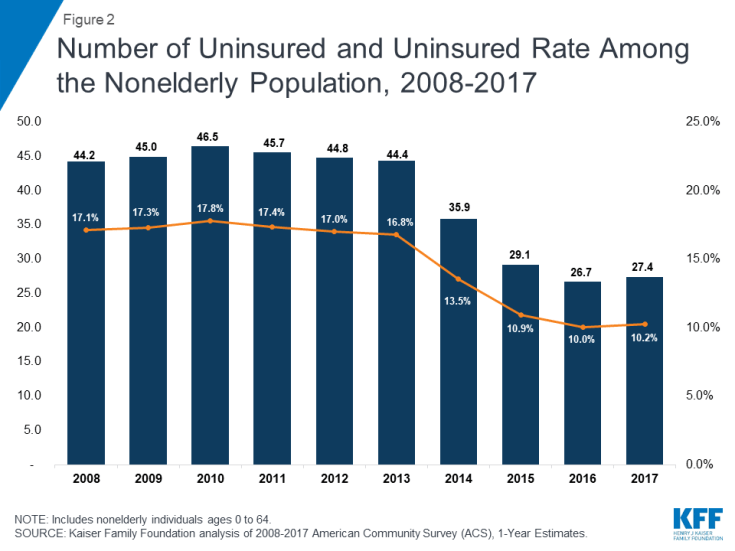
Before the ACA, the number of uninsured Americans grew over time, particularly during economic downturns. By 2013, the year before the major coverage provisions of the ACA went into effect, more than 44 million people lacked coverage.1 Under the ACA, millions of people have gained health coverage, and the uninsured rate dropped to a historic low in 2016. Coverage gains were particularly large among low-income people living in states that expanded Medicaid. However, for the first time since the implementation of the ACA, the number of people remaining without coverage increased by half a million in 2017, reaching 27.4 million.

Under the ACA, the uninsured rate and number of uninsured people declined to a historic low by 2016. The number of uninsured people and the share of the nonelderly population that was uninsured rose from 44.2 million (17.1%) to 46.5 million (17.8%) between 2008 and 2010 as the country faced an economic recession (Figure 2). As early provisions of the ACA went into effect in 2010, and as the economy improved, the number of uninsured and uninsured rate began to drop, hitting 44.4 million (16.8%) in 2013. When the major ACA coverage provisions went into effect in 2014, the number of uninsured and uninsured rate dropped dramatically and continued to fall through 2016 to 26.7 million (10.0%).2 Overall, nearly 20 million more people had coverage in 2016 than before the ACA was passed.

7451-14-figure-2.png
 
Last edited:

MJ12666

New member
Messages
794
Reaction score
60
How many people are uninsured?
Before the ACA, the number of uninsured Americans grew over time, particularly during economic downturns. By 2013, the year before the major coverage provisions of the ACA went into effect, more than 44 million people lacked coverage.1 Under the ACA, millions of people have gained health coverage, and the uninsured rate dropped to a historic low in 2016. Coverage gains were particularly large among low-income people living in states that expanded Medicaid. However, for the first time since the implementation of the ACA, the number of people remaining without coverage increased by half a million in 2017, reaching 27.4 million.

Under the ACA, the uninsured rate and number of uninsured people declined to a historic low by 2016. The number of uninsured people and the share of the nonelderly population that was uninsured rose from 44.2 million (17.1%) to 46.5 million (17.8%) between 2008 and 2010 as the country faced an economic recession (Figure 2). As early provisions of the ACA went into effect in 2010, and as the economy improved, the number of uninsured and uninsured rate began to drop, hitting 44.4 million (16.8%) in 2013. When the major ACA coverage provisions went into effect in 2014, the number of uninsured and uninsured rate dropped dramatically and continued to fall through 2016 to 26.7 million (10.0%).2 Overall, nearly 20 million more people had coverage in 2016 than before the ACA was passed.


The problem with the above highlighted statement is that between 2010 and 2016 the number of individuals who are enrolled in Medicaid increased by approximately 21 million (see data in the attached linked file). Basically there has been no significant change in the number of uninsured individuals who 1) earn to much and therefore do not qualify for Medicaid or 2) simply have decided not to purchase health insurance. Further, one can make a good argument that Medicaid is not health insurance since Medicaid does not charge any premiums. As such the ACA has not even come close to living up to its hype.

https://www.statista.com/statistics/245347/total-medicaid-enrollment-since-1966/
 
Last edited:
Top