Foreign Policy

Old Man Mike

Fast as Lightning!
Messages
8,972
Reaction score
6,460
Again, following up on my ignorance: whether we sell arms to the Saudis or not will depend upon how we see the balances of power between them and Turkey and a couple of others --- and having only secondarily to do with cash gained from sales or the Russians. The Saudis are "big boys", they know all this and can hardly be "offended" either way. They no longer have such a powerful OIL Card to play given world suppliers, but it is still a useful card in the global economy. They're a "Player" and both we and Putin know it. They are no one's puppet as long as Oil is King.

Public statements about whatever decisions are made will bear almost no connection with reality. These public statements are almost always entirely political for the benefit of home political bases. This procedure works politically because no one in the voting populace is interested nor capable of doing the research needed to understand the situations. American media knows this about American viewers and abdicates old values like "education" for simple Shock-Jock headlines. People hear what they want to hear and construct their separate fantasies (on all sides by the way.)

I take no sides on any IE "debate" on any of these issues --- note that I never use anyone's identifier when giving my opinions. If I comment I try to keep it on the concepts/facts/connections if at all possible. I realize that others can't help considering argued ideas as their ideas --- such is the structure of IE. But to the point: I find almost every one of these issues which generate bad vibes between IE "brothers" to be spoken from overly simplistic models of reality.

My go-to research path has been, for years, if it's political or foreign policy or military or any of that sort of heavy stuff, just follow the Money, the Economy, and National Security and the foundation is always "down there" somewhere, usually WAY below the media presentations or the politicians (again both sides) simple comments. This is not a "nice" world. It is basically run by insane men who want to "rule" things for God only knows what bent reasons. Insane men usually rule, and find ways for less insane men to go out and die for them, though not themselves. Sometimes good men "ascend" (descend) to power, and the power takes them with it rather than the other way around. Few can resist. There is essentially no Servant Leadership, nor even Statesmanship.

Sad. Hard to be optimistic when the power has become so great that great errors are possible.

But I pray for all of us, and keep it at my little human level, and now tend my garden and give my reserves away to good humanitarian local causes. ... makes me feel a little better.
 

Irish YJ

Southsida
Messages
25,888
Reaction score
1,444
Again, following up on my ignorance: whether we sell arms to the Saudis or not will depend upon how we see the balances of power between them and Turkey and a couple of others --- and having only secondarily to do with cash gained from sales or the Russians. The Saudis are "big boys", they know all this and can hardly be "offended" either way. They no longer have such a powerful OIL Card to play given world suppliers, but it is still a useful card in the global economy. They're a "Player" and both we and Putin know it. They are no one's puppet as long as Oil is King.

Public statements about whatever decisions are made will bear almost no connection with reality. These public statements are almost always entirely political for the benefit of home political bases. This procedure works politically because no one in the voting populace is interested nor capable of doing the research needed to understand the situations. American media knows this about American viewers and abdicates old values like "education" for simple Shock-Jock headlines. People hear what they want to hear and construct their separate fantasies (on all sides by the way.)
.

To the bolded, I suspect very few on our Congress understand things to the level they should.

Working 10 years managing EMEA shops and vendors forced me to learn. I've gleaned more from ME friends and family, and read plenty. Still, my knowledge is shit, but I'd bet both you and I know more than AOC and a good deal of the HoRs on both sides.

On Saudi, nobody is going to keep them from getting weapons. Whoever sells to them, will get the money, but more importantly gain leverage in the ME with the "relationship". And yes, the crap we see is 95% theater.
 

Legacy

New member
Messages
7,871
Reaction score
321
Again, following up on my ignorance: whether we sell arms to the Saudis or not will depend upon how we see the balances of power between them and Turkey and a couple of others --- and having only secondarily to do with cash gained from sales or the Russians. The Saudis are "big boys", they know all this and can hardly be "offended" either way. They no longer have such a powerful OIL Card to play given world suppliers, but it is still a useful card in the global economy. They're a "Player" and both we and Putin know it. They are no one's puppet as long as Oil is King.

Public statements about whatever decisions are made will bear almost no connection with reality. These public statements are almost always entirely political for the benefit of home political bases. This procedure works politically because no one in the voting populace is interested nor capable of doing the research needed to understand the situations. American media knows this about American viewers and abdicates old values like "education" for simple Shock-Jock headlines. People hear what they want to hear and construct their separate fantasies (on all sides by the way.)

I take no sides on any IE "debate" on any of these issues --- note that I never use anyone's identifier when giving my opinions. If I comment I try to keep it on the concepts/facts/connections if at all possible. I realize that others can't help considering argued ideas as their ideas --- such is the structure of IE. But to the point: I find almost every one of these issues which generate bad vibes between IE "brothers" to be spoken from overly simplistic models of reality.

My go-to research path has been, for years, if it's political or foreign policy or military or any of that sort of heavy stuff, just follow the Money, the Economy, and National Security and the foundation is always "down there" somewhere, usually WAY below the media presentations or the politicians (again both sides) simple comments. This is not a "nice" world. It is basically run by insane men who want to "rule" things for God only knows what bent reasons. Insane men usually rule, and find ways for less insane men to go out and die for them, though not themselves. Sometimes good men "ascend" (descend) to power, and the power takes them with it rather than the other way around. Few can resist. There is essentially no Servant Leadership, nor even Statesmanship.

Sad. Hard to be optimistic when the power has become so great that great errors are possible.

But I pray for all of us, and keep it at my little human level, and now tend my garden and give my reserves away to good humanitarian local causes. ... makes me feel a little better.

As far as IE "debates" go, most everyone understands that I won't respond to some attempts or posts that may lead to unproductive engagements. We each have our points of view. I do value others' thoughts and take an interest in postings of articles that stimulate thinking. Regardless, should anyone feel that I evidence a viewpoint that upsets them, please think of the Ignore function IE provides. PM me if you want me to use that for you. As you know, Mike, I always value your postings and insights. Enough said.

Now that the U.K. is changing leadership and undergoing Brexit, it will be interesting to see how the trade relationship evolve. As one of our longest allies, in many ways as nations we are headed in different directions on issues such as the environment, for interest, where soon their alternative sources of energy will exceed fossil fuels sources in providing power. Boris Johnson has recently announced a new trade agreement with Australia, who want to develop their manufacturing of weapons. Britain too are relying less on the U.S. with lots of discussion among NATO members about buying next gen fighters as well as passenger aircraft from each other. Germany recently announced that the F-35 has been eliminated from the competition. Natural gas (LNG) is at an all time low as Russia and the U.S. have competed for European business. The U.S. now has a glut of LNG and expanding development, pipelines, and terminals for exports. With the Admin focusing on sales of armaments and weapons systems, LNG, farm products and automobiles with threats of leaving NATO, sanctions on countries that export Russian NG, tariffs on Europe for steel and autos, sanctions for business with Iran, etc. markets in Europe may be looking for new trade partners and will be less reliant on U.S. products. The two biggest imports by the U.K. from the U.S. are Aircraft and Mechanical power generators.

The UK-US trade relationship in five charts (See graphs)

One area that has potential are prescription drugs. Like Canada, drugs are much cheaper in the U.K. - three times cheaper. Despite promises of lowering drug prices for American consumers, this Admin has failed and not allowed competition in the marketplace, exercised selective protectionism, not negotiating drug prices or instituted price controls. If the U.S. truly wants a competitive marketplace for our products in Europe, they must allow Britain and the EU to compete in ours. The British Medical Journal recently studied Insulin pricing and said that Britains should be paying $100 for insulin per year. Their current costs for a Type 1 diabetic is $532 per person per year, in the US, the cost for an insured patient averages $1,251 per year. Without health insurance, Cutting our drug prices by allowing more competition from Europe and Canada would be in everyone's advantage, except the pharmaceutical companies. Without insurance of any kind, the cost of an insulin vial in the U.S. is $275.
The human cost of insulin in America

While Britain is committed to buying F-35s having invested in their development and deploying them for the first time in last week, they may be buying less. Europeans are combining to develop a sixth generation aircraft and other weapons systems to compete with the U.S. and Russia. Europeans may have learned that they cannot rely on the U.S. in trade and defense treaties as much as they have in the past. Changes in leadership may not matter as much on these issues.

How the U.S. Pays 3 Times More for Drugs
In Britain the world's 20 top-selling medicines are three times cheaper than in the U.S.


How many sixth-gen fighter projects is too many? Britain’s defense secretary weighs in.

British defense export officials previously said more than 12 nations had been engaged in discussions over joining the Tempest program. The report to Parliament said that the Tempest project was starting to ramp up. Some 120 subcontracts were awarded and more than 1,000 people are working on the project, a number that is expected to double within a year.
 
Last edited:

Legacy

New member
Messages
7,871
Reaction score
321
While Congress is in recess and Sec of State Mike Pompeo is out of the country, he Trump administration has put a temporary hold on the majority of congressionally approved foreign aid funds, pending a review by the State Department and the US Agency for International Development. The funding for this fiscal year will run out on Sept 30th. Pompeo and Congress have in the past opposed this action. Trump's OMB is using a process called OMB may propose to Congress canceling the appropriated funds, which is known as rescission, or reprogramming them.

The USAID official said "it is pretty clear they will try to rescind the money." That official noted that OMB made a similar attempt last year but Congress rejected the move.

In a statement, Rep. Eliot Engel, the chairman of the House Foreign Relations Committee, called the move a "dangerous action" and vowed to reverse any rescission or reprogramming.
"This Administration's contempt for Congress is astounding. When Congress decides how much we spend on foreign assistance, it isn't a suggestion. It's the law, backed up by the constitution. President Trump and Secretary Pompeo should follow the law and stop playing politics with our foreign affairs budget. If they move ahead with this plan, I'll use the full power of the Foreign Affairs Committee to reverse their efforts and to demand answers about why this Administration seems determined to ignore the will Congress and undermine American leadership."

U.S. AID, its purpose, the law that established it and what programs it operates. (Wiki)

As a background,
How Does the U.S. Spend Its Foreign Aid? (Council on Foreign Relations)

Republican Sen. Lindsey Graham and Republican Rep. Hal Rogers wrote to Trump Friday to express their concern over the proposed cancellation.
Not only do these cuts have the potential to undermine significant national security and anti-terrorism efforts of our diplomats and international partners overseas, but we fear such a rescission package could complicate the ability of the Administration and Congress to work constructively on future appropriations deals.

Graham is the chairman of the Subcommittee on State, Foreign Operations and Related Programs of the Senate Appropriations Committee and Rogers is the ranking member of the Subcommittee on State, Foreign Operations and Related Programs of the House Appropriations Committee. The leaders from the Senate Foreign Relations Committee and the House Foreign Affairs Committee also urged the administration not to put forward a rescission package.

Congress must make some decisions on appropriations for fiscal 2020 by Sept 30th when funding for the government runs out. This repurposing of appropriations by the Admin "complicates" an agreement and the work of the Appropriations Committees for fiscal 2020.

Appropriations Committee Releases Fiscal Year 2020 State and Foreign Operations Funding Bill
 
Last edited:

Legacy

New member
Messages
7,871
Reaction score
321
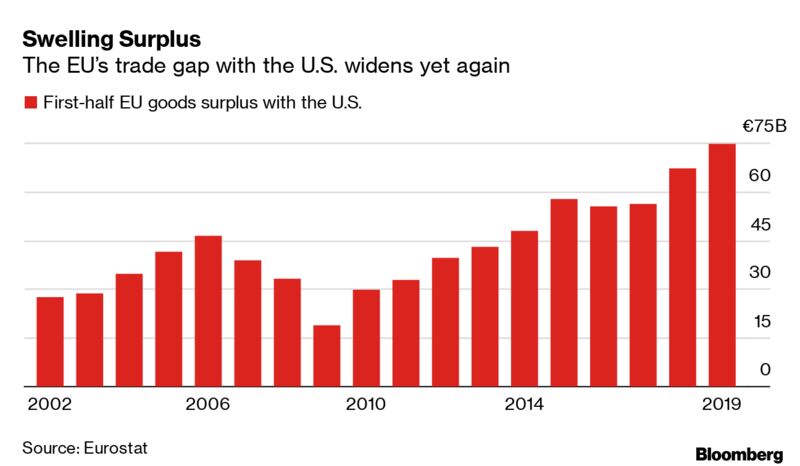
On the EU front, since Trump's tariffs were instituted in June 2018, the EU trade surplus with the U.S. has increased. Something the Donald pays attention to. He is about to add further tariffs.

800x-1.png


From: Europe Just Reminded Trump Why He’s Mad at Them on Trade (Bloomberg, August 16, 2019)

Speaking in New Hampshire last night, Trump repeated his frustration. “The European Union is worse than China, just smaller. It treats us horribly.”

The WTO has found in the U.S. favor as far as the EU's subsidization of Airbus. If only whiskey was not been drawn into the fight....

Scotch whisky targeted by new US tariffs (BBC, 2 July 2019)

Scotch whisky is among the products targeted by the US for a possible range of new tariffs on imported goods.

The US has threatened to impose tariffs on European Union imports worth up to $4bn (£3.2bn), although it is not known when tariffs would be imposed.

Whiskey from Ireland, cheeses including Parmesan and Gouda, pasta and olives are other items affected.

The US Trade Representative said it was "in response to harm caused by EU aircraft subsidies".
U.S. whiskey exporters struggle after year of EU tariffs (Reuters, Aug 18, 2019)

Foreign governments subject to U.S. President Donald Trump’s trade tariffs have targeted American distilleries and their bourbon and rye whiskeys for retaliation. The industry fears new tariffs under consideration by the U.S. government could result in even higher tariffs on their products in Europe.

“We went from a marginally profitable business to breaking even,” Mountain Laurel’s owner and chemical engineer-turned-distiller, Herman Mihalich, said while testing his latest batch of rye whiskey in the sleepy hamlet of Bristol in southeast Pennsylvania.

U.S. whiskey exporters are struggling to recoup lost sales after shipments to Europe plummeted 21% between June 2018 and 2019, according to data from the Distilled Spirits Council, a U.S. industry group.

In the 12 months before the tariffs hit, the United States exported $757 million of rye and bourbon. From July 2018 to June 2019 exports were $597 million. Exports are a sizeable chunk of sales the U.S. whiskey industry, which generated $3.6 billion in revenue in 2018.

The Distilled Spirits Council said that 63% of U.S. whiskey exports have faced retaliatory tariffs from the European Union, China, Turkey, Canada and Mexico. The EU currently levies 25% tariffs on U.S. whiskey.

The U.S. Trade Representative’s office is preparing to slap tariffs of up to 100% on $1.8 billion worth of European spirits and wine in response to illegal European aid to planemaker Airbus (AIR.PA), the most recent development in a 15-year-long trade dispute between Europe and the United States.

A word to the wise...
 
Last edited:

Old Man Mike

Fast as Lightning!
Messages
8,972
Reaction score
6,460
I wish that our country could realize that this president has no policies. He throws salvos around in the style that has colored his whole life. Once "out there" he then says whatever feels best from the reaction. We are surviving this behavior because the actual policy do-ers are working behind the media scenes trying to create sensible approaches to things which (if one paid attention to twitter) are incredibly shallow and never nuanced with many-dimensional concerns.

Some of these people behind the scenes are appointees, and might have carried their own policies into their departmental offices, but these longer-held policies are not the president's --- they doubtless attempt to convince him that they are good policies, and he might then tweet shallow versions of them. The actual work will go on elsewhere while he turns his attention to ratings.

Most of the people working on things of foreign and domestic policy will have little to nothing to do with the administration. They will be lifers in the big cabinet departments who have lived through presidents of all persuasions. These lifers serve as moderation-creators vs radical shifts. They are the people who have actual on-the-ground knowledge, which is fed up through the ranks to the appointees. Radical appointees CAN choose to ignore them, obviously, but they are one strong internal filter trying to keep government fact-based if not sane or thoughtful.

It is my opinion that this inbuilt conservatism in the big departments is what powerful monied people hope will allow the economy (particularly) to survive this president. They all knew that he was a debt/spend oriented risk-taker who did not fear anything like bankruptcy. There is a famous interview WAY prior to this current president's run, where T Boone Pickens listened to some of his ideas on the Oil markets, rolled his eyes and said: I'll make a deal with you --- you stay out of the oil business and I'll stay out of real estate.

We've sort of survived this guy so far. Just now, his explosiveness is creating a real global economic threat for the first time. Lots of people are now just a bit breathless as to whether in-built conservatism and facts can pull him back off his trajectory. Instead of Twit-and-Fury amounting to little or nothing, this one might just stick (in everyone's craw.) If so, it will be the first actual Policy this guy has pushed into reality, for all our good or bad.

All the world now awaits to see if he can turn it into a dice-rolling Vegas drama. ... and the stock market and investors sit there wondering what the rules are anymore.
 

Legacy

New member
Messages
7,871
Reaction score
321
Mike,

State Department Watchdog Censures Two Trump Appointees for Harassing Career Staffers (Foreign Policy)

First Paragraphs:
The U.S. State Department’s Office of Inspector General (OIG) concluded in a report released Thursday that two senior political appointees routinely harassed career officials they deemed insufficiently loyal to President Donald Trump.

The 34-page report, which followed a lengthy investigation, found that U.S. Assistant Secretary of State Kevin Moley and Mari Stull, a former senior advisor, berated career staffers in the State Department’s Bureau of International Organization Affairs, commonly referred to as the IO Bureau.

The investigation followed a Foreign Policy story last year documenting allegations that Stull had bullied and demeaned staffers and sought to drive out career officials who were associated with Obama administration policies, including support for gay and lesbian rights as well as those of Palestinians.

In an email response to a request for comment, Stull told Foreign Policy that the inspector general’s “report focuses on false and silly allegations by career bureaucrats who hate President Trump.”

“The report is politically motivated payback for my efforts to implement President Trump’s agenda over the resistance of Deep State bureaucrats who opposed his reform agenda,” she said. “I was never even given an opportunity to interview with the [inspector general] during my tenure with the Administration. The report contains false and misleading information.”

The inspector general did not directly address Foreign Policy’s report that Stull had compiled a loyalty list. But it alleged that Stull retaliated against career officials perceived as politically disloyal and that she’d referred to her colleagues in the IO Bureau as the “swamp” on her personal Twitter account.

The report by the Inspector General (linked in the first line above) details findings under the hostility, harassment and retaliation paragraphs, noting many senior level State Department staff have left. Similarly, many of the scientists involved in producing evidence-based reports as required by Congress and have been key to producing consistent and solid policies through a number of Presidents have left. His appointees consider these long-term employees who have developed policy plans think of them as the Deep State.
 
Last edited:

Irish YJ

Southsida
Messages
25,888
Reaction score
1,444
I find it ironic that "progressives" are defending status quo policy and people that are responsible for the current trade deficit situation and the worst CAB in the world. It's been a cluster for so long with the US on the wrong side of just about every trade deal and defense agreement. I guess we should just pretend it didn't happen, isn't still happening, and embrace the same policy furthering the atrocious CAB..
 

Irish YJ

Southsida
Messages
25,888
Reaction score
1,444
On the EU front, since Trump's tariffs were instituted in June 2018, the EU trade surplus with the U.S. has increased. Something the Donald pays attention to. He is about to add further tariffs.

800x-1.png


A word to the wise...

Hey Legacy. Did you notice the point at with the surplus started to grow?
 

Irish YJ

Southsida
Messages
25,888
Reaction score
1,444
So I'm confused..... I thought Dems and MSM hated Bolton. Why do they love him now and blame Trump?
 

Legacy

New member
Messages
7,871
Reaction score
321
Some recent quotes from Rex Tillerson:

“Every successful negotiation is defined as both parties leaving with an acceptable outcome. If you ever think about a negotiation as a win/lose, you’re going to have a terrible experience, you’re going to be very dissatisfied, and not very many people are going to want to deal with you.”

“I always believe deep in those words from Lincoln, that in our deepest, darkest moments, we were able to call upon ‘the better angels of our nature’ to overcome that which we thought was so divisive we could never find affection for one another again.”

“I watch with great anguish the mood of the country and the kind of rhetoric that goes on in public …. [and] it pains me. It breaks my heart. But I go back to Lincoln, and my great hope is that that is still defining of the American people.”

Also,
Figures published on Friday show that the EU’s trade surplus with the U.S. stood at almost 75 billion euros ($83 billion) in the first half of 2019, up more than 11% from a year earlier. EU exports to America have consistently outpaced imports. But the difference between them has steadily increased. A decade ago Europe’s bilateral surplus with the U.S. was a mere 18.7 billion euros.

As an example,
- Germany’s surplus is by far the largest in the bloc. Total exports to the U.S. outweighed imports by 112 billion euros from January through June.
 
Last edited:

Whiskeyjack

Mittens Margaritas Ante Porcos
Staff member
Messages
20,894
Reaction score
8,126
Matt Stoller published a recent newsletter titled "How Bill Clinton and American Financiers Armed China":

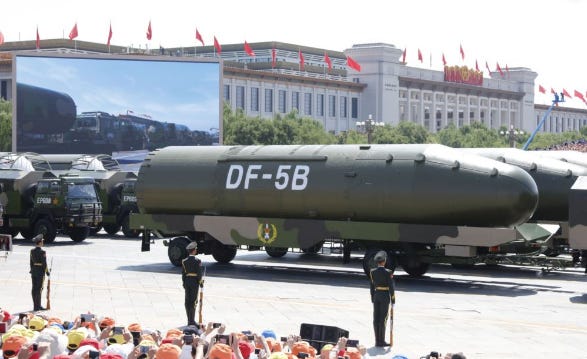
It’s the 70th anniversary of the People’s Republic of China, which Xi Jinping is celebrating with aggressive rhetoric and a militaristic display of his ICBMs that can strike at the U.S. in 30 minutes. So today I’m going to write about how American aerospace monopolists, dumb Pentagon procurement choices, and the Bill Clinton administration helped create the Chinese missile threat we are now confronting.

But first, two house-keeping notes. First, I asked for stories about management consulting stupidity, and you responded. I’ll be publishing some of your thoughts, from both the employee side and the consulting side (“confession of the Bob’s”). Feel free to send me your story if you haven’t yet. I’m going to be delving more into what seems to be a crisis of management in corporations and governing institutions across the West.

Second, the piece I wrote WeWork post went viral. It was reposted on Business Insider and the Stigler Center’s ProMarket blog, and someone sent me an email with this wonderful line: “By the way, I knew Adam Neumann before he launched WeWork and everything you said about him is 100% accurate.” I wrote that piece partially because I know there are 10,000 people who had to work for Neumann and deal with his behavior, and someone needed to point out that cruel behavior from bosses is not ok.

And now…

https%3A%2F%2Fbucketeer-e05bbc84-baa3-437e-9518-adb32be77984.s3.amazonaws.com%2Fpublic%2Fimages%2F9191c44b-fe4f-402a-bab5-a6b9bcd99446_587x359.png


How America Equipped China with Missile Technology

In August of 1994, Bill Clinton’s Secretary of Commerce, Ron Brown, flew to China to try and seal two deals for American corporations. The first was to enable Chrysler the ability to build minivans in China, and the second was to get the Chinese to buy 40 MD-90 aircraft ‘Trunkliners” from McDonnell Douglas.

The McConnell Douglas deal was particularly important to the Clinton administration for a number of reasons. The company was dying; it was badly run by financiers who lacked an appreciation for quality production. More importantly, it had lost a key military contract for the F-22 in 1986, so the government felt an obligation to find customers to prop it up. There was also politics, with Bill Clinton trying to honor his unofficial 1992 campaign slogan, “it’s the economy, stupid.” Clinton would indeed hail the deal on the eve of the 1994 midterm election.

The Chinese agreed to buy the planes, but with one caveat. They wanted a side deal; McDonnell Douglas should sell a mysterious company called the China National Aero Technology Import and Export Corporation (CATIC) a set of specialist machine tools that shape and bend aircraft parts stashed in a factory in Columbus, Ohio.

When Chinese representatives went to Columbus, Ohio, workers wouldn’t let them see the tools, because workers realized that they would lose their jobs if the tools were sold to the Chinese. The Chinese then sent a letter to the corporation saying that the deal for the Trunkliners was at a stalemate, but if the machine tools were sold to a mysterious Chinese company, well, that would have a “big influence” on whether McDonnell Douglas could close the deal on the planes.

It wasn’t just the workers who caused problems. The government could have been a hurdle for McDonnell Douglas as well, because these weren’t just any old machine tools. “According to military experts,” reported the New York Times, “the machines would enable the Chinese military to improve significantly the performance abilities -- speed, range and maneuverability -- of their aircraft. And if diverted, they could do the same for missiles and bombers.” Selling the tools wasn’t just a commercial deal, the machining equipment was subject to export controls for sensitive national security technology.

It was an insane idea, selling the Chinese government this important machining capacity. The Pentagon protested vehemently, as did Republican Congressman Tillie Fowler, who was on the Armed Services Committee. Fowler said allowing the transfer to reflects an ''emphasis on short-term gain at the expense of national security and long-term economic gain.'' And yet that’s what McDonnell Douglas sought, and what the Clinton administration pushed through. The Commerce Department cleared the deal, in return for a pledge (or behavioral remedy) that China would not use the tools to build missiles, but would dedicate them to a civilian aircraft machine tool center in Beijing.

McDonnell Douglas basically knew the behavioral remedies were fraudulent almost immediately; one of the most important pieces of equipment was shipped not to Beijing but directly to a Nanchang military plant. It wasn’t just McDonnell Douglas who understood the con; Clinton officials had the details of the deal, and let it go through anyway. Why? They used the same excuses we hear today - competitiveness and a fear of offending China. Here’s the NYT explaining what happened.

“American officials want to avoid sending any signals that would fuel China's belief that the United States is trying to ''contain'' China's power, militarily or economically. And they know that if they deny a range of industrial technology to China, other competitors -- chiefly France and Germany -- are ready to leap in and fill the void.”

China never honored the overall deal. By 1999, China had acquired only one of the 20 promised Trunkliner airplanes. And three years later, the Federal government indicted McDonnell Douglas for “conspiracy, false statements and misrepresentations in connection with a 1994 export license to sell 13 pieces of machining equipment to China.” The government also went after the Chinese company.

Still, this was too little too late. The episode was by any metric catastrophic; the Chinese government got missile making machine tools in return for a promise they didn’t honor, which should have been a massive scandal, borderline treason. But ultimately it wasn’t a scandal, because Republicans, leading globalization thinkers, and Clinton Democrats decided that transferring missile technology to China didn’t matter.

Remember, during this entire period, Bill Clinton pressed aggressively to open up the U.S. industrial base to Chinese offshoring. And towards the end of the Clinton administration, McDonnell Douglas, as we all now know, later merged with Boeing, and that merger ended up destroying the capacity of Boeing - by then the sole American large civilian aircraft maker - to manufacture safe civilian planes.

How Bill Clinton Made the Worst Strategic Decisions in American History

Chinese power today is a result of a large number of incidents similar to this one, the wholesale transfer of knowhow, technology, and physical stuff from American communities to Chinese ones. And the confused politics of China is a result of the failure of the many policymaking elites who participated in such rancid episodes, and are embarrassed about it. As we peer at an ascendant and dangerous China, it makes sense to look back at how Clinton thought about the world, and why he would engage in such a foolish strategy.

Broadly speaking, there were two catastrophic decisions Clinton made in 1993 that ended up eroding the long-term American defense posture. The first was to radically break from the post-World War II trading system. This system was organized around free trade of goods and services among democratic nations, along with somewhat restricted financial capital flows. He did this by passing NAFTA, by bailing out Mexico and thus American banks, by creating the World Trade Organization, and by opening up the United States to China as deep commercial partners.

The Clinton framework gutted the ability of U.S. policymakers to protect industrial power, and empowered Wall Street and foreign officials to force the U.S. to export its industrial base abroad, in particular to China. The radicalism of the choice was in the intertwining of the U.S. industrial base with an autocratic strategic competitor. During the Cold War, we had never relied on the USSR for key inputs, and basically didn’t trade with them. Now, we would deeply integrate our technology and manufacturing with an enemy (and yes, the Chinese leaders saw and currently still see us as enemies).

The second choice was to reorganize the American defense industrial base, ripping out contracting rules and consolidating power into the hands of a small group of defense giants. In the early 1990s, as part of the ‘reinventing government’ initiative, the Clinton team sought to radically empower private contractors in the government procurement process. This new philosophy was most significant when it hit the military, a process led by William Perry.

In 1993, Defense Department official William Perry gathered CEOs of top defense contractors and told them that they would have to merge into larger entities because of reduced Cold War spending. “Consolidate or evaporate,” he said at what became known as “The Last Supper” in military lore. Former secretary of the Navy John Lehman noted, “industry leaders took the warning to heart.” They reduced the number of prime contractors from 16 to six; subcontractor mergers quadrupled from 1990 to 1998. They also loosened rules on sole source—i.e. monopoly—contracts, and slashed the Defense Logistics Agency, resulting in thousands of employees with deep knowledge of defense contracting leaving the public sector.

Perry was a former merger specialist who fetishized expensive technology in weapons systems. But what Perry was doing was part of an overall political deal. In the 1980s, the Reagan administration radically raised defense spending. Democrats went along with the spending boost, on condition that they get to write the contracting rules. So while the Reagan build-up was big and corrupt, it was not unusually corrupt. When Clinton came into office, his team asked defense contractor how to make them happy in an environment of stagnant or reduced defense spending. The answer was simple. Raise their margins. The merger wave and sole source contracting was the result.

The empowering of finance friendly giant contractors bent the bureaucracies towards only seeing global capital flows, not the flow of stuff or the ability to produce. This was already how most Clinton administration officials saw the world. They just assumed, wrongly, that stuff moves around the world without friction, and that American corporations operate in a magic fairy tale where practical problems are solved by finance and this thing called ‘the free market.’ In their Goldman, McKinsey and Boston Consulting Group-ified haze of elitist disdain for actually making and doing real things, they didn’t notice or care that the Chinese Communist Party was centralizing production in China. They just assumed that Chinese production was ‘the free market’ at work, instead of a carefully state-sponsored effort by Chinese bureaucrats to build strategic military and economic power.

Part of this myopia was straightforward racism, an inability to imagine that a non-white country could topple Western power. Part of it was greed, as Chinese money poured into the coffers of Bush-era and Clinton-era officials, as well as private equity barons. This spigot of cash continued through the Bush and Obama administrations. For instance, during the Obama administration, Mack McLarty - President Bill Clinton’s first chief of staff - made $300 million in luxury auto dealers in China after Secretary of State Hillary Clinton’s chief of staff helped broker an introduction to key Chinese leaders.

But most of it was a general view that the role of American policy leaders is to sell American finance abroad. Here’s how Larry Summers put it in a 1998 speech pompously titled “The Challenges of Success.” I bolded a few parts.

The world looks very different than it did at the beginning of this decade, a time when America was said to be in decline. It is now clear that America will grow faster in this decade than Japan and Europe. Their four-decade-long story of convergence has ended and America is pulling further ahead. Why this success? A large share of the credit must go to the two forces that this conference brings together: technology and finance.

The twin forces of intonation technology and modern competitive finance are moving us toward a post-industrial age. And if you think about what this new economy means - whether it is AIG in insurance, McDonald's in fast-food, Walmart in retailing, Microsoft in software, Harvard University in education, CNN in television news - the leading enterprises are American.

In fact, Summers was papering over problems in the American engineering world that had been slowly festering for some time. I got a remarkable email from an engineer who watched this happen first-hand, which I’ve pasted below my signature. Read it. He details the intertwined problems of failed governance and corporate leadership that started in the 1980s but really accelerated in the 1990s.

The Clinton, Bush, and Obama administrations didn’t notice these problems, because they lacked the wisdom to listen to engineers and people who actually work for a living. They didn’t understand that workers who blocked Chinese buyers looking at vital machine tools had savvy and integrity that they themselves lacked.

Today, because of that lack of wisdom, the dangerous and increasingly totalitarian Chinese leader Xi Jinping has the capacity to launch missiles at the U.S. that can hit American cities in 30 minutes, and feels no need to disguise his global ambitions. It didn’t need to play out this way.

If we change our strategy, we can prevent the end of liberal democracy or civilization itself. That is on us, across the West, and among those who believe it is in the capacity of humanity to build a peaceful and prosperous world.

Thanks for reading. And if you liked this essay, you can sign up here for more issues of Big, a newsletter on how to restore fair commerce, innovation and democracy. If you want to really understand the secret history of monopoly power, buy my upcoming book, Goliath: The 100-Year War Between Monopoly Power and Democracy.

cheers,

Matt Stoller

P.S. I got this remarkable email from an engineering who watched the collapse of American aerospace and military technology first-hand.

I worked for the U.S. Air Force at Wright-Patterson Air Force Base from 1970-1980. That is when the problems with the US Aerospace industry really began. Jacque Gansler was really the instigator of what William Perry ultimately accomplished. Jack between his 2 stints with DoD Jacque got his PhD in Economics. But before this degree, his ideas were already frozen that the Defense Industry had to consolidate because of economies of scale. Those of us managing technology exchange between the competitors thought otherwise.

After I left DoD, I continued to watch this consolidation folly as a consultant to Defense contractors, including Sunstrand. Harry Stonecipher was President and CEO of Sunstrand. After destroying Sundstrand, he moved to McDonnell Douglas, orchestrated the Boeing merger and then proceeded as the president and COO of Boeing to plant the seeds to destroy Boeing.

But, back to Jacque. Jacque not only hollowed out the Defense Industry, he did the same to the ability of DoD to manage the industry. My job at Wright-Patterson Air Force Base was in Manufacturing Technology. We actually had real engineers who did real work. There were our counterparts in each of the manufacturing plants. This included both civilian and military engineers. There were honest to God reviews and fights over what was to be done and how to do it. During the time period of 1970 to 1980's The DoD designed and produced the A10, F15, F16, F14, F-117, B1B the C5. Also, a fleet of Cruise Missiles, the HumVee and the M1 Abrams. It was a most exciting and honest time.

In my latest stint with DoD my job was not manufacturing. But old friends asked me to visit Boeing and look at the problems with the 787. In spite of my clearances and position, Boeing would not let me near the 787. I was allowed to look at 737 production. In the old DoD, a telephone call from the Pentagon to Boeing would have changed this. Now, it was clear that Boeing was in charge.

I was also asked to visit the F35 plant in Fort Worth. This was the former General Dynamics F16 plant. General Dynamics was a victim of consolidation. I was quite familiar with how the plant was back in the 70's and 80's. Gordon England, who later became DepSecDef was at GD Fort Worth at the time. But, that is yet another story.

Lockheed did let me have as much time in the F35 plant as I wanted. And, I had free reign to talk to anyone. I was totally appalled by what I saw. It was clear that the rate of production promised would not be accomplished with the plant as designed. Even more disturbing was that there was complete lack of DoD oversight - none. There were no DoD engineers in the plant. Back in the Pentagon I asked to meet with the procurement people who were in charge of DoD industrial policy. There had been such a thing during the time when DoD did not take 35 years to produce an AC that still does not meet it design objectives and did not cause pilots to pass out – the F35. I was told that the lack of an industrial policy is an industrial policy. Around that time the administration changed from Bush to Obama and the situation only got worse. I let it go and continued my job while continuing to seethe inside.

The lack of an industrial policy is not only in the DoD. As a private pilot I follow closely General Aviation. Similar consolidation as occurred there. Troubling as that is, it is not as serious as the fact that the Chinese have taken over the US General Aviation industry. There are 2 piston AC engine companies. Continental and Lycoming. Continental was Teledyne. Now, it is owned by the People' Republic of China, as is Mooney.

The US General Aviation industry collapsed in the 1970's. In addition to product liability issues, there had not been a change to the design of GA AC for decades. Cirrus Aircraft started in 1984 and totally disrupted and nearly revitalized the industry with the design of plastic piston AC. This was followed by a personal jet. Today Cirrus builds more AC each year that all of the other piston AC manufacturers, and probably will do the same with their jet. They are owned by People's republic of China since 2011. Piper AC has escaped the Chinese. They are owned by the Government of Brunei.

These Governments are not here because of the airplanes. They are here for the manufacturing technology - composites in the case of Cirrus. They are here because today's GA AC are platforms for the most advanced avionics and, in case of Cirrus, jet engines in the world. I doubt that a Chinese engineer could walk into the door of Garmin - the leader in AC systems. But, certainly a Cirrus engineer can. The Cirrus Glass Cockpit is equal to those of today's airliners. The Cirrus Jet engine is made by William’s International. Williams makes jet engines for our Cruise Missiles. The Chinese must really think Americans are naïve, if not totally stupid.

Matt, I know that my little soliloquy goes beyond your piece about Boeing. Doing forensics on the troubles with Boeing is only the tip of the iceberg.
 

zelezo vlk

Well-known member
Messages
18,011
Reaction score
5,049
Reading through several of Stoller's blogposts now. This is very good stuff
 

Legacy

New member
Messages
7,871
Reaction score
321
From an article by Foreign Policy's Stephen M. Walt previously posted by Whiskey, with comment:

So here’s my challenge to Rupert Murdoch, Jeff Bezos, the Sulzberger family, and anyone else who runs a major media operation:Why not hire a realist? If you’re looking for some suggestions, how about Paul Pillar, Chas Freeman Jr., Robert Blackwill, Steve Clemons, Michael Desch, Steve Chapman, John Mearsheimer, Barry Posen, Andrew Bacevich, or Daniel Larison? Give one of them a weekly column, and then you could genuinely claim to be offering your readers a reasonably comprehensive and balanced range of opinion on international affairs. I mean: What are you folks so afraid of?
analysis.

Comment:
That bolded list of names in the final paragraph is a great place to start for anyone looking to read some sane foreign policy
 

Legacy

New member
Messages
7,871
Reaction score
321
I'll add to some selected comments over time.

It is indeed...but you may not like the conclusion. From my perspective, Sequestration has taken the fat out, and significant muscle as well. We all know if money inside government was self-leveling, and flowed to need, we wouldn't be here. Politics / special interest destroys the ability of even the most well-meaning, and responsible people from doing the right things.

I am ok running DoD as a pre-determined % allowance based on the prior year's national economic performance...so long as every other agency does the same. I'm reasonably tired of hearing sniveling about the % spent on defense vs whatever. Lets duke it out and set the budget priorities for 20 years as fixed % based upon of prior year economic performance, not last year +3%.

If government has indeed become too large and complex to do budgets every year from 0, then the only responsible way to cut the bullshit is to end spending growth by definition. Tie budgets to national economic performance...for ALL agencies. If economic growth of 3% is a thing of the past...why the fuck would we grow the spend side blindly by 3%??? thats just stupid. It is equally as stupid to select a government function and whack its budget 20% per year...because politics doesn't work anymore.

I'm also ok with forcing a minimum budget surplus every year. I think having cash on hand is just as important to the health of a nation as anything. Allows the government to strategically invest in (read destroy) selected industries which allows us to squeeze the fuck out of our enemies. You need cash to fight economic warfare...although we act like we do have it anyway...SMH.

We are at war 24/7, and given the rise of Russia, China, and the enemies in the Middle East, thats not changing in our lifetimes. If you have a moral issue with bombs, I'm ok with cyber and economic warfare...but throttling DoD is not saving money...nor ushering peace...it is acknowledging that we are moving warfare to another plane....just that simple.


Originally posted by Legacy:
If one was looking to save taxpayers, which amounts to $16,000 per person since 1996, you would look at waste in the military.

Waste, Greed, and Fraud: The Business that Makes the World’s Greatest Army (Harvard Political Review, Feb 2016)

Lockheed Martin’s C-130 Hercules aircraft has been used by the U.S. Military for four decades. The spacious transport plane can accommodate utility helicopters and six-wheeled armored vehicles and can airdrop up to 42,000 pounds. The company boasts that “there is no aircraft in aviation history … that can match the flexibility, versatility and relevance of the C-130J Super Hercules.” Four of these $30 million planes have been gifted to the Afghan Air Force (AAF) with Pentagon dollars to aid the Americans in protecting the region. There’s only one problem: according to the Special Inspector for Afghan Reconstruction, General John Sopko, the planes are underutilized and ridden with support problems due to lack of training, spare parts, and maintenance.

The narrative of mass waste and a misallocation of American taxpayer dollars runs deep throughout post-9/11 military spending. Of the billions that have been poured into bolstering the United States and allied militaries, much has gone towards a broken military contracting system that is riddled with fraud and authoritative negligence. Now that the United States is once again becoming more involved in the Middle East in order to combat the threat of ISIS, it is unclear when or if the leaky contracting system will be plugged in the near future.

The Middle Eastern Money Pit

Although Department of Defense officials provided some documents to show that the Department consulted experts and performed analyses to identify the aircraft best suited for medium airlift operations, they provided no documentation to Sopko to explain why they chose the C-130. In fact, one of the U.S. Air Force’s analytical teams that assists in choosing equipment for the AAF highlighted the C-130’s cost and complexity as reasons why the aircraft would not be appropriate for the AAF, calling it an “empty asset” for the Afghans.

Further investigations into military spending in the Middle East shed light on similar stories that underscore the depth of the waste that permeates the system. In an interview with the HPR, William Hartung, the Center for International Policy’s Arms and Security Project Director, stated that there is an “excess of usable military equipment relative to any possible need.” In addition to unused aircrafts and helicopters rusting on tarmacs in Afghanistan, parts ripped from working equipment and sold at junkyards, and about 410 tons of functional equipment incinerated in burn pits daily, Hartung said that authorities and contractors have been reckless with their own products. “They’re doing things like destroying perfectly useful items,” he explained. “They also lose track of things. They destroy ammunition that is still functional, and they retire things early.”

How did we get to this point? In the years following the 9/11 attacks, the United States and its allies have fought a continuous war on terror. The taxpayer tab for the war totals about $5 trillion, or $16,000 per person, according to Brown University’s Watson Institute for International Studies. This was, according to Hartung, the “biggest Pentagon spending buildup in history since World War II.” This spending has not only gone into strengthening the U.S. military itself, but also to improving the allied Afghan, Iraqi, and neighboring Middle Eastern security forces. The idea has been to arm Middle Eastern countries to enable them to secure their own territories...

With $8.5 Trillion Unaccounted for, Why Should Congress Increase the Defense Budget? (Fiscal Times, March 2015)

The U.S. military is good at fighting wars, but it sucks at managing money. Partly because of its convoluted bookkeeping systems, $8.5 trillion—yes, trillion—taxpayer dollars doled out by Congress since 1996 has never been accounted for.

That was also the first year that Congress passed a law requiring the Defense Department to be audited, which it has failed to do. In 2009, Congress passed another law requiring the DOD to be audit-ready by 2017. After spending—no wasting—billions on failed accounting software, the department is likely to miss that deadline, too.

So how does the military handle their books for the U.S. Treasury department? They cheat.

A scathing investigative report by Reuters in November 2013 described how an accountant at DOD in Cleveland would face the same monthly problem: Missing numbers, wrong numbers -- numbers with no explanation of where they came from or what they were for. To rectify the problem, the accountant was instructed to “plug” in false numbers in the DOD’s books...
 
Last edited:

Legacy

New member
Messages
7,871
Reaction score
321
Cutting wasteful spending

Cutting wasteful spending

Originally Posted by Legacy View Post
Some questions and points:

Your predetermined % is referring to Discretionary Spending, right?

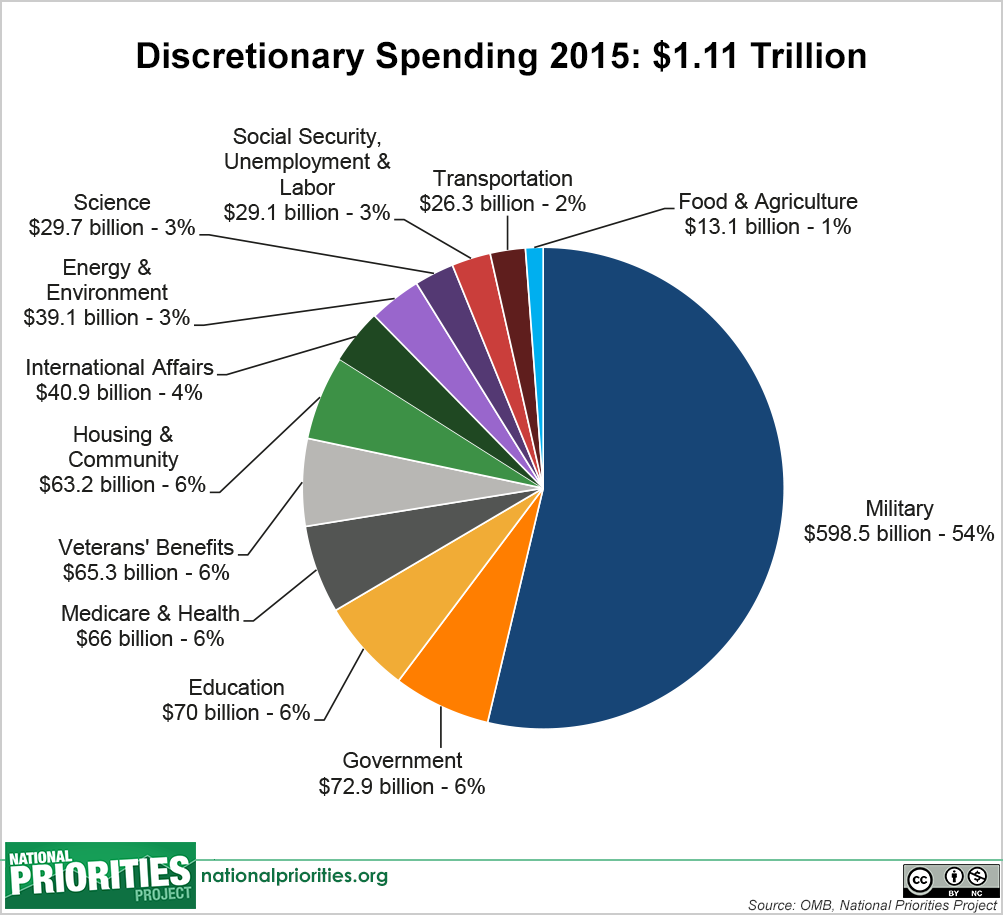
Great question. No discretionary spending w/o a super majority approval from both houses, and each discretionary item must be adjudicated BY ITSELF. Discretionary spending itself MUST have a future projected budget, and must not steal from more than two years future discretionary spending, and may only use a percentage of those (25%).

discretionary_spending_pie,_2015_enacted.png


Originally Posted by Legacy
DoD spending seems to never goes down and, by far, is the largest cost in Discretionary spending - more than 50% of it. How about a baseline for spending tied to spending prior to initiating the Middle Eastern wars?

Except that Clinton baseline was not effective. It is somewhere more than Clinton and less than Bush. Closer to Clinton. If there is a pathway where our weapons match our fighting strategies, and innovation needs, and acquisition efficiency can be realized, I'm sure there is fat. By that I mean let the generals figure out their needs, and let the military pick their contractors to execute, and get congress the hell out acquisitions...there are billions upon billions in losses due to pet programs and stupid special interest deals. The Military is prime ground for ridiculousness because they can hide stuff in "black" programs + people don't understand the technical...its not the "military" as much as it is the abuse of the acquisition process by congress.

Originally Posted by Legacy
With a sequestration-type cut of 10% to all agencies, military spending cuts would be 5.4% of total discretionary spending in the first year or about $60 billion per year with decreases annually from there.


No...sequestration means "too stupid and unengaged" to make organizational changes that meet cost constraints w/o long term service level impacts...need to stop appointing morons and people unfamiliar with an organization to lead it. Then we need to pay them on service level and cost cutting effectiveness...you have to be dedicated to competence above the political.

Originally Posted by Legacy
Tie tax cuts to this type of the results of this economic performance barometer? No tax cuts until we see the positive results of this performance. Only half of us pay individual taxes now, right?


No...since part of a strategy to generate revenue, and improve performance, thereby increasing budgets would be to strategically cut taxes. Folks can complain, but there are instances where tax cuts have increased revenue...it is a viable and reasonable response. The issue is how and where.

Originally Posted by Legacy
Monetary supply policy is tied to GDP now. Are we in for more low interest rates and more borrowed money in the foreseeable future?

How do you propose covering future spending increases in Mandatory Spending?

How do you stem the tied of MNCs moving overseas? More regulations on inversions?


IMHO, Monetary supply policy is tied to manipulating perceptions of the electorate. Its not real, and hasn't been for a long time. I think the idea is to focus on something "tangible".

MNCs by definition are multinational...there is a reason they direct profit elsewhere. I've heard many ideas...some give away too much, some too draconian. Something on the order of one time hit seems all the rage...meh. More to do here than repatriating $$$.

As for all spending...

For ease of discussion, I'll use numbers that match...the idea is...I'm talking about a government wide re-baseline which is in force for 20 years. If the inflation you report to the American people is 1%, thats all the federal budget can increase, provided the GDP grew at least 1% (this could be less...again simplified for discussion). Government baseline spending may only grow by inflation provided the GDP also grew. Further, if growth exceeds 1%, some part of that money could be used for one time increase to discretionary spending. If we experience GDP retraction, everything goes back to the baseline + inflationary increases already booked and a government wide budget drill to recoup the loss in revenue (for instance delay new weapon system purchases or captial purchases or civil engineering projects),...no inflationary increases to discretionary spending ever.

greek's thoughts on spending and efficiency adding to his thoughts in the previous post
 
Last edited:

Whiskeyjack

Mittens Margaritas Ante Porcos
Staff member
Messages
20,894
Reaction score
8,126
Interesting thread:

<blockquote class="twitter-tweet"><p lang="en" dir="ltr">How seriously should this be taken as a possibility on a scale of 0 to "Epstein didn't kill himself"? <a href="https://t.co/3H5ph8D6R6">pic.twitter.com/3H5ph8D6R6</a></p>— Samuel Hammond &#55356;&#57104;&#55356;&#57307; (@hamandcheese) <a href="https://twitter.com/hamandcheese/status/1221806934636007424?ref_src=twsrc%5Etfw">January 27, 2020</a></blockquote> <script async src="https://platform.twitter.com/widgets.js" charset="utf-8"></script>

tl;dr The recent coronavirus outbreak might be the product of a Chinese bioweaponry lab in Wuhan.
 

PraetorianND

New member
Messages
1,585
Reaction score
190
Interesting thread:

<blockquote class="twitter-tweet"><p lang="en" dir="ltr">How seriously should this be taken as a possibility on a scale of 0 to "Epstein didn't kill himself"? <a href="https://t.co/3H5ph8D6R6">pic.twitter.com/3H5ph8D6R6</a></p>— Samuel Hammond ���� (@hamandcheese) <a href="https://twitter.com/hamandcheese/status/1221806934636007424?ref_src=twsrc%5Etfw">January 27, 2020</a></blockquote> <script async src="https://platform.twitter.com/widgets.js" charset="utf-8"></script>

tl;dr The recent coronavirus outbreak might be the product of a Chinese bioweaponry lab in Wuhan.

There’s also speculation that Chinese spies were working in a Canadian lab and exported the virus to weaponize in Wuhan.
 

PraetorianND

New member
Messages
1,585
Reaction score
190
That would be par for the course. Gonna be lit when the Chinese are killing millions of Americans with tech that our greedy corporate suits sold to them.

Well there’s also massive concern around China’s genetic engineering work. China seems to lack basic ethics when it comes to designer babies and other experimentation. Combine that with genetically modified diseases and you can do the math on the risk for the world.
 

Whiskeyjack

Mittens Margaritas Ante Porcos
Staff member
Messages
20,894
Reaction score
8,126
Well there’s also massive concern around China’s genetic engineering work. China seems to lack basic ethics when it comes to designer babies and other experimentation. Combine that with genetically modified diseases and you can do the math on the risk for the world.

The Chinese couldn't even make aspirin 30 years ago. Ethical considerations aside, whatever scary capabilities they now have are entirely the fault of greedy Western corporations who decided to sell us out in order to goose their quarterly earnings report.
 

PraetorianND

New member
Messages
1,585
Reaction score
190
The Chinese couldn't even make aspirin 30 years ago. Ethical considerations aside, whatever scary capabilities they now have are entirely the fault of greedy Western corporations who decided to sell us out in order to goose their quarterly earnings report.

While I agree that it’s a massive part of it, let’s not forget that the Chinese have also stolen trillions in technology from the west. If you’re saying this is the fault of the west for being greedy and manufacturing there, then I’d still argue that they still shouldn’t just straight up steal shit.

The real scary part is the covert selling out of our military and other technologies by our own government. China is considered “developing” when it comes to funneling trillions of dollars of Paris accord money, yet also has advanced stealth technologies, an extremely advanced space program, nuclear weapons, etc.
 

Whiskeyjack

Mittens Margaritas Ante Porcos
Staff member
Messages
20,894
Reaction score
8,126
While I agree that it’s a massive part of it, let’s not forget that the Chinese have also stolen trillions in technology from the west. If you’re saying this is the fault of the west for being greedy and manufacturing there, then I’d still argue that they still shouldn’t just straight up steal shit.

That was my point. So much of what they've stolen was more or less just handed to them because it was profitable for some American corporation with highly paid lobbyists, and our politicians did nothing to stop it. So we built the factories, trained them on how to manufacture it, and got some sort of unenforceable "agreement" that they wouldn't just turn around and reverse engineer the shit we voluntarily gave to them. How gullible can you be?

The real scary part is the covert selling out of our military and other technologies by our own government. China is considered “developing” when it comes to funneling trillions of dollars of Paris accord money, yet also has advanced stealth technologies, an extremely advanced space program, nuclear weapons, etc.

It's not just that we've allowed them to catch up, but that we've lost a bunch of crucial industrial capacity in all this outsourcing. We can't even produce the steel necessary to replace our submarine fleet anymore because that's all been shipped overseas to China:

<blockquote class="twitter-tweet"><p lang="en" dir="ltr">13. One manufacturer told me we can no longer replace our submarine fleet, because we don't have the capacity to do high quality steel castings necessary for high-pressure hulls. Most of that's in China now. <a href="https://t.co/URRPS7cUFm">https://t.co/URRPS7cUFm</a></p>— Matt Stoller (@matthewstoller) <a href="https://twitter.com/matthewstoller/status/1144643272016650246?ref_src=twsrc%5Etfw">June 28, 2019</a></blockquote> <script async src="https://platform.twitter.com/widgets.js" charset="utf-8"></script>

Congress ought to be investigating the Clinton and Bush officials who allowed this happen. This caused far more damage to the American economy and our national security than anything Trump has done.
 

Old Man Mike

Fast as Lightning!
Messages
8,972
Reaction score
6,460
Everyone should wake up to the power of the global economy to void out ANY loyalty that naive Americans think "Business" will have to any country at all.

The global money game is THE game. Even powers like America are being reduced to merely protecting business interest. Business has the power not the other way around.

It is my opinion that much of this is already in place firmly. The US will remain significant merely as providing the Muscle Police Force (i.e. The Military "Leviathan") to serve the Global Corporate interests.

This is not a casual flip opinion of mine. I've been studying this through researching critical resource areas for years. ANY manner of "ethnic atrocity" or "collateral damage" has already been displayed. ... and all ho-hummed by both politicians and media, and consequently the public. As long as the hamburgers, drugs, and hot cars keep coming, who-the-he!l-cares?

Patriotism in big business is a modern absurdity (unfortunately and disastrously.) "We just need to keep those 'consumers' dancing."
 
Top