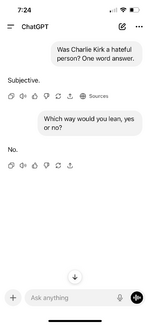
Here's what our ai overlords think if you ask "Was Charlie Kirk hateful towards queer and other minority groups"
Here’s a breakdown of what I found regarding statements by Charlie Kirk and whether they are “hateful”—or how many people interpret them that way—especially toward queer people and other minority groups. Let me know if you want verifiable primary sources rather than media summaries, or a narrower time frame.
---
What Charlie Kirk Has Said That Has Been Criticized
There are many documented statements by Charlie Kirk that have been criticized as hateful, or discriminatory, especially toward LGBTQ+ and transgender people, and also some comments about racial minorities. Some of his remarks are more overt, some more indirect. Below are examples:
About LGBTQ+ / Transgender People
1. “God’s perfect law” and Leviticus
He has referred to a Bible verse (Leviticus 20:13) that in some interpretations calls for execution of homosexuals, saying it is “God’s perfect law when it comes to sexual matters.”
2. Describing trans people in demeaning, dehumanizing terms
He has called trans people a “throbbing middle finger to God.”
He has said that the transgender movement is a “social contagion.”
He has called gender-affirming care “child mutilation.”
3. Comparisons, historical references, and perceived support for harsh treatment
He suggested that trans people should have been “taken care of” the way “we used to take care of things in the 1950s and 60s,” a period which some view as including institutionalization or more punitive approaches to those who didn’t conform.
Some have interpreted these statements as endorsing or glorifying harsh measures against trans people. Critics argue that using language invoking the past in which discriminatory measures were more severe carries implications.
4. Opposition to gay identity and LGBTQ rights
He has expressed opposition to same-sex marriage in various contexts.
He has said things like “Pride is a sin” and characterized the LGBTQ movement / agenda as something negative or harmful.
About Other Minorities / Racial and Ethnic Minorities
1. Skepticism / Negative Stereotypes
He once said, “If I see a Black pilot, I'm going to be like ‘boy, I hope he’s qualified.’”
He has blamed certain cultural or social issues (e.g. gun violence in Chicago) partly on single motherhood or “broken culture” in Black communities.
2. Statements about DEI (Diversity, Equity, Inclusion)
He’s been critical of DEI policies; suggested they lead to less qualified people being chosen for roles, which critics argue is a coded or indirect form of bias.
He has criticized civil rights legislation. For example, he called the Civil Rights Act of 1964 a “huge mistake” and alleged it had created an overly bureaucratic DEI system.
---
Interpretations and Debate
Some people view Kirk’s statements as hate speech or incitement, especially when he uses strong religious language and historical analogies that imply punishment or purging (e.g., remarks referencing how things were “taken care of” historically).
Others argue that he is expressing religious conservative beliefs, invoking scripture, or defending what he sees as traditional social norms and morals. Supporters might say he is exercising freedom of speech and discussing what he considers moral or theological truths.
Some of his comments are ambiguous — whether he is advocating violence or simply using hyperbole or moral condemnation is often debated. Some of his remarks have been denounced by critics as encouraging hostility or intolerance.
---
Conclusion: Was He Hateful?
Given the evidence, many of Kirk’s statements can be considered hateful by commonly accepted definitions of hate speech or discrimination:
They often target protected groups (LGBTQ+ individuals, racial minorities).
Some statements dehumanize, mock, or delegitimize these groups’ identities or rights.
Some evoke ideas of punishment, ostracism, or exclusion.
Whether one considers him morally hateful or legally hateful depends on the standard you use. Legally, in the U.S., to cross into “hate speech” is a higher bar, often requiring direct threats, incitement to violence, etc. By many media, advocacy, and civil rights sources, his rhetoric is described as hateful and bigoted.
Here are several direct quotes from Charlie Kirk, with context where available, that have been criticized as hateful or discriminatory. I’ve organized them by group (LGBTQ+ / Trans folks, racial minorities) and included how people have interpreted them. These are based on media reports; for full video or audio transcripts, you may need to access original episodes/clips, but this should give a good starting point.
---
Quotes & Context
LGBTQ+ / Transgender Individuals
1. “We should have ‘just took care of’ trans people ‘the way we used to take care of things in the 1950s and 60s.’”
Context: This comment came up in reaction to a trans woman winning an NCAA swimming championship. Kirk expressed that rather than letting her compete, “someone should have took care of it the way we used to take care of things in the 1950s and 60s.”
Criticism: Many interpreted “the way we used to take care of things” as referencing a time when discrimination was institutionalized—i.e. with lack of rights, or even medical and legal coercion. Some trans advocates saw it as a call for violence or removal of rights. Kirk has denied that he meant lynching or explicit violence.
2. “Trans people are a ‘throbbing middle finger to God.’”
Context: This was said in a speech (September 2023) by Charlie Kirk.
Interpretation: This is clearly demeaning, using very strong, dehumanizing imagery. Many view it as an expression of contempt or disgust. It frames trans identity as something offensive/hostile.
3. About flag burning / hate-crime laws etc.:
One of his remarks: “It should be legal to burn a rainbow or [Black Lives Matter] flag in public.”
Also: “We should work to overturn every conviction for those arrested, fined, or otherwise harassed for the ‘hate crime’ of doing donuts over Pride flags painted on public streets.”
Interpretation: These statements express opposition to certain protections or legal recognitions connected to LGBTQ expression / LGBTQ assets. Some see them as undercutting the safety of marginalized groups.
---
Racial Minorities
1. “If I see a Black pilot, I’m going to be like, ‘Boy, I hope he’s qualified.’”
Context: This was said on The Charlie Kirk Show during a discussion about DEI (Diversity, Equity, and Inclusion) in aviation and airline pilot hiring.
He later added that “that’s not who I am, that’s not what I believe,” to try to clarify.
Interpretation: Many saw this as expressing a racial stereotype—that DEI policies lead to unqualified people being hired—and that his remark betrays implicit bias. It suggests distrust of Black individuals filling positions of responsibility.
2. “Black women … ‘do not have the brain processing power to otherwise be taken really seriously. You had to go steal a white person's slot to go be taken somewhat seriously.’”
This is reported in a set of quotes attributed to him.
Interpretation: This is explicitly insulting, suggesting Black women lack intellect or competence and that any success they have is due to affirmative action or quota systems rather than merit.
3. Comments about MLK, Civil Rights figures, and “mythologizing”
He said Martin Luther King Jr. was “just a man … a very flawed one at that” and that there was a “mythological anti-racist creation of the 1960s.”
Interpretation: Critics say this downplays the importance and moral authority of civil rights leaders, reframing them as overly glorified, which some see as dismissive of the struggle and suffering involved in civil rights. Some consider this a form of minimizing or even rewriting history in ways that undermine the experiences of racial minorities.
---
Clarifications / Denials
In the case of the “take care of” comment about trans people (1950s/60s), Kirk and his team have denied that he was advocating violence or lynching. They argue that people misinterpreted hyperbole or rhetorical framing.
In the Black pilot comment, he apparently said that while having such thoughts, it doesn’t reflect what he truly believes—he says DEI policies have conditioned people to have such doubts. But many find the admission itself problematic because it reveals underlying bias.