He did speak the truth about the US carrying other prominent members of NATO. He also spoke of potentially leaving NATO. Was that posturing just to try to get other countries to ante up? Did he really want to leave NATO? I can't say with any level of certainty. Regardless, Putin was content waiting to see what happened, because there was a total lack of unity.
The president’s repeatedly stated desire in private to withdraw from the alliance has raised concerns among officials who fear he may revisit the threat.

www.nytimes.com
Posturing? Maybe. Multiple times though? Concerning.
Also a general list of all things Trump did that gave air to Putin:
Trump has repeatedly praised Putin
While he was a private citizen, during his 2016 campaign and throughout his presidency,
Trump has showered Putin with praise. He said Putin was “so nice,” he called Putin a “strong leader” and said Putin has done “a really great job outsmarting our country.” Trump also claimed he’d “get along very well” with Putin. Few, if any, Western leaders have echoed these comments.
Trump hired Manafort to run his campaign
Trump
raised eyebrows in spring 2016 when he hired GOP operative Paul Manafort to run his presidential campaign. Manafort spent a decade working for pro-Russian politicians and parties in Ukraine and cultivated close relationships with Putin-friendly oligarchs. Manafort was
sentenced in 2019 to 7.5 years prison for, among other things, evading taxes on the $60 million he had made in Ukraine. (He was
released to house arrest in May 2020 amid coronavirus concerns.)
Trump suggested Russia can keep Crimea
Trump said Putin did “an amazing job of taking the mantle” when Russia annexed Crimea in 2014. During the 2016 presidential campaign,
Trump broke with US policy and suggested he was OK if Russia kept the Ukrainian territory. He repeated a Kremlin talking point, saying, “The people of Crimea, from what I’ve heard, would rather be with Russia than where they were.”
Trump aides softened GOP platform on Ukraine
Ahead of the 2016 Republican National Convention, Trump campaign aides
blocked language from the party platform that called for the US government to send lethal weapons to Ukraine for its war against Russian proxies. Mueller investigated this for potential collusion but determined the change was not made “at the behest” of Russia. (The Trump administration ultimately gave lethal arms and anti-tank weapons to the Ukrainian military.)
Trump made light of Russian hacking
Throughout the 2016 campaign, Trump cast doubt on the US government assessment that Russia hacked the Democratic National Committee and Democratic nominee Hillary Clinton’s campaign chairman. At a news conference in July 2016, he even
asked Russia to hack more, saying, “Russia, if you’re listening, I hope you’re able to find the 30,000 emails that are missing,”
Trump capitalized on Russian meddling to win
Instead of condemning Russia for hacking and leaking Democratic emails, Trump
eagerly capitalized on the Kremlin’s meddling, and used the emails to attack Clinton on a near-daily basis in the final stretch of the campaign. The
Mueller report said Trump’s campaign “expected it would benefit electorally from information stolen and released through Russian efforts” and that top officials believed they had inside information about WikiLeaks, so they planned a strategy around the expected release of hacked emails.
Trump denied that Russia interfered in 2016
The Office of the Director of National Intelligence, the FBI, the CIA, the National Security Agency, the Department of Homeland Security, the Justice Department and the Senate Intelligence Committee all confirmed that Russia interfered in the 2016 election to help Trump. But Trump has
repeatedly rejected this view, and publicly sided with Putin at the Helsinki summit in 2018, saying he accepted Putin’s denials.
Trump transition undermined Russian sanctions
After the 2016 election, the Trump transition team asked Russia not to retaliate too strongly against new US sanctions imposed by then-President Barack Obama. The sanctions were intended to punish Russia for interfering in the election, but then-Trump aide Michael Flynn
asked the Russian ambassador not to escalate the situation so they could have a good relationship once Trump took over.
Trump was open to lifting Russian sanctions
Days before his inauguration,
Trump told The Wall Street Journal that he was open to lifting sanctions on Russia. He said: “If you get along and if Russia is really helping us, why would anybody have sanctions if somebody’s doing some really great things?” Putin has tried for years to persuade the US and European countries to end crippling sanctions on Russia’s economy.
Trump refused to say Putin is a killer
Bucking other US leaders, Trump has dismissed credible allegations that Putin uses violence against his opponents.
Trump said in 2015, “I think it would be despicable if that took place, but I haven’t seen any evidence that he killed anybody, in terms of reporters.”
Asked again in February 2017, Trump deflected, saying, “There are a lot of killers. Do you think our country is so innocent?”
Trump mulled returning spy bases to Russia
The Washington Post reported in May 2017 that the Trump administration considered returning two diplomatic compounds to Russia. The Obama administration expelled Russian diplomats and seized the compounds in New York and Maryland after the 2016 election, claiming they were used for “intelligence” purposes. The compounds were never returned to Russia.
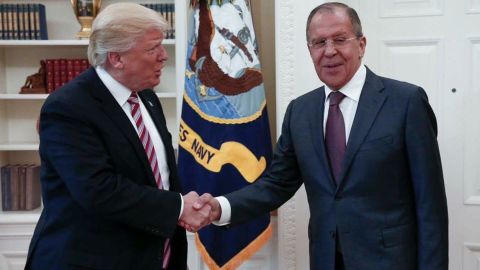
President Trump with Russian Foreign Minister Sergey Lavrov in the Oval Office
from twitter/Russian Foreign Minister
Trump gave Russia classified intelligence
In a shocking move during the early months of his presidency,
Trump shared highly classified intelligence with two senior Russian officials during an Oval Office meeting in May 2017. The intelligence, which was about ISIS, was sensitive enough that it could have exposed a vulnerable source. The unplanned disclosure by Trump rattled even many of his Republican allies.
Trump criticized and alienated NATO allies
Trump has repeatedly attacked NATO, aligning himself with Putin, who wants to weaken the alliance. Trump said NATO was “obsolete,”
rattling European leaders. At his first NATO summit in May 2017, Trump
scolded other countries for not spending enough on defense and declined to commit to NATO’s mutual defense pledge. (Trump later said he
supported the mutual defense provision.) He has also said he wanted to withdraw from NATO,
according to The New York Times, though it hasn’t happened.
Trump was reluctant to sign Russian sanctions
Lawmakers passed a bipartisan bill in July 2017 imposing new sanctions against Russia, even though Trump administration officials
reportedly tried to water down the language.
Trump reluctantly signed the bill, but claimed the new law contained “clearly unconstitutional provisions.” Trump had little choice in the matter because the bill had passed with veto-proof majorities: 419-3 in the House and 98-2 in the Senate. (The Treasury Department followed up with several rounds of hard-hitting sanctions.)
Trump proposed a cyber unit with Russia
After the July 2017 meeting of G20 leaders, Trump said he had spoken with Putin about “forming an impenetrable Cyber Security unit” to combat “election hacking.”
Trump quickly backtracked after lawmakers from both parties said it would be ridiculous to work with Russia on cybersecurity because Russia was responsible for egregious hacks against American targets, including during the 2016 election.
Trump thanked Putin for expelling US diplomats
Trump thanked Putin for expelling hundreds of US diplomats from Russia in August 2017, saying, “I want to thank him because we’re trying to cut down our payroll.” Putin kicked out the officials to retaliate against US sanctions. Trump’s comments conflicted with the State Department, which said the mass expulsion was “uncalled for.” (
Trump later said he was being sarcastic.)
Trump eased sanctions on Deripaska
The Treasury Department in 2018
sanctioned Russian oligarch and Putin ally Oleg Deripaska, along with three companies linked to him, over his support for Russian interference in the 2016 election. But by January 2019, the Trump administration
lifted some of these sanctions. In a
bipartisan rebuke, 11 Senate Republicans supported a Democratic resolution calling for the sanctions to remain.
Trump congratulated Putin on his sham election
Ignoring the advice of several top national security aides, Trump congratulated Putin on his March 2018 reelection victory. Putin got 77% of the vote, but
Western observers declared that the election “lacked genuine competition” and took place in an “overly controlled legal and political environment.” Trump’s critics said he had given the election legitimacy it did not deserve.


whyevolutionistrue.com


 www.foxnews.com


