Spotting the ball where it is at the moment a runner is declared out of bounds seems to be pretty clear. That moment is when you should look at where the football is. Not a moment before or after.unfortunately that definition still isn’t clear.

You are using an out of date browser. It may not display this or other websites correctly.
You should upgrade or use an alternative browser.
You should upgrade or use an alternative browser.
Gerad Parker - Troy Head Coach :)
- Thread starter IrishLax
- Start date

irishff1014
Well-known member
- Messages
- 26,542
- Reaction score
- 9,332
ab2cmiller
Troublemaker in training
- Messages
- 11,514
- Reaction score
- 8,651
In a situation where you have the runner diving out of bounds, it seems like you would have to spot it where the ball breaks the vertical plane. Otherwise I’m envisioning a scenario where you have two defenders planted a yard short of the first down and so the runner could theoretically approach on a dead run and intentionally dive 3 yards out of bounds to get a first down. Maybe the defenders could intentionally position one guy out of bounds to take away that possibility. LOL
A player diving out of bounds wouldn't be a striding runner, but even if your scenario is considered to be a striding runner I don't see how it would ever be a problem in a real game situation. I don't know of any defenders that are just going to plant themselves a yard short of the 1st down and wait for a runner to come to them. As soon as the runner gets near, the defender is going to blast him and try to prevent the runner from advancing the football in any way that he can. If the runner dives the defender is almost certainly going to dive right into him to prevent him from moving forward.In a situation where you have the runner diving out of bounds, it seems like you would have to spot it where the ball breaks the vertical plane. Otherwise I’m envisioning a scenario where you have two defenders planted a yard short of the first down and so the runner could theoretically approach on a dead run and intentionally dive 3 yards out of bounds to get a first down. Maybe the defenders could intentionally position one guy out of bounds to take away that possibility. LOL

GATTACA!
It's about to get gross
- Messages
- 15,248
- Reaction score
- 13,082
The part of the rule you bolded specifically says airborne.A player diving out of bounds wouldn't be a striding runner, but even if your scenario is considered to be a striding runner I don't see how it would ever be a problem in a real game situation. I don't know of any defenders that are just going to plant themselves a yard short of the 1st down and wait for a runner to come to them. As soon as the runner gets near, the defender is going to blast him and try to prevent the runner from advancing the football in any way that he can. If the runner dives the defender is almost certainly going to dive right into him to prevent him from moving forward.

Irishdrunk
Not Banned Yet
- Messages
- 2,861
- Reaction score
- 807
I still think the reversal was reasonable. It’s pretty clear to me that when the ball actually broke the Outabounds, it was well before the 17 yard line.
I don't think a runner can simultaneously be airborne and striding at the same time (without looking like Wiley Coyote falling off a cliff). It seems to me when they put "including a striding runner" in parentheses, they mean they are similar circumstances so the rule for a striding runner is the same as that of an airborne player. They are similar in that the play and the ball are alive until a body part or the ball touches out of bounds.The part of the rule you bolded specifically says airborne.
If they meant the runner always has to be completely airborne there would be no need to specifically say that a striding runner is also part of the exception to the forward progress rule. They could have just left it as "when a ball carrier is airborne."
GATTACA!
It's about to get gross
- Messages
- 15,248
- Reaction score
- 13,082
Yes I agree on this, but that doesn't contradict the ball moving back to the spot that it broke the plane out of bounds once play is stopped.They are similar in that the play and the ball are alive until a body part or the ball touches out of bounds.
Irishdrunk
Not Banned Yet
- Messages
- 2,861
- Reaction score
- 807
It still didn’t get to the 17 yard line. The reverse was reasonable.Yes I agree on this, but that doesn't contradict the ball moving back to the spot that it broke the plane out of bounds once play is stopped.
It is easy to blame Hartmann for not knowing where the first down was but in terms of Parker… wtf was there anything but a running play called. So basic of a mistake. No way does that UU OC make that mistake.
Right, but my point has been that this specific rule only applies to what is considered forward progress as a ball carrier is going out of bounds. It says the ball should be spotted where the ball crosses the sideline. It also says there are 2 situations/exceptions in which you would NOT look at where the ball crosses the sidelines - an airborne player and a striding runner.Yes I agree on this, but that doesn't contradict the ball moving back to the spot that it broke the plane out of bounds once play is stopped.
So the next question might be, why would they create those 2 exceptions to that rule? Since this isn't just a rule about going out of bounds; it is also a rule about forward progress, it seems to me that it's possible that an airborne player or a striding runner could still both be moving forward. So, if forward progress hasn't stopped, referees should not look at where the ball crosses the sideline, they should wait to see when the ball carrier 1st touches out of bounds and then look at the forwardmost point of the ball since that is the moment the play is dead.
Bottom line: Hartman was a striding runner, so the forward progress rule states no one should care where the ball crosses the sideline.

IRISHMAN
Well-known member
- Messages
- 1,245
- Reaction score
- 176
i was concerned about parker as a first time OC but up this point i think he's done a very good job. i have noticed that ND rotates in a lot of RBs and WRs throughout the game which i don't mind (really the only way to build depth) but i wonder if by doing this your not getting your best players more touches. for example tyree catches a pass and runs for 25 yards on the second play of the game and then never sees the ball again, i mean come on he's the fastest player on offense and he touches the ball only once against osu. would like to see NDs best offensive players see more game action and get a few more touches.

ulukinatme
Carr for QB 2026!
- Messages
- 31,637
- Reaction score
- 17,653
Parker fudged that final drive up so bad other than the Estime run, but if he doesn't lay an egg for almost 3 quarters we could have won by 2+ scores.

Jiggafini19Deux
Minister of Delayed Gratification
- Messages
- 13,628
- Reaction score
- 14,344
I like having all of these running backs contributing. It's a lot for opposing DCs to prepare for.
You've got Hartman. He gets the ball where it needs to go.
When you need that big yard, when you need that big carry, in the end you give the ball to Audric. He is the best RB in college football. Put it on his shoulders and finish the game. There is zero reason to overthink it.
You've got Hartman. He gets the ball where it needs to go.
When you need that big yard, when you need that big carry, in the end you give the ball to Audric. He is the best RB in college football. Put it on his shoulders and finish the game. There is zero reason to overthink it.
GATTACA!
It's about to get gross
- Messages
- 15,248
- Reaction score
- 13,082
That exception seems to contradict their own interpretation of the rules here.Right, but my point has been that this specific rule only applies to what is considered forward progress as a ball carrier is going out of bounds. It says the ball should be spotted where the ball crosses the sideline. It also says there are 2 situations/exceptions in which you would NOT look at where the ball crosses the sidelines - an airborne player and a striding runner.
So the next question might be, why would they create those 2 exceptions to that rule? Since this isn't just a rule about going out of bounds; it is also a rule about forward progress, it seems to me that it's possible that an airborne player or a striding runner could still both be moving forward. So, if forward progress hasn't stopped, referees should not look at where the ball crosses the sideline, they should wait to see when the ball carrier 1st touches out of bounds and then look at the forwardmost point of the ball since that is the moment the play is dead.
Bottom line: Hartman was a striding runner, so the forward progress rule states no one should care where the ball crosses the sideline.
If airborne players are exempt that ball should be spotted at the goal line.III. The ball, in possession of airborne ball carrier A21, crosses the sideline above the one-yard line, continues beyond the pylon and is then declared dead out of bounds in possession of A21. RULING: Ball is declared out of bounds at the one-yard line (Rules 2-12-1 and 4-2-4-d).

forkbeard3777
Well-known member
- Messages
- 1,671
- Reaction score
- 2,037
Parker fudged that final drive up so bad other than the Estime run, but if he doesn't lay an egg for almost 3 quarters we could have won by 2+ scores.
Parker did not call a good game. Prior to the game, if you told me Ohio State would only score 17 points, I’d tell you that Notre Dame would win.
However, prior to the game, if you told me Notre Dame would only score 14 points, I’d tell you Ohio State would win.
His play calling was erratic, his personnel and substitutions didn’t make a whole lot of sense at times, I hated not attempting to get any points at the end of the first half, I loathed the play calling and substitutions on a portion of the final drive, and, despite moving the ball fairly well and being balanced, you left a lot of points off the board.
This is a rule specifically for goal-line plays. It has nothing to do with what happens on the rest of the field. The rule was changed to this about 10 or so years ago (if I remember correctly). Before that, the same rule as every other airborne player going out of bounds would have applied, i.e., it would have been ruled a TD.That exception seems to contradict their own interpretation of the rules here.
If airborne players are exempt that ball should be spotted at the goal line.
Edit: I should add to this - I believe the reason they changed the rule was because that situation wasn't just a matter of a player going out of bounds; it was also about whether or not the football crosses the goal line inbounds.
Last edited:

NDRock
Well-known member
- Messages
- 7,490
- Reaction score
- 5,453
Agree. Reminded me of a Rees game where we go an entire half without scoring.Parker fudged that final drive up so bad other than the Estime run, but if he doesn't lay an egg for almost 3 quarters we could have won by 2+ scores.
I wish they would change the name of the Gug to “the National”, at least then when we do a national search for an OC we would be telling the truth.
ulukinatme
Carr for QB 2026!
- Messages
- 31,637
- Reaction score
- 17,653
Agree. Reminded me of a Rees game where we go an entire half without scoring.
I wish they would change the name of the Gug to “the National”, at least then when we do a national search for an OC we would be telling the truth.
Rees scored almost the same number of points in Columbus with less talent at WR and Buchner at QB. We already know he doesn't call a busted screen on the final drive because he didn't even have a screen in the playbook


theclassickiller
old and improved
- Messages
- 500
- Reaction score
- 104
Right, but my point has been that this specific rule only applies to what is considered forward progress as a ball carrier is going out of bounds. It says the ball should be spotted where the ball crosses the sideline. It also says there are 2 situations/exceptions in which you would NOT look at where the ball crosses the sidelines - an airborne player and a striding runner.
So the next question might be, why would they create those 2 exceptions to that rule? Since this isn't just a rule about going out of bounds; it is also a rule about forward progress, it seems to me that it's possible that an airborne player or a striding runner could still both be moving forward. So, if forward progress hasn't stopped, referees should not look at where the ball crosses the sideline, they should wait to see when the ball carrier 1st touches out of bounds and then look at the forwardmost point of the ball since that is the moment the play is dead.
Bottom line: Hartman was a striding runner, so the forward progress rule states no one should care where the ball crosses the sideline.
I think you're misinterpreting the exception. It reads "Exception: When a ball carrier is airborne as they cross the sideline (including a striding runner), forward progress is determined by the position of the ball as it crosses the sideline," meaning airborne and striding players are considered one in the same. This exception is to the rule "The most forward point of the ball when declared out of bounds between the goal lines is the point of forward progress ."
All of this to say that, if a player is airborne or striding, the spot of the ball (assuming they don't reestablish inbounds) is where the ball crossed the sideline, and not the spot of the ball when the player touched out-of-bounds.
The clarification needed here is to the definition of "striding." Surely, if a player holds the ball out-of-bounds as he runs the sideline, and then steps out twenty yards downfield, the ball isn't placed 20 yards back. So striding can't be just running. I'm assuming that striding is the act of becoming "airborne" by leaping forward, as opposed to diving forward. So, logically, the stride starts when the player is truly airborne (in Hartman's case, when his left foot leaves the ground). If this is the case, they still cannot possibly overturn the call. But it also would mean if they called it short on the field, there's no way to overturn that call, either.
This is the last frame that Hartman is "inbounds." You'd be wrong if you said this was definitive proof that he was short of the 17-yard line. I'm speaking generally, not specifically to you, bumpdaddy.
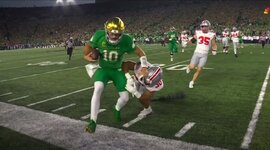
That exception seems to contradict their own interpretation of the rules here.
If airborne players are exempt that ball should be spotted at the goal line.
Try rewording this for me. Maybe it's my comprehension, but I'm confused by your phrasing here. If I'm reading your post correctly, the exemption is actually opposite of how you're interpreting it. The exemption says that the ball would be placed at the one. If there was no exemption, the ball would be placed at the 1-inch line, because the line would be the furthest advancement of the ball (but it didn't cross the pylon).
GATTACA!
It's about to get gross
- Messages
- 15,248
- Reaction score
- 13,082
That is essentially what I was getting at. If bumpdaddy's interpretation about airborne players was correct then the ball should be placed at the 1 inch line, not brought back to the spot at which it crossed the sideline. Like they specify it would in that example ruling.Try rewording this for me. Maybe it's my comprehension, but I'm confused by your phrasing here. If I'm reading your post correctly, the exemption is actually opposite of how you're interpreting it. The exemption says that the ball would be placed at the one. If there was no exemption, the ball would be placed at the 1-inch line, because the line would be the furthest advancement of the ball (but it didn't cross the pylon).
I think you are actually misinterpreting the rule. The words that are in parentheses and those that are outside of parentheses are the key. When considering what the rule actually is you should look at everything that is NOT in parentheses. So if we just include the words not in parentheses we get this:I think you're misinterpreting the exception. It reads "Exception: When a ball carrier is airborne as they cross the sideline (including a striding runner), forward progress is determined by the position of the ball as it crosses the sideline," meaning airborne and striding players are considered one in the same. This exception is to the rule "The most forward point of the ball when declared out of bounds between the goal lines is the point of forward progress ."
The most forward point of the ball when declared out of bounds between the goal lines is the point of forward progress , forward progress is determined by the position of the ball as it crosses the sideline.
The exception to the rule above IS what is in parentheses:
(Exception: When a ball carrier is airborne as they cross the sideline (including a striding runner)
If the rules makers wanted to make "forward progress is determined by the position of the ball as it crosses the sideline" to apply to an airborne or striding player, they would have included those words inside the parentheses where it actually mentions the exceptions. The exception is set as an aside statement that is to be considered separate from what is outside parentheses.
You saw my explanation for that rule, correct? It is a separate rule because they are 2 different situations and there was a time when the goal line rule matched the broader rule for airborne players.That is essentially what I was getting at. If bumpdaddy's interpretation about airborne players was correct then the ball should be placed at the 1 inch line, not brought back to the spot at which it crossed the sideline. Like they specify it would in that example ruling.
theclassickiller
old and improved
- Messages
- 500
- Reaction score
- 104
I think you are actually misinterpreting the rule. The words that are in parentheses and those that are outside of parentheses are the key. When considering what the rule actually is you should look at everything that is NOT in parentheses. So if we just include the words not in parentheses we get this:
The exception to the rule above IS what is in parentheses:
If the rules makers wanted to make "forward progress is determined by the position of the ball as it crosses the sideline" to apply to an airborne or striding player, they would have included those words inside the parentheses where it actually mentions the exceptions. The exception is set as an aside statement that is to be considered separate from what is outside parentheses.
I can't tell anymore if we're on the same page, to be honest. There are two sets of parentheses, one inside of the other (Gattaca forgot to copy the last one, but you'll see if you follow the link below). The entire exception, if you cleaned up the double-parentheses, would read:
Exception: When a ball carrier is airborne as they cross the sideline (including a striding runner), forward progress is determined by the position of the ball as it crosses the sideline.
If the runner is airborne (again, it's unclear what "striding" means, in this case) as they cross out-of-bounds, then the ball is placed at the spot that it crossed the sideline.
http://www.myiafoa.org/rules/2018/ifaf2018/4.html
Irishdrunk
Not Banned Yet
- Messages
- 2,861
- Reaction score
- 807
Oh - if so there you go. That is what was called.I can't tell anymore if we're on the same page, to be honest. There are two sets of parentheses, one inside of the other (Gattaca forgot to copy the last one, but you'll see if you follow the link below). The entire exception, if you cleaned up the double-parentheses, would read:
Exception: When a ball carrier is airborne as they cross the sideline (including a striding runner), forward progress is determined by the position of the ball as it crosses the sideline.
If the runner is airborne (again, it's unclear what "striding" means, in this case) as they cross out-of-bounds, then the ball is placed at the spot that it crossed the sideline.
http://www.myiafoa.org/rules/2018/ifaf2018/4.html
I think we are on similar pages and I think the way the rules makers put the parentheses causes unnecessary confusion. I hate to be pedantic but we've gone far enough down this road, so why not? Here it goes...I can't tell anymore if we're on the same page, to be honest. There are two sets of parentheses, one inside of the other (Gattaca forgot to copy the last one, but you'll see if you follow the link below). The entire exception, if you cleaned up the double-parentheses, would read:
Exception: When a ball carrier is airborne as they cross the sideline (including a striding runner), forward progress is determined by the position of the ball as it crosses the sideline.
If the runner is airborne (again, it's unclear what "striding" means, in this case) as they cross out-of-bounds, then the ball is placed at the spot that it crossed the sideline.
http://www.myiafoa.org/rules/2018/ifaf2018/4.html
Here, again, is the exact wording of the rule with all the parentheses and statements where the rules-makers placed:
d. The most forward point of the ball when declared out of bounds between the goal lines is the point of forward progress (A.R. 8-2-1-I and A.R. 8-5- 1-VII) (Exception: When a ball carrier is airborne as they cross the sideline (including a striding runner), forward progress is determined by the position of the ball as it crosses the sideline (A.R. 8-2-1-II-III and V-IX).
I agree with you. A parenthetical statement within a parenthetical statement causes unnecessary confusion, especially since they didn't seem to close the main parenthetical statement. They could have done so by doing this:
They could have added a 2nd closing parentheses to make it clear the overall statement is closed. They didn't do that but they do have a closing parentheses after the word "runner". If they wanted to make, "forward progress is determined by the position of the ball as it crosses the sideline" part of the main parenthetical statement, they would have used a closing parentheses after the word "sideline" like this:(Exception: When a ball carrier is airborne as they cross the sideline (including a striding runner))
forward progress is determined by the position of the ball as it crosses the sideline)
Having said that, it wouldn't have made sense because then the overall rule would be this:
The most forward point of the ball when declared out of bounds between the goal lines is the point of forward progress
That rule, taken in isolation, would mean that the refs would have to wait until the player is ruled out of bounds, meaning something touches out of bounds, and it would be at that moment and only that moment when he would consider where the forward point of the football was. In other words, that rule would be the same as what I am saying should happen to an airborne player or a striding runner.
If the rules-makers always wanted the refs to only look at the forward point of the football at the moment the football crossed the sideline there would have been no need to create an exception.
But they did create an exception, and as I stated earlier, the reason appears to be that forward progress is a very important consideration. A player moving forward means forward progress hasn't stopped which means the play hasn't stopped. It's still live until something touches out of bounds.
Also, the reason why they would want refs to look at where the ball crosses the sideline for non-airborne or non-striding players is so that refs do not mark the ball further back if a player touches out of bounds behind the point where the ball crossed out of bounds. They don't want an out-of-bounds runner to be given a disadvantage.
Sorry, this was a lot but I hope it helps clear up what I've been trying to say.
Jiggafini19Deux
Minister of Delayed Gratification
- Messages
- 13,628
- Reaction score
- 14,344
File that under "careful what you wish for" I guess.Rees scored almost the same number of points in Columbus with less talent at WR and Buchner at QB. We already know he doesn't call a busted screen on the final drive because he didn't even have a screen in the playbook
Moving forward, I think the passing game is going to have to be way more dynamic and creative. Maybe this comes with the younger WR and Staes growing into bigger contributors, but it was something like 7 yards per attempt and not even 200 passing yards? With Sam Hartman? At home?
Rough.
ulukinatme
Carr for QB 2026!
- Messages
- 31,637
- Reaction score
- 17,653
People kept clamoring last season and asking "Why don't we run a screen?" I always guessed that we were incapable of executing screens, which is why we didn't run them. Maybe that was right.File that under "careful what you wish for" I guess.
Moving forward, I think the passing game is going to have to be way more dynamic and creative. Maybe this comes with the younger WR and Staes growing into bigger contributors, but it was something like 7 yards per attempt and not even 200 passing yards? With Sam Hartman? At home?
Rough.
NDRock
Well-known member
- Messages
- 7,490
- Reaction score
- 5,453
Either way, I wish we had the guy from Utah. Amazing how we’re never willing to go full in on winning (recruiting, paying for top coaches, facilities, etc…) and then are surprised we consistently come up short against elite programs. Almost like all the small stuff adds up and makes a difference.Rees scored almost the same number of points in Columbus with less talent at WR and Buchner at QB. We already know he doesn't call a busted screen on the final drive because he didn't even have a screen in the playbook
IRISHMAN
Well-known member
- Messages
- 1,245
- Reaction score
- 176
didnt utah only score 14 points agains ucla over the weekend?Either way, I wish we had the guy from Utah. Amazing how we’re never willing to go full in on winning (recruiting, paying for top coaches, facilities, etc…) and then are surprised we consistently come up short against elite programs. Almost like all the small stuff adds up and makes a difference.
NDRock
Well-known member
- Messages
- 7,490
- Reaction score
- 5,453
Yep. In a win. But sure, we can do that with every coach in history.didnt utah only score 14 points agains ucla over the weekend?