Foreign Policy

Whiskeyjack

Mittens Margaritas Ante Porcos
Staff member
Messages
20,894
Reaction score
8,126
Observer's John R. Schindler just published an overview of the NatSec issues Trump will be inheriting:

Dear President-Elect Trump: Congratulations on a winning a hard-fought campaign. I haven’t always been your biggest fan (I wasn’t your opponent’s either) but you will soon enter the Oval Office facing more diverse security challenges, in more corners of the globe, than perhaps any of your predecessors. You’ll need help.

The world you’re about to encounter as our commander-in-chief is more dangerous and discombobulated than any new president has encountered in many decades. Your bumbling predecessor hasn’t exactly done you many favors either. Let’s walk through some must-dos, with a healthy dose of geopolitical reality.

Russia: You made being friends with Russia a cornerstone of your campaign. You’re about to find out how tricky that will be in practice. Washington and Moscow have deeply embedded strategic interests that aren’t necessarily compatible, beyond platitudes. Vladimir Putin wants to shake your hand but he will not be charmed out of defending his country’s vital interests. President Obama’s denial and timidity together comprised one of the main causes of the West’s current problems with Russia. Putin runs a country that, aside from its several thousand nuclear weapons, is in economic and demographic decline: it’s hardly more than Mexico with ICBMs. Yet Russia can still cause enormous damage to the international system. Putin is a cunning operator thanks to his KGB background. We can partner with Russia on some issues but never mistake partnership for genuine friendship: Moscow doesn’t do that.

Europe/NATO: Our NATO allies never had much faith in your predecessor and during your campaign you scared the hell out of them. The Atlantic Alliance isn’t in good shape, and it’s facing a real enemy for the first time in a quarter-century. Unless you want to dismantle NATO—which would be very unwise, strategically—there’s hard work to be done. Military spending by NATO members, beyond a few outliers, still lags below the notionally required two percent of GDP. You need to get our partners to ante up; try to be tactful, they dislike you already. Moreover, unless you can seriously charm Putin, limited NATO deployments in Eastern Europe may be the start, not the end-state, of what the Alliance must do to deter Russian adventurism. Make clear to our allies that we are behind them, that you understand Article 5, but they need to meet their alliance commitments too. Drop talk of NATO expansion—it’s not going to happen and just feeds the Russian agitprop machine. Finland and Sweden are different, they’re welcome, but that’s as far as that should go right now.

ISIS: The Islamic State is slowly losing ground in the Middle East but is still very much alive and dangerous. We already have “boots on the ground” fighting ISIS, but the final defeat of this jihadist death cult is still years away. President Obama’s diffident pseudo-war against this enemy never truly got off the ground and promises to drag on without resolution. Resist extremes of over-commitment of forces and just walking away: neither is a realistic strategy. “Bombing the hell out of them” is a tough-talk fantasy that the Pentagon will quickly disabuse you of. Containment can work, given time, but you must remember that your real mission is keeping ISIS out of the West. You’re refreshingly willing to call our jihadist enemy what he actually is. You have a good shot at degrading ISIS significantly, with most of the heavy lifting being done by our allies, while not lying to the American people about the nature of our foe. Try not to alienate the entire Muslim world while doing so, we need them to win this fight.

Syria: Here Obama’s foreign policy sins are manifest, and your options are therefore limited. By abandoning his own “redline” over the Assad regime’s use of chemical weapons back in the summer of 2013, and letting Putin “fix” the situation, Obama outsourced U.S. policy in Syria to the Kremlin. Hundreds of thousands of innocents have died since, and as you were getting elected, Putin parked his navy in the Eastern Mediterranean to bombard the already wrecked city of Aleppo. Moscow has gotten what it wanted in Syria—preserving its client in Damascus while demonstrating Russian power—and you cannot change that now. There already is a No-Fly Zone in Syria: Putin’s. Our top generals and admirals will explain the messy military realities in Syria, including that Russia isn’t really fighting ISIS much in Syria. Listen to them.

Iraq: Here, again, President Obama has done you no favors. His leaving-then-returning act in Iraq was an unfunny comedy of errors, and Iraq’s mostly ramshackle military—built at enormous cost in American blood and treasure—isn’t up to defeating ISIS alone. The good news is the Iraqis have gotten military help and they’re finally making progress against ISIS. The bad news is that help is Iranian. Under Obama, Baghdad became a nearly full-blown satellite of Tehran, and that won’t change anytime soon. Neither will the reality that few Sunnis and Kurds want to be part of this Shia-dominated and Iranian-puppet-mastered country. Post-Saddam Iraq, created by George W. Bush and nurtured by Barack Obama, will never be a functional unitary state. Accept that reality and set achievable goals: Defeat ISIS, slowly, use American influence where we can to keep Iraq together, unhappily, and understand that Baghdad considers Tehran and Moscow to be its real friends—not Washington.

Afghanistan: There’s no good news here. At the beginning of his presidency, Obama was told by Joe Biden, a surprisingly savvy strategist, to minimize American commitments to Afghanistan to achieve long-term success: eschew nation-building to focus on counterterrorism, the key mission. Obama didn’t listen, opting for an Afghan “surge” in what Democrats called the “good war” (as opposed to Dubya’s disaster in Iraq). It didn’t pan out, of course, because it took little account of Afghanistan’s ethnic, political, and economic realities. Now the Taliban are on the march and Kabul’s security forces—built, again, with lots of American blood and cash—are incapable of holding their ground, much less turning the Taliban back. After 15 years, America’s longest war is on the precipice of taking a turn for the truly awful. Total collapse of Afghanistan is the nightmare you must avoid if you wish to not replay Saigon in the spring of 1975, with helicopters evacuating panicked people off the roof of the American embassy. There can be no getting out of Afghanistan without some sort of parley with the Taliban: everybody knows this but nobody wants to tell you this basic reality. Perhaps empower Biden to open lines of communication with our enemies, secretly. That’s frequently how ugly wars eventually end. We need a radical break from what we’ve been doing in Afghanistan since late 2001.

Iran: Here, too, you’re inheriting a tricky military and diplomatic situation created by your predecessor. Obama’s Big Deal with the mullahs—officially the Joint Comprehensive Plan of Action – is already ailing, despite all the shallow media fanfare last year, given Iran’s rising willingness to confront the U.S. Navy in and around the Persian Gulf. Ditching JCPOA sounds easy but won’t be so simple in reality. Don’t expect good behavior from the Islamic Republic on any front—nuclear weapons are just one worry alongside Iranian terrorism and subversion across the Middle East—and be prepared to push back. Your actual agenda is: no Iranian nukes while you’re in office. Getting along with Putin may help here, since Russia’s only slightly more excited about Tehran having The Bomb than we are. Congress will be breathing down your neck on Iran; work with them in a bi-partisan manner if you want to avoid a debacle later in your term.

China/North Korea: Beijing won’t become America’s peer competitor, militarily speaking, during your presidency, but it will get closer. Chinese risk-taking in the South China Sea is only going to rise, since it sells well at home, and Obama’s caution about sending our navy to conduct freedom of navigation operations in those contested waters didn’t work as intended. Beijing is an old-school power that’s not seeking to utterly overturn the Asia-Pacific status quo that’s prevailed for decades, but it does want significant changes to it. This will test your resolve, especially because your talk about trade wars has infuriated party leadership in Beijing. America has been a major force in the Western Pacific since Admiral Dewey prevailed at Manila Bay in 1898; you don’t want to be the president who changed that. From Pyongyang, you can expect nothing but trouble: dangerous games, nuclear antics, omnidirectional saber-rattling. You have surprisingly little leverage over North Korea, as you will soon discover. The only phone calls Pyongyang answers are the ones from Beijing, and China has no more interest in a nuclear war in Northeast Asia than we do. That said, don’t expect the Chinese to sell out their North Korean buffer state, no matter how badly they behave. Beijing remembers 1950 with clarity. This is a problem to be managed; there is no palatable fix.

Border Security: Your campaign made it abundantly clear that securing our southern border is a national security issue, and it’s obvious that many Americans agree with you. You will soon discover that your “wall” is a fantasy and having Mexico pay for it is an even bigger one, but it is very possible to reduce the surging flows of illegals coming into the United States to a trickle through rigorous enforcement of existing laws. There will be national security benefits from preventing drug traffickers and narco-terrorists from entering from Mexico—be sure to remind Congress of this on a regular basis.

U.S. Military: You’re about to become the commander-in-chief of the most powerful military on earth. America alone can fight wherever it wants, however it wants, at a time of our choosing. However, that overmatch is waning and our impressive war machine is creaking. It’s tired from interminable commitments in the Greater Middle East that never end in anything like victory. Major reinvestment in expensive weaponry, across the board, will become an issue during your presidency. It cannot be dodged for long. First, however, you need to make serious efforts to reform the Pentagon’s utterly broken acquisitions and budgeting processes, as revealed by debacles like the F-35, which must not be repeated. Congress will be willing to help you, so long as it’s sold as assisting national defense with greater efficiencies in leaner times. Last, our military leadership is skeptical of politicians, after 15 years of failed wars of choice, but they will respect your office. Treat them with respect—stop the public comments about what idiots and losers our generals are—and they’ll respect you in return. Our men and women in uniform want a leader they can trust to not commit them to wars they will never be able to win. Be that leader, always be straight with them, and you will earn their loyalty and admiration.

U.S. Intelligence: During your predecessor’s two terms, America’s sprawling spy empire went off the cliff: the Snowden debacle, cyber-attacks on virtually everything in Washington, plus the humiliating loss of the security clearance paperwork of 22 million Americans thanks to non-existent security in Washington. You’re inheriting an espionage system without equal on the planet, but it has serious defects which need remedy. This is the secret shield which defends Americans while they sleep, so the Intelligence Community needs your attention. You must force much-needed reform to broken security processes. Start with the National Security Agency, which has just had another Snowden-like counterintelligence failure of the kind that Obama tolerated—but you must not. The IC is wary of you, given your ties to Russia and your insulting comments about America’s spies, but you can win them over by showing you can listen and you’re serious about getting intelligence right.

Cybersecurity: The whole country is getting robbed blind online, our private companies as much as our government, and every American now knows about hacking and identity theft, often personally. Your rival in the campaign was a textbook example of what happens when you don’t think about online security. You’ve said you will take this issue seriously, but it will be difficult to make meaningful progress. When you encounter resistance from the Washington bureaucracy here—and you will—go to the public and tell them how important this issue is to America’s national security and prosperity.

You have a big job ahead of you as commander-in-chief. Your natural instincts are pugnacious and secretive. Avoid those as commander-in-chief. Listen to our national security professionals. Many Americans, including those who didn’t vote for you, care deeply about our national security. Assemble a top team there, including voices from across the ideological spectrum. Obama made national security as partisan as everything else he touched. Don’t repeat that mistake. The stakes today are too high.

Good luck.
 

Legacy

New member
Messages
7,871
Reaction score
321
‘Black budget’ summary details U.S. spy network’s successes, failures and objectives (Wash Post, Aug 2013)

U.S. spy agencies have built an intelligence-gathering colossus since the attacks of Sept. 11, 2001, but remain unable to provide critical information to the president on a range of national security threats, according to the government’s top-secret budget.

The $52.6 billion “black budget” for fiscal 2013, obtained by The Washington Post from former *intelligence contractor Edward Snowden, maps a bureaucratic and operational landscape that has never been subject to public scrutiny. Although the government has annually released its overall level of intelligence spending since 2007, it has not divulged how it uses the money or how it performs against the goals set by the president and Congress.

The summary provides a detailed look at how the U.S. intelligence community has been reconfigured by the massive infusion of resources that followed the 2001 attacks. The United States has spent more than $500 billion on intelligence during that period, an outlay that U.S. officials say has succeeded in its main objective: preventing another catastrophic terrorist attack in the United States.

Historical data on U.S. intelligence spending is largely nonexistent. Through extrapolation, experts have estimated that Cold War spending probably peaked in the late 1980s at an amount that would be the equivalent of $71 billion today.

Spending in the most recent cycle surpassed that amount, based on the $52.6 billion detailed in documents obtained by The Post plus a separate $23 billion devoted to intelligence programs that more directly support the U.S. military.

Intelligence Budget Data (Office of the Director of National Intelligence Budget Justifications)
On February 9, 2016, the Administration submitted its Fiscal Year 2017 budget request, including a request of $53.5 billion for the National Intelligence Program (NIP). The Department of Defense requested $16.8 billion for the Military Intelligence Program (MIP) in FY 2017.
 
Last edited:

Legacy

New member
Messages
7,871
Reaction score
321
Military Experts: Trump Defense Spending Plans Would Break the Budget (Foreign Policy)

Over 18 months of campaign stops, stump speeches, and debates, President-elect Donald Trump rarely detailed his plans for the U.S. military, other than pledging to use it as a blunt object to hammer the Islamic State and other foreign extremist groups that threaten the United States.

But there is much more to his national security vision, and it involves tens of thousands of new troops, dozens of ships and hundreds of warplanes. Defense experts said the plans would cost almost $100 billion more than the Pentagon has currently budgeted for Trump’s first term, an amount that would require Congress to change laws setting budget caps for the Pentagon.

Still unknown, however, is where that money would come from, given Trump’s other plans to slash taxes while keeping many entitlement programs intact and also embarking on a $1 trillion infrastructure improvement program.

“I see big deficits in our future,” said long-time budget analyst Todd Harrison of the Center for Strategic and International Studies.

Speaking at the Atlantic Council earlier this week, Harrison noted that the U.S. Navy’s shipbuilding plans are already under extreme pressure to meet the goals of expensive new submarine and aircraft carrier programs. As they already stand, the budgets don’t take into account the inevitable cost overruns that come with such projects.

There’s also Congress to consider. Lawmakers have been unable to reach consensus on much when it comes to defense budgets in recent years. While most lawmakers can be relied on to increase the defense budget incrementally, Trump’s plans represent a massive military buildup not seen since the administration of President Ronald Reagan.

“I’m not so sure that that will actually happen,” Harrison said of a possible buildup, given the spending caps imposed under the 2011 Budget Control Act. Budget hawks on Capitol Hill have little incentive to peel back the caps, and given Trump’s promises to keep many entitlement programs intact, money will continue to be tight.

Sen. Lindsey Graham (R-S.C.) told reporters this week that any increases in defense spending — should the budget caps be repealed — would require “Democrats to buy in.”

So “I think you’re going to have to look at some non-defense areas of the government” that would also be in line for more funding,” Graham said.

By far the most expensive part of Trump’s plan is to grow the U.S. Navy by dozens of ships in coming years. Defense hawks and Navy leadership have warned of the dangers inherent in shrinking the size of the fleet to its current level of 272 ships, and that number is slated to rise to 308 over the next 30 years. Yet even that increase won’t be enough, experts said, to meet American commitments abroad — particularly given the buildup of the Chinese and Russian navies in recent years.

The number of hulls many analysts have settled on as necessary — including those in the Trump team — is 350. Mackenzie Eaglen and Rick Berger of the American Enterprise Institute estimate the cost of growing the fleet to 350 is possible if the Navy is given an extra $15 billion over the next four years, with another $60 billion in the years beyond that. The Congressional Research Service recently estimated the Navy would need about $4 billion a year over the course of 30 years to reach the goal of a 350-ship Navy.

An internal Trump campaign memo from October obtained by the Navy Times indicates the ship buildup would be, at least in part, a jobs program. “Mr. Trump’s plan will require a significant partnership with a defense industrial base that has been strained by years of significant cuts to shipbuilding and ship repair,” the memo said. “The nationwide infrastructure of yards, depots, and support facilities that created and sustained the World War II and Cold War-era Navy has been largely dismantled.”

When it comes to the Army, candidate Trump called for an active-duty force of 540,000 soldiers — up from the currently budgeted force of 450,000. But adding troops, which Army leadership would clearly love to do, comes with a price. The plan would cost between $35 to $50 billion during the four-year Trump term, Eaglen and Berger estimated. There is significant support in Congress for more soldiers, but no lawmaker has suggested a way to pay for troops increase.

For the Marine Corps, Trump advocates increasing the size of the active-duty force to 200,000 from the current target of 182,000. That would run at least $12 billion over four years.

The Air Force would also receive a massive shot in the arm, if the Trump administration managed to get Congress to play ball. The plan is to grow the fighter fleet by about 900 planes to 1,200 combat aircraft. The quickest way to do so would likely be to increase purchasing of the long-troubled and over-budget F-35A fighter, for which the Air Force would need an extra $30 billion over the next four years.

These spending plans come as Trump’s team has called for cutting non-defense spending by about 1 percent a year, a move that the Center on Budget and Policy Priorities said would strangle entitlements and all other government programs by as much as 37 percent by 2026. That would not sit well with Democrats on Capitol Hill. But, as Harrison noted, “Democrats are out of power.”
 
Last edited:

Legacy

New member
Messages
7,871
Reaction score
321
Military Budget Caps to be rolled back impact

Military Budget Caps to be rolled back impact

Graham: Opponents of lifting military spending caps are 'a-holes' (The Hill)

Sen. Lindsey Graham (R-S.C.) is predicting an end to budget caps next year so that cuts to military can be rolled back, and he indicated he is prepared for a fight to make that happen.

“If you’re going to fight fixing sequestration, you’re a complete a-hole,” he said. “If you want a fight over this, whether you’re Democrat or Republican, we’re going to have one hell of a fight because I’m not going to put up with this crap any longer. Come next year, we’re going to get a resolution.”

Trump has called for the end of those military budget caps, promising he would “ask Congress to fully eliminate the defense sequester and will submit a new budget to rebuild our military".

The biggest obstacle to enacting the military goals of the Trump administration (see above for targets) is the cost. Ending the military budget caps and meeting those targeted goals has been estimated to could range from about $100 billion to $300 billion more over the next four years than President Obama’s current plan.

Trump “Penny Plan” Would Mean Large Cut in Non-Defense Spending (Center on Budget and Policy Priorities)

To help pay for his tax cut plan, Republican presidential nominee Donald Trump is proposing to cut total funding for non-defense programs funded through the annual appropriations process by 1 percent below the previous year’s total each year. THE CUMULATIVE CUT WOULD BE VERY SUBSTANTIAL.While this may sound modest, the cumulative cut would be very substantial. By the tenth year (2026), non-defense appropriations would be about 29 percent below current levels, after accounting for inflation.

Moreover, the cuts would come on top of cuts over the past six years due to the 2011 Budget Control Act and sequestration. By 2026, non-defense discretionary funding would be 37 percent below the 2010 level, adjusted for inflation (see Figure 1) — and one-third below the previous record low as a share of the economy, as explained below.

The category of funding targeted by the Trump plan covers a wide range of basic services, from veterans’ medical care to scientific and medical research, border enforcement, education, child care, national parks, air traffic control, housing assistance for low-income families, and maintenance of harbors, dams, and waterways.

9-15-16bud2-f2.png


Current non-defense discretionary spending is lowest in the last fifty-four years, at or near lows of 1962 and 1996.

9-15-16bud2-f1.png


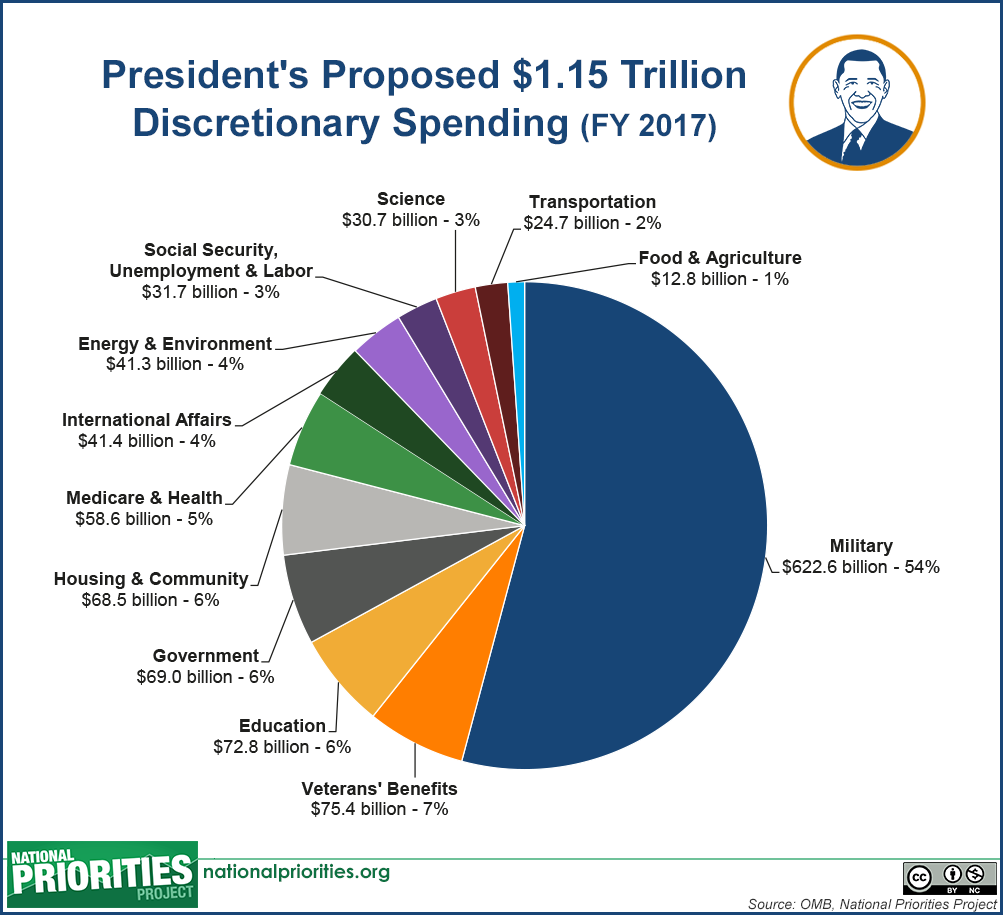
Military Spending currently accounts for 54% of federal discretionary spending. If total federal discretionary spending remains the same ($1.11 trillion currently), military spending would consume 65% of all discretionary spending by 2026. However, lifting military budget caps are intended not only to exempt the military from mandatory sequestration but to increase total spending on the military. It's not unreasonable to expect military spending to reach 70% of all discretionary spending in ten years. Budgeting forecasts do not include cost overruns on contracts, which are comonplace.
 
Last edited:

MNIrishman

Well-known member
Messages
2,532
Reaction score
481
Man, that's awesome. I can't wait to be protected even harder from enemies that can't possibly reach us while removing funding from things like cancer research. I don't know about you, but I'm a hell of a lot more scared of the Chinese than I am of cancer! (600,000 American deaths a year).
 

Legacy

New member
Messages
7,871
Reaction score
321
US leaving TPP: A great news day for China (BBC)

The Chinese government will rejoice to hear Donald Trump promise that the US will quit the Trans-Pacific Partnership (TPP) on his first day in the White House.

For years, Beijing has listened to the Obama administration say the 12-nation regional trade deal was a way of bolstering American leadership in Asia.

China was not included in the deal, and President Barack Obama went out of his way to remind the region that this was no accident. TPP allows America - and not countries like China - to write the rules of the road in the 21st Century, which is especially important in a region as dynamic as the Asia-Pacific.

Nor was this ever just about the rules on trade. TPP was a core part of the Obama administration's strategic "pivot to Asia". US Defence Secretary Ash Carter said that alongside boosting US exports, it would strengthen Washington's key relationships in the Asia-Pacific, signal US commitment to the region and promote American values.

"Passing TPP is as important to me as another aircraft carrier," he insisted.

No wonder then that Beijing saw the US pivot to Asia, and the TPP within that, as a thinly disguised plan to contain China's growing might. Just this weekend, the official Chinese news agency described TPP as "the economic arm of the Obama administration's geopolitical strategy to make sure that Washington rules supreme in the region".

Today US diplomats can't have it both ways in Asia. After telling partners that pushing through TPP was bolstering American leadership in the region, the obvious conclusion must be that reversing TPP is undermining US leadership. And into this perceived leadership vacuum, China itself is ready to move.

Already at the APEC summit in Peru last weekend, Chinese President Xi Jinping told fellow regional leaders it was time for strong partnerships, win-win solutions and strategic initiatives.

China will not shut its door to the outside world but open more.

Officials travelling with President Xi lost no time in setting to work on re-energised discussion of the less ambitious trade deals Beijing backs, the Regional Comprehensive Economic Partnership, or RCEP, and Free Trade Area of the Asia Pacific, FTAAP.

And these moves on trade leadership come within the context of China's "One Belt One Road", a multi-year, multi-billion-dollar blueprint to expand China's investment, trade and strategic influence throughout Asia; alongside Beijing's funding of new development lending institutions like the Asian Infrastructure Investment Bank.

In any zero sum view of the great power game in Asia, the US retreat from TPP is in China's strategic interest, and not just because of the loss of an American-backed trade deal or a pillar of its strategic pivot to Asia.
The TPP announcement goes to the heart of enormous uncertainty about US intentions under a Trump presidency. Does the US still intend to champion a fair and inclusive rules based system? Or does Mr Trump's "put America first" mean replacing the commitment to co-operative internationalism with a narrower interpretation of US national interest, one based on competition?

If the TPP decision suggests a shift towards the latter, American allies in Asia will now await Mr Trump's pronouncements on security with even greater unease.

Put bluntly, can the US still be trusted to come to the rescue of its Asian allies if cowed or threatened by a rising China?
Whatever the answer, the fact that American allies are even asking the question is already good news for China.

And before we leave the subject of Beijing's run of good news from Trump Tower, it comes as much from what Mr Trump didn't say as what he did. While laying out his plans for his first days in office, the US president-elect made no mention of campaign threats to brand China a currency manipulator and slap punitive tariffs on Chinese goods.

Silence on this and funeral rites for the TPP which China hated: an excellent news day indeed.
 
Last edited:

IrishinSyria

In truth lies victory
Messages
6,042
Reaction score
1,920
^^^^

Yup- we're handing control of South East Asia over to China for a generation with this one.

I highly recommend reading Monsoon by Robert Kaplan for why that's important.
 

Legacy

New member
Messages
7,871
Reaction score
321
Australia signals support for Chinese-led trade deals to replace TPP (Guardian)

The Australian government has effectively cut its losses in the Trans-Pacific Partnership, signalling support for Chinese-led trade deals before a meeting this weekend of the Asia-Pacific Economic Cooperation group in Peru.

In an opinion piece published by the Australian Financial Review on Thursday and in an interview with the Financial Times before Apec, the trade minister, Steve Ciobo, said Australia would support a proposal being advanced by the Chinese government, the Free Trade Area of the Asia-Pacific.

“With the future of the TPP looking grim, my ministerial counterparts and I will work to conclude a study on the Free Trade Area of the Asia-Pacific, which sets out agreed actions towards a future free trade zone,” Ciobo said in the piece published on Thursday.

China was excluded from the TPP, which was the key economic component of the Obama administration’s pivot to Asia. It has pursued two rival trade pacts, the Apec-wide Free Trade Area of the Asia-Pacific and a separate trade deal called the Regional Comprehensive Economic Partnership, which includes 16 countries but not the US.

China's Regional Comprehensive Economic Partnership (RCEP) includes the 10-member Association of Southeast Asian Nations (ASEAN), Australia, New Zealand, India, South Korea and Japan.

RCEP will promote free flow of goods and services among countries accounting for 30 percent of the global economy and half the world’s population.


Australia blocks Ausgrid energy grid sale to Chinese companies
(BBC)

Australia has blocked the sale of Ausgrid, the country's biggest energy grid, to two Chinese companies over security concerns.
Australian Treasurer Scott Morrison officially rejected the bid by the two firms to buy a 50.4% stake in Ausgrid.
 
Last edited:

Legacy

New member
Messages
7,871
Reaction score
321
The Tragedy of the American Military
The American public and its political leadership will do anything for the military except take it seriously. The result is a chickenhawk nation in which careless spending and strategic folly combine to lure America into endless wars it can’t win
(The Atlantic)

In mid-September, while President Obama was fending off complaints that he should have done more, done less, or done something different about the overlapping crises in Iraq and Syria, he traveled to Central Command headquarters, at MacDill Air Force Base in Florida. There he addressed some of the men and women who would implement whatever the U.S. military strategy turned out to be.

The part of the speech intended to get coverage was Obama’s rationale for reengaging the United States in Iraq, more than a decade after it first invaded and following the long and painful effort to extricate itself. This was big enough news that many cable channels covered the speech live. I watched it on an overhead TV while I sat waiting for a flight at Chicago’s O’Hare airport. When Obama got to the section of his speech announcing whether he planned to commit U.S. troops in Iraq (at the time, he didn’t), I noticed that many people in the terminal shifted their attention briefly to the TV. As soon as that was over, they went back to their smartphones and their laptops and their Cinnabons as the president droned on.

If any of my fellow travelers at O’Hare were still listening to the speech, none of them showed any reaction to it. And why would they? This has become the way we assume the American military will be discussed by politicians and in the press: Overblown, limitless praise, absent the caveats or public skepticism we would apply to other American institutions, especially ones that run on taxpayer money. A somber moment to reflect on sacrifice. Then everyone except the few people in uniform getting on with their workaday concerns.
 

Legacy

New member
Messages
7,871
Reaction score
321
VA's rising costs

VA's rising costs

With U.S. encouragement, VA disability claims rise sharply (LA Times, 2014)
As Malvin Espinosa prepared to retire from the Army in 2011, a Veterans Affairs counselor urged him to apply for disability pay.

List all your medical problems, the counselor said.

Espinosa, a mechanic at Ft. Lee in Virginia, had never considered himself disabled. But he did have ringing in his ears, sleep problems and aching joints. He also had bad memories of unloading a dead soldier from a helicopter in Afghanistan.

"Put it all down," he recalled the counselor saying.

Espinosa did, and as a result, he is getting a monthly disability check of $1,792, tax free, most likely for the rest of his life. The VA deems him 80% disabled due to sleep apnea, mild post-traumatic stress disorder, tinnitus and migraines.

The 41-year-old father of three collects a military pension along with disability pay — and as a civilian has returned to the base, working full-time training mechanics. His total income of slightly more than $70,000 a year is about 20% higher than his active-duty pay.

Similar stories are playing out across the VA.

With the government encouraging veterans to apply, enrollment in the system climbed from 2.3 million to 3.7 million over the last 12 years.

The growth comes even as the deaths of older former service members have sharply reduced the veteran population. Annual disability payments have more than doubled to $49 billion — nearly as much as the VA spends on medical care.

More than 875,000 Afghanistan and Iraq war veterans have joined the disability rolls so far. That's 43% of those who served — a far higher percentage than for any previous U.S. conflict, including World War II and Vietnam, which had significantly higher rates of combat wounds.

Disabled veterans of the recent wars have an average of 6.3 medical conditions each, also higher than other conflicts.

Incentives to seek disability ratings have increased due to changes in VA policy, including expanded eligibility for post-traumatic stress disorder and a number of afflictions that affect tens of millions of civilians.

Nearly any ailment that originated during service or was aggravated by it — from sports injuries to shrapnel wounds — is covered under the rationale that the military is a 24/7 job.

The disability system was unprepared for the massive influx of claims, leading to backlogs of veterans waiting months or longer to start receiving their checks.....

Growth in veterans' disability program (LA Times, 2014)

la-me-veteran-disability-WEB.png


From Congressional Budget Office:

45615-land-figure1.png
 
Last edited:
B

Buster Bluth

Guest
Fitting that the Type 2 Diabetes was added to the Agent Orange conditions in 2001, my father died in 2000 and everyone knew it was due to Agent Orange. He had Type 2 diabetes and Leukemia. Since then they've sorta Leukemia to the list but they're making us fight for it. In my opinion the VA is waiting Vietnam Vets out hoping they die so they don't have to backpay everyone who lost a family member to cancer from Agent Orange contact.

My father and his college roommates all went to Veitnam, all but one died of a blood cancer, and 4/11 children had childhood/young adult cancers. My sister had a lymphoma at 24. I have no doubt that the inter-generational effects of Agent Orange will trickle out in the coming decades.

That's 43% of those who served — a far higher percentage than for any previous U.S. conflict, including World War II and Vietnam, which had significantly higher rates of combat wounds.

I'm going to guess that's a combination of relaxed standards that reflect science better than ever, but also the reality of "days in combat" being higher than those who served in World War II, etc, as well as the prevalence of IEDs being a gamechanger for concussions and mental problems.

Separately I'm glad to see the costs explode as it's a very real way of changing the minds of the political elites in this country who make decisions about war-making. Rumsfeld and Wolfowitz promised us the war would be a cakewalk and, iirc, cost us only $75 billion. The next time neoconservatives want to go to war, they'll be forced to understand the actual costs.
 

IrishinSyria

In truth lies victory
Messages
6,042
Reaction score
1,920
So Trump took to Twitter to rail against China. Like this actually happened- our President Elect went on a rant against our biggest trading partner and our major military rival in the biggest economic region in the world. And to put salt in the wound, he didn't even GET IT RIGHT as he falsely claimed that China is devaluing their currency- this hasn't been true for almost a decade. In fact, China is trying to keep its currency artificially propped up at the moment. This isn't a minor detail, it's crucial to understanding the current state of the Chinese economy and what they're trying to accomplish.

<blockquote class="twitter-tweet" data-lang="en"><p lang="en" dir="ltr">Did China ask us if it was OK to devalue their currency (making it hard for our companies to compete), heavily tax our products going into..</p>— Donald J. Trump (@realDonaldTrump) <a href="https://twitter.com/realDonaldTrump/status/805538149157969924">December 4, 2016</a></blockquote>
<script async src="//platform.twitter.com/widgets.js" charset="utf-8"></script>


<blockquote class="twitter-tweet" data-lang="en"><p lang="en" dir="ltr">Trump railing against China on Twitter like it is a Celebrity Apprentice feud is not funny, but deeply, deeply worrying for the world.</p>— Ed Miliband (@Ed_Miliband) <a href="https://twitter.com/Ed_Miliband/status/805551017676906497">December 4, 2016</a></blockquote>
<script async src="//platform.twitter.com/widgets.js" charset="utf-8"></script>

Dropping this here because apparently we're going to be conducting our foreign policy through Twitter moving forward. Obviously I agree with Miliband but question whether the same logic doesn't apply to him as well.
 

Irish YJ

Southsida
Messages
25,888
Reaction score
1,444
OK, so Twitter is evil.
What did Obama do to combat China? Please don't say the TPP..

So Trump took to Twitter to rail against China. Like this actually happened- our President Elect went on a rant against our biggest trading partner and our major military rival in the biggest economic region in the world. And to put salt in the wound, he didn't even GET IT RIGHT as he falsely claimed that China is devaluing their currency- this hasn't been true for almost a decade. In fact, China is trying to keep its currency artificially propped up at the moment. This isn't a minor detail, it's crucial to understanding the current state of the Chinese economy and what they're trying to accomplish.

<blockquote class="twitter-tweet" data-lang="en"><p lang="en" dir="ltr">Did China ask us if it was OK to devalue their currency (making it hard for our companies to compete), heavily tax our products going into..</p>— Donald J. Trump (@realDonaldTrump) <a href="https://twitter.com/realDonaldTrump/status/805538149157969924">December 4, 2016</a></blockquote>
<script async src="//platform.twitter.com/widgets.js" charset="utf-8"></script>


<blockquote class="twitter-tweet" data-lang="en"><p lang="en" dir="ltr">Trump railing against China on Twitter like it is a Celebrity Apprentice feud is not funny, but deeply, deeply worrying for the world.</p>— Ed Miliband (@Ed_Miliband) <a href="https://twitter.com/Ed_Miliband/status/805551017676906497">December 4, 2016</a></blockquote>
<script async src="//platform.twitter.com/widgets.js" charset="utf-8"></script>

Dropping this here because apparently we're going to be conducting our foreign policy through Twitter moving forward. Obviously I agree with Miliband but question whether the same logic doesn't apply to him as well.
 

Irish YJ

Southsida
Messages
25,888
Reaction score
1,444
Trying to figure out if the following needs italics are not.....

Perhaps Twitter is a way of getting to all the masses that don't keep up on mainstream policy... In all honesty, what % of voters on each side actually understand that they trade deficit with China is ~360Billion, and that China sets it currency to always be partially lower than the dollar, and that China is largest purchaser of US Treasury notes which keeps our interest rates artificially low and gives China incredible leverage over the US... Maybe someone should start a Twitter University of Foreign Economics...
 
B

Buster Bluth

Guest
What did Obama do to combat China? Please don't say the TPP..

The Obama Administration's goal over of the last eight years was to GTFO of Iraq and resume the role of being an offshore balancer in that region, and then using that spare political/military capital to "pivot to China." The United States simply cannot be everywhere in the world every day, so Obama wanted to be where the future was: East Asia.

Hence the moves to stop fighting the Arabs' wars and stop antagonizing Iran at every turn. Unfortunately in the middle of that move offshore, ISIS exploded and we're still dealing with the fallout of 2003 a whole thirteen god damn years later. Then you can throw his decision to side with Clinton on Libya, only to be hung out to dry by the Europeans, and it's a mixed bag of results in his desire to step back from the Middle East.

Since you brought up the TPP, despite all of its corporate misgivings it would have accomplished something significant with China: set the ground rules for trade on American terms. Given that TPP is all but dead, China will almost certainly step in to fill that American void and we may be dealing with that reality for a century.

But mostly what Obama did to combat China was not be a fool. That's something we can't be sure of with Donald Trump. I would have thought his Twitter episodes would have ended, but here we are. He can't even tolerate heat from SNL, what the hell will happen in the Situation Room??
 
Last edited:

IrishinSyria

In truth lies victory
Messages
6,042
Reaction score
1,920
Trying to figure out if the following needs italics are not.....

Perhaps Twitter is a way of getting to all the masses that don't keep up on mainstream policy... In all honesty, what % of voters on each side actually understand that they trade deficit with China is ~360Billion, and that China sets it currency to always be partially lower than the dollar, and that China is largest purchaser of US Treasury notes which keeps our interest rates artificially low and gives China incredible leverage over the US... Maybe someone should start a Twitter University of Foreign Economics...

This is no longer true:

https://www.bloomberg.com/news/arti...ons-of-u-s-debt-americans-couldn-t-care-less-

China is dumping U.S. debt - Sep. 10, 2015

Once the Biggest Buyer, China Starts Dumping U.S. Government Debt - WSJ

China leads global U.S. debt dump - Feb. 17, 2016


MI-CM113_CBANK_16U_20151006170009.jpg


China's been a net seller of US debt for the past two years. It's true that they keep their currency pegged to the dollar, but most economists believe that this is artificially propping it up right now.
 
B

Buster Bluth

Guest
Trying to figure out if the following needs italics are not.....

Perhaps Twitter is a way of getting to all the masses that don't keep up on mainstream policy... In all honesty, what % of voters on each side actually understand that they trade deficit with China is ~360Billion, and that China sets it currency to always be partially lower than the dollar, and that China is largest purchaser of US Treasury notes which keeps our interest rates artificially low and gives China incredible leverage over the US... Maybe someone should start a Twitter University of Foreign Economics...

China is the largest foreign buyer of US treasuries, and that doesn't mean they are keeping interest rates low. Being the the most advanced, developed, and diversified economy in the history of the world while Europe struggles to accept its Eurozone limitations is a bigger reason why our rates are so great.

Did that fit into 180 characters?
 

IrishinSyria

In truth lies victory
Messages
6,042
Reaction score
1,920
Even if Twitter is an appropriate forum on which to conduct foreign policy, he should probably wait until he's actually President to do so.
 

Irish YJ

Southsida
Messages
25,888
Reaction score
1,444
This is no longer true:

https://www.bloomberg.com/news/arti...ons-of-u-s-debt-americans-couldn-t-care-less-

China is dumping U.S. debt - Sep. 10, 2015

Once the Biggest Buyer, China Starts Dumping U.S. Government Debt - WSJ

China leads global U.S. debt dump - Feb. 17, 2016


MI-CM113_CBANK_16U_20151006170009.jpg


China's been a net seller of US debt for the past two years. It's true that they keep their currency pegged to the dollar, but most economists believe that this is artificially propping it up right now.

They still own more than any foreign entity at around 7% of treasury bonds and 30% of overall intl debt . That's a huge chunk. They are selling it off to prop up their dollar, but their dollar is tied to a basket of currencies which include the US dollar.

As of September 2016, the U.S. debt to China was $1.157 trillion. That's 30 percent of the total public debt owned by foreign countries. Many are concerned that this gives China political leverage over U.S. fiscal policy since it could call in its loan. (Source: "Major Foreign Holdings of Treasury Securities, U.S. Treasury.)

China is the largest foreign buyer of US treasuries, and that doesn't mean they are keeping interest rates low. Being the the most advanced, developed, and diversified economy in the history of the world while Europe struggles to accept its Eurozone limitations is a bigger reason why our rates are so great.

Did that fit into 180 characters?

If you think China is not impacting our low interest rates, I don't know what to tell you. Is it the only cause, no, but it is a significant cause. If you think China want's our rates to rise and isn't doing everything they can to keep it low, I don't know what to tell you.

https://www.thebalance.com/u-s-china-trade-deficit-causes-effects-and-solutions-3306277

https://www.bloomberg.com/news/articles/2016-05-25/china-said-to-plan-pressing-u-s-on-timing-of-fed-rate-increase
 
Last edited:
B

Buster Bluth

Guest
If you think China is not impacting our low interest rates, I don't know what to tell you. Is it the only cause, no, but it is a significant cause. If you think China want's our rates to rise and isn't doing everything they can to keep it low, I don't know what to tell you.

I didn't say that, I made the point that fundamentals of the US economy have more impact than China buying the debt we sell.

If they choose to cash out it would hurt them more than us. It's not even MAD, it's suicide.
 

Irish YJ

Southsida
Messages
25,888
Reaction score
1,444
I didn't say that, I made the point that fundamentals of the US economy have more impact than China buying the debt we sell.

If they choose to cash out it would hurt them more than us. It's not even MAD, it's suicide.

Whatever we both believe, I think we both can agree that China owning a significant portion of our debt is not a good thing given China's interests and state of being.
 
B

Buster Bluth

Guest
Whatever we both believe, I think we both can agree that China owning a significant portion of our debt is not a good thing given China's interests and state of being.

I don't think it's a bad thing per se.
 

Irish YJ

Southsida
Messages
25,888
Reaction score
1,444
Hilldog backer and Obama/Bill fan Matteo Renzi out.
Wonder what Trumper will have to say over the Twitterspace.
 

Legacy

New member
Messages
7,871
Reaction score
321
Senate passes defense bill setting stage for Trump buildup

Calling for an end for sequestration for the military .

"Next year, with a new president and a new Congress, let’s go to work immediately on ending sequestration once and for all and returning to a strategy-driven defense budget," Senate Armed Services Chairman John McCain said recently, urging the new Trump administration to send a request to Congress for supplemental defense funding beyond what’s in the defense policy bill.

"The president-elect has said we're not spending enough and we aren't doing enough," McCain said on the Senate floor Thursday. "And by the way, we've go to do it right. We need to spend more."

Their multi-pronged strategy included boosting an off-budget war account, refusing to go along with White House money-saving proposals such as cuts to weapons programs and pushing for budget deals with Democrats to give all federal agencies some reprieve each year from strict spending caps put in place in 2011. The approach appears to have paid off, with Republicans preserving key weapons platform, bases force structure through the end of Obama's term

Congress will undoubtedly raise the debt ceiling and borrow to fund these.

Short-Term Spending Bill: The Good and the Bad (The Heritage Foundation)

First of all, the proposed bill spends too much money. Due to spending gimmicks passed as a part of last year’s omnibus appropriations act, which funded the government for 2016, staying at the current spending level would require an extra $10 billion in funding above the amended fiscal year 2017 budget cap.

Furthermore, Congress is setting itself up for a budget cliff at the end of fiscal year 2017. Because of the Boehner-Obama deal that was passed in October of 2015 (with the support of only 79 House Republicans), the spending caps were raised for fiscal years 2016 and 2017.
 
Last edited:

Whiskeyjack

Mittens Margaritas Ante Porcos
Staff member
Messages
20,894
Reaction score
8,126
TAC's Stephen H. Balch just published an article titled "For a Concert of Powers":

The history of Western diplomacy alternates between periods of “realism” and ideology. In the first, regimes maneuver for marginal advantage, their conflicts tempered by shared beliefs and interests. In the second, they seek to destroy or transform one another, with much less concern for means. Warfare occurs in both, but it is more limited, easily settled, and fluid with respect to coalitions in the former. In the latter, intervals of “neither war nor peace” and relatively rigid alliance systems punctuate few-holds-barred combat. One setting is a theater for worldly and cynical statesmen; the other for zealots, adventurers, and tyrants. Far better to live during the first’s orderly quadrille than the second’s totentanz.

These are simplifications, no doubt, but they help describe actual patterns relevant to foreign policy today. Diplomatic lessons of the past are useful only to the extent one understands the similarities and differences between previous and current international environments. After a transition from one era to another, policymaking may struggle to catch up, committing unforced errors through failure to recognize how the world has changed.

We recently completed such a transition, and the recognition lag is proving a real problem, particularly for the diplomacy of the United States.

♦♦♦

The Western state system emerged gradually and piecemeal during the early modern era, a time of bitter religious warfare. The severity of its conflicts fostered the centralization of civil and military authority, as well as conceptual innovations like “sovereignty” and “international law.” Indeed, it helped crystallize the very ideas of “state” and “nation,” with England, France, and the Netherlands as the principal pioneers. The era’s climax, the Thirty Years’ War, drowned sectarian passions in a sea of blood.

The Treaty of Westphalia, signed in 1648, consolidated state sovereignty. This created a new diplomatic landscape and led to the ebbing of theological rivalry, which in turn cleared the field for machinations aimed at enhancing state power and mercantile advantage. The spiritual unity of the pre-Reformation world was also restored, but with the rationalism of the philosopher replacing the Catholicism of the pope. Nor were the chief actors any longer semi-feudal suzerains, but monarchs and their ministers wrapped in the full institutional panoply of coherent states. Fighting was frequent but restricted in objective, with alliances—shuffled by professional diplomats—tending toward equilibrium. Massacre and terror came off the table, at least in fighting purely among Europeans.

All this ended with the French Revolution, triggering 23 years of virtually unbroken warfare, mass levies, and radical realignments in borders. Yet this proved but an interlude, not the new normal. To be sure, the hundred years that followed were very different from the previous century and a half. States became constitutionalized, mass participation was routinized, the European continent and the world were compressed by new technologies, and prosperity expanded beyond what anyone had imagined in the past. Revolutionary eruptions occasionally occurred, but each time governing elites remained in—or climbed back into—their saddles. If crowns rested uneasily, their wearers, or those governing in their names, succeeded in preserving a general peace, often helping each other to suppress unrest and settle disagreements, sometimes bilaterally, at other times through conference. Rising nationalism and a revolutionary underground remained troubling facts of life, but facts pragmatic statesmen succeeded in keeping under control.

Until they didn’t …

In 1914, a great war, ignited by nationalism, finally unloosed the demons of revolution. The Versailles settlement that followed it failed to reimprison them. Slow to comprehend the dangers of the new environment fully, diplomats floundered, quickly leading to another, even greater, conflagration. Although this one destroyed what was perhaps the fiercest ideological demon, another, almost as bad, was elevated to nearly half the world’s command. A third great war would almost surely have ensued, had not the appalling power of nuclear weaponry deterred the demoniacal and non-demoniacal alike. Then, one fine day, the second demon also vanished, leaving diplomacy once more befuddled.

♦♦♦

The crucial fact about our new epoch is its low ideological temperature, the world’s major states all being of comparatively moderate ambition.

One set of powers, post-communist Russia and China, has abandoned global crusades for limited, if regionally expansive, national goals. Moreover, tenuous legitimacy makes satisfying domestic consumers more of an imperative for the stability of these states than it would be for better-secured regimes. To be sure, border bullying also fires up internal support, but neither state wishes to bring down any temples.

The other great powers have also been shorn of motive force. The United States—having, with its allies, defeated communism—finds itself at loose ends, deprived of foreign-policy consensus. Japan, although anxious about China, is still largely unwilling to abandon its post-1945 crouch. India, while capable of a global role, has yet to develop many aspirations beyond its region. (Brexit, and the European Union’s other turmoils, make it hard to predict where, or in how many places, future responsibility for European diplomacy will be lodged.)

The world does, of course, continue to be menaced by a brutal ideology, Islamism. But no great state embraces it, each being high on its target list. Moreover, Islamism’s menace is less a matter of its own energies and resources than the faltering confidence and divided diplomacy of the great powers. A concert of realists would crush it. The world as it recently was—organized into competing camps—would probably have kept it much better caged. But the current scene, partly ideologically deflated and partly ideologically confused, allows Islamist radicalism surprising scope for mayhem.

Because the democratic states are the strongest economically—and, in America’s case, militarily—their befogged diplomacy represents the chief impediment to realizing the beckoning promise of an international concert. Fundamentally unaggressive, they suffer, if anything, from a surfeit of niceness. But democracies can’t bring their benignity to bear because, unlike the world’s rougher customers, their thinking is mired in a mixture of Cold War constructs and postmodern fantasy—the first, favored by many on the right, belonging to another age, the second, endorsed by most on the left, to no age at all. Democracy promotion, noble but self-defeating beyond some modest point, strains America’s own republican fabric. The equally quixotic goal of globalized egalitarianism does the same by fostering the dissolution of the historic identities upon which American and Western freedom rest. Ideology’s last playground thus lies, oddly, within the democratic camp, deluding and dividing it. The former totalitarians are comparatively clear-sighted.

For American diplomacy, the result has been a succession of flip-flops, adding unreliability to unrealism. Under the second Bush the U.S. sought to exercise missionary muscle, assuming that successes in spreading democratic—hence peaceful—governments in Europe and East Asia could be replicated in the wastes of the Middle East. Under Obama it has sought moral redemption through apologetic multilateralism, convinced that past American and Western arrogance lies at the heart of current world conflict. More interested in the forceful exercise of domestic power, Obama’s administration has sounded retreat on almost every foreign front, while hoping against hope that diminished American influence would bend the arc of history further toward justice.

Each of these approaches has a high-minded goal. Together they dominate American discourse. But neither can bear fruit in any world remotely like our own.

Politics, even in well-established regimes, tends to be unruly and unpredictable. The international realm magnifies that disorder substantially, rendering grand long-term objectives exceedingly difficult to realize. Unfeasible objectives jeopardize attainable ones in a variety of ways. When America invests blood and treasure building democracy in regions that have never known it and that lack its requisites; when America tries to act the hegemon on the borders of important and potentially cooperative powers while obsessing about the sins of their political cultures; and when America needlessly meddles in disputes that are currently intractable, the opportunity costs are immense—including the erosion of its own ideals and institutions.

♦♦♦

World ideological recession, together with the softening effects of global consumerism, puts within reach solutions to serious international problems formerly beyond grasp—including nuclear proliferation, militant Islam, terrorism more generally, rogue and failed states, uncontrolled population movements, environmental disruption, and threats to the orderly flow of world commerce. Not long ago these challenges would have been approached, if at all, largely in a spirit of ideological gamesmanship. There is now a chance to reframe them on the basis of common interest.

Following the Second World War, America and non-communist Europe recreated among themselves the civilized comity that had disappeared along the Marne. Within this realm, war became unthinkable; free trade the reigning ideal. In this spirit, a host of permanent international organizations also came forth to smooth conflicts and promote the larger good.

On the other hand, an ideological chasm, wider than that which separated Pope and Protestant or Bonaparte and Bourbon, had opened between the capitalist democracies and the communist camp. Among the democracies, politicians were strongly consumer-orientated since recessions led to electoral drubbings. But while their Soviet counterparts took credit for whatever improvements in living standards they could deliver, for them, until the communist regime’s very final years, considerations of state control regularly trumped those of economic efficiency. Because real-world economic connections were few, when the West was in recession Soviet propagandists could afford to smirk, feeling little of the downdraft. The Chinese communist economy was even more autarchic.

By contrast, both Russia and China are today thoroughly intermeshed in world trade networks, the Russians principally as energy suppliers, the Chinese across the board. World economic breakdown would be disastrous for them.

In Cold War times Soviet security was linked to Western insecurity. The Soviet Union’s address as the headquarters of world revolution was a vital source of its legitimacy, even after the private ardor of its cadres had cooled. “Mutual Assured Destruction” made European war unlikely, but, this aside, the Soviets had a vested interest in keeping the world’s pot aboil, which they did through backing revolutionary and terrorist movements, directly or via proxies. Mao’s China, more internally distracted and less militarily capable, was generally content with making noise, though her intervention against America in Korea, and the shelling of Quemoy and Matsu, briefly threatened Far Eastern war.

The post-communist giants are still far from having fully succumbed to the gentling effects of commerce or parliamentary practice. But both have traveled a long way toward making business a primary concern, toward pursuing profit rather than proletarian or peasant upheaval. And this means that they can be dealt with in a manner they couldn’t have been before.

♦♦♦

In the new world system American interests would best be served by a foreign policy that aimed to preserve, not enlarge; that focused on things core rather than peripheral; that concentrated on the well understood instead of the dreamily aspirational; that sought common ground where that could be found; that was risk-averse and economical—in sum, that respected practical limits.

None of these precepts are absolutes, nor do they exclude ideals and considerations of honor. Nor, as guides, do they offer obvious answers to the subtle complexities of implementation—to questions of timing, deterrence, bargaining, and public justification. But if they don’t dictate they should certainly steer, and in the present improved state of the world, they should steer toward something like the following.

First, the altered international environment should be acknowledged for what it is and the rhetoric inspired by ideological contest scaled back. A struggle for hearts and minds required a message to mirror the adversary’s. Yet even during the Cold War, when the banner of liberty was held high, it only partially explained policy. We now need to reappraise how far further it can be wisely carried. Liberty should undoubtedly remain something we recommend to those open to our counsels, and where wanted, be the object of our good offices. Most other things equal, there should be a strong preference for well-rooted democracies and a repugnance for the truly barbarous. Beyond this, how the world’s states conduct their domestic affairs is best left more to hope than exertion.

Second, we should see the interest of the post-communist states in their “near abroad” as natural, opportunities for bargaining instead of fruitless confrontation. Russia and China, though hardly the states we would like them to be, have the same interests in their security perimeters as we do in ours. That of Russia includes Ukraine, Belarus, the Baltic coast, and the Caucasus. (Most of these were historically part of Russia for longer than the U.S. has had a history.) That of China includes much of the South China Sea, Taiwan, and the Korean peninsula. These are regions where Western recognition of Russian and Chinese security primacy should be gradually traded for cooperation on other major issues, including, in the cases of the Baltic republics, South Korea, and Taiwan, respect for indigenous democracy.

Third, we should treat the other great powers as full partners in quashing the dangers that exist outside their (and our) security perimeters. If core disputes can be accommodated and bonds of operational trust strengthened, remaining conflicts shouldn’t prove insuperable obstacles to controlling common threats. At the very least the temptations for the self-interested exploitation of these problems will be substantially reduced. And to strike the constructive bargains upon which such settlements depend, a rebuilding of America’s dwindling military capacities will be in order.

In the Middle East and elsewhere jihadism could be suppressed—think a replay of the Boxer Rebellion; Sykes-Picot could be revised to reflect communal realities and temper persistent discords; nuclear proliferation could be cooperatively addressed; and the flow of oil could be collectively guaranteed. In a more cooperative environment, mass out-migrations might also be staunched. China’s part of the bargain would involve, in the short term, reducing North Korea’s malignancy and, in the longer run, facilitating Korean reunification. We would expect from Russia forbearance along the Baltic coast and the Caucasus.

Finally, the West should use a new era of global concert to remedy its own deepening pathologies—a task greater diplomatic harmony would facilitate, though not, of course, guarantee. The toils of the security state could be relaxed, fiscal overhangs pared back, a flourishing worldwide commerce allowed to raise all boats, and creative energies redirected to repairing our stressed institutions of freedom. Most important, perhaps, it could allow us again to view the strength of the American nation in a prideful light—as an acknowledged steward of a stabilized international order, instead of a pursuer of fanciful and divisive quests. Indeed, by realizing that the rest of the world won’t anytime soon resemble us, we might learn once more to appreciate our uniqueness as an extraordinary gift, something whose special traditions can be cherished, bolstered, and passed along to its distinctive heirs.
 

Legacy

New member
Messages
7,871
Reaction score
321
Budgeting for the Military

Budgeting for the Military

The recently proposed budget (2017) for the military in discretionary spending by President Obama is $622 Billion (54% of all discretionary spending) which is an increase of $24 bìllion from the 2015 budget. The two categories account for 61% of all federal discretionary spending.

2017_pres_budget_disc_spending_pie.png


The costs of war and care for our injured military appears in VA budgets, which are separate. Proposed VA discretionary spending for 2017 is $75 billion (7%), which is an increase of $10 billion over the 2015 budget.

Disability claims for the military have been rising significantly. With commitments and possible engagements in the future, not only will military budgets increase, but VA budgets and disability claims are projected to continue to rise. Even should all engagements involving personnel become stagnant, the cost of health care for veterans would rise as they age.Congress recently passed abill spending $82 bilion for VA construction and to cover cost ovrruns in current building.

Additional spending ...Senate Vets Bill Could Create New $500 Billion Entitlement Program

Within this context, President-elect Trump has proposed to increase Army personnel by 90,000 soldiers and Marine personnel by18,000. Of course, besides increasing troop strength levels is only part of Trump's proposed military spending. VA budgeting growth is projected to rise proportionately. Trump's Cabinet contains three retired Generals.

Senator McCain previously projected that military spending including the costs of contracts for projects might rise until $1 trillion over the years as it is constrained by the Balanced Budget Amendment and deficit spending as thr National Debt now exceeds $19 trillion. McCain and Sen Lindsey Graham are now proposing to lift the budget caps on the military and free that spending from restrictions of the Balanced Budget Act.

So the economic costs of increased deficit spending on the military must also include proportional interest payments on the borrowed money. All this while cutting taxes and reducing federal revenue.
 
Last edited:
Top