Environmental Issues

NorthDakota

Grandson of Loomis
Messages
15,705
Reaction score
6,004
When people have been assaulted by cheap shots all their lives, it's particularly hard to view the next one as "aw shucks, just kiddin'." Most people here on IE thankfully have more civil sensibility.

The former now-banned clown enjoyed making terrible childish comments about the fat ugly universality of West Virginia women. As my Mom lived there, my two sisters lived there, five of my nieces lived there, this "inspired" me to tell him to shove it where the Sun don't shine. (and remind the A-hole to find a picture of Jennifer Garner and beat off sometime.)

If you can't "get" this, your interpersonal intelligence is single digit. (By the way, when ACamp referred to you as some kind of inbreed, I didn't rate that comment highly either, even though it was you and your normal commentary he was reacting to.)

Look at my avatar and look at my location. Inbred comments are kinda funny and come with the territory. Gotta be able to laugh at yourself and your people every now and then.

Literally hit ya with a John Denver lyric. Lighten up. From one coal state native to another...keep on keeping on.

By the way, when lecturing someone on how they treat others, it's probably best to heed your own advice.
 
K

koonja

Guest
Look at my avatar and look at my location. Inbred comments are kinda funny and come with the territory. Gotta be able to laugh at yourself and your people every now and then.

Literally hit ya with a John Denver lyric. Lighten up. From one coal state native to another...keep on keeping on.

By the way, when lecturing someone on how they treat others, it's probably best to heed your own advice.

Don't take it personal. OMM has convinced himself he's above the peasants of IE, and cannot complete a post without a pompous, self-righteous shot at we the people.

And John Denver was full of sh!t.
 

Legacy

New member
Messages
7,871
Reaction score
321
Coal Sector Issues

Coal Sector Issues

Coal miners in Appalachia work in dangerous conditions and under known hazards to their health for a good paycheck and the promise of lifetime health and pension benefits. Consider coal economics, health insurance and pension benefits a three legged stool that helps support miners and their families and, indirectly, impacts many businesses and services in coal country. As each or all of those legs erodes, miners and even coal companies increasingly look to the federal government for support.

Coal Marketplace
Coal as an electricity-generating power source is being replaced by low cost natural gas. Natural gas now produces 33.8% of the nation’s electricity. Coal produces 30.4%. (In 1990, coal produced 57% of our electricity.) Nationally, the number of coal miners jobs was 56,700, and 76,572 total jobs if you include office staff, salesmen and other non-miners. (In 1985, the number of coal jobs was 178,300.) There are also indications that more mining jobs are being cut to part-time.

In West Virginia, coal production is at its lowest level since the 1970s. The state’s economy has lost more than 35% of its coal jobs since 2011 with an additional 23% decline expected when the 2015-17 figures come out. Hours worked by miners in central Appalachia fell by 52% from 2012-15. (As noted previously, West Virginia’s median household income is $42,800, third lowest nationally.)

Easy-to-mine coal throughout West Virginia is largely gone and is costlier to extract than in western mines. Alpha Natural Resources, for example, spent nearly six times more per ton to extract coal from its Appalachian mines than it did in its western mines in the second quarter of 2015, losing $277 million in its eastern mining operations. Mining coal in the PRB is at a 1:1 ratio of rock to coal vs the 6:1 ratio in the east.

Mountaintop removal mining (MRM) in Appalachia is favored by coal companies for the economics, but is controversial not only for the environmental damages but the increasing health risks to surrounding communities as byproducts of removal and processing end up in nearby water sources including many carcinogens, e.g. heavy metals and solvents. (West Virginia’s cancer rate is second highest nationally. )

Peabody, the nation's largest coal company, slid into Chapter 11 bankruptcy in 2016, Peabody's bankruptcy filing follows at least 50 in the industry over the last few years including Arch Coal in January and last year's filings of Patriot Coal, Alpha Natural Resources and Walter Energy.
Two other factors affect demand for Appalachian coal. PRB coal has less sulfur (termed sub-bituminous coal), which plants must removed costing them more than the bituminous coal mined in Appalachia. Also, as more coal-powered plants are switching to cleaner fuels, both here and internationally, demand for bituminous coal has dropped. China, for instance, has made a commitment to reduce carbon emissions in power generation.

The Administration's Interventions
Trump, to great fanfare and to fulfill a campaign promise, rescinded Obama’s regulations to protect waterways from coal mining waste, saying "This is a major threat to your jobs.” Trump also said, “Since the fourth quarter of last year until most recently, we’ve added almost 50,000 jobs in the coal sector.” (A recent Columbia University study found that regulations accounted for 3.5 percent of coal's decline, while competition from natural gas accounted for around 49 percent.)

Trump rescinded the Office of Surface Mining's Stream Protection Rule, a regulation to protect waterways from coal mining waste.

Trump also ended funding for a two year independent study by two West Virginia agencies on the health effects on the population from mountaintop mining in its second year.

Trump ended Obama’s Valuation Rule, which would have required royalties on coal to be determined by sale prices to the first unaffiliated buyer. Coal companies pay lower royalties by selling coal to affiliated buyers, who then resell it at market prices.The result of repeal will cost taxpayers up to $75 million annually.

Finally, in letters obtained by the AP, Trump, aka the “Jobs President”, was told by the CEO of Murray Energy, Robert Murray, that a primary customer, First Energy, was on the verge of bankruptcy which would cause the loss of 6,500 jobs unless the federal government stepped in to subsidize the industry. Murray also warned Energy Secretary, Rick Perry, that at least 24 coal-fired plants are slated for closure over the next 14 months, unless the federal government intervened. (Murray was a major contributor to the Trump campaign. In his letter, Murray and the CEO of First Energy, Robert Moore in a meeting with Trump, Trump said to an assistant “tell [chief economic adviser Gary] Cohn to do whatever these two want him to do.” West Virginia’s Gov. Jim Justice’s has proposed a $4 billion annual federal subsidy to prop up the struggling Appalachian mining industry. Moore warned Perry: “With coal supplies already in excess of coal demand, there will be no option other than the immediate closure of dozens of thermal coal producing mines resulting in the elimination of thousands of jobs and the aforementioned destruction and devastation of the very population that voted President Donald J. Trump into the Oval Office.”

(Health and Pension Benefit issues in the future)
 
Last edited:

Legacy

New member
Messages
7,871
Reaction score
321
Some links

Some links

OIL, GAS, AND COAL ROYALTIES Raising Federal Rates Could Decrease Production on Federal Lands but Increase Federal Revenue (US GAO, June 2017)

CAN COAL MAKE A COMEBACK? (Columbia Center on Global Energy Policy, April 2017)

Letter from Murray Energy Company to White House Advisor: (Murray Energy, August 2017)

Dear Mr. McEntee:

Last evening in Huntington, West Virginia, after President Donald Trump met
briely with Mr. Charles E. Jones, Chief Executive Officer of FirstEnergy Corporation,
and the undersigned, he turned to you and said "tell (National Economic Counsel Director, Gary) Cohn to do whatever these two want him to do".

In Youngstown, Ohio nine days ago, after my personally speaking with President
Trump, he turned to Energy Secretary Rick Perry and said three (3) times "I want this
done". What is the action that the President has directed, but his staff has not carried
out?

We have requested that President Trump direct Energy Secretary Rick Perry to
invoke Section 202(0) of the Federal Power Act declaring an emergency on the electric
power grid...

This situation was created by the destructive regulations of the Obama
Administration and his Democrat supporters and bureaucrats, many of whom are still in
place by the slowness in replacing them since the inauguration. In my presence in
Youngstown on July 25, President Trump told Secretary Perry to invoke Section 202(0)
of the Federal Power Act to temporarily declare a "time out" on this job and electric power
system reliability destruction. He also said similar words to you last evening.

This urgent action, now ordered by President Trump several times, has not
occurred. As stated, disastrous consequences for President Trump, our electric power grid
reliability, and tens of thousands of coal miners will result if this is not immediately done.

Trump turns down Murray Energy coal relief proposal (Charleston Gazette-Mail)

Energy Department spokeswoman Shaylyn Hynes confirmed the agency’s decision, which was first reported Tuesday morning by The Associated Press. Hynes said the administration is sympathetic but that the White House and DOE agreed to turn down the proposal.

“We look at the facts of each issue and consider the authorities we have to address them but, with respect to this particular case at this particular time, the White House and the Department of Energy are in agreement that the evidence does not warrant the use of this emergency authority,” Hynes said in an email.

Under the law, the federal government can order a power plant to stay open “during the continuance of any war in which the United States is engaged” or whenever “an emergency exists by reason of a sudden increase in the demand for energy or a shortage of electric energy.”

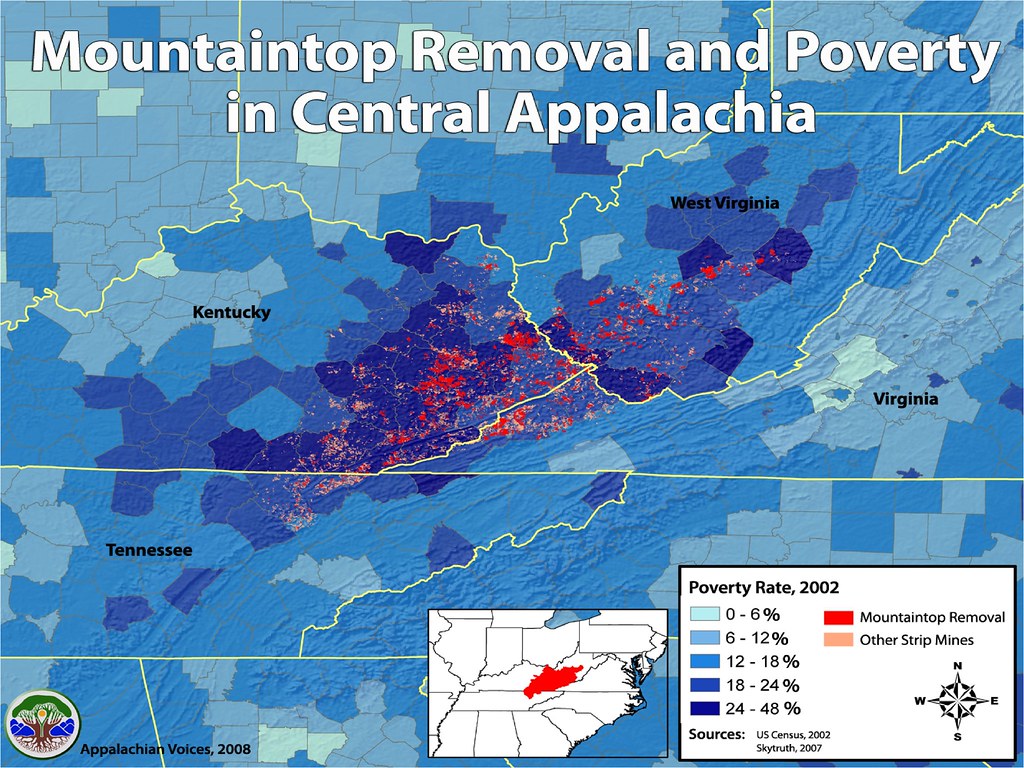
6348078676_59216c9f25_o_web2.jpg


Mountaintop removal mining (MTR) (Wikipedia)

MTR in the United States is most often associated with the extraction of coal in the Appalachian Mountains, where the United States Environmental Protection Agency (EPA) estimates that 2,200 square miles (5,700 km2) of Appalachian forests will be cleared for MTR sites by the year 2012.[8] Sites range from Ohio to Virginia.[6] It occurs most commonly in West Virginia and Eastern Kentucky, the top two coal-producing states in Appalachia, with each state using approximately 1,000 tonnes of explosives per day for surface mining.[9] At current rates, MTR in the U.S. will mine over 1.4 million acres (5,700 km²) by 2010,[10] an amount of land area that exceeds that of the state of Delaware.

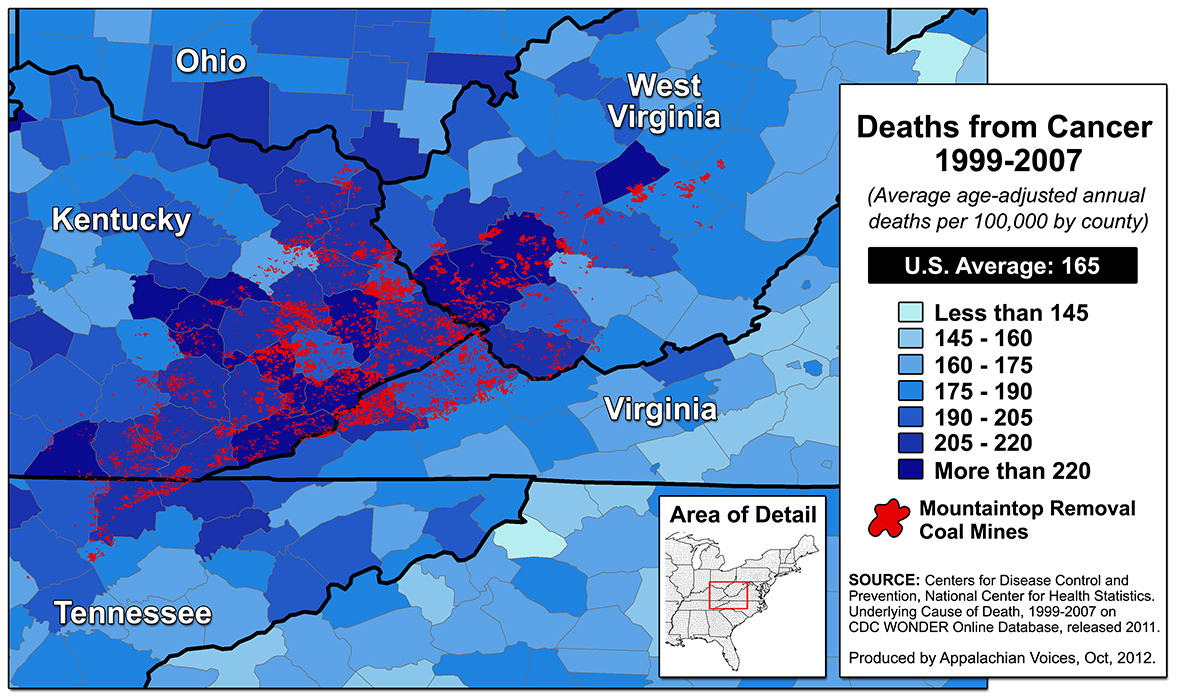
The Human Cost of Mountaintop Removal Coal Mining:
Mapping the science behind health and economic woes of Central Appalachia
(Appalachia Voices)
CDC_Cancer_Map.jpg

(Also maps on Lung Cancer and Respiratory Disease, Cardiovascular Disease and Heart Attacks, Life Expectancy Changes with MTR sites)
2511159339_034e0e34a0_b.jpg


Political Contributions by the Coal Mining Sector (Open Secrets)
Robert Murray, head of Murray Energy, also donated $300,000 for Trump's inauguration.
 
Last edited:

Old Man Mike

Fast as Lightning!
Messages
8,975
Reaction score
6,464
If this sort of extraction industry was needed for almost any serious reason other than coal corporation profits, then one might consider the destruction of these Appalachian mountains and the attendant ecosystem obliterations and the remaining run-off pollution and aesthetic scarring for a brief moment's meditation anyway. But this coal particularly is NOT needed for anything associated with the greater national resource interest.

America is loaded with fossil fuel resources far more accessible, and environmentally controllable, than this almost worst possible choice. What's going on here is obvious to everyone: status quo greed coupling with political power plays. This President's order to call emergency on the national power grid for the sake of keeping some cronies' coal-burner plant open should be viewed as criminal --- in a higher moral sense anyway.
 

Domina Nostra

Well-known member
Messages
6,251
Reaction score
1,388
If this sort of extraction industry was needed for almost any serious reason other than coal corporation profits, then one might consider the destruction of these Appalachian mountains and the attendant ecosystem obliterations and the remaining run-off pollution and aesthetic scarring for a brief moment's meditation anyway. But this coal particularly is NOT needed for anything associated with the greater national resource interest.

America is loaded with fossil fuel resources far more accessible, and environmentally controllable, than this almost worst possible choice. What's going on here is obvious to everyone: status quo greed coupling with political power plays. This President's order to call emergency on the national power grid for the sake of keeping some cronies' coal-burner plant open should be viewed as criminal --- in a higher moral sense anyway.

It's not that simple. I hate the mountain top stuff as well. But coal was a vital part of the energy sector until about 5 years ago when all the sudden VAST stores of NG became accessible.

All of the country, including California and New York, consume tons of power, and are not willing or able to live without it for even a day. We are all implicated in that. In fact, a lot of the least natural parts of the country--places completely paved over and covered in man-made stuff--are the places that blame everyone else for bad stewardship.

So you have large parts of the country, like WV, that were dedicated to getting that coal to supply the nation's needs. NG is now a cheaper and cleaner way to achieve the same goals (although fracking is hardly uncontroversial by the same people that oppose coal). So what do you do with all those people and resources? Make them learn computers? The point is, its really hard on those people in that industry, and it makes sense for the people involved to fight for their livings and, at the very least, make sure the landing is as soft as possible.

The coal industry isn't anymore evil than any other industry. Tesla batteries uses poisonous cobalt mined by child laborers. Apple conspires with totalitarians to build cheap iphones. Google censors according to rules set by dictators. Windmill companies ruin whole landscapes and kill endangered birds by the thousands.
 

Old Man Mike

Fast as Lightning!
Messages
8,975
Reaction score
6,464
Generally true post.

Not sure why my post isn't equally true (and aimed precisely at the point of the OP.) ... was I supposed to write a book on the evils of the general power industry systems as well as the critical resource extraction social and health issues? (I AM writing that very book now as an environmental utopia novel, by the way.)

Please phrase stuff more collegially if possible. (By the way, as most know, West Virginia is my original home state --- I know perfectly well the problems out-of-work displaced coal miners have. There is NO solution for any worker whose job becomes economically obsolete other than them doing something heroic to change their employability, or we returning to small scale community oriented economies --- since the country will not tolerate a full-fledged social/economic safety net for such [continually] displaced labor.)
 
C

Cackalacky

Guest
Generally true post.

Not sure why my post isn't equally true (and aimed precisely at the point of the OP.) ... was I supposed to write a book on the evils of the general power industry systems as well as the critical resource extraction social and health issues? (I AM writing that very book now as an environmental utopia novel, by the way.)

Please phrase stuff more collegially if possible. (By the way, as most know, West Virginia is my original home state --- I know perfectly well the problems out-of-work displaced coal miners have. There is NO solution for any worker whose job becomes economically obsolete other than them doing something heroic to change their employability, or we returning to small scale community oriented economies --- since the country will not tolerate a full-fledged social/economic safety net for such [continually] displaced labor.)
Yes OMM you must completely explore both sides of an issue with 50/50 fair and balanced reporting or otherwise your entire post is bupkus and you will risk being deemed one-sided and biased.
 

Old Man Mike

Fast as Lightning!
Messages
8,975
Reaction score
6,464
It was so much easier when I was in front of the college classroom and could force the class to stay linearly on topic for a little while ... that directed problem-solving-oriented style has obviously permanently spoiled me.
 

Old Man Mike

Fast as Lightning!
Messages
8,975
Reaction score
6,464
Every Superfund site is different. They are different in the type of chemical toxic waste "stored"/abandoned there, some of which can be quickly poisonous, some of which can be long-term accumulative poisonous or cancerous, some of which is dangerous to pregnancies but little else, some of which is ecosystem destructive, etc. Both the local communities and the general National Government have opinions about what sort of risks they want to take, or even believe to be true (the latter stance being especially moronic but fully real.)

Every superfund also differs as to which corporation is responsible, and therefore whether the community or the National wants to anger or in any way hinder them. Almost never is there an objective scientific/medical assessment of risk which drives the ultimate legal decision. Almost always the power play of economics is the driver. So, it is a rare pollution site indeed which is truly cleaned up, or in some other way "isolated" from human or natural world impact (even in the heyday when superfund money was large and sort-of available.)

The only way to avoid health damages from these things is to have industrial systems which don't create them in the first place. Unfortunately, THAT requires Government regulation and oversight --- something that a whole lot of people (including many on this board) do not want. You CAN decide as a country to make such a "sacrifice the lesser number for the benefit of the greater number" economic philosophy in a religious-neutral liberal-capitalist "democracy", but if one does then one should at least publicly "own" that stance. ... and say to the afflicted: Sorry. Too bad for you.
 
C

Cackalacky

Guest
Every Superfund site is different. They are different in the type of chemical toxic waste "stored"/abandoned there, some of which can be quickly poisonous, some of which can be long-term accumulative poisonous or cancerous, some of which is dangerous to pregnancies but little else, some of which is ecosystem destructive, etc. Both the local communities and the general National Government have opinions about what sort of risks they want to take, or even believe to be true (the latter stance being especially moronic but fully real.)

Every superfund also differs as to which corporation is responsible, and therefore whether the community or the National wants to anger or in any way hinder them. Almost never is there an objective scientific/medical assessment of risk which drives the ultimate legal decision. Almost always the power play of economics is the driver. So, it is a rare pollution site indeed which is truly cleaned up, or in some other way "isolated" from human or natural world impact (even in the heyday when superfund money was large and sort-of available.)

The only way to avoid health damages from these things is to have industrial systems which don't create them in the first place. Unfortunately, THAT requires Government regulation and oversight --- something that a whole lot of people (including many on this board) do not want. You CAN decide as a country to make such a "sacrifice the lesser number for the benefit of the greater number" economic philosophy in a religious-neutral liberal-capitalist "democracy", but if one does then one should at least publicly "own" that stance. ... and say to the afflicted: Sorry. Too bad for you.

Absolutey right on every point. Mitigated risks. I have always advocated for a sensible cradle to grave approach where there is a well understood pathway for chemicals to be created and handled properly. Unfortunately that tends to fall into the I am "an evil anticapitalist who wants to ruin our businesses" category.

One of the sites here in charleston is called Macalloy and it was a former hexavalent chromium site. Its been heavily remediated but not fully. We also have numerous other NPL sites along the rivers, each with its own problems ranging from Heavy metals from phospshte ore processing in the 1880s -1950s to creosote pitch facilities where today a water sample collected from ground water turns up creosote in the water column. All of these things could potentially be resurfaced from serious flooding as our groundeater level is less than 5 feet below surface.
 

Legacy

New member
Messages
7,871
Reaction score
321
We shall see what the impact of Harvey is on washing petrochemicals into the Gulf on next year's Dead Zone.

Gulf of Mexico ‘dead zone’ is the largest ever measured:
June outlook foretold New Jersey-sized area of low oxygen (NOAA)

Scientists have determined this year’s Gulf of Mexico “dead zone,” an area of low oxygen that can kill fish and marine life, is 8,776 square miles, an area about the size of New Jersey. It is the largest measured since dead zone mapping began there in 1985.

The annual forecast, generated from a suite of NOAA-sponsored models, is based on nutrient runoff data from the U.S. Geological Survey. Both NOAA’s June forecast and the actual size show the role of Mississippi River nutrient runoff in determining the size of the dead zone.

This large dead zone size shows that nutrient pollution, primarily from agriculture and developed land runoff in the Mississippi River watershed is continuing to affect the nation’s coastal resources and habitats in the Gulf.

These nutrients stimulate massive algal growth that eventually decomposes, which uses up the oxygen needed to support life in the Gulf. This loss of oxygen can cause the loss of fish habitat or force them to move to other areas to survive, decreased reproductive capabilities in fish species and a reduction in the average size of shrimp caught.
PHOTO-%20dead%20zone%20map-NOAA-700x345-Landscape.jpg
 
Last edited:
C

Cackalacky

Guest
Low dissolved oxygen is a hallmark of heavily polluted water.
 

Old Man Mike

Fast as Lightning!
Messages
8,975
Reaction score
6,464
I'd doubt that Harvey run-off will have a negative effect on the dead zone, but I'm no expert. The dead zone is fairly removed from Houston et al, plus it's composed of a different contaminant --- livestock farming waste. One could almost imagine a good vortex or violent water movement breaking it up a little.

Still, the dead zone is so big that it's not about to go away. All one can wish is that we don't add more to it (we will), and that it doesn't come back to kill off the coastal ecosystems (which excess fishing has done pretty well on its own.)
 

Legacy

New member
Messages
7,871
Reaction score
321
West Virginians’ health, jobs and “Suckin’ at the federal teat”?

West Virginians’ health, jobs and “Suckin’ at the federal teat”?

West Virginia - and Appalachia - are the center the result of a number of unfortunate circumstances. You have disappearing industries - mining, lumber - that were the economic engines for the state, leaving in their wake a population with a high poverty rate (17.9% live below the Federal Poverty Level, 38% live below 200% of the FPL). Almost 20% of West Virginians are on food stamps (the SNAP program)- sixth nationally.

West Virginians’ annual median Household Income - $42,824, 3rd lowest. Compared to the median US household income, West Virginia median household income is $13,756 lower. In 2016, the largest industry in West Virginia was government, which accounted for 16.0 percent of West Virginia GDP. The second largest industry was finance, insurance, real estate, rental, and leasing. The industry that subtracted the most from real GDP growth in West Virginia was construction. The second largest industry to subtract from growth was mining. West Virginia’s GDP per capita ranks 45th nationally.

For every dollar in federal tax money paid, West Virginians get back $2.55 in federal money.

Health Care Dollars
Senator Shelley Moore Capito (R-W.Va) after voting against the Senate’s repeal and replacement bill:
As I have said before, I did not come to Washington to hurt people. For months, I have expressed reservations about the direction of the bill to repeal and replace Obamacare. My position on this issue is driven by its impact on West Virginians. With that in mind, I cannot vote to repeal Obamacare without a replacement plan that addresses my concerns and the needs of West Virginians.

Yet Capito voted more than 40 times to dismantle Obamacare as a House member. The year following her election to the Senate with one of the largest margins in W.Va history, she voted with virtually all Senate Republicans for a bill repealing major parts of Obamacare — without a replacement. They knew President Barack Obama would veto the bill.

Capito also voted for the first Senate healthcare bill, the Better Care Reconciliation Act of 2017 (BCRA), which included provisions for higher costs to people with chronic medical conditions and higher costs to the 50-64 age group as well as block grants to states.

West Virginia leads the nation in people on Social Security Disability Insurance. SSI imposes a $2,000 cap on countable financial assets. Eight percent of adults covered by the Medicaid expansion “are permanently disabled, have serious physical or mental limitations—caused by conditions like cancer, stroke, heart disease, cognitive or mental health disorders, arthritis, pregnancy, or diabetes—or are in fair or poor health.” The block grant to the states proposed by BCRA would cause states like West Virginia to soon run out of Medicaid money for those on disability. Nearly two-thirds (61%) of the state’s Medicaid spending is for the elderly and people with disabilities

West Virginia leads the nation in diabetes, drug overdose deaths, overweight/obesity, and is second nationally in cancers, accidents,smoking and third nationally in kidney disease and chronic respiratory disease, The state with limited resources, high percentage of people in poverty, reliance on federal programs like Medicaid would have limited ability to afford expensive treatments, fund clinics or provide preventative care and outreach in a rural state (46% of its citizens) to populations that significantly lag (9%) behind the national average (33%) in degrees after high school.

Capito also voted for the Senate’s “skinny repeal”, which would allow insurers to waive the rules that ban insurers from rejecting consumers or charging them more because they have a pre-existing condition.

A Vulnerable Population
Capito also said on the Senate healthcare bill that would repeal without replacement:
I only see it through the lens of a vulnerable population who needs help.” and "I have serious concerns about how we continue to provide affordable care to those who have benefited from West Virginia’s decision to expand Medicaid, especially in light of the growing opioid crisis.

State and federal resources for the opioid fight are already stretched thin despite federal monies through the Medicaid expansion. More than 40 percent of funding for drug abuse and mental health treatment in the state comes from Medicaid expansion. If Medicaid’s expanded coverage is rolled back and the program’s funding is capped as part of the GOP’s repeal bill, the area will lose what grant money it does receive to fight the drug crisis.

Under BCRA, West Virginia would have had to make up $3.4 billion in loss of federal funds between 2020-2029. Thirty percent of West Virginians are on Medicaid, making West Virginia the state with the highest share of its population enrolled in Medicaid. Over three-fourths (79%) of all federal funds West Virginia receives are for Medicaid.

If West Virginia dropped the Medicaid expansion in response to the loss of enhanced federal financing, the state would forgo an additional $7.6 billion over the 2020-2029 period. By 2029, 227,000 West Virginians estimated to be covered in the expansion group would lose Medicaid coverage. The federal match rate for the 2017 calendar year for West Virginia’s Medicaid expansion population due to their low incomes is 95%. 53% of all children in West Virginia are covered by Medicaid.

Federal money is also spent in West Virginia on 30,000 children covered under the Childrens Health Insurance Program (CHIPs) which is set to expire on September 30th


Wide-Ranging Impacts
The West Virginia Policy Center on Budget and Policy in a report this January "Repealing the ACA: Hurting Our Health and Our Economy” said: “184,000 West Virginians would lose health insurance, many of whom are working in low-wage jobs such as food services.” and details the other results of Repeal without replacement.

WVCBP Executive Director Ted Boettner, who authored the report, said "The ACA is much more than a lifeline for hundreds of thousands of West Virginians who have gained health coverage and important patient protections," and "It has been a billion dollar investment in our people that has lead to thousands of new jobs during a time when our state's communities are struggling."

Trump would let the ACA with its Medicaid expansion “implode”.

When Pope Francis addressed a joint meeting of Congress in a historic speech in September 2015, he said:
Your own responsibility as members of Congress is to enable this country, by your legislative activity, to grow as a nation. You are the face of its people, their representatives. You are called to defend and preserve the dignity of your fellow citizens in the tireless and demanding pursuit of the common good, for this is the chief aim of all politics. A political society endures when it seeks, as a vocation, to satisfy common needs by stimulating the growth of all its members, especially those in situations of greater vulnerability or risk. Legislative activity is always based on care for the people. To this you have been invited, called and convened by those who elected you.

$8.5 Billion of Federal Revenue Request by Coal Company and the State
Capito flew to West Virginia with Trump for his speech there. Both Trump and Capito are very popular in West Virginia, each getting over 60% each in their recent elections. On that visit, Robert Murray, the head of Murray Mining and a large donor to the Trump campaign and inauguration, told Trump that one of his primary customers was on the verge of going bankrupt and that “tens of thousands of coal miners” would lose their jobs without a federal infusion of $4.5 billion annual federal subsidy. Murray had previously told Trump should “temper his expectations” and that coal mining would not be coming back. In contrast to his support for the Republican healthcare repeal bills, Trump told Gary Cohn, his Economic Advisor, “to do whatever these two want him to do.” for the coal companies. However, the $4.5 Billion did not show up in Trump’s fiscal plan submitted to Congress, having been turned down by the Dept of Energy.

The Governor of West Virginia, Jim Justice (D), announced he was changing parties to Republican after Trump’s visit. He then requested $4 Billion in federal money for the state.


Pope Francis in his Congressional speech:
Politics is, instead, an expression of our compelling need to live as one, in order to build as one the greatest common good: that of a community which sacrifices particular interests in order to share, in justice and peace, its goods, its interests, its social life. I do not underestimate the difficulty that this involves, but I encourage you in this effort.

(Under this topic since I previously posted on West Virginia's environmental issues)
 
Last edited:

Old Man Mike

Fast as Lightning!
Messages
8,975
Reaction score
6,464
All that I can say is that the report sounds very much like my old state. I have several family members who still live there. One brother was a high school math teacher and coach. That's "government employment." Now that he's retired, he and his wife gave WVA a fair try, but are moving out. Two of my other brothers once worked in WVA, but have moved just across the Ohio River into Ohio. One brother travels back into WVA as a real estate/landlord owner, and constantly gripes about "people" while praising Trump.

I have a sister who, with her husband, like the beauty of the country, but she works at a big hospital in Wheeling as an RN. Nieces are school teacher, newly graduated medical technician, and chief waitress at a restaurant in Morgantown. (Mentally overqualified but her personality gets big tips.) The point of this is, most West Virginians don't have near the mental skills plus robust health and solid upbringing that my family had/has. "We" could find the way; most West Virginians, even though MANY of them have good intelligence, have a very hard time fighting the job war. --- unless they decide simply to leave the state (once that was almost entirely for Ohio, Michigan, Chicago, but now increasingly to the "South". ... or the military.)

The ones who stay and lose, get into the eat-and-drink your troubles away lifestyle. That's why WVA leads the nation in obesity and diabetes. Uncharitable unsympathetic outsiders then make the remark that it's all their own fault and the country would be better off without them, so who really cares? That attitude might be viewed as Ayn Rand pragmatic and economically efficient (trim off the dying leaves on the Money plant,) but doesn't match Beatitudes-based Catholicism very well (Thus Pope Francis' thoughts.)
 

Legacy

New member
Messages
7,871
Reaction score
321
Some article links for occupational and environmental-related illnesses in WV and Appalachia.

Black Lung Disease
Breathless and Burdened (Center for Public Integrity) - a series of articles on Black Lung disease, which won the author the 2014 Pulitzer Prize for Investigative Reporting)
This yearlong investigation examines how doctors and lawyers, working at the behest of the coal industry, have helped defeat the benefits claims of miners sick and dying of black lung, even as disease rates are on the rise and an increasing number of miners are turning to a system that was supposed to help alleviate their suffering. Winner of the 2014 Pulitzer Prize for investigative reporting.

Opioids
Drug firms poured 780M painkillers into WV amid rise of overdoses (First of three articles on opioids in WV, which won the author the 2017 Pulitzer Prize in Investigating Reporting)
For courageous reporting, performed in the face of powerful opposition, to expose the flood of opioids flowing into depressed West Virginia counties with the highest overdose death rates in the country.

His other two:
'Suspicious' drug order rules never enforced by state

Drug firms fueled 'pill mills' in rural WV


Coal Ash
A Burning Issue: The Health Costs of Coal Ash (Appalachian Voices, August 2017)

After laboring to clean up the nation’s largest coal ash spill, many workers became sick and 17 died, alleges a lawsuit filed in July on behalf of more than 50 workers and workers’ survivors.

The lawsuit was filed against Jacobs Engineering, the company hired by the Tennessee Valley Authority to clean up the 2008 disaster, which occurred when a dam failed at the TVA’s Kingston coal-fired power plant in Harriman, Tenn. More than 1.1 billion gallons of coal ash sludge spilled across rivers, homes and fields. According to the Knoxville News Sentinel, the workers sent to clean up the toxic substance were not provided any protection or warning about the dangers of coal ash exposure
 
Last edited:

Legacy

New member
Messages
7,871
Reaction score
321
Perhaps the solar industry discussion may nestle here. Anyway, lighting Africa and the Chinese solar position is worthy of a post in this thread.

The Race to Solar-Power Africa: American startups are competing to bring electricity to communities that remain off the grid.
(New Yorker)
Electrifying Africa is one of the largest development challenges on earth. Until recently, most people assumed that the continent would electrify in the same manner as the rest of the globe. “The belief was, you’d eventually build the U.S. grid here,” Xavier Helgesen, the American co-founder and C.E.O. of Off-Grid Electric, told me. “But the U.S. is the richest country on earth, and it wasn’t fully electrified until the nineteen-forties, and that was in an era of cheap copper for wires, cheap timber for poles, cheap coal, and cheap capital. None of that is so cheap anymore, at least not over here.”

Solar electricity, on the other hand, has become inexpensive, in part because the price of solar panels has fallen at the same time that the efficiency of light bulbs and appliances has dramatically increased. In 2009, a single compact fluorescent bulb and a lead-acid battery cost about forty dollars; now, using L.E.D. bulbs and lithium-ion batteries, you can get four times as much light for the same price. In 2009, a radio, a mobile-phone charger, and a solar system big enough to provide four hours of light and television a day would have cost a Kenyan a thousand dollars; now it’s three hundred and fifty dollars.

President Trump has derided renewable energy as “really just an expensive way of making the tree huggers feel good about themselves.” many Western entrepreneurs see solar power in Africa as a chance to reach a large market and make a substantial profit. This is a nascent industry, which, at the moment, represents a small percentage of the electrification in the region, and is mostly in rural areas. There’s plenty of uncertainty about its future, and no guarantee that it will spread at the pace of cell phones. Still, in the past eighteen months, these businesses have brought electricity to hundreds of thousands of consumers—many of them in places that the grid failed to reach, despite a hundred-year head start. Funding, much of it from private investors based in Silicon Valley or Europe, is flowing into this sector—more than two hundred million dollars in venture capital last year, up from nineteen million in 2013—and companies are rapidly expanding their operations with the new money. M-Kopa, an American startup that launched in Kenya, in 2011, now has half a million pay-as-you-go solar customers; d.light, a competitor with offices in California, Kenya, China, and India, says that it is adding eight hundred new households a day. Nicole Poindexter, the founder and C.E.O. of Black Star, told me that every million dollars the company raises in venture capital delivers power to seven thousand people. She expects Black Star to be profitable within the next three years.
. (Helgeson is a ND alum)

earth_lights.jpg


Why China Is Dominating the Solar Industry (Scientific American)
 
Last edited:

Old Man Mike

Fast as Lightning!
Messages
8,975
Reaction score
6,464
All this is puzzling to me, but I think that this is because I'm ignorant about a vast number of US companies and their agendas. It SEEMS obvious that "markets" in other continents are potentially huge, but at the same time, what are the short term profit margins? Are the US Big players happy with their short term economic trajectories? Are they afraid of China's ability to gov-fund profit eaters until dominance evolves? Something is going on here on both very large scales and very narrow-vision corporate values.

My (rather long-term) reading of the critical resources literature indicates to me that US corporations value Africa, South and Central America, and parts of Asia only as sources of raw materials --- NOT as potential markets, almost of any kind. US corporations want to make and sell very high-end products to wealthy and semi-wealthy persons and nations in situations of secure payback for goods and services rendered ("logical" but hardly wild west risk-taking.) The exception to this is the sale of weaponry to anyone who has the gold to pay for it immediately whether in an insecure "stability" situation or not.

China seems to have a longer vision: go into Africa and dominate both the economic structures and the resource areas. South Africa and the US do not like the second of these and so position their interests militarily to protect "their" minerals without caring much about who lives around there. China seems to be trying to play the long term resources game everywhere they can. But that is the key area where the US military/industrial collaboration is highly alert. China seems to believe that they can win the war for hearts and minds by these life quality efforts (which contain some other benefits to them) and "take over" ultimately that way. The US corporations don't want to make that effort nor risk, and they count on power to provide what they want without the long view effort.

Looked at as a War Game, this is "interesting." Looked at as reality, one could see ourselves as short-sighted and stupid at best, and immoral at worst. Everything that I've read about this stuff says "both."
 

Old Man Mike

Fast as Lightning!
Messages
8,975
Reaction score
6,464
The title makes it sound like a joke but it is not. Going back to legendary Supreme Court Justice Douglas, his views recognized that requiring the obvious physical or economic harm of an individual HUMAN (or even a whole community) was far too much to ask in defense of the destruction or violent damage to certain types of natural resources. His views gave rise to the classic book: Should Trees Have Standing? (reflecting upon the commonly known devastation of clear-cutting national forests as a example of the sort of thing where damage to the aesthetic, the recreational, and the ecological could not be readily measured for court purposes.) (The Colorado River is even more of a future-critical health, economics, and survival situation.)

The idea of court "standing" for a non-human is not obviously stupid, nor without precedence, as the article immediately reminds the reader --- corporations have legal standing now (and have had for a long and environmentally, socially-devastating time (Corporations being able to sue citizens in things like SLAP suits is a violent persuasion against criticizing them.)

But I wonder if I could wipe out corporate "standing" and not have nature "standing" vs have both, what would I choose? I almost intuit that wiping out corporate standing would be the better choice.
 

Legacy

New member
Messages
7,871
Reaction score
321
From previous post #49,
$8.5 Billion of Federal Revenue Request by Coal Company and the State
(Sen) Capito flew to West Virginia with Trump for his speech there. Both Trump and Capito are very popular in West Virginia, each getting over 60% each in their recent elections. On that visit, Robert Murray, the head of Murray Mining and a large donor to the Trump campaign and inauguration, told Trump that one of his primary customers was on the verge of going bankrupt and that “tens of thousands of coal miners” would lose their jobs without a federal infusion of $4.5 billion annual federal subsidy. Murray had previously told Trump should “temper his expectations” and that coal mining would not be coming back. In contrast to his support for the Republican healthcare repeal bills, Trump told Gary Cohn, his Economic Advisor, “to do whatever these two want him to do.” for the coal companies. However, the $4.5 Billion did not show up in Trump’s fiscal plan submitted to Congress, having been turned down by the Dept of Energy.

The Governor of West Virginia, Jim Justice (D), announced he was changing parties to Republican after Trump’s visit. He then requested $4 Billion in federal money for the state.

Having detailed the necessary (at this time) federal revenue need for vulnerable West Virginians' health, poverty, food assistance in comparison to the excessive requests for billions from Trump's friend and big donor, Robert Murray, and the WV Governor, Jim Justice, a former coal executive, I thought their money-grab had been decided despite Trump's statement to "to do whatever these two want him to do.". I figured that more fiscally-conscious heads within the WH had prevailed. How wrong I was. This does not not even need Congressional approval. Talk about suckin' at the federal trough and taking taxpayer money for a dying industry that avoids paying health benefits, pensions and obligations to its former employees effectively turning over the cost for their health care to the federal government.

Trump seeks FERC help for coal-fired power plants . (Charleston Gazette)

The Trump administration on Friday urged federal energy regulators to pursue a potentially sweeping rule aimed at helping the nation’s declining coal industry compete with low-priced natural gas and with the continued growth of renewable energy sources, like solar and wind.

U.S. Energy Secretary Rick Perry asked the Federal Energy Regulatory Commission to move quickly to adopt the rule, which he said would allow troubled coal and nuclear plants to recover more of their costs, a move that Perry portrayed as ensuring the nation’s electrical grid remains “reliable and resilient.”

“My proposal will strengthen American energy security by ensuring adequate reserve resource supply and I look forward to the commission acting swiftly on it,” Perry said in a prepared statement.

Friday’s announcement by Perry follows the Department of Energy’s rejection last month of a request by West Virginia’s largest coal producer, Murray Energy, for the agency to help the industry by invoking emergency authority meant to allow power plants to remain open during times of national emergency.

The White House has not announced any sort of action on a somewhat related proposal from West Virginia Gov. Jim Justice for a $4 billion annual federal subsidiary to the Eastern U.S. coal industry.

Perry’s proposal asks FERC, an independent agency with commissioners who are presidential appointees, to step in and make sure that coal and nuclear plants can “recover ... fully allocated costs and thereby continue to provide the energy security on which our nation relies.”

I underestimated the degree of sleeze to which these guys are capable.
 
Last edited:

Old Man Mike

Fast as Lightning!
Messages
8,975
Reaction score
6,464
Underestimate no more. "We" have a tunnel mining company in northern WV that has killed people through safety negligence long after complaints were turned in, inspections made, and upgraded safety measures claimed. Sleeze-o-meter rising........
 

Old Man Mike

Fast as Lightning!
Messages
8,975
Reaction score
6,464
The depth of inappropriateness of Trump-appointee behavior beggars the imagination. I thought that when Reagan appointed James Watt and Ann Gorsuch that we'd never see worse --- they were merely uncaring and value-dead sell-out pikers compared with these bastards. Back then, the saner elements of American society were able to get this sort of creature ousted for cause; now nothing is viewed as cause.
 

Legacy

New member
Messages
7,871
Reaction score
321
How Will the Clean Power Plan Repeal Change Carbon Emissions for Your State? (NY Times)

It all depends on where you live. For California, repeal won’t make much difference. For West Virginia, it could matter a lot.

When the Obama administration unveiled the Clean Power Plan in 2015, each state was given individual goals to slash power sector emissions. The aim was to shift utilities away from coal in favor of cleaner sources like natural gas, wind, solar and nuclear to help address global warming.

Even though the rule has never taken effect — it was temporarily blocked by the Supreme Court in 2016 and is now slated for repeal by the White House — dozens of states were making that shift anyway, driven by economic considerations and local clean-energy policies.

EPA head met with a mining CEO -- and then pushed forward a controversial mining project (CNN)

Within hours of meeting with a mining company CEO, the new head of the US Environmental Protection Agency directed his staff to withdraw a plan to protect the watershed of Bristol Bay, Alaska, one of the most valuable wild salmon fisheries on Earth, according to interviews and government emails obtained by CNN.

The meeting between EPA Administrator Scott Pruitt and Tom Collier, CEO of Pebble Limited Partnership, took place on May 1, Collier and his staff confirmed in an interview with CNN. At 10:36 a.m. that same day, the EPA's acting general counsel, Kevin Minoli, sent an email to agency staff saying the administrator had "directed" the agency to withdraw an Obama-era proposal to protect the ecologically valuable wetland in southwest Alaska from certain mining activities.

In 2014, after three years of peer-reviewed study, the Obama administration's EPA invoked a rarely used provision of the Clean Water Act to try to protect Bristol Bay after finding that a mine "would result in complete loss of fish habitat due to elimination, dewatering, and fragmentation of streams, wetlands, and other aquatic resources" in some areas of the bay.

"All of these losses would be irreversible," the agency said.
 
Last edited:

Old Man Mike

Fast as Lightning!
Messages
8,975
Reaction score
6,464
Following the Money, not the Covenant of God with Noah to steward His Creation. Criminal and immoral.
 
Top