Healthcare

kmoose

Banned
Messages
10,298
Reaction score
1,181
Trump's Stealth Health Plan Could Be 'Medicare For All' (Forbes)


Getting a national health care system for all through Congress? It took Nixon to go to China.


Not saying you, but I can just see the heads of liberals exploding, if Trump were to get a single payer system of healthcare that covered everyone into place. And I'm sure mobs of 20-somethings would form in cities all over the country and start vandalizing everything they could find.
 

Legacy

New member
Messages
7,871
Reaction score
321
Trump’s CDC May Face Serious Hurdles (Scientific American)

When the clock The nation’s public health agency is battling on several fronts, including an Obamacare repeal noon Friday, presidential inauguration day, there will be another transition of power some 600 miles southwest of the White House. Tom Frieden, director of the U.S. Centers for Disease Control and Prevention, will hand over his Atlanta-based agency to an acting director, a career civil servant named Anne Schuchat who has been serving as Frieden’s principal deputy director. Succession for this temporary role is spelled out by a federal law that applies to top government vacancies.

On day one of the Donald Trump administration, Schuchat will already be grappling with numerous threats as the agency continues its work of investigating outbreaks and seeking to prevent new ones. In the past seven and a half years under Frieden’s leadership the CDC has been roiled by crises including government furloughs, H1N1 flu, lab safety issues and the U.S. responses to Ebola and the Haiti earthquake. The agency is also still in emergency mode as it confronts the mosquito-borne Zika virus and its related birth defects. And the hits are likely to keep on coming.

The CDC will struggle to deal with emerging threats because it does not have the cash or power to respond immediately in a crisis, Frieden says. “There’s a need to establish a rapid-response fund for emergencies that has both dollars and emergency authority,” he told Scientific American. “It’s a big problem that when there is an emerging threat, we are not able to surge as rapidly or work as rapidly as we should, because of lack of money and legislative authority. When there is an earthquake, FEMA doesn’t have to go to Congress and say, ‘Will you give us money for this?’ but CDC does.”

The agency has other money troubles, too. Its Prevention and Public Health Fund, which is part of the Affordable Care Act, accounts for more than a tenth of the agency’s budget, Frieden notes. Its monies support immunization programs to prevent disease and block grants to states, he says, adding that a repeal of the ACA—a stated priority of the Trump administration and the congressional majority—would endanger these programs. “Zika is the first predictable problem,” Frieden explains. “Zika is not over. It is likely to spread in Latin America and the Caribbean for months and years to come, and we still don’t fully understand the range of birth defects it causes.” Other big issues include combating antibiotic resistance in the U.S., stemming the opioid epidemic that has quadrupled overdose deaths in the U.S. since 1999 and remaining vigilant against the perennial onslaught of influenza—as well as emerging threats including tick-borne pathogens......
 
Last edited:

Valpodoc85

Well-known member
Messages
1,719
Reaction score
466

CDC was originally set up after WWII to help track/combat malaria. It was centered in Atlanta because that was where malaria was endemic in the US. Over the years there has been an "administrative drift." It now tracks all sort of illness and chronic diseases. Not suprising they should agitate for more funding. Seems to me a good description of mission should proceed any budget talks
 

Legacy

New member
Messages
7,871
Reaction score
321
CDC was originally set up after WWII to help track/combat malaria. It was centered in Atlanta because that was where malaria was endemic in the US. Over the years there has been an "administrative drift." It now tracks all sort of illness and chronic diseases. Not suprising they should agitate for more funding. Seems to me a good description of mission should proceed any budget talks

Could you provide examples of "administration drift"?

Here's their Mission statement.

Here's the CDC's Strategic Framework with their Priorities

Some of the highlights arranged according to timeline by decade in the CDC's history.

And their Disease Surveillance and Monitoring.

You may be familiar with their work and their website, but an example of one disease surveillance and work on a growing health problem with information to the public and clinicians. Antibiotic/Antimicrobial Resistance

As well as the Budget Fact Sheets for their work they must submit annually as part of the President's Budget for appropriations by Congress.
 
Last edited:

Valpodoc85

Well-known member
Messages
1,719
Reaction score
466

I get your point. The CDC has a mission statement priorities and committees to tract performance but like the Department of Energy has grown consistently with each administration. I guess I'm referring to a broader discussion regarding bureaucratic growth. In1946 it was tasked with malaria today it is tracking Zika in South America. Both seem to be laudable, but with the scope described in the current mission statement is the budget ever big enough?
 

Legacy

New member
Messages
7,871
Reaction score
321
I get your point. The CDC has a mission statement priorities and committees to tract performance but like the Department of Energy has grown consistently with each administration. I guess I'm referring to a broader discussion regarding bureaucratic growth. In1946 it was tasked with malaria today it is tracking Zika in South America. Both seem to be laudable, but with the scope described in the current mission statement is the budget ever big enough?

I understand your point, too. There's a point at which, though laudable, health spending and priorities need to be examined closely and limited by funding. Separating the baby from the bathwater. Of course, goals are always quite general, such as Defense goals to keep America safe from attacks, and bureaucracy grows. But Congress looks at the CDC discretionary budget each year.

It looks to me as though in their latest Annual Report from their Office of Financial Affairs that the 2016 appropriations were trimmed from 2015 and that the decrease amounting to the total elimination of Ebola funding from the prior year. Also it appears Congressional funding for the CDC has remained fairly constant for the past five years (2012-16). (See page 13)
 

Legacy

New member
Messages
7,871
Reaction score
321
I was referring to this
https://www.cdc.gov/budget/documents/fy2017/cdc-overview-factsheet.pdf

6.98 billion. All started with tracking malaria.

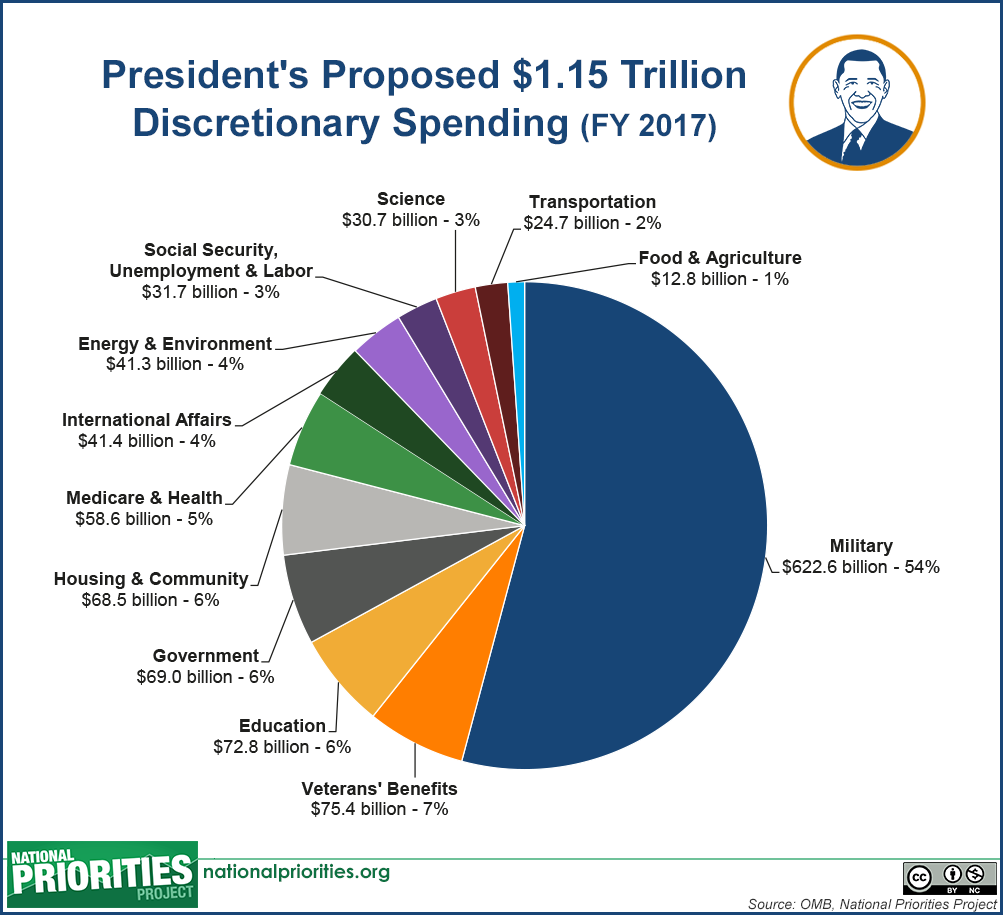
Thanks, VPMD. This was very interesting and helpful. Not saying that the proposed $7 Billion is a lot of money for the CDC, which has remained the same for at least the last five years. I'm sure they think it's not enough. Good to know the breakdown. In the bigger picture, this is discretionary allocations as noted. The largest part of discretionary spending is Defense at $622 Billion proposed for 2017 or 54% of all federal discretionary budgeting. That's more, of course, than all other areas combined and not including the VA's $75 Billion (7%). Medicare and Health (Discretionary only) is $59 Billion (5%), which is what the CDC's $7 Billion would come under.

So, the CDC's budget is 1.1% of the Defense's budget. The new President and Congress are also committed to lifting the caps on the military imposed by the Balanced Budget amendment. The CDC - from the article I first linked - is expected to decrease by 10-15% since some funding comes from ACA or Obamacare.

I also appreciate the breakdown which notes their commitment to public and preventative health commitments since:
-- 117 million people in the U.S. have a chronic disease,
-- 75 people a day die of overdoses,
-- 75% of the total $2.5 trillion in annual health care costs to treating preventable conditions
-- their second largest expenditure is $200 million to Detect and Protect against Antibiotic Resistance

I understand how they can spend dollars overseas in monitoring and fighting infectious diseases since those do not recognize borders. Anyway, thanks for the link and your thoughts.

2017_pres_budget_disc_spending_pie.png
 

Legacy

New member
Messages
7,871
Reaction score
321
Judge Blocks Health Care Merger, Saying It Would Hurt Competition (NPR)

U.S. District Judge John Bates found that to be the case, writing in his decision that, "the merger of Aetna and Humana would be likely to substantially lessen competition in markets for individual Medicare Advantage plans and health insurance sold on the public exchanges" in 364 counties.

Medicare Advantage plans are privately run but reimbursed by Medicare.

Bates also spent a considerable chunk of the 158-page decision analyzing Aetna's decision, announced last summer, to withdraw its insurance plans from 17 counties where Aetna and Humana both sold plans on the public exchanges.

[Aetna CEO Mark] Bertolini and his company "have long been supporters of the public exchanges," today's decision noted.

But, as Scott also reported, a letter leaked to reporters last summer indicated Aetna CEO Mark Bertolini had tied his company's decisions about participating in the exchanges to the Justice Department's decision on the merger. In the letter to the DOJ, Bertolini wrote, "if the DOJ sues to enjoin the transaction, we will immediately take action to reduce our 2017 exchange footprint."

The company subsequently did just that.

In his Monday decision blocking the merger, Bates found, "Aetna tried to leverage its participation in the exchanges for favorable treatment from DOJ regarding the proposed merger."

He found Aetna had withdrawn from the 17 counties where it competed with Humana "at least in part for the purpose of improving its litigation position" in the government's lawsuit against it.

"Meanwhile, the same court is considering another case brought by the Justice Department's antitrust division against the proposed merger of Anthem and Cigna," she reported. "A decision in that case is also expected soon."

In this case, Aetna got out of the exchanges for health insurance, decreasing competition and giving consumers less choices and, possibly, increasing prices and costs for the consumer for health insurance from the remaining insurance providers - because the DOJ sued to block the merger. One of the remaining competitors in those marketplaces was Humana, who could raise it rates to the consumer, and, if the merger was eventually approved, could continue with the higher rates as part of the Aetna-Humana company.
 
Last edited:

Legacy

New member
Messages
7,871
Reaction score
321
The G.O.P.’s Health Care Death Spiral (NY Times)

Last week, President-elect Donald J. Trump called Obamacare “a complete and total disaster,” and pushed for a swift repeal of the Affordable Care Act and a replacement within weeks. But at the moment, there is no workable replacement. So what happens to the individual insurance market — whose problems did not start with the Affordable Care Act and will not be easily solved — when it is destabilized so dramatically?

From my point of view as a former health insurance company chief executive, “total disaster” would also describe any Republican repeal-and-delay plan. Although my former colleagues in the insurance industry are too cowed by the president-elect to say so, Republican insistence on repeal without having a meaningful replacement at the same time will drive most insurers out of the individual market and leave the 10 percent of Americans now covered by some aspect of the A.C.A. without coverage — especially if Medicaid expansion is rolled back as well.

The proportion of uninsured Americans, which has dropped to less than 9 percent, the lowest on record, will at least double. By April, when filings from insurance company plans and premiums for 2018 are due, there will be a sizable exit — of insurers running away from the greatly increased and unpredictable risk and of individuals not able to afford insurance without the subsidies.

Of course, the A.C.A. has a number of flaws, and repair is critical. But delay is not an option if the replacers really want to use private insurers to meet society’s goals of access, affordability and quality in health care. All known Republican alternatives envision heavy reliance on the same insurers that are now ready to bolt and leave a total mess rather than a defective but repairable market.

After they leave, the damage will spread to doctors and hospitals, whose bad debt will skyrocket when patients miss copays and drop coverage while providers and hospitals still must continue care.


This is not speculation but based on my experience in the industry and as a member of the board of a public hospital that stands to lose substantial Medicaid payments if the state expansions are rolled back.

Let’s go back for a moment to pre-Obamacare days. Why did insurers refuse to cover individuals with pre-existing conditions, cancel policies if customers used them too much, set high premiums for women and old people, and so forth? These tools were the only way to limit risk when insurers didn’t have a ready-made pool of sufficient size to balance the sick and well as employer-sponsored plans do.

Refusing coverage and the like was good business, but it did not serve small businesses, the self-employed or other people unable to get the insurance they wanted. The Obamacare exchanges tried to fix this by requiring everyone to join the pool, providing premium and cost-sharing subsidies geared to income (the “affordable” in the law’s name) and limiting risk to insurers to entice them to offer policies.


It’s a tricky business to fine-tune a market and encourage buyers and sellers to do the right thing — both providing access to individuals in need and encouraging enough insurers to join to make competition work. But George W. Bush, with some bipartisan support, did it not so long ago with the Medicare drug plans.

But unfortunately, the A.C.A. law created by Democrats in Congress had several big flaws. Pricing restrictions — which essentially mandated that insurers overcharge younger customers relative to older ones — created the wrong incentives, and so too many older, sicker individuals joined, and younger, healthy people were discouraged.

This was compounded by a Republican Congress that reneged on its promise to help insurers in the first years of the program by limiting risk. Congress allowed only 12 percent of the backup that was promised to companies when they set their premiums on the Obamacare exchanges. This ramped up their risk dramatically.

If you’re wondering why insurers substantially increased premiums for this year, even far beyond the underlying health care inflation rate — now at around 4 percent — this shell game with risk is your answer.

Ultimately, if the risk is too high, exit is inevitable. That is what my top-rated plan, Qualchoice, did in Ohio in the late 1990s to stem multimillion-dollar losses from its participation in the Medicaid Advantage managed care program. It’s also what United Healthcare did and most others will do this spring when faced with the uncertainty of delay.

Finally, none of the participants, in government or business, want to recognize that in many parts of the country, only one insurer or a highly consolidated health system dominates, which eliminates meaningful competition and choice.

Since 2010, Republicans have made political hay by demonizing the mandate to buy insurance, subsidies to make it affordable and taxes on employers, suppliers, insurers and especially the wealthy to finance it. But now they own the problem and must fix it or do something better.

Obamacare, or any plan that replaces it that is reliant on private insurers and individual enrollment, will succeed only under the following conditions: a meaningful incentive to purchase insurance (the individual mandate or equivalent); help to make it affordable; risk reduction for insurers to stabilize premiums; and enough funding to pay for it all.

If any replacement plan doesn’t include these elements, private insurance will revert to the chaos of the pre-A.C.A. market. In business, managing risk is important; in insurance, it is everything. Whoever plays games with it — knowingly or inadvertently — is playing with fire. If we manage this risk badly through repeal and delay, the damage to insurers, individuals, hospitals and professionals will be profound.
 
Last edited:

Legacy

New member
Messages
7,871
Reaction score
321
Two sides of changing the FDA Drug Approval process

What if the Free Market Decided Whether or Not Drugs Work? (MIT Technology Review)

During a meeting with leaders of the pharmaceutical industry on Tuesday, President Donald Trump said he wanted the U.S. Food and Drug Administration to speed drug approvals.

“We’re going to get the approval process much faster,” Trump said, adding that he has an unnamed “fantastic person” in mind to lead the agency.

Just how Trump will do that isn’t clear. But some of those with the president’s ear have embraced a radical free-market view. They want the marketplace, not the FDA, to determine how good drugs are.

For instance, one name floated in December as a potential FDA pick was that of Jim O’Neill, managing director of Peter Thiel’s investment firm Mithril Capital. O’Neill is a libertarian who has said he thinks drug makers shouldn’t have to prove their pills actually work at all, but only that they are safe. “Then let people start using them at their own risk,” he argued in a 2014 speech.

The idea is that the market itself will find ways to judge the best drugs, just as it rates restaurants, books, or software programs.
...

Trump's FDA Chief May Implement Progressive Approval For Drugs (Forbes)

President-elect Trump's cabinet appointments are generating a great deal of attention and controversy. After eight years of Democrat rule, it would be foolish to expect otherwise.

One appointment, though, will have a profound impact on your health… and the health of your loved ones.

The “progressive approval” process for drugs


The first potential FDA chief appointee leaked by the Trump transition team is Jim O’Neill. Managing director of Peter Thiel’s Mithril Capital, O’Neill has publicly supported proposals to do away with the FDA’s requirement for phase 2 and 3 trials. Instead, he favors “progressive approval” of drugs and other medical technologies.

O’Neill would not be the first FDA head to favor progressive drug approval. Andrew von Eschenbach developed this system when he served as FDA chief. But during his tenure, Eschenbach was not able to put such a far-reaching reform into practice in the US.

The Japanese, though, saw the value of Eschenbach’s plan. They now use it for regenerative medicine. Japan legalizes therapies following proof of safety. Once a drug is in use, companies can move to phase 4. This means they monitor their patients and disclose efficacy data regularly.
 
Last edited:

Legacy

New member
Messages
7,871
Reaction score
321
Editorial: The false promise of state-based health insurance markets reform

News leaks from last month's Republican Congressional retreat revealed there's a growing concern that precipitous change to the individual health insurance markets created by Obamacare will trigger their collapse.

GOP backbenchers worry that former Secretary of State Colin Powell's invocation of the Pottery Barn rule, issued just before the invasion of Iraq, will apply: If you break it, you own it.

The vestigial moderate wing of the GOP is attempting to come up with what on the surface looks like a compromise. Unfortunately, it can't work—not unless the majority party is willing to put money behind it comparable to funding for the Affordable Care Act.

The likelihood of that happening is not one of former Defense Secretary Donald Rumsfeld's unknown unknowns. Short answer: very unlikely.

The Patient Freedom Act, introduced last month by Sens. Bill Cassidy (R-La.) and Susan Collins (R-Maine), would leave it to states to decide how and whether they should move toward universal health insurance coverage. leaks from last month's Republican Congressional retreat revealed there's a growing concern that precipitous change to the individual health insurance markets created by Obamacare will trigger their collapse...
.
 

Legacy

New member
Messages
7,871
Reaction score
321
Editorial: Trump's choice of Mick Mulvaney signals trouble for Medicare (Modern Healthcare)

By Merrill Goozner | January 28, 2017
Donald Trump campaigned on a promise to leave Medicare alone. But in choosing Rep. Mick Mulvaney of South Carolina to head the Office of Management and Budget, he is signaling a huge fight lies ahead over the future of the program.

Mulvaney, first elected in the Tea Party wave of 2010, helped found the House Freedom Caucus. The conservative Republican Study Committee wants to cut 17% from the federal budget. The Freedom Caucus complains that's not enough to lower future government deficits.

He'll be writing the president's first budget. At his confirmation hearing last week, when pressed about Trump's promise, Mulvaney replied, “I have to imagine the president knew what he was getting when he asked me to fill this role.”

Getting anywhere near that level of cuts without cutting defense spending—the president wants to increase it—will require huge cuts in Medicare and Medicaid. The new OMB chief could zero-out every discretionary federal program—The National Institutes of Health, Homeland Security, the Energy Department, the Environmental Protection Agency—and it wouldn't come close to 17%.

Last week's annual Congressional Budget Office projections for federal spending laid out the dimensions of the deficit problem. Healthcare costs remain the single largest driver of increasing government spending over the next decade.

For all the hostilities directed against the Affordable Care Act, its subsidies are close to a rounding error in the projections. They will consume less than 5% of the $2.2 trillion the U.S. will spend in 2027 on Medicare, Medicaid, the Children's Health Insurance Program and the individual exchanges under current law.

Medicaid isn't the problem, either.
Its spending growth is projected to remain relatively tame. It will grow about 1.5 percentage points faster than the rest of the economy as the number of enrollees from the ACA expansion levels off at 17 million in 2027, up from 12 million now.

But Medicare is another story, largely driven by the aging of the baby boomers. We're now in year five of its entry into the golden years, traditionally defined as beginning at age 65. People born in 1946 (Bill Clinton, George W. Bush, Donald Trump, among others) have now turned 70. Enrollment, now at 57 million, will swell to about 75 million over the next decade.

By then, those earliest enrollees, at least those that survive, will be 81. Sadly, Mary Tyler Moore passed away last week at the tender age of 80 from complications from pneumonia. Can you say, “High healthcare cost years”?

The CBO projections reflect this further graying of an already gray America. In the second half of the coming decade, average growth in Medicare spending will rise twice as fast the rest of the economy in many years. That's very unlike the tame growth we've seen over the first five years of the baby boomers' retirement, when they were what you might call young old.

That's why nostrums on the “entitlement reform” wish list like extending the eligibility age to 67 or premium support make no sense. Yes, the young old are costly. That's why insurers want to charge people over 55 in ACA-compliant plans five times the price of young enrollees, not the 3-to-1 limit in the law.

But the young old are in relatively good health compared to those 75 to 85, who account for the lion's share of Medicare spending. Ending the young olds' access to Medicare does nothing more than transfer their healthcare costs back to employers—the equivalent of a huge tax increase on corporate America. Or they will wind up in other government programs, since many will not find work.

Turning the program over to private insurers with limited premium support may limit taxpayers' exposure, but it does nothing about the underlying problem driving excessive cost growth.


The CBO's projections are not destiny. Policymakers need to start working on making end-of-life care less costly, a surer path to improving Medicare's finances.
 
Last edited:

Legacy

New member
Messages
7,871
Reaction score
321
Sanders, Cruz debate Obamacare: CNN's Reality Check Team vets the claims (CNN)

Fact checks on:

- Sanders: The United States is the only major country on earth not to guarantee health care to all people as a right.
- Sanders: 'Overwhelming majority' want to improve, not repeal Obamacare
- Cruz: FDA too slow to approve new cancer drugs for children
- Sanders: 28 million Americans still uninsured
- Sanders: 20% can't afford their medications
- Cruz: there has been an increase in part-time employees due to employers who don't want to provide Obamacare
- Cruz: the rising cost of insurance premiums and deductibles as one of the many reasons Obamacare does not work
 
Last edited:

BleedBlueGold

Well-known member
Messages
6,270
Reaction score
2,493
Sanders, Cruz debate Obamacare: CNN's Reality Check Team vets the claims (CNN)

Fact checks on:

- Sanders: The United States is the only major country on earth not to guarantee health care to all people as a right.
- Sanders: 'Overwhelming majority' want to improve, not repeal Obamacare
- Cruz: FDA too slow to approve new cancer drugs for children
- Sanders: 28 million Americans still uninsured
- Sanders: 20% can't afford their medications
- Cruz: there has been an increase in part-time employees due to employers who don't want to provide Obamacare
- Cruz: the rising cost of insurance premiums and deductibles as one of the many reasons Obamacare does not work

I watched the entire debate. I was pleasantly surprised with the format and how Sanders and Cruz were allowed to talk and then counter in a back-and-forth manner. This wasn't about ratings, it was about information and reasonable debate regarding a very important issue in this country. I enjoyed it.

In real-time, it seemed like Bernie was less prepared than Cruz. Bernie certainly made valid points, but because most of the ACA is easy to pick apart, Ted seemed right at home in this debate. *The above posted fact-check link only focused on parts of the debate (which lasted almost two hours). I find that to be a little discouraging and misleading.

My bottom line:

- These are two men with drastically different sets of ideals and opinions on government involvement. I, personally, felt like both made valiant efforts to defend their position.

- Both are in agreement when it comes to big pharma and the FDA. I really hope they can collaborate to get this resolved. They may have disagreements on methods, but a little compromise can go a long way.
 

Legacy

New member
Messages
7,871
Reaction score
321
Cigna-Anthem Merger 2017: With Billions Of Dollars At Stake, Proposed Health Insurance Deal Is Blocked By Federal Judge

"The antitrust laws are designed to protect competition, and the claimed efficiencies do not arise out of, or facilitate, competition."
"The evidence has also shown that the merger is likely to result in higher prices, and that it will have other anticompetitive effects: it will eliminate the two firms’ vigorous competition against each other for national accounts, reduce the number of national carriers available to respond to solicitations in the future, and diminish the prospects for innovation in the market," U.S. District Judge Amy Berman Jackson wrote in a 12-page order.
The American Medical Association called the ruling "an important victory for consumers."

"The AMA agrees with Judge Jackson’s conclusion that Anthem’s strategy of gaining size to strong-arm physicians would not have benefited consumers," said the statement released by AMA president Andrew W. Gurman. "Instead, it would diminish prospects for innovation in health care delivery and payment."

Today’s ruling by the D.C. District Court confirms that the Department of Justice made the right decision in challenging the Anthem-Cigna mega-merger. As a result, millions of Americans have been protected from higher insurance costs, fewer choices of providers and less innovation in health care delivery," said Rick Pollack, president of the American Hospital Association, in a statement.
 

Legacy

New member
Messages
7,871
Reaction score
321
Key Facts about the Uninsured Population (Kaiser Family Foundation)

Decreasing the number of uninsured is a key goal of the Affordable Care Act (ACA), which extends Medicaid coverage to many low-income individuals in states that have expanded and provides Marketplace subsidies for individuals below 400% of poverty. The ACA’s major coverage provisions went into effect in January 2014 and have led to significant coverage gains. As of the end of 2015, the number of uninsured nonelderly Americans stood at 28.5 million, a decrease of nearly 13 million since 2013. This fact sheet describes how coverage has changed under the ACA, examines the characteristics of the uninsured population, and summarizes the access and financial implications of not having coverage.

In the past, gaps in the public insurance system and lack of access to affordable private coverage left millions without health insurance, and the number of uninsured Americans grew over time, particularly during periods of economic downturns. By 2013, more than 41 million people lacked coverage........

8848-04-figure-1.png
 
Last edited:

Legacy

New member
Messages
7,871
Reaction score
321
A bleak week for Obamacare (Politico)

Obamacare’s health insurance markets are flirting with financial disaster — and that’s before Republicans have had a chance to lay their hands on the law they’ve vowed for seven years to repeal.

The insurance markets, which have been bleeding money, have taken one hit after another this week, beginning with news that Humana would become the first major insurer to pull out of the market completely next year. Molina — which had expected a $60 million profit on the exchanges for 2016 — reported a $110 million loss on Wednesday, and will assess ongoing participation at a later date. “There are simply too many unknowns with the marketplace program to commit to our participation beyond 2017,” said CEO Mario Molina.

Humana's withdrawl in 2018 affects 200,000 people in eleven states with 70,000 in Tennessee alone, the home state of Senate Health Committee Chairman Lamar Alexander, a Republican. All will be forced to find health insurance coverage elsewhere, including 40,000 residents in Knoxville without any option at all. (BCBS of Tenn pulled out for 2017) Humana cited the uncertainty regarding health insurance alternatives and the rising costs of drugs in the individual insurance marketplace as reasons for its withdrawl.

Humana and Aetna were recently blocked from merging by a federal court decision as anti-competitive, a decision which was praised by the American Medical Association and the American Hospital Association. Aetna had threatened to withdraw from the Obamacare marketplace if the federal government tried to block the merger.

Alexander renewed his call to move forward on a rescue plan to help Americans “trapped in the failing Obamacare exchanges” before they run out of options. Alexander has said full repeal and replace could take years.

One option to stabilize the marketplaces is for the Republican Congress to fully fund Obamacare as they work to craft a replacement.
Republicans move to spend billions on Obamacare — before they kill it (Politico)

On their way to killing Obamacare, Republicans are leaning toward funding up to $9 billion in health care subsidies this year to keep the program afloat — even though they sued the Obama administration to stop those exact payments.

The move is the most significant sign yet that the GOP is serious about propping up Obamacare temporarily to provide a smooth transition to a yet-to-be disclosed Republican replacement....

Trump has signed an executive order that directs the IRS to eliminate the mandatory disclosure line that the taxpayer has health insurance. That may effectively eliminate the healthier population that was meant to balance out risk with the sicker people - and drive more insurers out of the marketplace.

Congress will soon adjourn and return to their districts and states to interact with the voters in town halls.

#Trumpmycare
 
Last edited:

Legacy

New member
Messages
7,871
Reaction score
321
Hospitals In Safety Net Brace For Health Care Law's Repeal (NY Times)

Jason Colston Sr. went to the emergency room at Temple University Hospital last month with his calf swollen to twice its normal size. A bacterial infection had entered his bloodstream, requiring him to spend nine days at Temple, where patients are overwhelmingly poor.

Mr. Colston, 36, had no insurance through his job at a 7-Eleven, but it turned out he was eligible for Medicaid under the Affordable Care Act. Temple helped him enroll as soon as he was admitted, and Medicaid paid for his stay and continuing treatment.

Before the health law, the hospital had to absorb the cost of caring for many uninsured patients like Mr. Colston. Now, with President-elect Donald J. Trump and the Republican-controlled Congress vowing to dismantle the law, Temple and other hospitals serving the poor are bracing for harsh financial consequences that could have a serious effect on the care they provide. ....
 
Last edited:

Legacy

New member
Messages
7,871
Reaction score
321
Why is the Republican Congress having such difficulty with repeal and replacing Obamacare when they've had six years to craft a replacement and now have a Republican President and is an essential part of their platform for the American people? That got them a lot of votes, but they have some uncomfortable facts with which to deal (see "Death Spiral" article in post 130).

The chairman of the Health, Education, Labor and Pensions Committee (HELP) has said
“To me, ‘simultaneously’ and ‘concurrently’ mean Obamacare should be finally repealed only when there are concrete, practical reforms in place that give Americans access to truly affordable health care. The American people deserve health care reform that’s done in the right way, for the right reasons, in the right amount of time. It’s not about developing a quick fix. It’s about working toward long-term solutions that works for everyone.”

Republican Governors have also gone to Washington to reinforce that message. Trump has promised that everyone will still get coverage. Former Speaker of the House, John Boeher, says repeal and replace is "happy talk" and is "not going to happen". Some facts that the Republican establishment at the WH and Congress will need to address:

- 52 million adults under 65 have pre-existing conditions that would make them uninsurable before the Affordable Care Act
- ACA Marketplace enrollees receiving $32.8 Billion in Tax Credits, which would be eliminated with repeal
- the uninsured, non-elderly population has dropped from 18% of the population to 10% with Obamacare

Here is a article comparing the four replacement plans (interactive) in Congress:
Compare Proposals to Replace The Affordable Care Act (Kaiser Foundation)

Boehner has said, when he heard the promises of immediate repeal and replace plans last November:
“I started laughing. Republicans never ever agree on health care.”

For now, the Republican Congress has turfed it to the Governors and will have to fund Obamacare for a year. That does't mean that those representatives won't be getting earfuls from their constituants on their health care needs - as they should.
 
Last edited:

kmoose

Banned
Messages
10,298
Reaction score
1,181
Rick Santorum just said something about Obamacare, on State of the Union on CNN, and I'm wondering how accurate it is. According to Santorum, the Obamacare rules state that Insurance companies cannot drop your coverage without a 3 month "waiting period" (my term, not his). So he is saying that there is growing evidence that people are signing up, paying their premiums for 9 months, then not paying the last 3 months (because they know the insurance company can't drop them until the end of that 3 months). Then, because of the Obamacare rules, they can sign up for another plan, and the insurance company is required to take them. So they just do it all over again.

Anyone else heard about this? Know if there is any real truth to it?
 

NOLAIrish

May Contain 10% Ethanol
Messages
344
Reaction score
107
Rick Santorum just said something about Obamacare, on State of the Union on CNN, and I'm wondering how accurate it is. According to Santorum, the Obamacare rules state that Insurance companies cannot drop your coverage without a 3 month "waiting period" (my term, not his). So he is saying that there is growing evidence that people are signing up, paying their premiums for 9 months, then not paying the last 3 months (because they know the insurance company can't drop them until the end of that 3 months). Then, because of the Obamacare rules, they can sign up for another plan, and the insurance company is required to take them. So they just do it all over again.

Anyone else heard about this? Know if there is any real truth to it?

He's referring to the "grace period," but it's slightly more complicated than that. The total grace period is 90 days, but the insurer is only required to process claims in the first 30 days. During the last 60 days, the insurer can "pend" all new claims; if the insured brings his account current, the insurer has to pay those pending claims; if the insured lets coverage lapse, the insurer can deny those pending claims.

So effectively, the insurer eats the first 30 days and the health care provider eats the final 60 days. Somewhat oddly, it seems to be primarily insurers who are complaining about the churn (since open enrollment happens every 12 months, a person could pay their first 9 and then game the last 3 before enrolling in a new plan and never losing coverage).

It is a real problem, though. I didn't see the Santorum statement, so I couldn't tell you if he got the details right. Most of the issue could be cleaned up through rulemaking, but I doubt HHS is going to be too keen to fix PPACA.
 

Legacy

New member
Messages
7,871
Reaction score
321
Rick Santorum just said something about Obamacare, on State of the Union on CNN, and I'm wondering how accurate it is. According to Santorum, the Obamacare rules state that Insurance companies cannot drop your coverage without a 3 month "waiting period" (my term, not his). So he is saying that there is growing evidence that people are signing up, paying their premiums for 9 months, then not paying the last 3 months (because they know the insurance company can't drop them until the end of that 3 months). Then, because of the Obamacare rules, they can sign up for another plan, and the insurance company is required to take them. So they just do it all over again.

Anyone else heard about this? Know if there is any real truth to it?

Since we are talking about the past, from the individual's standpoint prior to Trump's EO, they pay a penalty on their taxes if they do not have coverage for three consecutive months. So, maybe they could drop the final two months, only if they are assured that they will be enrolled the month following. That narrows the number that do this, is a bit disingenuous and reinforces an opinion of a stereotype of the single person gaming the system. Families and anyone concerned about their risk for a catastrophic event would not be doing this either.

Keep in mind that the healthcare system has evolved into a combination of non-profit and for-profit entities with Americans divided into different pools - elderly, employed, low income, non-employed, veterans, disabled, etc. with the point being that the reality is that the for-profit parts of healthcare can and will tend to move away from high-risk or low profit groups. Consider the solution of national healthcare where all groups and ages are included and risk is shared and drug prices are negotiated. That's an entirely different discussion.
 

Legacy

New member
Messages
7,871
Reaction score
321
As Obamacare Repeal Looms, Hospitals Brace For Job Losses (Forbes, Jan 8, 2017)

A repeal of the Affordable Care Act could cost more than 2.5 million jobs, and many would come from the nation’s hospitals and health systems, new reports and industry lobbies say.

The ACA’s subsidized private individual coverage and expanded Medicaid benefits have turned patients who couldn’t afford care into paying customers, allowing hospitals to hire more nurses, medical technicians, doctors and other caregivers to treat millions of newly insured Americans.

But the Republican Congress and the incoming Trump White House are promising to repeal the ACA with no detailed plan on how to replace it. That has hospitals worried that unpaid bills and bad debt will rise should the number of uninsured begin to rise again.

“Given that our hospitals already operate with no margin on average, it's hard to see how they could avoid layoffs if repeal increases uncompensated care,” says Beth Feldpush, senior vice president of policy and advocacy at America’s Essential Hospitals, which represents public health systems across the country.

A hospital is often the largest employer in a community, and healthcare facilities have been an economic engine that have helped reduce unemployment under President Obama . Friday’s jobs report again showed major growth in health industry jobs, "with most of the increase occurring in ambulatory healthcare services and hospitals." ...

(Also article on impact on "Safety Net" Hospitals, Post 139)
 
Last edited:

Legacy

New member
Messages
7,871
Reaction score
321
How Repealing Portions of the Affordable Care Act Would Affect Health Insurance Coverage and Premiums (Congressional Budget Office)

A little more than a year ago, the Congressional Budget Office and the staff of the Joint Committee on Taxation (JCT) estimated the budgetary effects of H.R. 3762, the Restoring Americans’ Healthcare Freedom Reconciliation Act of 2015, which would repeal portions of the Affordable Care Act (ACA) eliminating, in two steps, the law’s mandate penalties and subsidies but leaving the ACA’s insurance market reforms in place. At that time, CBO and JCT offered a partial assessment of how H.R. 3762 would affect health insurance coverage, but they had not estimated the changes in coverage or premiums that would result from leaving the market reforms in place while repealing the mandate penalties and subsidies. This document—prepared at the request of the Senate Minority Leader, the Ranking Member of the Senate Committee on Finance, and the Ranking Member of the Senate Committee on Health, Education, Labor, and Pensions provides such an estimate. ....
 

Legacy

New member
Messages
7,871
Reaction score
321
Rumblings of possible Anthem-DOJ settlement are cause for “alarm”
MAR 08, 2017 (American Medical Assoc)

In a letter to Acting Assistant U.S. Attorney General Brent Snyder, AMA CEO and Executive Vice President James L. Madara, MD, expressed “alarm” regarding the statements and noted “press reports of settlement negotiations.” Meanwhile, Bloomberg Law reported that a former Anthem Inc. registered lobbyist, Makan Delrahim, is working as deputy counsel in the White House and is a contender to head the DOJ’s antitrust division.

“We find it implausible that the U.S. Department of Justice, 11 states, and the District of Columbia—that have diligently and successfully prosecuted this antitrust merger case—could now be swayed to allow this merger to close pursuant to politically driven settlement negotiations as Anthem has suggested,” Dr. Madara wrote. “To do so would cause irreparable harm to the integrity of the federal courts to adjudicate anticompetitive behavior in a fair and impartial manner, leaving consumers at risk. We strongly believe that political influence should play no role in the enforcement of the antitrust laws and urge you to vigorously defend Judge Jackson’s ruling.”

Justice Department and State Attorneys General Sue to Block Anthem’s Acquisition of Cigna, Aetna’s Acquisition of Humana
(Dept of Justice, 7/16/16)

Lawsuits Challenge Unprecedented Consolidation in the Health Insurance Industry
The U.S. Department of Justice and attorneys general from multiple states and the District of Columbia sued today to block Anthem’s proposed acquisition of Cigna and Aetna’s proposed acquisition of Humana, alleging that the transactions would increase concentration and harm competition across the country, reducing from five to three the number of large, national health insurers in the nation. .....

At the time that the lawsuit was filed, Dr. Andrew Gurman, president of the American Medical Association, the nation's largest organization of physicians, said in a news release Monday that the Aetna-Cigna merger would compromise physicians' ability to advocate for their patients.
“In practice, market power allows insurers to exert control over clinical decisions, which undermines our relationships with patients and eliminates crucial safeguards of patient care."

(See Post 129 for judge's decision and reaction among the medical community)
 
Last edited:

MJ12666

New member
Messages
794
Reaction score
60
Rumblings of possible Anthem-DOJ settlement are cause for “alarm”
MAR 08, 2017 (American Medical Assoc)


Justice Department and State Attorneys General Sue to Block Anthem’s Acquisition of Cigna, Aetna’s Acquisition of Humana
(Dept of Justice, 7/16/16)

Lawsuits Challenge Unprecedented Consolidation in the Health Insurance Industry


At the time that the lawsuit was filed, Dr. Andrew Gurman, president of the American Medical Association, the nation's largest organization of physicians, said in a news release Monday that the Aetna-Cigna merger would compromise physicians' ability to advocate for their patients.


(See Post 129 for judge's decision and reaction among the medical community)


I wonder if Dr. Andrew Gurman understands health insurance never cured anyone. And the only reason someone needs health insurance is for the most part because of exorbitant doctors fees and drug prices. I therefore wonder if the good doctor would agree to the government setting the prices doctors can charge for their services, thus eliminating the need for health insurance.
 

Legacy

New member
Messages
7,871
Reaction score
321
Texas - a microcosm of the cost of healthcare for the poor

Texas - a microcosm of the cost of healthcare for the poor

A few facts on Texas (pop 28 million):

Texas Poverty and Uninsurance Rates
-- Texas chose not to participate in Obamacare despite bills in the legislature by a significant minority and overwhelming support by their medical community. Rick Perry made it clear that he would veto any bill passed by their legislature
-- Texas, by many reports, leads the nation in the number of uninsured state residents. Called "The Uninsured Capital of the U.S., Texas unininsured rate is 1.75 time the national average (translated into 4.3 million people, including over 623,000 children)
-- Texas poverty rate by income is 17.2% (38th nationally) or 4.5 million residents (2nd nationally to California)
-- The twenty-eight largest cities in Texas had a greater uninsured rate than the average for the rest of the U.S.
-- Uninsured rates of the top twenty counties in Texas range from 45% to 22%

Since the advent of Obamacare...

-- Texans do participate in ACA through the national exchange. Without a replacement plan, 2.6 million would lose health insurance
-- Texas uninsured rate did drop 7% since Obamacare. California, which did accept Medicaid expansion, saw their uninsured rate drop by over 50%
-- If Texas had expanded Medicaid, 2.5 million Texans could have qualified for insurance
-- Without a replacement plan for ACA, 6.9 milion Texans will be uninsured by 2019

Texas and Medicaid
-- Some Texans do qualify for Medicaid and CHIP programs in Texas - 4.7 million - second only to California
-- However, Texas sets very low limits on Medicaid qualification for adults.
-- To qualify for Medicaid in Texas, adults with dependent children must make less than 18% of the federal poverty level (FPL), which amounts to less than $3,600 per year
-- Adults without children are not eligible for Medicaid in Texas unless they are disabled

The Working Poor in Texas
-- 84% of the uninsured in Texas have one or more adults in the family working
-- 33% of uninsured Texans fall below the Federal Poverty Limit of $15,000 (if you are paid $7.50 per hour, work 40 hours per week for 52 weeks a year, your income is just over $17,000
-- To obtain insurance without subsidies, an employed worker must contribute $1,255 of his salary a year. Working at minimum wage for a full year, that leaves about $15,000 for other expenses - food, car, rent, etc.
-- Almost 700,000 Texans have no chance at getting insurance because they fall into the "Coverage Gap" between Texas' Medicaid limit of $3,600 and below the FPL (just over $15,000/yr) when the Medicaid Expansion limits kick in. One quarter of those in the Coverage Gap in the U.S. live in Texas.

Quantifying Losses and Costs
-- The impact of the uninsured in Texas without preventative health care is significant. Due to poor health, uncontrolled chronic conditions costs Texas $1.7 billion a year. Additionally, Texas loses $2.9 billion a year in lost productivity due to these workers losing time from work due to illnesses.
-- Texans still fund the ACA in other states since they pay federal income taxes - $36.2 billion last year.
-- By not expanding Medicaid, Texas missed out on billions of federal dollars in payments to providers - doctors, hospitals, etc.
-- Texas hospital ERs swallowed $5.5 billion in losses due to uncompensated medical care last year. They generally don't have recourse to health care, or it's too expensive, causing them to wait until they become ill enough to go to the ER.

Those facts should provide a baseline for comparison for changes ranging from simply repealing the ACA to whatever replacement plans the Republican Congress passes.
 
Last edited:

Legacy

New member
Messages
7,871
Reaction score
321
Editorial: The American Health Care Act's hidden costs will hurt everyone (Modern Healthcare)

By Merrill Goozner | March 18, 2017

It's time to start calling the American Health Care Act by its true name—the Force Older and Poorer Americans to Postpone Health Care Act.

That is what the legislation promoted by President Donald Trump and House Speaker Paul Ryan would accomplish. And that, in turn, would wind up costing the federal government and the nation's employers a ton of money, none of which was included in the Congressional Budget Office's score of the bill.

Don't blame the CBO for that. Its economists declared the Republican plan “major legislation” that would have significant effects on the broader economy. Unfortunately, the agency said it was “not practicable” to estimate those effects due to “the very short time available to prepare this cost estimate.”

Those largely hidden costs will be huge. Hospital and physician lobbyists in Washington need to impress on legislators from both political parties that uncompensated-care costs don't go away. Much of it simply gets transferred to other payers like Medicare and the privately insured. If people are forced to postpone care because they become uninsured, those costs will grow larger than ever.

There hasn't been much research on that latter point in recent years. But studies conducted during the run-up to passage of the Affordable Care Act found that older Americans—people between the ages of 50 and 64—are especially vulnerable when they become uninsured.

The CBO estimated the uninsured rate for people in that age bracket who earn less than 200% of the federal poverty level would more than double to nearly 30% by 2026. Even those with higher incomes—a majority among older workers—would see their uninsured rate return to low double digits.

We know a lot about the behavior of older people who are uninsured. They are less likely to have their blood sugar or blood pressure checked. They are less likely to get cancer screenings. They are less likely to have their pre-diabetes and hypertension treated with low-cost generic medicines.

Their circumstances will change, of course, when they turn 65. A study done a decade ago found people joining Medicare who had been previously uninsured while suffering from chronic conditions such as diabetes and heart disease recorded 23% more doctor visits and 37% more hospitalizations than similarly sick new Medicare beneficiaries who had been previously insured.

Moreover, the difference in service use persisted until the groups turned 72. Forcing millions of older adults into the ranks of the uninsured will increase Medicare costs by tens of billions of dollars per year well into the future.

A similar dynamic will play out with the millions of poorer Americans thrown off Medicaid by the AHCA. They will postpone routine care and show up at their local emergency rooms when a crisis occurs.

Medicaid is a notoriously poor payer—just 63% of the cost of care on average. But that's better than nothing. Those uncompensated costs get transferred to a hospital's paying customers. Moving millions of people from Medicaid to the uninsured will make the size of that transfer greater than ever.

The Mayo Clinic's CEO, Dr. John Noseworthy, recently gave the public an unguarded glimpse into the world of hospital cost-shifting. In a speech to employees that was leaked to the Minneapolis Star Tribune, he noted the famed hospital system needed more insured patients to offset the uncompensated-care costs associated with public programs such as Medicaid.

“Balancing payer mix is complex and isn't unique to Mayo Clinic,” a spokesman said in a statement to Modern Healthcare. “It affects much of the industry, but it's often not talked about.”

It's time to start talking about it. Throwing millions of people off Medicaid will lead to soaring uncompensated costs at the nation's hospitals, which will have no recourse except to raise rates on the 155 million or so Americans with employer-based coverage. The AHCA won't just affect those losing insurance. It will make everyone—except a handful of the superrich who will get a tax break—worse off.
 
Last edited:
Top