Simple IQ Test 1 & 2

Endzone2

Banned
Messages
89
Reaction score
11
Someone said the average SAT score at ND is 1350. I like that--even if it's an easier test now than when I took it in 1981, I still like that number.

In the diagram below, if a vehicle averages 30MPH uphill for the first half mile, what must be it's average downhill speed for the last half mile in order to average 60MPH for the entire mile?

Incorrect Answer: 90MPH

original.jpg


In the diagram below are the front view (bottom drawing) and the top view of this 3 dimensional object. Draw the side view of this object or draw an 3-D isometric drawing of this object and post your results in this thread.
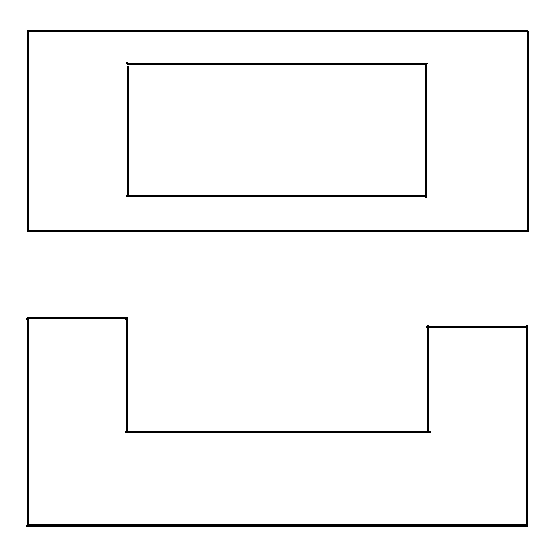
original.jpg
 

kmoose

Banned
Messages
10,298
Reaction score
1,181
In order to avg 60 MPH for the whole mile, the vehicle would have to traverse that mile in 1 minute (60 MPH = 1mile/minute). If the vehicle averages 30 MPH (.5miles/minute) for the first half mile, it would take the vehicle 1 minute to travel that half mile. That uses up the entire minute alloted, to finish the full one mile. Therefore, I would have to think that it would have to travel infinity miles per hour, to cover the last half mile instantaneously?
 

Endzone2

Banned
Messages
89
Reaction score
11
In order to avg 60 MPH for the whole mile, the vehicle would have to traverse that mile in 1 minute (60 MPH = 1mile/minute). If the vehicle averages 30 MPH (.5miles/minute) for the first half mile, it would take the vehicle 1 minute to travel that half mile. That uses up the entire minute alloted, to finish the full one mile. Therefore, I would have to think that it would have to travel infinity miles per hour, to cover the last half mile instantaneously?

That didn't take long. You are correct, it isn't possible to average 60MPH for this particular mile.

Now, the 2nd one? Did you have drafting in high school?
 

kmoose

Banned
Messages
10,298
Reaction score
1,181
That didn't take long. You are correct, it isn't possible to average 60MPH for this particular mile.

Now, the 2nd one? Did you have drafting in high school?

Look up................your chances of seeing God are better! :wink:

I'm not good with drawings like that.
 

IrishLax

Something Witty
Staff member
Messages
37,545
Reaction score
28,993
Wouldn't the side view just be a square? That's shooting from the hip, kinda confused by the question (and sadly I'm a civil engineer lol).
 

Endzone2

Banned
Messages
89
Reaction score
11
Wouldn't the side view just be a square? That's shooting from the hip, kinda confused by the question (and sadly I'm a civil engineer lol).

No, the side view isn't a square. This is just an orthographic projection of the front and top views of this object.
 

BeauBenken

Shut up, Richard
Staff member
Messages
16,041
Reaction score
5,491
...I can't figure it out if it isn't a square/rectangle.
 

IrishLax

Something Witty
Staff member
Messages
37,545
Reaction score
28,993
I just emailed my whole drafting department... initial responses seem to suggest there is an infinite solution set (and one dude promises to back up his claims with AutoCAD proof tomorrow). The logic is that, obviously, you could stick any number of 2D shapes on the side that wouldn't affect the top/front views.
 

BeauBenken

Shut up, Richard
Staff member
Messages
16,041
Reaction score
5,491
I just emailed my whole drafting department... initial responses seem to suggest there is an infinite solution set (and one dude promises to back up his claims with AutoCAD proof tomorrow). The logic is that, obviously, you could stick any number of 2D shapes on the side that wouldn't affect the top/front views.

What about a triangle though? Would you not draw the point on the top view?

Note: My only training in anything like that was industrial tech in 7th grade...
 

D-BOE34

F*** Michigan
Messages
1,730
Reaction score
81
Im using question 1 for free shots at the bar. I have some friends that think they know err thang!
 

DomerInHappyValley

dislikes state penn
Messages
3,297
Reaction score
1,694
A lot of it would be angle of viewing but straight on would be a 3d rectangle since you can't see the cut out.
 

Endzone2

Banned
Messages
89
Reaction score
11
I just emailed my whole drafting department... initial responses seem to suggest there is an infinite solution set (and one dude promises to back up his claims with AutoCAD proof tomorrow). The logic is that, obviously, you could stick any number of 2D shapes on the side that wouldn't affect the top/front views.

There are a lot of solutions, but the side view must still match the front and top views.
 

Endzone2

Banned
Messages
89
Reaction score
11
What about a triangle though? Would you not draw the point on the top view?

Note: My only training in anything like that was industrial tech in 7th grade...

If it was a triangle on the side view, you would have 2 lines going across the top view on the sides (in the center) to show the crest of the triangle. So, the side view isn't a triangle either.
 

BeauBenken

Shut up, Richard
Staff member
Messages
16,041
Reaction score
5,491
If it was a triangle on the side view, you would have 2 lines going across the top view on the sides (in the center) to show the crest of the triangle. So, the side view isn't a triangle either.

So then it is either a square, rectangle, or circle.
 

tankjeep

New member
Messages
2,511
Reaction score
67
unfortunately i can't see the image cuz i'm at work. i'll try and take a look at it tonite.

i'm a mechanical designer, so i should be able to figure it out.
 

Te'o4Heisman

Well-known member
Messages
2,510
Reaction score
2,616
Neither the front nor top image would give true perspective of the curves at the top. It would not be a rectangle, because in the front view the lower portion in the middle does not have a distinguishable difference in elevation from above. If the middle were cut out like that of a perfect rectancle, the verticle inside lines of of the top rendering would extend all the way to the edges of the outer rectangle thus creating the image as a series of two isolated rectangles on the outside running vertical, two narrow rectangles on the top and bottom inside running horitontal, and then the inner most rectangle.

If the image from the side if a half circle upside down, and the middle is dug out almost like a road on a truss bridge, then the elevation at the two verticle ends of the arches would be the same elevation as the cross piece running horitonal. If the roadway were dug out in the middle slightly below the grade of the road at the vertical ends, the image would appear as a square from above, but from the front you would not see the true bottom of the square dug out in the middle, as it would intersected by the hozintal plane connecting the two vertical ends of the sides.

If anybody can follow what I just said, God bless you, but I believe that is basically the correct answer minus maybe a small mistake or two in the explanation.
 

IrishLax

Something Witty
Staff member
Messages
37,545
Reaction score
28,993
Sorry, but I'm going back to the thought that there is no answer to this question... or rather that the question is really flawed.

The bottom line is you cannot determine a 2D side view from a 2D top view and 2D front view. The only thing you can determine is the "height" of the side view from the front view and "width" from the top view. That's why I originally said "rectangle?"

I just had this verified for me by one of our drafters on AutoCAD. You can literally stick any 2D shape you want as a "cover" on the side view (as long as it has less than or equal to height & width as identified in the top and front views) and still maintain unaltered top and front views.

So I don't know what the question is going for, but I'm watching someone do these exercises right now in AutoCAD, and there is an infinite solution set.
 

IrishLax

Something Witty
Staff member
Messages
37,545
Reaction score
28,993
A circle totally works though and makes perfect sense (without any funny business).
 

Te'o4Heisman

Well-known member
Messages
2,510
Reaction score
2,616
I hace circled in red to show a rough idea of why a rectangle does not work. The sharp edges of the higher elevation would create a natural line that would have to be accounted for when compared to the lower elevation of the middle sector. From above this would cause the vertical lines of the inner rectangle to extend all the way to the boundary of the outer rectangle. Only a half circle or something of the sort could creat that transition in elevation withou being noticable by a line.

2wd0lew.jpg
 

IrishLax

Something Witty
Staff member
Messages
37,545
Reaction score
28,993
I hace circled in red to show a rough idea of why a rectangle does not work. The sharp edges of the higher elevation would create a natural line that would have to be accounted for when compared to the lower elevation of the middle sector. From above this would cause the vertical lines of the inner rectangle to extend all the way to the boundary of the outer rectangle. Only a half circle or something of the sort could creat that transition in elevation withou being noticable by a line.

2wd0lew.jpg

See, that's not exactly true, and here's why. If you stick a 2D rectangle or whatever (re: no depth to this object) on the side view you can still have unaltered top and front views while completely altering the side view. That's why the question is flawed. To put it another way, you could have your object with a circle or semi-circle that works; and then stick a 2D rectangle on top of it in AutoCAD and get a completely different side view.

On principle, you are correct. In practicality, I'm saying the question doesn't work unless we add some more premises/conditions to it.
 

D-BOE34

F*** Michigan
Messages
1,730
Reaction score
81
I need the answer to question one explained. I am going over and over this. An average speed is an average speed. The question was, what does the average speed on the secnod half have to be to make the average speed 60mph over the etire mile. With 30 mph being the averageon the first half.
 

IrishLax

Something Witty
Staff member
Messages
37,545
Reaction score
28,993
I need the answer to question one explained. I am going over and over this. An average speed is an average speed. The question was, what does the average speed on the secnod half have to be to make the average speed 60mph over the etire mile. With 30 mph being the averageon the first half.

Think of it terms of time elapsed. You have one minute to go the length of a mile if you want to average 60 MPH.

So if you go 30 MPH for the first half of mile... you will already have used one minute of time. Therefore, when you complete the mile, no matter how fast you go over the second half you cannot achieve an average speed of 60 MPH for the course of that mile.
 

DomeX2 eNVy

New member
Messages
1,354
Reaction score
66
Question 1: The only way to average 60 mph for 1 mile is to travel that 1 mile in exactly 1 minute. [ 1 mile / (60 miles/hour) = 0.01667 hours = 1 minute). The same is true for travelling 1/2 mile at 30 mph: it takes exactly 1 minute ( 0.5 mile / (30 miles/hour) = 0.01667 hours = 1 minute)
Since the question explains that the first 1/2 mile was done at 30 mph, it took exactly 1 minute. Therefore it is impossible to complete the full mile in 1 minute to achieve the 60 mph average. Even as the speed approaches infinity, it will take a fraction of a second to complete the second 1/2 mile and the average speed will be 59.9999999 mph but never 60.

Question 2: I agree with LAX. I don't think it could be a half circle, because of the vertical half wall along the front side. It could definitely be an arc on top of vertical walls though.
 

BeauBenken

Shut up, Richard
Staff member
Messages
16,041
Reaction score
5,491
I need the answer to question one explained. I am going over and over this. An average speed is an average speed. The question was, what does the average speed on the secnod half have to be to make the average speed 60mph over the etire mile. With 30 mph being the averageon the first half.

110907-171959.jpg


Really you can ignore the part at the end. All you have to take notice of is that going at 30mph for one 1/2 mile you allot a time of 1 minute. To average 60 miles per hour, you have to travel 1 mile in 1 minute. Since you already traveled for 1 minute, you can not technically go an average speed of 60mph in that 1 mile.
 
Last edited:

D-BOE34

F*** Michigan
Messages
1,730
Reaction score
81
If I take the next half mile at 90 mph I would still average 60mph, or, 1 mile per min. The only way I can understand your thinking is if the question had further stipulations saying you had to tavel this certain distance in a time frame. Correct?
 

D-BOE34

F*** Michigan
Messages
1,730
Reaction score
81
Question 1: The only way to average 60 mph for 1 mile is to travel that 1 mile in exactly 1 minute. [ 1 mile / (60 miles/hour) = 0.01667 hours = 1 minute). The same is true for travelling 1/2 mile at 30 mph: it takes exactly 1 minute ( 0.5 mile / (30 miles/hour) = 0.01667 hours = 1 minute)
Since the question explains that the first 1/2 mile was done at 30 mph, it took exactly 1 minute. Therefore it is impossible to complete the full mile in 1 minute to achieve the 60 mph average. Even as the speed approaches infinity, it will take a fraction of a second to complete the second 1/2 mile and the average speed will be 59.9999999 mph but never 60.

Question 2: I agree with LAX. I don't think it could be a half circle, because of the vertical half wall along the front side. It could definitely be an arc on top of vertical walls though.


hmmmm...
 
Top