New Continental Congress

chicago51

Well-known member
Messages
3,658
Reaction score
387
This is just my personal theory, but I think that the Electoral College suppresses voter turnout. If you are a liberal in a solid red state or a conservative in a solid blue state (like me) you start to feel that your vote really does not matter with regard to presidential elections. You feel like your vote has absolutely no bearing on the national outcome because the other side posted better numbers. The office of the President is the only truly national office and I think a person's vote should have bearing outside the confines of his state.

The common arguments in favor of the Electoral College have always rung false to me. People say that with direct popular vote, the candidates will just focus their campaigning on large states with big populations and ignore the smaller states. But that's what happens anyway with the EC. Delaware, with its measly 3 EC votes barely gets any attention. The only reason Obama made a stop here in his first go round is because Biden was his VP candidate. And I assume the EC is not compatible with Chicago51's runoff plan, which I support.

As for public campaign funding, how many of us check off the box on our federal tax return that reads "Yes, I want $3 to go to the presidential campaign fund?" As cynical as I can be, I've always checked "yes." But so many people check "no" either out of ignorance and/or spite. Then those same people whine that corporations and unions are buying elections. Well, the money has to come from somewhere, so if the people won't support campaign financing, there's plenty of deep-pocket groups who will open their checkbooks.


I agree with all of this.
 
Last edited:

RDU Irish

Catholics vs. Cousins
Messages
8,622
Reaction score
2,722
I'll post more on this later. As mentioned I am entirely opposed to consumption taxes.

Any consumption tax is going to be a regressive tax has to be done carefully. Rebates are part of it but it is still a regressive tax. I do support consumption taxes but in addition I would exempt food, housing, education, and healthcare.

Even with rebates under an all consumption tax system working families are going to pay a higher effective tax rate than millionaires and billionaires. Some who makes 20 million may realistically spend 2 million so with a 20 percent consumption that individual would effectively be a paying 4 percent tax rate. Meanwhile someone that makes 20k and spends it all pays 20 percent. So Paris Hilton making 20 million from dividend checks from her dad pays 4 percent. Single mom pays 20 percent plus and has to pay more for stuff.

FYI when it comes to VATs this is how much it would take just get rid of the payroll taxes much less all of the taxes:

Washington Post

Wealth does not survive multiple generations, it gets spent. Your Paris Hilton example is more like this, Paris blows her trust fund over the course of her life, spending 5x what she actually earns every year until she is merely a millionaire instead of a multimillionaire. Her next generation spends it all by their twenties on rehab.

You wanna talk regressive? How about the $110k to $130k range at which the child tax credit phases out for a married couple. Say you have five kids, that is a 25% tax ON TOP OF a 25% tax rate for each dollar you earn between $110k and $130k. But keep on thinking the millionaires are screwing you over. And your dumb chart showing GDP growth versus top tax bracket is a freaking joke if you pull apart the myriad loopholes and hiding places. Real wealth is created through capital formation, which is only taxed when it is sold at a gain - See Warren Buffett giving his billions to charity, he ends up paying virtually no taxes on billions accumulated.

Under a consumption tax you are fully incentivized to earn an extra dollar, not punished on the margin. Consider all tourists, welfare recipients working cash jobs, drug dealers, prostitutes, whatever black market income - those people all pay taxes based on consumption. No time wasted on income taxes, you focus on earning instead of avoiding loss. Corporations would want to move earnings to the US because they pay no tax here. FICA goes away - gee that's a bit regressive no? If you consume at roughly 2x the poverty line you pay no tax, consume less than that and you are receiving more than you pay.

There is incredible value in a simplified code. Just think of effects on lobbying for a few seconds, which is the reason exempting consumption items or consuming organizations spoils the program. All citizens get equal benefit (pre-bate) and all consumers pay an equal rate. Suddenly I see tremendous value in illegal immigrants and work Visas. Open the doors and let anyone in to visit and work as long as they want, they are paying our taxes under this system.
 

chicago51

Well-known member
Messages
3,658
Reaction score
387
Wealth does not survive multiple generations, it gets spent. Your Paris Hilton example is more like this, Paris blows her trust fund over the course of her life, spending 5x what she actually earns every year until she is merely a millionaire instead of a multimillionaire. Her next generation spends it all by their twenties on rehab.

Are you saying that higher income earners spend more in terms of % of income.

You wanna talk regressive? How about the $110k to $130k range at which the child tax credit phases out for a married couple. Say you have five kids, that is a 25% tax ON TOP OF a 25% tax rate for each dollar you earn between $110k and $130k. But keep on thinking the millionaires are screwing you over. And your dumb chart showing GDP growth versus top tax bracket is a freaking joke if you pull apart the myriad loopholes and hiding places. Real wealth is created through capital formation, which is only taxed when it is sold at a gain - See Warren Buffett giving his billions to charity, he ends up paying virtually no taxes on billions accumulated.

Actually that phasing out the child credit at higher incomes is progressive not regressive. The same hiding places are still around so you have lower rates and more hiding places. By the way I'm not saying we bring back the 91% tax rate.

Under a consumption tax you are fully incentivized to earn an extra dollar, not punished on the margin. Consider all tourists, welfare recipients working cash jobs, drug dealers, prostitutes, whatever black market income - those people all pay taxes based on consumption. No time wasted on income taxes, you focus on earning instead of avoiding loss. Corporations would want to move earnings to the US because they pay no tax here. FICA goes away - gee that's a bit regressive no? If you consume at roughly 2x the poverty line you pay no tax, consume less than that and you are receiving more than you pay.

I'm not oppose to lowering or even getting rid of FICA and corporate taxes. We can do through with some type of VAT on consumption, along with tariffs on China, and carbon taxes.

It take a 12.5% VAT and a VAT that does not exempt food, housing, education, and healthcare just raise the 12 trillion a decade to get out the payroll taxes. It would take a 25 to 30% tax to get raise enough revenue to go with only a consumption tax. Again that would be without exemptions. So those rising healthcare cost go up 25% more, college education 25% increase.


There is incredible value in a simplified code. Just think of effects on lobbying for a few seconds, which is the reason exempting consumption items or consuming organizations spoils the program. All citizens get equal benefit (pre-bate) and all consumers pay an equal rate. Suddenly I see tremendous value in illegal immigrants and work Visas. Open the doors and let anyone in to visit and work as long as they want, they are paying our taxes under this system.

Illegal hiring brings working wages down but that is another topic. Yes legit Visas are a different story.

There is actually evidence on saving patterns accross income levels and the studies on the effects of a consumption tax.

Study on saving patterns and potential regressivity of a consumption tax:
http://www.dartmouth.edu/~jskinner/documents/DynanKEDotheRich.pdf

From the studies conclusion:

In addition, our results that high-income households save a greater fraction of income while working than low-income households imply that a flat rate consumption tax will (on a lifetime basis) be regressive relative to a flat rate income tax. There are two reasons for this. First, even if there were no bequests (so that all households consumed their wealth during their lifetime), households with higher incomes would pay more under an income tax compared to an equal revenue consumption tax, simply because such households can expect to receive a disproportionate share of interest and dividend income.

Second, one needs to take into account that bequests are not zero and may vary with lifetime earnings. A number of studies have calculated the distributional effects of moving from an income-based tax system to one that taxes just consumption. Fullerton and Rogers (1993), Metcalf (1994), and Altig et al. (2001) use data from Menchik and David (1982)to estimate how bequests differ by lifetime income group. The Menchik and David data, however, exhibited a U-shaped relationship between the fraction of resources bequeathed and lifetime income; bequests were the largest share of lifetime resources for the lowest income decile.46 This pattern is consistent with the poor (in the lowest income decile saving, on average, a larger fraction of their lifetime resources than the rich! Not surprisingly, Metcalf (1994) found, using these data, that adjusting for bequests added progressivity to a consumption tax relative to an income tax. In contrast, our results show substantially higher saving rates (and wealth-income ratios) among families with higher lifetime income(see also Mieszkowski and Palumbo 2002). These results, together with the lack of evidence that the elderly high-income households dissave at a higher rate, suggest that, on average, higher-income households bequeath a larger fraction of lifetime earnings than lower-income households. Because bequests are effectively exempt from a consumption tax (at least for the current generation) but are not exempt from an income tax, our evidence suggests further regressivity in a consumption tax relative to an income tax.

Finally, the results have implications for the “choice versus chance” question first raised by Friedman (1953) and more recently by Venti and Wise (1998). Is the considerable variation in accumulated wealth the consequence of choice (preferences and tastes) or chance? Venti and Wise argue that most of the variation in wealth within lifetime income
groups is due to saving decisions, or choice. Our finding that differences in saving behavior across income groups are also an important source of the overall variation in wealth of the U.S. population suggests a diminished role for choice. For example, wealth accumulation because of government or private policies that differentially affect saving (such as asset-based means testing or the availability of 401(k) plans) cannot be readily attributed to tastes or preferences. Nor can a lucky career outcome such as joining Microsoft in 1984, and a subsequently higher rate of saving, be attributed entirely to choice. In sum, much remains to be learned about household saving behavior, especially that of elderly households and that of the very top of the income distribution. Still, we believe that our work has established one fact: The rich do, indeed, save more.
 
Last edited:

RDU Irish

Catholics vs. Cousins
Messages
8,622
Reaction score
2,722
This is just my personal theory, but I think that the Electoral College suppresses voter turnout. If you are a liberal in a solid red state or a conservative in a solid blue state (like me) you start to feel that your vote really does not matter with regard to presidential elections. You feel like your vote has absolutely no bearing on the national outcome because the other side posted better numbers. The office of the President is the only truly national office and I think a person's vote should have bearing outside the confines of his state.

Revising the electoral allocation would solve much of this. I think allocating EVs to match the way in which the EVs are earned (congressional district plus senators) makes much more sense. All or nothing per state should only apply to the two Senate seat EVs, congressional EVs should be allocated by district. All of California swinging one way borders on retarded. While much more complicated, it would also make presidential candidates scour more areas of the country they fly over now. A straight popular vote would mean candidates only focus on major population centers and their base.

I will concede that gerrymandering becomes more of an issue in this scenario.
 

RDU Irish

Catholics vs. Cousins
Messages
8,622
Reaction score
2,722
"the rich do, indeed, save more."

No sh!t? You don't get rich by spending yourself into oblivion?

Do you want more rich people or less?
 

chicago51

Well-known member
Messages
3,658
Reaction score
387
Revising the electoral allocation would solve much of this. I think allocating EVs to match the way in which the EVs are earned (congressional district plus senators) makes much more sense. All or nothing per state should only apply to the two Senate seat EVs, congressional EVs should be allocated by district. All of California swinging one way borders on retarded. While much more complicated, it would also make presidential candidates scour more areas of the country they fly over now. A straight popular vote would mean candidates only focus on major population centers and their base.

I will concede that gerrymandering becomes more of an issue in this scenario.

The presidency shoudn't depend on the way districts are drawn as it is only nationally elected office. I am all in favor of proportional splitting of each state's electoral votes based on just simple % of the vote in that state. So if Illinois as 20 electoral votes and a candidate wins 60% of the vote it should be split 12-8.

When start doing it my district you get a situation were the Democrats can get almost 1.5 million more House votes and lose the House by over 30 seats. By the way that is largely due to population patterns more so than actually rigging so I am not saying the Republicans flat out cheated (although there is some that going by both red states and blue states) that fact is Democrats tend to packed in tight while Republicans tend to more spread out.

The one national office though really shouldn't be decide based on how Ohio for instance draws its congressional lines. I know for a fact Illlinois draws its lines so we end up squeezing one more Democratic seat than we actually should. I think we were 12 to 6 in favor of Democrats when should be like 11-7 or 10-8 just based on the numbers because we do have alot of Republicans away from Chicago.
 
Last edited:

RDU Irish

Catholics vs. Cousins
Messages
8,622
Reaction score
2,722
As far as rising costs, what impact is there on the cost of living if at minimum 15% of the cost of wages goes away (both sides of FICA)? So McDonalds has to add a 20% tax to it's menu items, meanwhile their taxes on profits go to $0 (taxes on profits in 2012 were 10% of total revenue) which is half the difference. The other half would be the equilibrium of wages, FICA reduction and lower salaries due to higher take home pay ratio resulting from lower income taxes. Reducing all salaries 7.5% would still be ahead of the game for employees since that is their portion of FICA anyway and taxed to boot.

See how the elimination of taxes elsewhere allows for lower prices of goods which nets the same end price after the VAT?


As far as the regressive nature, I don't understand how a pre-bate does not demolish this argument? Every citizen starts with money in their pocket every month equal to tax on a certain level of spending. If you choose to consume used goods and less new goods than others, you are a net receiver. Choice is yours. Every single citizen gets the same dollar to start though. In many respects, this helps alleviate the pressure on unemployment, welfare and social security. Allowing a reduction in expenses elsewhere.

In another sense, consider if the stimulus had just been a check to every citizen for $2500, family of four gets $10K. Simple, straightforward and fast. Consume it, save it, pay down debt, give it to charity, its up to you. Alternatively, corporate welfare is the main recipient instead of the real constituents.
 

chicago51

Well-known member
Messages
3,658
Reaction score
387
"the rich do, indeed, save more."

No sh!t? You don't get rich by spending yourself into oblivion?

Do you want more rich people or less?

You do realize in some instances it takes one's full pay check to pay for groceries and pay the rent?
 

RDU Irish

Catholics vs. Cousins
Messages
8,622
Reaction score
2,722
The presidency shoudn't depend on the way districts are drawn as it is only nationally elected office. I am all in favor of proportional splitting of each state's electoral votes based on just simple % of the vote in that state. So if Illinois as 20 electoral votes and a candidate wins 60% of the vote it should be split 12-8.

When start doing it my district you get a situation were the Democrats can get almost 1.5 million more House votes and lose the House by over 30 seats. By the way that is largely due to population patterns more so than actually rigging so I am not saying the Republicans flat out cheated (although there is some that going by both red states and blue states) that fact is Democrats tend to packed in tight while Republicans tend to more spread out.

The one national office though really shouldn't be decide based on how Ohio for instance draws its congressional lines. I know for a fact Illlinois draws its lines so we end up squeezing one more Democratic seat than we actually should. I think we were 12 to 6 in favor of Democrats when should be like 11-7 or 10-8 just based on the numbers because we do have alot of Republicans away from Chicago.

I agree, gerrymandering is an issue. However, I would much rather see smaller areas have more influence than, say Philadelphia determining the outcome of the entire state of Pennsylvania. In a close election, any given district can be the swing district and candidates have to pander to that area. With a straight popular vote, they only focus on getting out the vote in the most populated areas and may do nothing more than hitting the TV shows. I like drawing candidates into appreciating regional differences rather than pandering more and more to their base.

With the current system, entire states are written off and the handful of swing states get 90% of the attention. Imagine if they had to choose between 100 districts instead of half a dozen states in allocating resources? Not to mention those same states would still be in play for their Senate EVs. This is the only way to make the candidates really respect the entire constituency instead of their base and population centers.
 

chicago51

Well-known member
Messages
3,658
Reaction score
387
As far as rising costs, what impact is there on the cost of living if at minimum 15% of the cost of wages goes away (both sides of FICA)? So McDonalds has to add a 20% tax to it's menu items, meanwhile their taxes on profits go to $0 (taxes on profits in 2012 were 10% of total revenue) which is half the difference. The other half would be the equilibrium of wages, FICA reduction and lower salaries due to higher take home pay ratio resulting from lower income taxes. Reducing all salaries 7.5% would still be ahead of the game for employees since that is their portion of FICA anyway and taxed to boot.

See how the elimination of taxes elsewhere allows for lower prices of goods which nets the same end price after the VAT?


As far as the regressive nature, I don't understand how a pre-bate does not demolish this argument? Every citizen starts with money in their pocket every month equal to tax on a certain level of spending. If you choose to consume used goods and less new goods than others, you are a net receiver. Choice is yours. Every single citizen gets the same dollar to start though. In many respects, this helps alleviate the pressure on unemployment, welfare and social security. Allowing a reduction in expenses elsewhere.

In another sense, consider if the stimulus had just been a check to every citizen for $2500, family of four gets $10K. Simple, straightforward and fast. Consume it, save it, pay down debt, give it to charity, its up to you. Alternatively, corporate welfare is the main recipient instead of the real constituents.

The regressive nature is simple. I make $20k I got spend all of that for my rent, my groceries, my utilities and such. I'm spending 100% of that so I paying consumption tax on 100% of my income.

Now say make $10 million. Okay I a buy a $2 million dollar house, 4 really nice cars, I pay for a couple of really expensive TVs, and I go out alot at fancy restraunts. I might spend $4 million if I'm lucky unless I'm like Eddy Curry or Antoine Walker and throw it all way by supporting 200 people.

So what about the other $6 million. I can throw some in the stock market after that intial consumption tax of buying the stock I would pay 0 taxes on all the money I get back in dividends. I can put money into a 401k and pay nothing in tax. I can throw some more in the bank because I just don't need it right now. By the way there is nothing wrong with any of that. The fact is though they are only paying consumption tax on $4 million not $10 million. So with consumption taxes you asking lower income Americans take on a greater burden in % of income to fund the government than higher earning Americans. You might think it should be that way and thats fine but my objection is legit.
 
Last edited:

chicago51

Well-known member
Messages
3,658
Reaction score
387
I agree, gerrymandering is an issue. However, I would much rather see smaller areas have more influence than, say Philadelphia determining the outcome of the entire state of Pennsylvania. In a close election, any given district can be the swing district and candidates have to pander to that area. With a straight popular vote, they only focus on getting out the vote in the most populated areas and may do nothing more than hitting the TV shows. I like drawing candidates into appreciating regional differences rather than pandering more and more to their base.

With the current system, entire states are written off and the handful of swing states get 90% of the attention. Imagine if they had to choose between 100 districts instead of half a dozen states in allocating resources? Not to mention those same states would still be in play for their Senate EVs. This is the only way to make the candidates really respect the entire constituency instead of their base and population centers.

I agree with all of this. That is why I would like % voting splitting. It make every state a big deal. All of a sudden it matters rather a Democrat in Illinois wins with 58% of the vote and gets 12 EVs or 57% of the vote and gets 11 EVs.
 

RDU Irish

Catholics vs. Cousins
Messages
8,622
Reaction score
2,722
You do realize in some instances it takes one's full pay check to pay for groceries and pay the rent?


Have you ever noticed how much of your paycheck ends up in your bank account? Do you realize the FICA you pay is matched by your employer? Do you realize the Big Mac you buy includes the entire cost of doing business for McDonalds, which includes taxes? Do you know how much of your cell phone, gas, electric, cable or other bills are tax?

Do you realize the government revenue consists of roughly 45% of FICA, 45% personal income tax and 10% corporate income tax?

And a Carbon Tax is economic suicide IMO.
 

RDU Irish

Catholics vs. Cousins
Messages
8,622
Reaction score
2,722
The regressive nature is simple. I make $20k I got spend all of that for my rent, my groceries, my utilities and such. I'm spending 100% of that so I paying consumption tax on 100% of my income.

Now say make $10 million. Okay I a buy a $2 million dollar house, 4 really nice cars, I pay for a couple of really expensive TVs, and I go out alot at fancy restraunts. I might spend $4 million if I'm lucky unless I'm like Eddy Curry or Antoine Walker and throw it all way by supporting 200 people.

So what about the other $6 million. I can throw some in the stock market after that intial consumption tax of buying the stock I would pay 0 taxes on all the money I get back in dividends. I can put money into a 401k and pay nothing in tax. I can throw some more in the bank because I just don't need it right now. By the way there is nothing wrong with any of that. The fact is though they are only paying consumption tax on $4 million not $10 million. So with consumption taxes you asking lower income Americans take on a greater burden to fund the government than higher earning Americans.

You keep forgetting that you start with $3K in your pocket in the first scenario and your take home pay would be 7.5% higher all else equal due to no FICA. I'll grant you that employers may cut wages 7.5% to keep take home the same, and hypothetically you spend 100% on taxable items (no thrift shopping or used cars). Then you pay $4600 in tax on $23,000 of spending for a net tax of $1600 on $20,000 of income = 8%.

The rich guy paid $800,000 in taxes, same 8% on income as you only it would take 500 of you to equal one of him as far as paying the bills. With his excess cash, he invests. This creates jobs and future consumption. Maybe he retires and lives off of the same $4 million a year and provides $800,000 of revenue to government for the rest of his life.

You think the government is getting rich off of Warren Buffett? Dude does not consume so he finds the most tax efficient way to compound the growth of his wealth. Then he leaves it all to charity to, yet again, avoid taxes. Taxing income doesn't faze him, taxing capital gains doesn't faze him. Neither does taxing estates or dividends or corporations. Yet we come up with the "Buffett Rule" under the guise of sticking it to rich people?

It is truly one thing to want someone else to pay for it, it is quite another to shoot yourself in the foot trying to make it happen.
 

chicago51

Well-known member
Messages
3,658
Reaction score
387
Have you ever noticed how much of your paycheck ends up in your bank account? Do you realize the FICA you pay is matched by your employer? Do you realize the Big Mac you buy includes the entire cost of doing business for McDonalds, which includes taxes? Do you know how much of your cell phone, gas, electric, cable or other bills are tax?

Do you realize the government revenue consists of roughly 45% of FICA, 45% personal income tax and 10% corporate income tax?

And a Carbon Tax is economic suicide IMO.

Seven thrilling facts about carbon taxes from the CBO

How is it economic sucide? I would argue the path we are on sucide in terms of the environmental impacts.

CBO estimates a carbon tax would raise electricity 16% with the exception of places like West Virginia that use alot of coal in which is case it may go up 25%.

So electricity bills are $50 to $100 so at most in a high cost region with coal (don't if there is any) electricity might rise $25. So $300 a year would the maximum increase the average would be about $200.

Gas prices would be a bit rougher and would rise 20 cents a gallon according to the CBO. So average is 12k miles per year at 20 miles per gallon is 600 gallons, another site on google said average American uses 500 gallons lets just say 600 gallons. That is about a $120 increase per year.

We can use a bit more than half about $700 billion of the $1.2 trillion the carbon tax would bring in over a decade and use it bringing back the 2009/2010 "making work pay" tax credit from Obama's 2009 stimilus which gave $400 per individual and $800 dollars per family. Use another $300-$400 billion to lower the corporate tax rate to at least 28% probably can get it down to 25%. Then you have $100-$150 billion left for an infrastructure bill, or for deficit reduction.

With more carbon dioxide in water vapor in the atmosphere stronger storms are innevitable we mine as well start making a down payment on cost of climate change. Plus with a carbon tax all of a sudden it becomes more economically profitable for Exxon, BP, and these energy corporations to start looking for other ways to generate electricity.
 
Last edited:

chicago51

Well-known member
Messages
3,658
Reaction score
387
By the way as far as taxes go, I did this stabalize the debt simulation. I couldn't do it without raising them I actually tried just cutting everything possible and I couldn't do it. Granted their probably other things to cut besides the choices they give but the fact is on the simulation even by destroying the social safety net the debt doesn't get stabalized.

Budget Simulator | Committee for a Responsible Federal Budget
 

RDU Irish

Catholics vs. Cousins
Messages
8,622
Reaction score
2,722
I agree with all of this. That is why I would like % voting splitting. It make every state a big deal. All of a sudden it matters rather a Democrat in Illinois wins with 58% of the vote and gets 12 EVs or 57% of the vote and gets 11 EVs.

Definite improvement over the current system, I agree. I also like that your system would open the door for third party candidates. EVs start accumulating with no more than 2 or 3 percent of the vote in the most populous states. That makes the electoral college get to work if some Ron Paul type is sitting on ten or twenty EVs and the main parties are split. I'm all for making it more interesting and increasing the influence of party crashers like that.
 

chicago51

Well-known member
Messages
3,658
Reaction score
387
Definite improvement over the current system, I agree. I also like that your system would open the door for third party candidates. EVs start accumulating with no more than 2 or 3 percent of the vote in the most populous states. That makes the electoral college get to work if some Ron Paul type is sitting on ten or twenty EVs and the main parties are split. I'm all for making it more interesting and increasing the influence of party crashers like that.

We can agree on that my friend and fight about taxes another day.
 
C

Cackalacky

Guest
Wealth does not survive multiple generations
How about the Walton Family? I think money that is invested or reserved in trusts and receiving interest does in fact survive through the years. Are you excluding swiss bank accounts and investments that last after one passes on? I still have mutual funds from my grandfather. Does that count?

Real wealth is created through capital formation,
What about demand for that product to fuel the capital formation? I am assuming that demand for a service must be present for this to occur or that capital obtained from inheritance.

which is only taxed when it is sold at a gain - See Warren Buffett giving his billions to charity, he ends up paying virtually no taxes on billions accumulated.
I see nothing wrong with this. If it does in fact go to charity, then the donations are serving the public good and are just as beneficial as taxes paid.

Under a consumption tax you are fully incentivized to earn an extra dollar, not punished on the margin. Consider all tourists, welfare recipients working cash jobs, drug dealers, prostitutes, whatever black market income - those people all pay taxes based on consumption. No time wasted on income taxes, you focus on earning instead of avoiding loss. Corporations would want to move earnings to the US because they pay no tax here.
I agree with this totally. But can we conclude corporations who will pay no taxes will pass its savings on to the customer? How can we be sure?

There is incredible value in a simplified code. Just think of effects on lobbying for a few seconds, which is the reason exempting consumption items or consuming organizations spoils the program. All citizens get equal benefit (pre-bate) and all consumers pay an equal rate. Suddenly I see tremendous value in illegal immigrants and work Visas. Open the doors and let anyone in to visit and work as long as they want, they are paying our taxes under this system.
I agree and see the logic here. No real need for immigration reform.
 
C

Cackalacky

Guest
We can agree on that my friend and fight about taxes another day.
Yes I am inclined to like this to encourage more parties and better choices. I am sick of choosing between the lesser of two evils.
 

RDU Irish

Catholics vs. Cousins
Messages
8,622
Reaction score
2,722
My problem is I think the whole thing needs to be redone, that simulator just nibbles around the edges and tweaks what is there without ever affecting real change or getting rid of anything. Plus the ten year BS is such a farce.

Adding a VAT without getting rid of other taxes is a fools errand.

What to cut
- Department of Education - maybe we need two people coordinating a national education conference for the states but that is about it.

- Farm subsidies

- Foreign aid (we are broke)

- IRS - Serious downsizing here with full repeal of income taxes and replacement by VAT

- Government pensions - make them similar to private sector by phasing out and replacing with generous 401k contributions

- Social Security - increase all retirement ages by two months for every year of age under 55 down to age 31 (66, 71 and 74 for those 31 and younger).

- Medicare - More of a larger issue of health care, I would start by facilitating more competition (unleash nurse practitioners to be less beholden to doctors), centralized medical records, medical malpractice reform and other methods to focus more on providing better outcomes and less on covering the doctors butt.

-Military - pretty drastic cuts focusing on protecting our borders more than the one between Afganistan and Pakistan. I would promote overall American readiness by having summer boot camps to instill basic combat skills and conditioning with some college money as the incentive. I don't need your four years, I need a qualified base to draw from if we need to ramp up our troop levels down the road. I would have gladly traded getting my arse kicked into shape for two months for, say, $4000 knocked off my student loans. Better than I can do flipping burgers and builds more character to boot.
 

chicago51

Well-known member
Messages
3,658
Reaction score
387
My problem is I think the whole thing needs to be redone, that simulator just nibbles around the edges and tweaks what is there without ever affecting real change or getting rid of anything. Plus the ten year BS is such a farce.

Adding a VAT without getting rid of other taxes is a fools errand.

What to cut
- Department of Education - maybe we need two people coordinating a national education conference for the states but that is about it.

- Farm subsidies

- Foreign aid (we are broke)

- IRS - Serious downsizing here with full repeal of income taxes and replacement by VAT

- Government pensions - make them similar to private sector by phasing out and replacing with generous 401k contributions

- Social Security - increase all retirement ages by two months for every year of age under 55 down to age 31 (66, 71 and 74 for those 31 and younger).

- Medicare - More of a larger issue of health care, I would start by facilitating more competition (unleash nurse practitioners to be less beholden to doctors), centralized medical records, medical malpractice reform and other methods to focus more on providing better outcomes and less on covering the doctors butt.

-Military - pretty drastic cuts focusing on protecting our borders more than the one between Afganistan and Pakistan. I would promote overall American readiness by having summer boot camps to instill basic combat skills and conditioning with some college money as the incentive. I don't need your four years, I need a qualified base to draw from if we need to ramp up our troop levels down the road. I would have gladly traded getting my arse kicked into shape for two months for, say, $4000 knocked off my student loans. Better than I can do flipping burgers and builds more character to boot.


They always say if you disagree some things and agree on some things is to agree with what you agree on.

We may not agree if food, housing, education, and healthcare should be part of any consumption tax. We may also not agree with the consumption taxes replacing income taxes.

However ...

We both want to eliminate or at the very least lower payroll and corporate taxes with some form of consumption taxes.

We both want consumption taxes on dirty energy. (You want it on everything so I assume dirty energy is part of it. Or do you specifically want just dirty energy exempt from it?).

We both want consumption taxes on stuff from China and other countries especially when it is things we have the capability to make in the United States.

So we can start with that.

For the record I also agree on cutting foregin aid, farm subsidies, and downsizing our military in terms of troop deployments and overseas bases. I still like to maintain a good sized navy and air force. I feel are certain changes to Medicare and Social Security I'm open to. Personally I'd raise the Medicare eligibility to match Social Security. I don't want raise the SS eligibility age any further because it is hard enough to get a job as it is without more people in the work place. Let Medicare negoiate for lower drug prices.

Chained CPI, or changes initial benefit calculations?..... I don't like it but I might agree to it; depends on what kind of protections in are in place for the more vulnerable retirees as they are the least likely to benefit from the other ways the federal government subsidizes retirement in this country.

Means testing for Medicare?.... Again for me its maybe. I wouldn't means test for rather or not one receives Medicare but I can see higher income seniors paying higher premiums.

Public Option?... Its a non starter amoung conservatives but it does reduce the deficit by bidding down cost and preventing price gouging.
 
Last edited:

RDU Irish

Catholics vs. Cousins
Messages
8,622
Reaction score
2,722
Chicago - nice links, I appreciate the info. Sorry I don't have links to back me up but consider the effects on manufacturing in this country. One of the reasons we have a bit of an industrial revival is our competitive advantage in natural gas pricing (in addition to reliable energy). These are great jobs being brought here by having less expensive, more abundant energy. Increasing electricity costs by 15% to 25% may not seem like much in the context of the average person, but for business you are possibly talking about their entire profit margin and the difference between coming here or going there.

Now pair the carbon tax with a VAT and complete repeal of corporate, personal and FICA taxes and I might be able to entertain it.

Regardless of whether I think man-made global warming is real, we cut off our nose to spite our face with a unilateral imposition of this tax. It absolutely is a disadvantage versus non-tax countries which inhibits our ability to innovate and lead in the future. From an economic perspective, it seems silly not to use our resources while they have value and put ourselves in the best position to be self sufficient and prosperous.
 

GowerND11

Well-known member
Messages
6,536
Reaction score
3,287
Yes I am inclined to like this to encourage more parties and better choices. I am sick of choosing between the lesser of two evils.

Which is why I chose to vote for the candidate I related to most, Gary Johnson. The libertarians are starting to gain traction. I think A LOT of Americans would find themselves comfortable voting Libertarian if they did the research (Shocker: People don't do that) and understood more about the party.
 

Black Irish

Wise Guy
Messages
3,769
Reaction score
602
Electoral Vote Allocation: Be careful what you wish for here. It may seem like a good thing to make candidates do more campaigning across a wider variety of areas instead of just focusing on swing states and large metro ares. But I'm not in favor of a system that encourages MORE campaigning. The campaign cycles are getting longer and more expensive every go round. Under the split EV system, politicians would need even more money and time to make more stops. Do we want to encourage that? Like I mentioned before, current officeholders are already spending too much time stumping for re-election or election to a higher office instead of attending to business.

VAT Tax: You can make the argument that VAT is regressive and has more of an effect on the poor. But the excess "untaxed" income of the rich only stays that way if they don't do anything with the extra cash. If they put it in the bank or invest in stocks or bonds, that money isn't doing them any immediate good. And when the time comes that they need to cash out their portfolio and spend it, they pay the VAT. If I have a million dollars in cash under my bed, I am technically a millionaire. But if I don't use it for anything, the money isn't doing me much good. Even if I put it in the bank and earn a nice interest rate on it, so what? If I don't spend it, the government doesn't get their VAT tax but I don't get anything out of it either.

Federal Reserve: I'm not saying end the Fed and I'm no economist, so I don't pretend to understand all of its functions. But I don't get the Fed buying Treasuries. We are spending money to buy our own debt instruments. What??? Do private companies do that? I wouldn't think so, because it seems silly. I need money so I issue a bond then I'll use my own money to buy the bond so that I have more money. I don't get it.
 

chicago51

Well-known member
Messages
3,658
Reaction score
387
Electoral Vote Allocation: Be careful what you wish for here. It may seem like a good thing to make candidates do more campaigning across a wider variety of areas instead of just focusing on swing states and large metro ares. But I'm not in favor of a system that encourages MORE campaigning. The campaign cycles are getting longer and more expensive every go round. Under the split EV system, politicians would need even more money and time to make more stops. Do we want to encourage that? Like I mentioned before, current officeholders are already spending too much time stumping for re-election or election to a higher office instead of attending to business.

VAT Tax: You can make the argument that VAT is regressive and has more of an effect on the poor. But the excess "untaxed" income of the rich only stays that way if they don't do anything with the extra cash. If they put it in the bank or invest in stocks or bonds, that money isn't doing them any immediate good. And when the time comes that they need to cash out their portfolio and spend it, they pay the VAT. If I have a million dollars in cash under my bed, I am technically a millionaire. But if I don't use it for anything, the money isn't doing me much good. Even if I put it in the bank and earn a nice interest rate on it, so what? If I don't spend it, the government doesn't get their VAT tax but I don't get anything out of it either.

Federal Reserve: I'm not saying end the Fed and I'm no economist, so I don't pretend to understand all of its functions. But I don't get the Fed buying Treasuries. We are spending money to buy our own debt instruments. What??? Do private companies do that? I wouldn't think so, because it seems silly. I need money so I issue a bond then I'll use my own money to buy the bond so that I have more money. I don't get it.

Social Security would last alot longer if they just threw it in a regular bank account. The trust fund is a complicated mess we are in effect we are paying interest to ourselves that we shouldn't be paying. Paying our interest on our own debt is one thing I am glad we can borrow for almost nothing by buying our own treasurey bonds but how the SS trust fund works doesn't make sense to me.
 
Last edited:

chicago51

Well-known member
Messages
3,658
Reaction score
387
Chicago - nice links, I appreciate the info. Sorry I don't have links to back me up but consider the effects on manufacturing in this country. One of the reasons we have a bit of an industrial revival is our competitive advantage in natural gas pricing (in addition to reliable energy). These are great jobs being brought here by having less expensive, more abundant energy. Increasing electricity costs by 15% to 25% may not seem like much in the context of the average person, but for business you are possibly talking about their entire profit margin and the difference between coming here or going there.

Now pair the carbon tax with a VAT and complete repeal of corporate, personal and FICA taxes and I might be able to entertain it.

Regardless of whether I think man-made global warming is real, we cut off our nose to spite our face with a unilateral imposition of this tax. It absolutely is a disadvantage versus non-tax countries which inhibits our ability to innovate and lead in the future. From an economic perspective, it seems silly not to use our resources while they have value and put ourselves in the best position to be self sufficient and prosperous.

Doing a huge VAT would raise energy prices more than a carbon tax. To raise the nearly 4 trillion we need a VAT would have to be close to 30% maybe more. Yes the GDP is 15 trillon but almost 1/5th 20% of GDP is government spending. So you put 25% VAT on government GDP and you just dramtically increased government spending driving it up to 5 trillion in spending.

Aside from the rich paying less it would cost low income Americans more.

Americans in the bottom income tax bracket have a 10% rate plus pay 7.95% in Medicare and Social Security taxes. So that is a 17.25% tax decrease.

Now groceries, healthcare, housing, utilities, education - all increase by 30%. Even with say a $2500 rebate which effectively a 10% tax cut. They still fall short of the 30%.
 
Last edited:

Ndaccountant

Old Hoss
Messages
8,370
Reaction score
5,771
They always say if you disagree some things and agree on some things is to agree with what you agree on.

We may not agree if food, housing, education, and healthcare should be part of any consumption tax. We may also not agree with the consumption taxes replacing income taxes.

However ...

We both want to eliminate or at the very least lower payroll and corporate taxes with some form of consumption taxes.

We both want consumption taxes on dirty energy. (You want it on everything so I assume dirty energy is part of it. Or do you specifically want just dirty energy exempt from it?).

We both want consumption taxes on stuff from China and other countries especially when it is things we have the capability to make in the United States.

So we can start with that.

For the record I also agree on cutting foregin aid, farm subsidies, and downsizing our military in terms of troop deployments and overseas bases. I still like to maintain a good sized navy and air force. I feel are certain changes to Medicare and Social Security I'm open to. Personally I'd raise the Medicare eligibility to match Social Security. I don't want raise the SS eligibility age any further because it is hard enough to get a job as it is without more people in the work place. Let Medicare negoiate for lower drug prices.

Chained CPI, or changes initial benefit calculations?..... I don't like it but I might agree to it; depends on what kind of protections in are in place for the more vulnerable retirees as they are the least likely to benefit from the other ways the federal government subsidizes retirement in this country.

Means testing for Medicare?.... Again for me its maybe. I wouldn't means test for rather or not one receives Medicare but I can see higher income seniors paying higher premiums.

Public Option?... Its a non starter amoung conservatives but it does reduce the deficit by bidding down cost and preventing price gouging.

Europe’s manufacturers caught in a vice - FT.com

Nice article on many things manufacturing in Europe, but pay close attention to the energy prices. Working for a business that manufactures in Europe, the Americas and Asia, I can assure you energy costs in Europe are a major cost problem. I am not sure I would want to do the same thing in the US unless China and India sign on (and it can be enforced).
 

RDU Irish

Catholics vs. Cousins
Messages
8,622
Reaction score
2,722
Doing a huge VAT would raise energy prices more than a carbon tax. To raise the nearly 4 trillion we need a VAT would have to be close to 30% maybe more. Yes the GDP is 15 trillon but almost 1/5th 20% of GDP is government spending. So you put 25% VAT on government GDP and you just dramtically increased government spending driving it up to 5 trillion in spending.

Aside from the rich paying less it would cost low income Americans more.

Americans in the bottom income tax bracket have a 10% rate plus pay 7.95% in Medicare and Social Security taxes. So that is a 17.25% tax decrease.

Now groceries, healthcare, housing, utilities, education - all increase by 30%. Even with say a $2500 rebate which effectively a 10% tax cut. They still fall short of the 30%.

$4 trillion of spending would be 1/4th of a $16T GDP. Also important to note tax collections were something like $2.2T last year or year before. Assuming VAT collections of $4T would have to be compared to essentially doubling all taxes as they stand today.

You also continue to ignore tax savings by corporations allowing for lower pre-VAT pricing. The equilibrium would never be 100% of today's price plus the VAT. Today's price would go down by the imbedded taxes before going back up by the VAT amount. Yes that takes time and requires people to have faith in basic economic principles, exactly why it will never happen.
 

RDU Irish

Catholics vs. Cousins
Messages
8,622
Reaction score
2,722
Currently the federal gas tax is 18.4 cents on gas and 24.4 cents on diesel (5.25% and 7% based on $3.50/gallon pricing). This was last raised in 1993 (when gas was like $1 a gallon (More than a 20% tax based on a pre federal tax price of 80 cents). Had they done the "smart" thing and set it as a percentage the current federal tax would be about 60 cents and that $3.50 gas would be pushing $4.

As far as revenue - this raised $25 billion in 2006 for the feds (per Wikipedia), call it 1% of federal taxes collected. Nothing dramatic here and grossly insufficient to properly fund infrastructure needs even when adding the state gas tax revenues that should be about twice as much.

However, look at this chart Federal Spending Grew Nearly 12 Times Faster than Median Income

growth in spending is unsustainable.
 

chicago51

Well-known member
Messages
3,658
Reaction score
387
Currently the federal gas tax is 18.4 cents on gas and 24.4 cents on diesel (5.25% and 7% based on $3.50/gallon pricing). This was last raised in 1993 (when gas was like $1 a gallon (More than a 20% tax based on a pre federal tax price of 80 cents). Had they done the "smart" thing and set it as a percentage the current federal tax would be about 60 cents and that $3.50 gas would be pushing $4.

As far as revenue - this raised $25 billion in 2006 for the feds (per Wikipedia), call it 1% of federal taxes collected. Nothing dramatic here and grossly insufficient to properly fund infrastructure needs even when adding the state gas tax revenues that should be about twice as much.

However, look at this chart Federal Spending Grew Nearly 12 Times Faster than Median Income

growth in spending is unsustainable.

Leave it to Jim Demint and the Heritage Foundation to be sneaky like that.

Of course spending has grown faster than the Median income, that is actually true.

Median income isn't growing! We have a middle class income growth problem not a spending problem.

us_GDP_Growth_median_income_compare.jpg


m


All the new income went to 1%

mc_growth_chart1.jpg


When you look at spending growth you have to look at it as a share of the economy. I would say we are spending a bit too much but we haven't overspent on infrastructure. There are 2 factors in the US over spending:

1) In the last decade we got two overseas wars, we spend more on defense than the next 13 coutries combined.

2) We have an aging population, and people I on my side don't like it but we have to make some changes here.

As far as infrastructure goes the US spends 2% of GDP on infrastructure while China spends 9%. The US used to be the kings of infrastructure spending from basically the Constitution to 1980s. We have always had the best roads, canals, rails, electricity and for a while education. We have been surpassed in the transportation for sure as a rail system is outdated and our roads are falling apart. Right now our natural gas boom and new drilling techniques are saving us but China and Europes solar and wind programs are on verge of taking off they will leave us behind their as well.

I wish Republicans would remember that they used to build things in the past. Eisenhower was a fiscal conservative he cut spending throughout the budget and brought the 120% of GDP debt from WWII down to a sustainable level but he was able to funded the interstate highway system. By during that same time period that we were paying down the debt we sent hundreds of thousands of GIs to college for free. You can a fiscally responsible budget and spend on education and infrastructure.

An aside: By the way this median income problem happened we stopped using high tariffs in the 1970s. So companies started taking jobs overseas. Plus over time technology got more efficent. So now the worker needs the corporation more than the corporation needs the worker. If we brought back the tariffs not only would American workers be more in demand but you see entrepreneurship increase because small businesses could compete better with guys who ship their stuff in from Asia.

We used to all grow until we stopped the tariffs, and also stop the high upper class tax rates. The high tax was actually incentive for employers to keep money in there business to try further grow it, rather pull it out like they do now with these insane CEO bonuses and such.

Growth-of-Family-Income-1947-1979.png


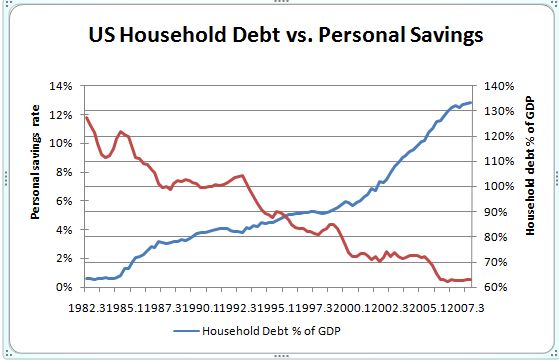
Meanwhile since middle class income hasn't grown American families undertaken more debt to pay for stuff. You to talk about debt crisis and economic bubbles. This is both. This really debt crisis and economic bubble that is really about to burst.

household-debt.jpg
 
Last edited:
Top